Is The Genius Song Safe to Use? Volume, Medical Cautions, the Pen-Name Presenter and the Fine Print
Safety guide to The Genius Song audio track: headphone volume, driving, epilepsy and hearing cautions, the pen-name presenter, staged testimonials and the Terms.
- Published
A short digital audio track (the seller says about 7 minutes) played daily on headphones, sold for $39 with digital bonuses and a 90-day refund window. Not an app, not a game.
- $39 one-time price
- 90-day refund
- Cognitive Support
Our editorial score: 3.5/5 (ours, not a customer rating) How we score
Check the price on the official store
Affiliate disclosure: this page contains affiliate links for The Genius Song. If you buy through them we may earn a commission at no extra cost to you. It does not change our assessment, and we do not publish customer ratings or testimonials we cannot verify. How we review.
At a glance
- Refund window
- 90 days
- 90 days from purchase (Terms and ClickBank checkout)
- Price
- $39
- one-time digital purchase
- Category
- Cognitive Support
- Our score
- 3.5 / 5
- editorial, not a customer rating
Claim reality check
| The Genius Song says | What we found |
|---|---|
| "Created by Dr. Robert Lake, a top NASA scientist" | The site's own disclaimer says Robert Lake is a pen name, so his credentials cannot be checked. |
| "Activates your dormant gamma brain wave" | Gamma research on 40 Hz light and sound is mostly in mice and small early human trials, and none of it tested this track. |
| "It starts working the very first time you listen" | No published study tests The Genius Song. Binaural beat research is mixed: a medium effect in a 2019 meta-analysis, but most studies in a 2023 review showed no brainwave change. |
| "Helped 18,366 everyday Americans" | The seller's own figure, and another page says 19,389. The Terms say testimonials may be acted out or paid. |
| "Regular price $200" | A seller reference price. The track costs $39, with tax and local currency added at checkout. |
A sound file cannot interact with your medicines, so most worries about The Genius Song come down to two things. The first is the listening itself: volume, place and any condition that makes rhythmic audio a bad idea for you. The second is the sales pitch, which leans on a presenter and customer stories that the seller’s own fine print undercuts. This page takes each in turn, with tables and a checklist you can finish in a few minutes.
What you are actually exposing yourself to
- The product: an audio track the seller says is about 7 minutes long, delivered digitally (the seller describes both a download and an online audio portal).
- The seller’s routine: headphones on, eyes closed, about 7 minutes a day. The video says skipping a day is “okay”.
- Nothing physical: no capsules, no device, no app and nothing shipped.
- What the seller says it does: “activate gamma”, the brain rhythm it calls “the super brain wave”, through what it calls brain entrainment.
- What has been tested: nothing about this specific track. No published study uses it.
That last line matters for safety as much as for results. A product with no trials behind it also has no safety data behind it, so ordinary caution is the right default.
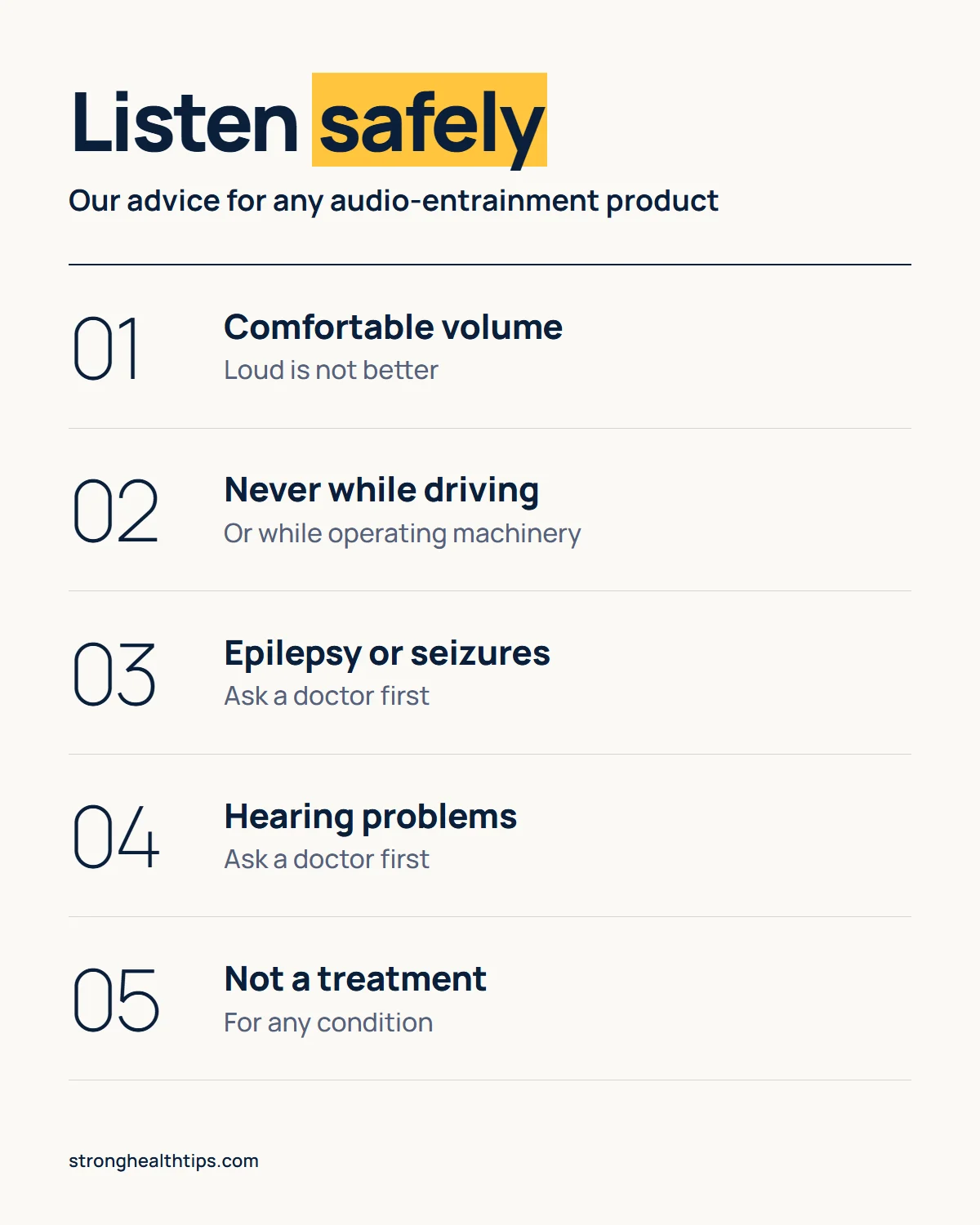
Our listening rules
The seller publishes no safety guidance beyond its disclaimers. The rules below are our own, based on general caution for any audio-entrainment product.
| When | What we suggest | The reason |
|---|---|---|
| Before you press play | Turn the device volume down first, then raise it to comfortable | Loud headphone sound adds to noise exposure over time |
| In a car or at work with machines | Do not listen | The routine asks you to shut your eyes and relax |
| You have epilepsy or have had a seizure | Talk to a doctor before the first session | Rhythmic audio has no safety data for this track |
| You have hearing loss, tinnitus or wear hearing aids | Check with a doctor or audiologist | Headphone listening may not suit your ears |
| You feel dizzy, uneasy or unwell mid-session | Stop and remove the headphones | There is no benefit worth pushing through discomfort |
| A child wants to use the bonus kids’ audio | Decide as a parent, and keep the volume low | Nothing in the offer has been tested on children |
None of this makes the track dangerous for most adults. Seven minutes of quiet audio is a small thing. The table simply lists the few situations where a little care avoids a real problem.
When to get a doctor’s view first
Book a conversation with a professional before you rely on the track if any of these apply:
- you have epilepsy or any history of seizures
- you have a hearing problem of any kind
- you are hoping it will ease migraines, joint pain or cravings, or help with weight or smoking, which the video mentions only as anecdotes
- a symptom is new or getting worse, because it needs a diagnosis that no audio can give
- you are thinking of stopping a treatment because the video made you hopeful
The site’s own disclaimer backs this up: “This product is not intended to diagnose, treat, cure or prevent any disease.”
The seller’s two statements about evidence
The Terms of Service contain a section headed “For Entertainment Purposes Only”. It says: “brain entrainment is not an exact science and we recommend that you do not treat it as such. The products are provided for entertainment purposes only.”
The same Terms also contain a seller statement that points the other way: “All claims regarding brainwave entrainment, focus, and mental energy are substantiated by established scientific research.” Both sentences sit in one document. When a legal page calls a product entertainment, that is the safer reading to plan around.
Here is what the research we checked actually covers, in short:
| Topic | What is known | Does it test this track? |
|---|---|---|
| Gamma waves | Real brain rhythms of roughly 30 to 100 Hz, linked to attention and memory processing | No |
| MIT’s 40 Hz light and sound work | Mainly mouse models of Alzheimer’s disease, with small early human trials; not about IQ, luck or money | No |
| Long-term meditators | Recorded with high-amplitude gamma activity in a 2004 PNAS study | No |
| Binaural beats, 2019 meta-analysis | A medium average effect pooled from 22 studies, depending on frequency and timing | No |
Our benefits page sets each of the seller’s promises against this research.
The seller's offer
Read the Terms and disclaimer on the seller's site
The entertainment-only section and the pen-name disclaimer are on the seller's own pages.
Visit the official websiteWho is presenting the video
The sales video is fronted by the presenter, who uses the pen name Dr. Robert Lake (the site says so in its disclaimer). The text page calls him a “NASA-Trained Neuroscientist”, the headline says “Top NASA Scientist”, and in the video he speaks of a New York City clinic and 34 years as a neuroscientist. Since the name is a pen name, none of that can be checked, and we do not treat it as fact.
There is a practical point here. A doctor’s title in an ad can make a product feel medically approved. This one is not. Judge the track as an untested audio product, whoever is said to have made it.
How to read the testimonials
The video features “Rachel, a nurse from Tustin, California”, “Michael in Dallas” and “Hannah from Manhattan”. Read the seller’s caveat alongside them. The Terms say names “have been changed”, that the seller uses pen names, that “some aspects of the marketing have been dramatized”, that feedback may be acted out by “digital representations, avatars, or actors”, that people were compensated for sharing their experiences, and that the results “are exceptional results and may not reflect the experience of a typical customer”.
| Claim in the pitch | What it really is | How much weight to give it |
|---|---|---|
| Named success stories | Seller testimonials, possibly acted and paid | Advertising only |
| “18,366 everyday Americans” helped | Seller figure; the text page headline says 19,389 | Unverified, and the two pages disagree |
| “Thousands of five star reviews” | Seller statement | Unverified |
| Luck at the casino | Q and A anecdote | The presenter says “there is, of course, no evidence to support that the genius song caused that” |
The FTC’s guidance on endorsements, in our sources, explains why paid connections and typical results matter when you weigh a story like these.
Money safety in brief
Payment runs through ClickBank, and your card statement shows CLKBANK*Genius Song. The Terms and the ClickBank checkout both give 90 days from purchase for a refund. A separate refund page on the site describes a 60-day policy for “NeuroActivate” bottles with an Ohio return address, which does not fit a digital track, so use ClickBank’s refund route and keep the receipt. Ordering steps are on our where to buy page, and the full refund math is on the price page.
Before you start: a checklist
- Pick a safe spot to listen: a chair, a sofa or bed, never a car.
- Lower the volume before the first play, then adjust to comfortable.
- Get a doctor’s opinion first if you have epilepsy, a seizure history or a hearing problem.
- Keep every treatment you already use. The track does not replace any of them.
- Note one or two things you want to watch, such as how settled you feel in the evening, so you can judge honestly.
- Save the ClickBank receipt and write down the purchase date.
- Put a reminder in your calendar a couple of weeks before day 90.
The seller's offer
Done the checklist and still curious?
The order is $39 plus local tax through ClickBank, with 90 days to ask for a refund.
Check the current priceIf something goes wrong
- Discomfort during a session: stop, take off the headphones and rest for a moment.
- Symptoms that linger: see a doctor and mention the audio track.
- You want your money back: contact ClickBank order support on 1-800-390-6035 within 90 days of purchase, or email product support at [email protected]. There is nothing to send back.
For a longer look at the scam question, read our article on whether The Genius Song is a scam. How we weigh safety information is explained in our methodology, and the overall verdict is on the review page. Related topics sit under cognitive support.
The seller's offer
See the seller's pages before you decide
Checkout runs through ClickBank, and the track is delivered digitally with nothing shipped.
Visit the official websiteThe Genius Song Official Pricing
The price as listed on the official order page when we checked. It is a one-time digital purchase with nothing shipped; any add-ons are optional, and tax and the amount in your currency show at checkout. The crossed-out figure is the seller's own "regular" price, a reference price rather than what anyone pays.
The Genius Song audio track
$39$200
One-time price
Seller lists a $161 saving
- Short daily audio track (seller says about 7 minutes)
- Digital delivery after checkout
- Bonuses listed on the sales page
- 90-day money-back guarantee
Other cognitive support products
All in this categoryThe Genius Switch
An 8-minute digital audio track you play daily on headphones, sold for $39 with four digital bonuses and a 90-day refund window. Not an app, not a game.
3.0 / 5 our score $39
Decided?
See the current The Genius Song price and guarantee
$39 one-time, tax and local currency shown at checkout. Refund window: 90 days from purchase (Terms and ClickBank checkout).
Check The Genius Song on the official siteQuestions people ask
Can The Genius Song damage my hearing?
Seven minutes is a short session, but sound played loudly through headphones adds to your total noise exposure, and that is a known cause of hearing loss. Keep it at a level where you could still hear someone speak to you, and do not turn it up in the hope of a stronger effect.
Should I use The Genius Song if I have epilepsy?
Ask your doctor first. No study has tested this track in anyone, so there is no safety data for people with epilepsy or a seizure history. That caution applies to audio-entrainment products in general, and it is our advice rather than the seller's.
Is it OK to play The Genius Song in the car?
Not while you drive, and not while you operate machinery. The seller's routine is headphones on and eyes closed for about 7 minutes, which only makes sense sitting or lying down somewhere safe.
Who is Dr. Robert Lake?
He is the presenter, who uses the pen name Dr. Robert Lake (the site says so in its disclaimer). Because the name is not his real one, we cannot check the NASA, neuroscientist or clinic background the sales pages give him.
Are the people in The Genius Song video real customers?
The video names Rachel, a nurse from Tustin, California, Michael in Dallas and Hannah from Manhattan. The seller's Terms say names are changed, some marketing is dramatized, feedback may be acted out by avatars or actors, people were compensated and the results are exceptional, not typical. Treat them as advertising.
Can The Genius Song help with migraines, joint pain or quitting smoking?
The video tells stories about all three, but they are anecdotes, and the site's own disclaimer says the product is not intended to diagnose, treat, cure, or prevent any disease. Keep your current treatment and see a doctor about any symptom.
Is The Genius Song a scam?
The purchase is a real ClickBank order with a 90-day refund window and a statement line reading CLKBANK*Genius Song. The marketing is a different matter: a pen-name presenter, staged testimonials and claims that no study of the track supports.
Sources
- NIDCD: Noise-induced hearing loss
- FTC: Guides concerning the use of endorsements and testimonials in advertising
- Garcia-Argibay M et al. (2019). Efficacy of binaural auditory beats in cognition, anxiety, and pain perception: a meta-analysis. Psychological Research
- Iaccarino HF et al. (2016). Gamma frequency entrainment attenuates amyloid load and modifies microglia. Nature
Not medical advice. This page is general information and does not replace a consultation with a qualified healthcare professional who knows your history. Full disclaimer.
Written by
Strong Health Tips Editorial Team
We check every claim against the seller's own pages, terms and refund policy, and against published research, then write it up in plain English. Our methodology.