The Genius Song's Promised Benefits, Checked One by One Against Gamma Research and the Fine Print
Every benefit The Genius Song promises, from focus and memory to luck, money and weight loss, set against gamma research and the seller's own fine print.
- Published
A short digital audio track (the seller says about 7 minutes) played daily on headphones, sold for $39 with digital bonuses and a 90-day refund window. Not an app, not a game.
- $39 one-time price
- 90-day refund
- Cognitive Support
Our editorial score: 3.5/5 (ours, not a customer rating) How we score
Check the price on the official store
Affiliate disclosure: this page contains affiliate links for The Genius Song. If you buy through them we may earn a commission at no extra cost to you. It does not change our assessment, and we do not publish customer ratings or testimonials we cannot verify. How we review.
At a glance
- Refund window
- 90 days
- 90 days from purchase (Terms and ClickBank checkout)
- Price
- $39
- one-time digital purchase
- Category
- Cognitive Support
- Our score
- 3.5 / 5
- editorial, not a customer rating
Claim reality check
| The Genius Song says | What we found |
|---|---|
| "Created by Dr. Robert Lake, a top NASA scientist" | The site's own disclaimer says Robert Lake is a pen name, so his credentials cannot be checked. |
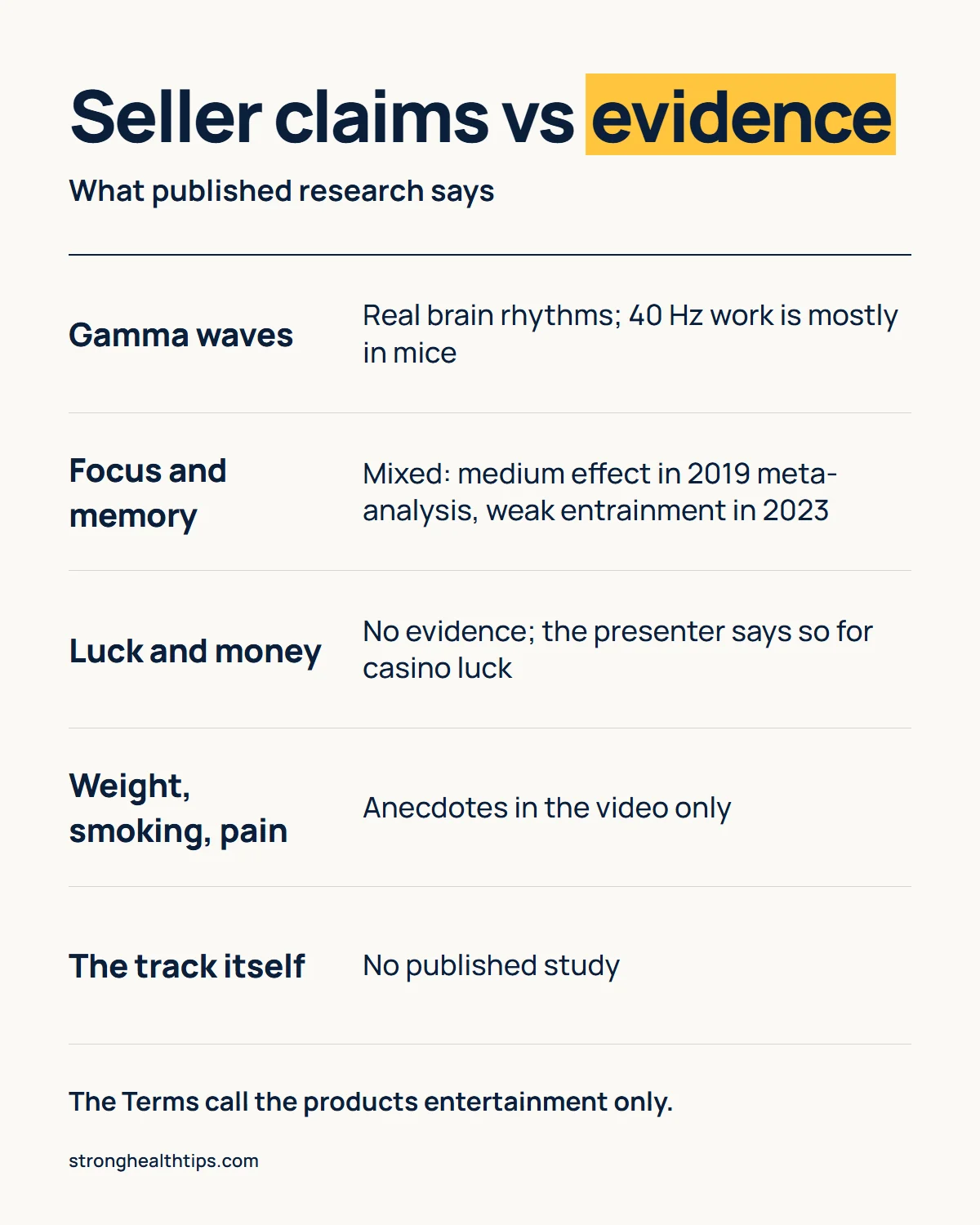
| "Activates your dormant gamma brain wave" | Gamma research on 40 Hz light and sound is mostly in mice and small early human trials, and none of it tested this track. |
| "It starts working the very first time you listen" | No published study tests The Genius Song. Binaural beat research is mixed: a medium effect in a 2019 meta-analysis, but most studies in a 2023 review showed no brainwave change. |
| "Helped 18,366 everyday Americans" | The seller's own figure, and another page says 19,389. The Terms say testimonials may be acted out or paid. |
| "Regular price $200" | A seller reference price. The track costs $39, with tax and local currency added at checkout. |
The Genius Song video promises a lot for a track the seller says lasts about 7 minutes. This page lines up every promise in one table, says what a buyer can realistically expect, and names the evidence or basis for each. After the table, we look at what gamma research actually covers, where the pitch contradicts itself, and how to judge the track fairly if you try it.
Promise by promise
The first column is always the seller’s claim. The middle column is our view of what is realistic.
| Seller’s promise | What is realistic | Evidence or basis |
|---|---|---|
| Reactivates a “dormant” gamma “super brain wave” | A description of the idea, not a measurable result | Gamma is a real rhythm; “dormant” and “super brain wave” are the seller’s words |
| Better focus and attention | Perhaps a calm, settled few minutes while you listen | Mixed research on entrainment in general; none of this track |
| Better memory and faster learning | No reason to expect a lasting change | A medium overall effect in a 2019 meta-analysis; nothing on this track |
| Eureka moments, problems solved “with little to no effort” | Quiet time can leave room to think, with any track or none | Anecdotes in the video only |
| Luck and “synchronicities” | Nothing to expect | The presenter says there is “no evidence” the track caused casino wins |
| Promotions, money and “abundance” | Nothing to expect from the track | Colleague stories and testimonials only |
| Better relationships | Nothing to expect from the track | Seller stories only |
| Better grades for children | Nothing to expect | A story about a colleague’s son; no data |
| Weight loss, including a 16-pound story | Not a weight-loss method | A single anecdote in the video |
| Quitting smoking | Not a quit-smoking method | Anecdote in the video |
| Migraines and joint pain easing | Not a pain treatment | Anecdotes; the site says it is not intended to treat any disease |
| Works “the very first time you listen” | You will hear about 7 minutes of audio; any effect is unknown | Seller statement, no data |
| Results within days or “a couple weeks” | No basis for a timeline | Seller statement, no data |
The pattern repeats down the table. The nearer a promise gets to money, luck or health, the thinner the support, until there is none at all. The review scorecard shows how this weighs on our overall score.
What gamma research actually covers
The pitch is built on gamma brain waves, so it is worth knowing what the research does say.
Gamma rhythms
Gamma waves are real, fast brain rhythms, roughly 30 to 100 Hz, linked in research to attention and memory processing. Nobody disputes that they exist. What the seller adds is the idea that they go “dormant” in adults and that a recording can switch them back on, and that part has no published support.
MIT and 40 Hz stimulation
The video opens with “MIT found that all lucky, wealthy, successful people have this one brain wave”. The MIT work we know of is different. Researchers there studied 40 Hz light and sound stimulation, mainly in mouse models of Alzheimer’s disease (Iaccarino and colleagues, 2016), followed by small early human trials. It is about brain changes linked to that disease, not about IQ, luck or money. We found no study showing successful people share a single brain wave.
Meditators and gamma
Long-term meditators were recorded with high-amplitude gamma activity during mental practice (Lutz and colleagues, 2004). The video’s story about a monk studied in Wisconsin is likely a simplified version of this kind of research. The finding describes what experienced meditators produced themselves. It does not show that listening to a recording produces the same state.
Sound-based entrainment overall
A 2019 meta-analysis by Garcia-Argibay and colleagues pooled 22 studies of binaural beats. It reported a medium average effect, with results depending on the beat frequency and when people listened. A 2023 systematic review by Ingendoh and colleagues asked a different question, whether the brain actually falls into step with the beat, and most of the 14 studies it covered found that it did not. So the research is mixed, and neither paper tested this track.
| Question | Answer |
|---|---|
| Are gamma waves real? | Yes |
| Has 40 Hz stimulation been studied? | Yes, mainly in mice, with small early human trials |
| Has any of it tested The Genius Song? | No published study tests this track |
| Does the seller say what is on the track? | No |
| Can general studies show what this track does? | No, because they tested other sounds in other settings |
For a longer, plain-English explainer of this research, see our post on The Genius Song and gamma waves.
Where the pitch contradicts itself
Several details in the seller’s own materials do not hold together, and they are worth weighing alongside the promises.
- Seven seconds versus seven minutes. The hook promises a “seven second brain trick”, but the product is a track of about 7 minutes, and no separate 7-second technique is shown.
- Gamma pitch, theta references. The video is about gamma, yet the 14 references on the sales page are mostly theta and general entrainment studies plus creativity articles. The list is identical to the one on the seller’s page for The Genius Wave, a different audio product.
- Changing institutions. The video credits Princeton and a center in Berlin, while the text page tells the same story with NASA and colleagues in Japan.
- The presenter. The story is told by the presenter, who uses the pen name Dr. Robert Lake (the site says so in its disclaimer). His NASA and neuroscientist credentials cannot be checked.
The seller's offer
Read the promises in the seller's own words
The seller's site shows the claims, the $39 price and the 90-day guarantee, so you can hold them up against this table.
Visit the official websiteIn the seller’s own words
Two passages do more to set expectations than any review.
The casino answer. Responding to a viewer question about luck at the casino, the presenter says: “there is, of course, no evidence to support that the genius song caused that”. The same caution fits the promises about promotions and money, which rest on stories rather than data.
The Terms, side by side. Under the heading “For Entertainment Purposes Only”, the Terms say: “brain entrainment is not an exact science and we recommend that you do not treat it as such. The products are provided for entertainment purposes only.” Further down, the same document states: “All claims regarding brainwave entrainment, focus, and mental energy are substantiated by established scientific research.” That second sentence is the seller’s statement. We could not find research on this track that would back it, and it is hard to square with the first.
The Terms also say testimonial names are changed, some marketing is dramatized, feedback may be acted out by avatars or actors, people were compensated and the results shown are not typical. So the success stories in the video cannot count as evidence of benefit.
Health promises: weight, smoking and pain
The health claims rest entirely on stories: a colleague said to have lost 16 pounds, someone who stopped smoking, migraines that “disappeared” and joint pains that eased. None of these has been tested for the track.
- The Genius Song is not a treatment for any condition. The site says it is “not intended to diagnose, treat, cure, or prevent any disease”.
- For weight, smoking, migraines or joint pain, a doctor can point you to approaches with real evidence.
- Do not stop or delay any treatment because of something said in the video.
- Ask a doctor before using any audio-entrainment product if you have epilepsy, a seizure history or hearing problems.
Volume and other listening precautions are on the safety page.
A fair way to judge it yourself
What can about 7 minutes a day of headphones and closed eyes plausibly offer? A short, regular pause. Many people value that, but it is not what the video sells, and a free track or a few quiet minutes can give the same pause. The comparison page covers those options.
If you try it, test it honestly:
- For a week or two before you start, write one line a day about sleep, mood and focus.
- Listen once a day at a comfortable volume, never while driving.
- Keep writing the same daily line.
- Compare the two sets of notes between day 60 and day 75.
- If nothing has changed, ask for a refund through ClickBank before day 90, using the order number on your receipt.
The seller's offer
Willing to test it on modest terms?
One $39 payment, a 90-day refund window under the Terms, and your own notes to decide whether it earns a place.
Check the current price on the official siteFor what the order contains, see the What’s Included page.
The Genius Song Official Pricing
The price as listed on the official order page when we checked. It is a one-time digital purchase with nothing shipped; any add-ons are optional, and tax and the amount in your currency show at checkout. The crossed-out figure is the seller's own "regular" price, a reference price rather than what anyone pays.
The Genius Song audio track
$39$200
One-time price
Seller lists a $161 saving
- Short daily audio track (seller says about 7 minutes)
- Digital delivery after checkout
- Bonuses listed on the sales page
- 90-day money-back guarantee
Other cognitive support products
All in this categoryThe Genius Switch
An 8-minute digital audio track you play daily on headphones, sold for $39 with four digital bonuses and a 90-day refund window. Not an app, not a game.
3.0 / 5 our score $39
Decided?
See the current The Genius Song price and guarantee
$39 one-time, tax and local currency shown at checkout. Refund window: 90 days from purchase (Terms and ClickBank checkout).
Check The Genius Song on the official siteQuestions people ask
What benefits does The Genius Song claim?
The video claims eureka moments, effortless problem solving, faster learning, better memory, luck, promotions, money, better relationships, better grades for children, weight loss, quitting smoking and relief from migraines and joint pain. All of these are the seller's claims.
Is The Genius Song backed by science?
No study tests the track. The seller borrows from real research on gamma waves and 40 Hz stimulation, but that work was mostly in mice with Alzheimer's-like disease and small early human trials, not about intelligence, luck or wealth.
Did MIT study The Genius Song?
No. MIT researchers have studied 40 Hz light and sound stimulation, mainly in mouse models of Alzheimer's disease. We found no MIT study of this track and no study showing that lucky or wealthy people share one brain wave.
Can The Genius Song help with weight, smoking or migraines?
The only support is stories in the sales video, such as a colleague said to have lost 16 pounds. The track is not a treatment for any condition, and the site itself says it is not intended to diagnose, treat, cure, or prevent any disease.
How quickly does the seller say it works?
The video says it starts working the first time you listen, that many customers notice a difference within two to three days and that most daily listeners see results within a couple of weeks. These are seller statements without published data behind them.
Sources
- Iaccarino HF et al. (2016). Gamma frequency entrainment attenuates amyloid load and modifies microglia. Nature
- Lutz A et al. (2004). Long-term meditators self-induce high-amplitude gamma synchrony during mental practice. PNAS
- Garcia-Argibay M et al. (2019). Efficacy of binaural auditory beats in cognition, anxiety, and pain perception: a meta-analysis. Psychological Research
- Ingendoh RM et al. (2023). Binaural beats to entrain the brain? A systematic review of the effects of binaural beat stimulation on brain oscillatory activity. PLOS ONE
- FTC: Guides concerning the use of endorsements and testimonials in advertising
Not medical advice. This page is general information and does not replace a consultation with a qualified healthcare professional who knows your history. Full disclaimer.
Written by
Strong Health Tips Editorial Team
We check every claim against the seller's own pages, terms and refund policy, and against published research, then write it up in plain English. Our methodology.