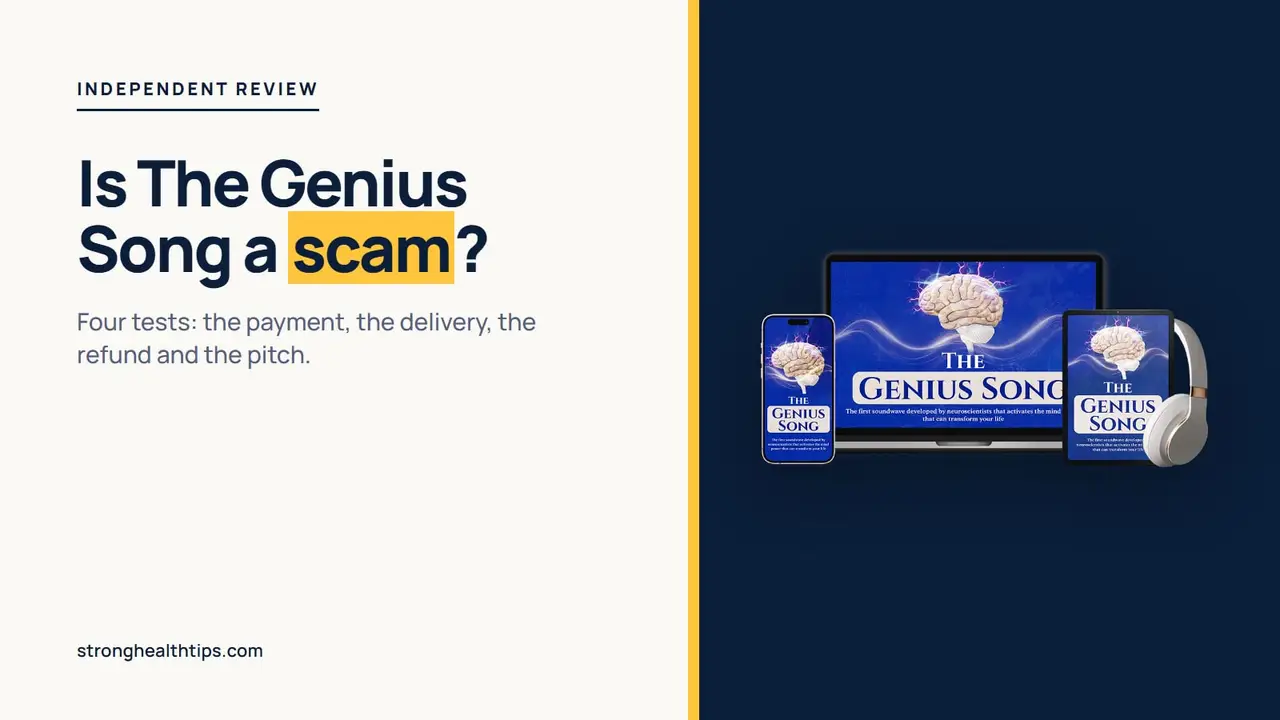
Is The Genius Song a Scam? Four Tests, the Legit Signals, the Red Flags and Our Fair Verdict
Is The Genius Song a scam? We run four tests: where the money goes, what you receive, how refunds work and how honest the pitch is, then give a fair verdict.
- Author
- Strong Health Tips Editorial Team
- Published
- Reading time
- 9 min read
Affiliate disclosure: this review contains links to the official The Genius Song website. If you buy through them we may earn a commission at no extra cost to you. It does not change our assessment. Details.
Is The Genius Song a scam? The question is reasonable. The product is sold through a 39-minute video by a self-styled NASA neuroscientist who promises that a short audio track can bring memory, luck and money, at a price that drops while you watch. That is a familiar shape for online offers, and some of them are outright frauds.
Instinct is not a verdict, though. So we put the offer through four plain tests that a classic scam tends to fail, using only the seller’s own pages, its Terms and the ClickBank checkout. Three tests concern the sale itself. The fourth concerns the pitch.
The quick answer
The sale passes three tests out of four. The marketing fails the fourth.
$39 once through ClickBank. 90 days to ask for a refund.
Visit the official websiteFour tests a scam usually fails
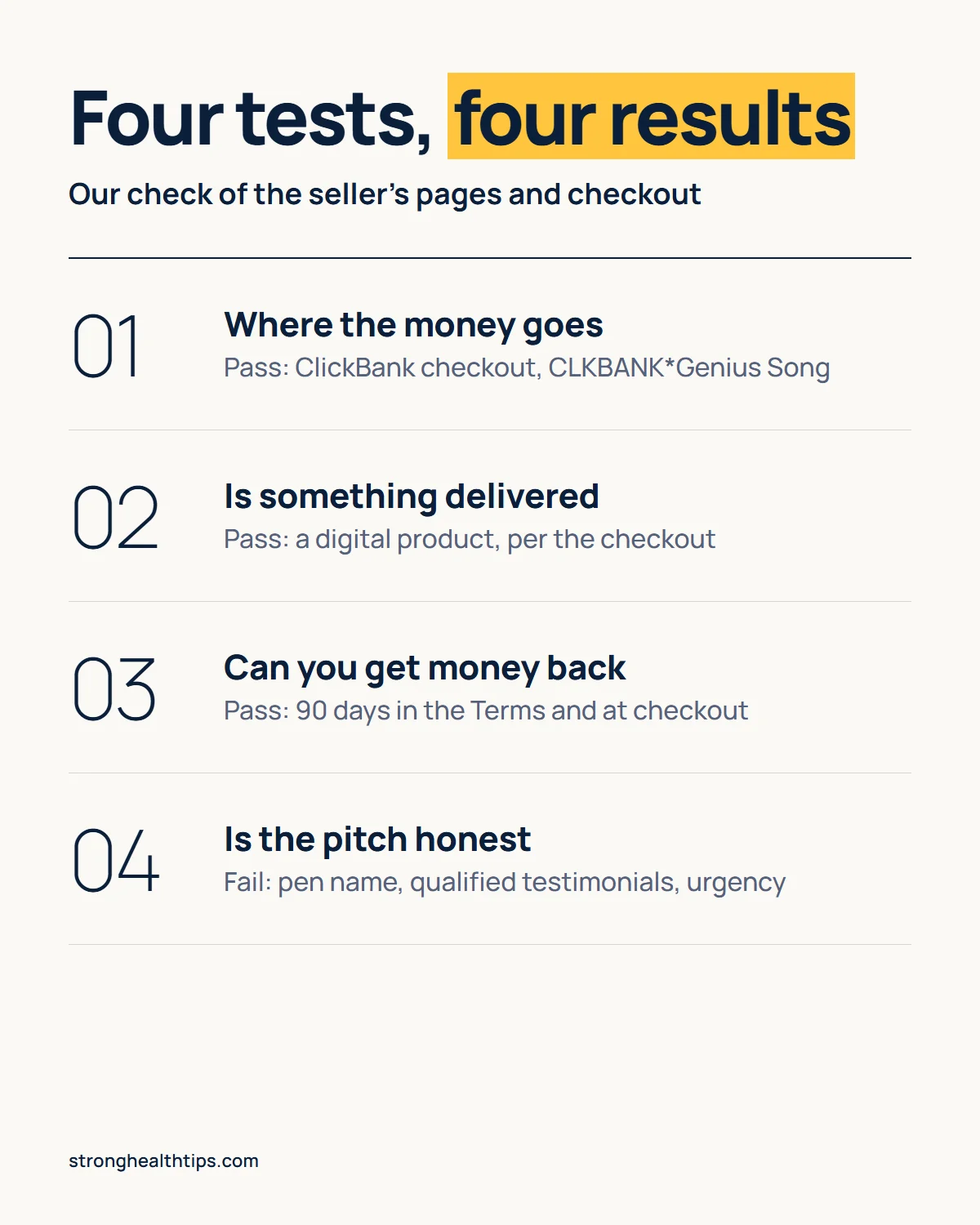
A fraudulent offer typically takes payment somewhere you cannot trace, delivers nothing, and leaves you no way back. A merely oversold offer takes payment normally, delivers what it said it would, and lets you return it, but describes the product in terms it cannot support. Our four tests separate the two:
- Where does the money go?
- Is anything actually delivered?
- Can you get your money back?
- Is the pitch honest?
Test 1: where the money goes
The order button leads to a ClickBank checkout at geniusbr.pay.clickbank.net. The vendor ID is geniusbr, and the checkout names the item “The Genius Song (90-Day 100% Money Back Guarantee)”. The charge should appear on your statement as CLKBANK*Genius Song.
The seller behind the Terms is Happy Consumer LLC, based in Puerto Rico, and the Terms are governed by Puerto Rico law. ClickBank’s own footer adds that its role as retailer “does not constitute an endorsement” of the product, which is worth knowing: the payment company checks the payment, not the claims.
Result: pass. The money goes to a known processor with a traceable statement line and its own support line, 1-800-390-6035.
Test 2: whether something is delivered
The checkout labels the item a “Digital Product”, not shippable and not recurring, with “Immediate access to digital products or services in your cart” once payment is approved. The Terms of Sale say: “You are paying $39 today for The Genius Song”, and describe the purchase as “a copyrighted digital article for personal use”.
There is one inconsistency. The video says the track is “emailed to you in a matter of minutes”, and the written FAQ says to download it to your phone or computer, while the order section of the same written page promises “on-demand access to your Private Audio Portal” with login details by email. We did not buy the product, so we cannot say which you get. Neither version suggests you get nothing.
Result: pass, with the delivery wording as a loose end.
Test 3: whether you can get your money back
The Terms say: “For Digital Products, you may get a refund on any purchase requested within 90 days of your initial purchase.” The ClickBank checkout states the same window: return or replacement “within 90 days from the date of purchase”.
Then there is the odd part. The site also has a refund page at /TOS/refunds/, and it is not about this product at all. It is a policy for “NeuroActivate” bottles: 60 days, unopened bottles only, a return address in Tallmadge, Ohio. The Terms also carry a shipping policy for orders sent from Ohio. Neither fits an audio track. They look like leftovers from a template, so ignore them and use ClickBank’s refund route with your order number.
Result: pass. Two written sources give you 90 days. The leftover page is sloppy, not a trap, but it is a good reason to keep your own receipt.
Test 4: whether the pitch is honest
This is where the offer struggles. We counted six problems.
A presenter under a pen name. The video is fronted by the presenter, who uses the pen name Dr. Robert Lake (the site says so in its disclaimer). The headline calls him a “Top NASA Scientist”, and in the video he speaks of a New York City clinic and 34 years as a neuroscientist. The footer then says the name is “a pen name used with the consent of our leading neuroscientist”. A credential attached to a pen name cannot be checked.
Testimonials the Terms qualify. The Terms say names in the marketing “have been changed”, that feedback may be acted out by “digital representations, avatars, or actors”, that the people featured were “compensated”, and that some may be “early supporters, friends, or family members of the company’s founders”. Those are the seller’s own words about its own social proof.
Numbers that disagree. The video says “eighteen thousand three hundred sixty six” Americans have been helped. The written page’s headline says 19,389. Neither is verified.
A hook that does not match the product. The video promises a “seven second brain trick” in its first minute, then sells a 7-minute audio track. It never shows what the 7-second trick is.
Stories that change between pages. The video cites a Princeton report and a centre in Berlin; the written page tells the same story with NASA and colleagues in Japan. The bonus list changes too: the video says “three free bonuses” and names four, while the written page promises four and lists three.
Pressure pricing. Crossed-out prices of $200, $100 and $49 sit above “Today Just For $39”. The video warns the price is “not guaranteed beyond today” and that your order “may be given away to someone else” if you leave. On the /video/ page the buy button is set to appear only after about 18 minutes of viewing.
Result: fail. None of this means you lose your money. It means the claims deserve a very large discount.
The scoreboard
| Test | What we found | Result |
|---|---|---|
| Where the money goes | ClickBank checkout, vendor geniusbr, CLKBANK*Genius Song | Pass |
| Whether something is delivered | Digital product with immediate access, per the checkout | Pass |
| Whether you can get money back | 90 days in the Terms and at checkout | Pass |
| Whether the pitch is honest | Pen name, qualified testimonials, mismatched figures, urgency | Fail |
Low risk, high hype
The refund window is the real protection. The promises are not.
Shown in your local currency plus tax at the ClickBank checkout.
Check the current price on the official siteWhat the evidence says about the promises
The video links the track to memory, faster learning, eureka moments, luck, promotions, weight loss, quitting smoking and the end of migraines. The seller’s own disclaimer says the product “is not intended to diagnose, treat, cure, or prevent any disease”, and the Terms say “the products are provided for entertainment purposes only”.
The research picture is mixed. Gamma waves are real brain rhythms linked to attention and memory processing. For auditory beats in general, a 2019 meta-analysis in Psychological Research found a medium overall effect on some outcomes, while a 2023 review found most studies did not show entrainment, the brainwave change itself. No published study tests this track. Even the presenter, telling a casino story, says “there is, of course, no evidence to support that the genius song caused that.”
For a claim-by-claim look at each promise, see our piece on reviews on The Genius Song. For our scorecard by area, see our full review.
One more surprise: the landing page
If you click through from any review site, including ours, do not be thrown by what loads. The official site’s home page currently features the seller’s related audio, The Genius Wave, and The Genius Song presentation is on the same site’s /video/ page. The home page sells a 12-minute theta audio with a buy button; The Genius Song is the 7-minute gamma track. They are separate products from the same seller account. Before you pay, check that the checkout names the product you meant to buy.
Who should not buy
- Anyone hoping to fix a health problem. It is not a treatment, by the seller’s own disclaimer.
- Anyone counting on luck or money. The presenter concedes there is no evidence for the casino story.
- Anyone who will not chase a refund. The 90 days only help if you use them.
- Anyone under 18. The Terms limit the service to adults.
- People with epilepsy, a seizure history or a hearing problem who have not asked a doctor. That is our general caution for audio-entrainment products. Everyone else should keep the volume comfortable and never listen while driving.
If calm is the real goal, the free habits in our guide on how to manage daily stress are a sensible place to start.
If you go ahead
Pay only on the ClickBank page, save the receipt and note day 90.
Buying also adds you to the seller’s email lists; every email has an unsubscribe link.
Visit the official websiteOur fair verdict
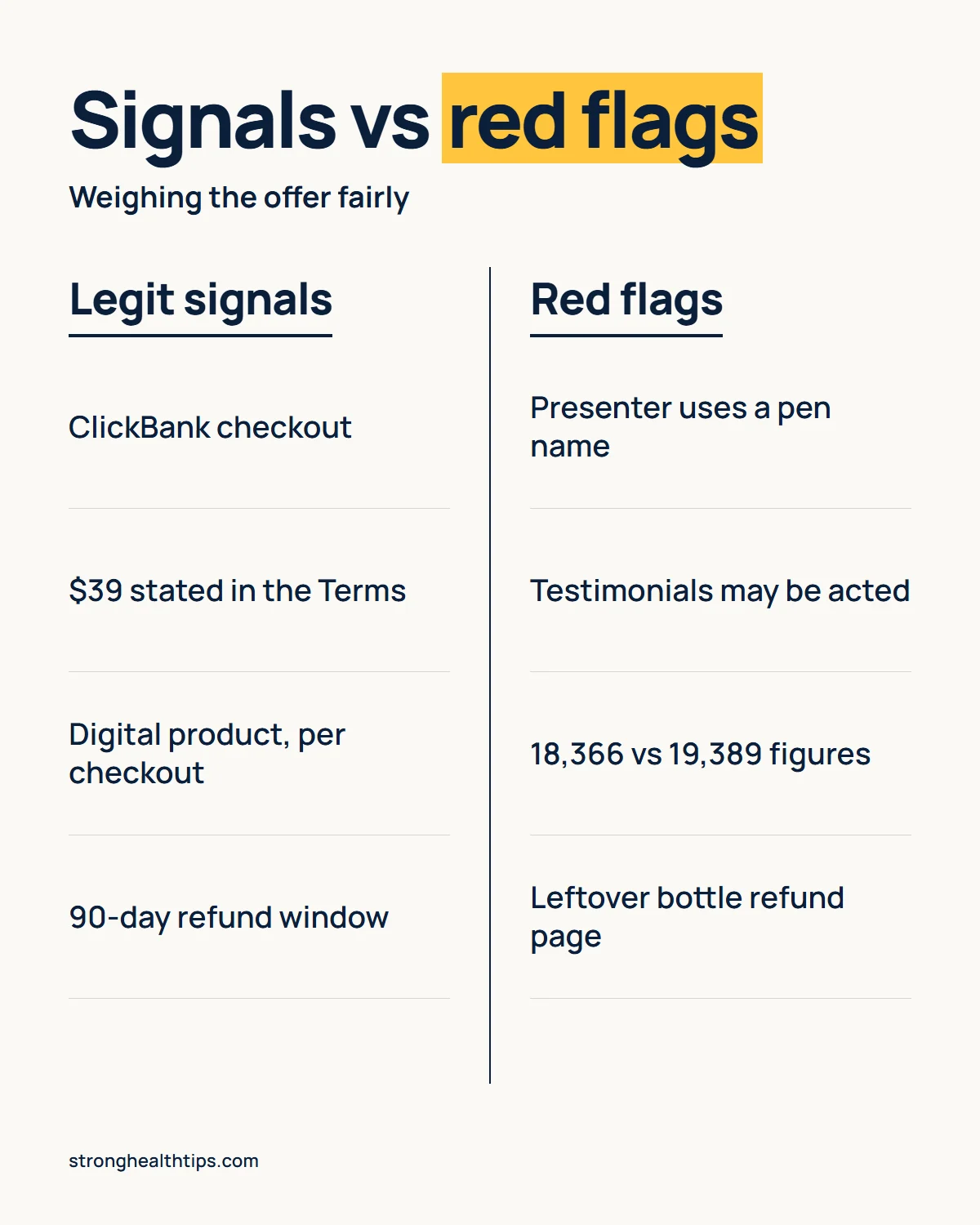
On the strict question, the answer is no: this does not behave like a scam. Your money goes through ClickBank, the checkout promises a digital product, and two written sources give you 90 days to change your mind.
On the broader question, the doubts are earned. The presenter works under a pen name, the testimonials come with a long list of caveats in the Terms, the customer numbers disagree, the bonus lists disagree, the refund page belongs to another product and the home page sells a different audio. The seller’s own description, “for entertainment purposes only”, is the fairest summary on the site.
Our editorial score, which is ours and not a customer rating, is 3.5 out of 5: cheap, refundable and easy to try, but sold with claims nothing supports. We are independent, not the seller, and we may earn a commission if you buy through our links. If you try it, go through the official website and keep your ClickBank receipt.
Health note: An audio track is not medical care. Keep the volume comfortable, do not listen while driving or operating machinery, and see a doctor about memory, mood, pain or other health worries.
Questions people ask
Does the money go through a real payment company?
Yes. The order page is a ClickBank checkout at geniusbr.pay.clickbank.net, the vendor ID is geniusbr, and the charge should appear on your card statement as CLKBANK*Genius Song. ClickBank order support is on 1-800-390-6035.
Is Dr. Robert Lake a real NASA scientist?
The site itself says the name is not real. Its disclaimer states that 'Robert Lake is a pen name used with the consent of our leading neuroscientist'. We could not verify who that is, so we treat the NASA and neuroscientist titles as marketing, not credentials.
Will I receive anything if I pay?
According to the checkout, yes: it lists a digital product, not shippable and not recurring, with immediate access once payment is approved. The seller describes delivery both as an emailed track and as a private audio portal, and we could not confirm which buyers get because we did not buy it.
Why does the site have a refund page about bottles?
The page at /TOS/refunds/ is a leftover policy for a product called NeuroActivate, with 60 days, unopened bottles and an Ohio return address. It does not fit a digital track. The Terms give 90 days for digital products and the ClickBank checkout says the same, so use ClickBank's refund route.
Why did the link open a page about a different audio?
The seller's home page currently features its related audio, a 12-minute theta session. The Genius Song presentation is on the same site's /video/ page. The two are presented as separate products.
What should I do if I feel misled after buying?
Ask for a refund within 90 days of purchase. Contact ClickBank order support with the order number from your receipt email. The seller's product support address is [email protected].
Sources
- FTC: Shopping online, avoiding scams and protecting your payment
- FTC: Guides concerning the use of endorsements and testimonials in advertising
- Garcia-Argibay M et al. (2019). Efficacy of binaural auditory beats in cognition, anxiety, and pain perception: a meta-analysis. Psychological Research
- Ingendoh RM et al. (2023). Binaural beats to entrain the brain? A systematic review of the effects of binaural beat stimulation on brain oscillatory activity. PLOS ONE
- NIDCD: Noise-induced hearing loss
Not medical advice. This guide is general information and does not replace a consultation with a qualified healthcare professional who knows your history. Full disclaimer.
Written by
Strong Health Tips Editorial Team
We research, write and fact-check every guide against current guidance from major health bodies and peer-reviewed studies, then rewrite it in plain English. How we work.