The Genius Song Gamma Waves: What Gamma Research Shows and What It Does Not
The Genius Song gamma waves claims, checked neutrally: what gamma rhythms are, what the 40 Hz and meditator studies found, and what no study has shown.
- Author
- Strong Health Tips Editorial Team
- Published
- Reading time
- 10 min read
Affiliate disclosure: this review contains links to the official The Genius Song website. If you buy through them we may earn a commission at no extra cost to you. It does not change our assessment. Details.
The sales video for The Genius Song is built around one idea: a fast brain rhythm called gamma, which it calls “the super brain wave”. If you searched for the Genius Song gamma waves, you probably want to know whether that idea holds up. Is gamma real? Did scientists really link it to luck and success? Can a short audio track switch it on?
This guide takes the question calmly. We explain what gamma waves are, set the video’s story next to the research it seems to draw on, and list what that research has not shown. We make no promises either way, because the evidence does not support any.
The product, briefly
A digital audio track the seller says lasts 7 minutes, for headphones.
$39 one-time through ClickBank. 90-day refund window in the Terms and at checkout.
Visit the official websiteGamma waves, in plain words
Your brain produces electrical activity in rhythms, and an EEG can record them from the scalp. Researchers group those rhythms by speed. Gamma is the name for fast activity, roughly 30 to 100 Hz, and studies link it to attention and to how the brain processes memories.
Two things are worth keeping in mind from the start. First, gamma is not rare or exotic. It is one of several normal rhythms, and it rises and falls with what you are doing. Second, a rhythm being linked to attention in the lab is not the same as that rhythm causing good ideas, good luck or a bigger salary. The video blurs those two things often, so we will keep them apart.
How the video tells the gamma story
In the video, the presenter, who uses the pen name Dr. Robert Lake (the site says so in its disclaimer), opens with a strong claim: “MIT found that all lucky, wealthy, successful people have this one brain wave in their mind at all times.” He says children show “a very active gamma wave”, adults show “almost no gamma wave”, and that modern life has left it “deactivated”. He calls this “a brand new discovery in twenty twenty six”.
From there the story adds more names: colleagues at “the Einstein Center in Berlin” linking the flow state to gamma, Edison’s “complicated device” for activating it, billionaires waking at 4 AM to use it, and Columbia University research said to show “your gamma could influence another person”. The text version of the sales page tells a similar story, with “colleagues in Japan” in place of Berlin.
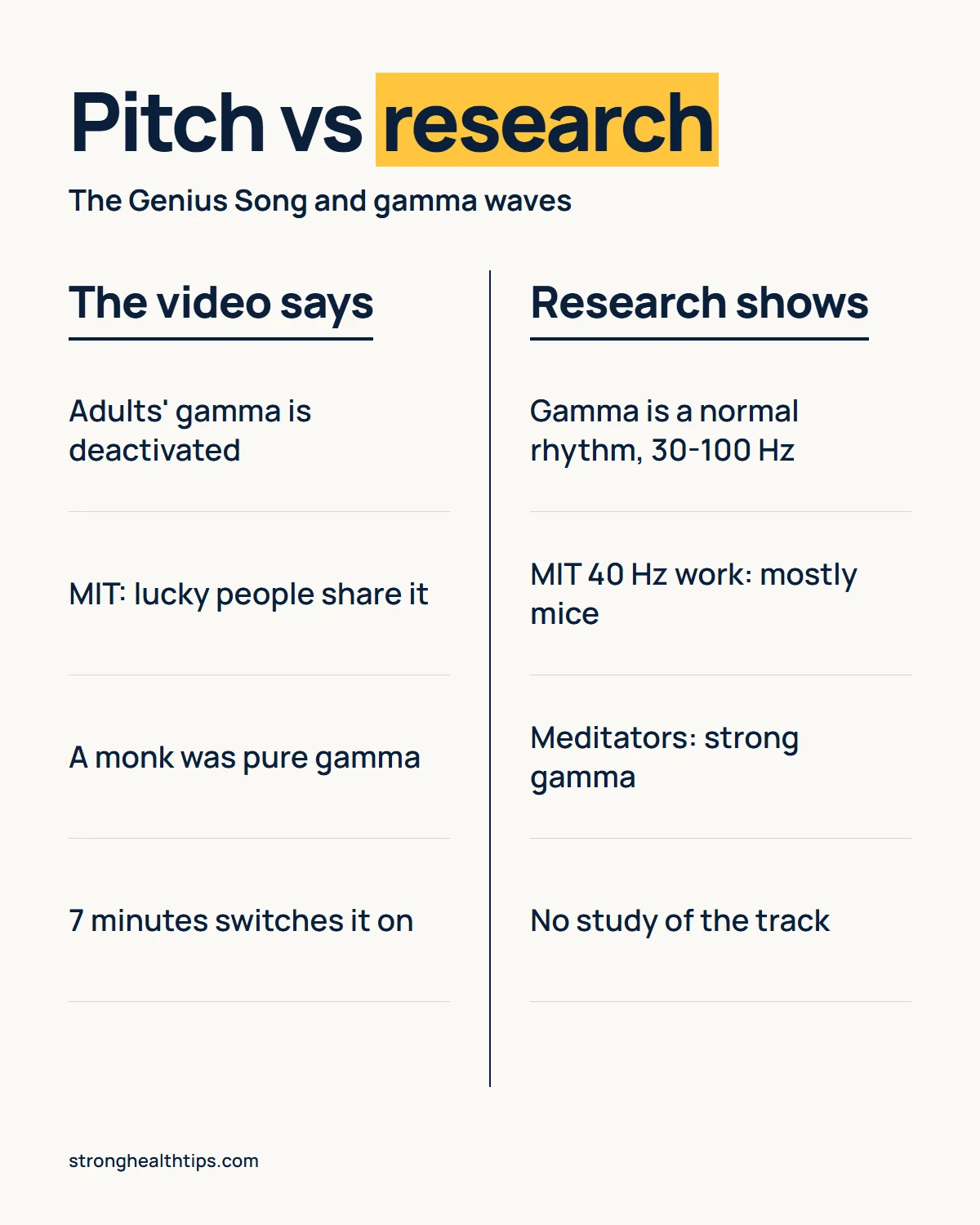
| What the video says | What the research we found says |
|---|---|
| MIT found all lucky, wealthy, successful people share one brain wave | We found no published study showing this |
| Adults’ gamma is “deactivated” | Gamma is a normal rhythm that varies with activity |
| A Wisconsin monk’s brain was “pure gamma wave” | Meditators showed strong gamma while meditating (Lutz, 2004) |
| Gamma brings luck, money and eureka moments | No study links gamma to luck or money |
| A 7-minute sound wave activates gamma | No published study tests the track |
We could not check the Berlin, Edison, billionaire or Columbia claims against a named source, so we report them only as the seller’s statements.
What MIT’s 40 Hz research actually studied
There is real MIT research on gamma, and it is probably what the video is leaning on. Researchers in the Tsai lab have studied stimulation at 40 Hz, a frequency in the gamma range, using flickering light and pulsing sound. An early paper in this line, published in Nature in 2016, is titled “Gamma frequency entrainment attenuates amyloid load and modifies microglia”. Amyloid and microglia are markers studied in Alzheimer’s disease.
The key details:
- Most of the work is in mice. The findings come mainly from mouse models of Alzheimer’s disease.
- Human trials are early and small. Small human studies have followed, but they are not large enough to settle anything.
- The question is about disease, not genius. This research asks whether 40 Hz stimulation affects signs of Alzheimer’s disease. It does not ask about IQ, creativity, luck or money.
So the honest summary is that scientists take 40 Hz gamma stimulation seriously as a research topic in brain disease. That is a long way from “all lucky, wealthy, successful people have this one brain wave”.
The meditators behind the monk story
The video mentions researchers in Wisconsin who “studied a monk known as the happiest man alive and found his brain was pure gamma wave”. The research this seems to simplify is a 2004 study in PNAS by Lutz and colleagues, titled “Long-term meditators self-induce high-amplitude gamma synchrony during mental practice”.
That title tells you what was found. People with many years of meditation practice produced strong, synchronized gamma activity while they meditated. It is a striking result. But it describes a skill trained over long practice, measured during meditation. It does not show a brain that is “pure gamma”, it does not show that gamma causes happiness, and it says nothing about whether an audio track can produce the same pattern.
Brain entrainment and audio: mixed results
The video says the track uses “brain entrainment, which works by guiding the brain into gamma”, and that its makers squeezed “one hour of brain entrainment into a seven minute sound wave”. Entrainment is the idea that a steady rhythm from outside, such as a pulsing sound, can nudge the brain’s own rhythm toward it.
Audio entrainment has been studied, most often as binaural beats, where each ear hears a slightly different tone. A 2019 meta-analysis in Psychological Research pooled 22 studies on binaural beats for attention, memory, anxiety and pain and found a medium overall effect that depended on beat frequency and timing. A 2023 systematic review in PLOS ONE asked whether the brain actually follows the beat, and most of its 14 studies found that it did not.
Three gaps matter for this product:
- The seller does not publish what is on the track. We do not know its frequencies or method, and we did not buy it to check.
- No published study tests The Genius Song track. Even strong evidence for entrainment in general would not show what this recording does.
- The sales page’s reference list does not match the pitch. Its 14 items cite theta and general entrainment studies plus creativity articles from Inc.com, Medium and a TED talk, while the video is about gamma.
Curious anyway?
Treat it as a listening experiment, not a brain upgrade.
$39 one-time. Keep the ClickBank receipt for the 90-day refund window.
Check the current price on the official siteWhat gamma research has not shown
It helps to list plainly what is missing, because the video’s claims rest on these gaps.
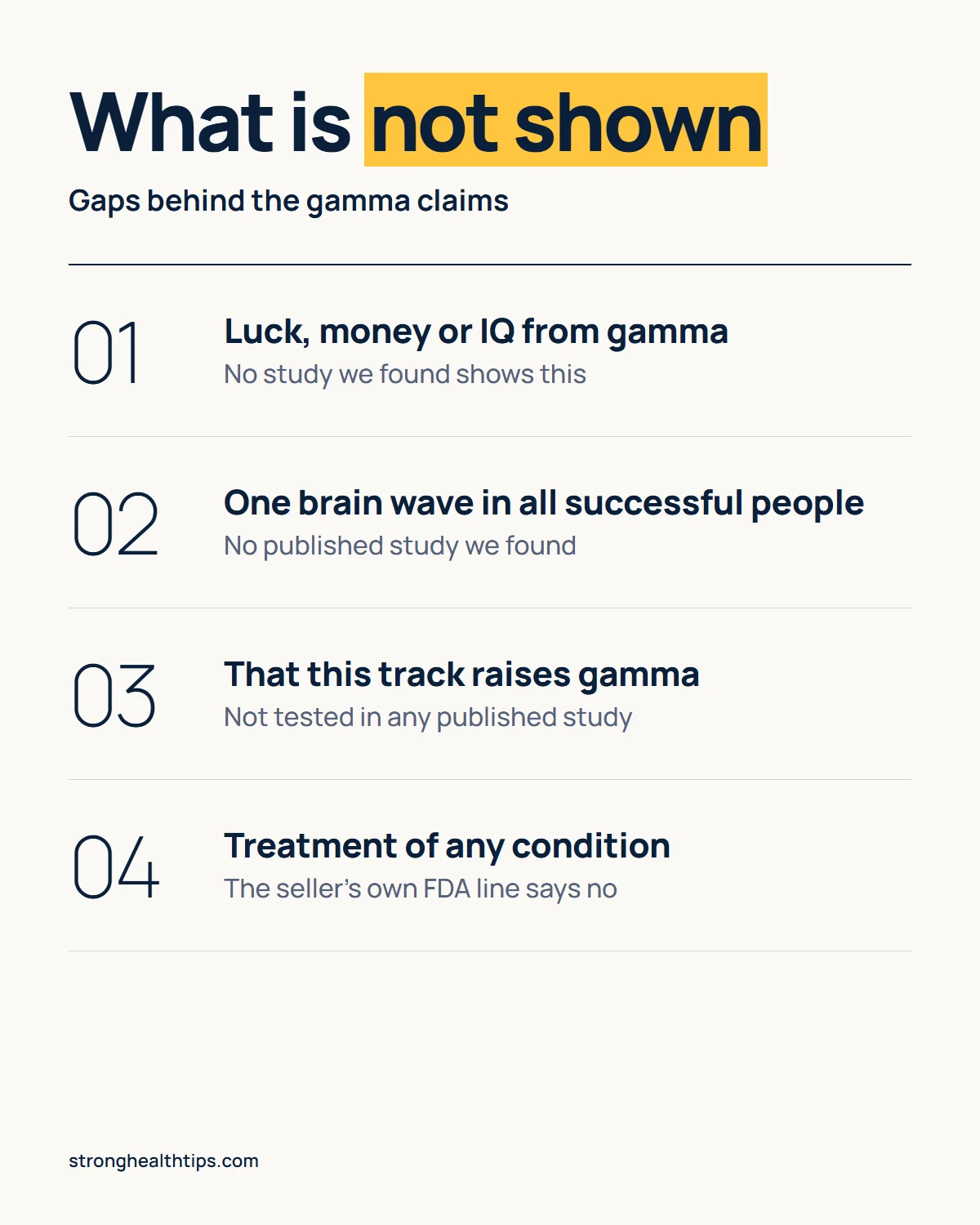
- That gamma brings luck, wealth or success. We found no study showing this.
- That adults have lost their gamma. The research we cite describes a normal rhythm that changes with activity.
- That this track raises gamma. No published study has measured it.
- That listening treats a condition. The site’s own line says the product “is not intended to diagnose, treat, cure or prevent any disease”. Migraines, pain, smoking and weight, all of which appear in the video’s anecdotes, are matters for a doctor.
For the same check applied to memory, focus, luck, money, weight, smoking and pain one by one, see the seven big claims, checked. The presenter himself concedes the point once. On a story about a casino win, he says “there is, of course, no evidence to support that the genius song caused that”.
What the seller’s own fine print says
The Terms of Sale are more modest than the video. Under the heading “For Entertainment Purposes Only”, they say “brain entrainment is not an exact science and we recommend that you do not treat it as such”, and that “The products are provided for entertainment purposes only.” In the same document, another line says “All claims regarding brainwave entrainment, focus, and mental energy are substantiated by established scientific research.” The two statements sit side by side, and only the first matches what we found.
The Terms also cover the people in the video. Names are changed, feedback may be acted out by “digital representations, avatars, or actors”, some people were “compensated”, and some may be “early supporters, friends, or family members of the company’s founders”. The results shown are described as “exceptional”. The disclaimer at the foot of the sales page says the presenter’s name is a pen name; we look at that in our piece on the presenter’s credentials. If you are new to the product, our plain explainer covers the basics.
If you decide to try the track
Nothing above means listening is harmful or pointless. Some people simply enjoy a short daily audio ritual. If you want to test it, here are the practical details.
| Item | What the seller’s pages say |
|---|---|
| Product | A digital audio track, 7 minutes per the seller |
| Price | $39 in the Terms; $200, $100 and $49 shown as reference prices |
| Delivery | Described both as an emailed download and as a “Private Audio Portal” |
| Bonuses | They differ: the video says three and names four, the text page says four and lists three |
| Refund | 90 days in the Terms and at the ClickBank checkout |
| Card statement | CLKBANK*Genius Song |
Our links pass through ClickBank to the seller’s site. The official site’s home page currently features the seller’s related audio, The Genius Wave, which the seller’s pages describe as a 12-minute theta audio, and The Genius Song presentation is on the same site’s /video/ page. They are separate products, so check the product name at checkout.
On refunds, the site also has a page at /TOS/refunds/ about “NeuroActivate” bottles, with 60 days and an Ohio return address. It is a leftover policy that does not fit a digital track. Use ClickBank’s route instead: call ClickBank order support on 1-800-390-6035 with your order number.
Low-cost test
Seven minutes a day, comfortable volume, modest expectations.
Digital delivery, no shipping. Refund requests within 90 days.
Visit the official websiteListening safely
Our advice for any brain-wave audio, this one included:
- Keep the volume comfortable. Loud sound through headphones over time can damage hearing, as the NIDCD explains.
- Never listen while driving or operating machinery. The video asks you to close your eyes and relax.
- Ask a doctor first if you have epilepsy, a seizure history or hearing problems. Rhythmic sound is worth checking with a professional.
- Stop if you feel unwell. Dizziness or anxiety while listening is a reason to stop.
If better focus is the goal, the habits with the strongest support are dull but reliable. Our guide to sleep hygiene habits for deeper sleep and a daily walk are good places to start.
Our take on the gamma claims
The Genius Song gamma waves story takes real science, MIT’s 40 Hz research and the meditator EEG studies, and stretches it into promises of luck, money and genius that the research does not make. Gamma is real and interesting. The idea that a 7-minute track restores a “deactivated” super brain wave has not been tested in any published study.
Our editorial score, which is ours and not a customer rating, is 3.5 out of 5. The clear $39 price, the ClickBank checkout and the 90-day refund window count in its favor; the stretched science, the pen-name presenter and the dramatized testimonials count against it. If you try it, try it for the experience, and keep the receipt.
We are independent, not the seller, and we may earn a commission if you buy through our links.
Our view in one line
Real research on gamma, no research on this track.
Entertainment purposes only, per the seller’s Terms. Our score: 3.5 out of 5.
Check the current price on the official siteQuestions people ask
What are gamma waves?
Gamma waves are fast rhythms in the brain's electrical activity, roughly 30 to 100 Hz, that can be recorded with EEG. Research links them to attention and memory processing. They are one of several normal rhythms, not a special switch that is either on or off.
Did MIT find that successful people share one brain wave?
We found no published study showing that. The MIT research on gamma that we know of, from the Tsai lab, studies 40 Hz light and sound stimulation, mainly in mouse models of Alzheimer's disease, with small early human trials. It is not about luck, wealth or success.
Can a sound track raise gamma activity?
Researchers have studied 40 Hz sound and light stimulation, and research on brain-wave audio such as binaural beats is mixed: a 2019 meta-analysis found a medium overall effect, but a 2023 review found most studies did not show entrainment. Whether a specific commercial track changes gamma in listeners would need its own study, and none has been published for this one.
What did the 40 Hz studies actually test?
Mostly whether flickering light or sound at 40 Hz changes signs of Alzheimer's disease in mice, for example amyloid load in the 2016 Nature paper. Early human trials have been small. None of this tested memory, creativity or luck in healthy adults.
Is the video's story about a monk with pure gamma true?
It appears to be a simplified version of real research. A 2004 study by Lutz and colleagues found that long-term meditators produced high-amplitude gamma synchrony while meditating. It did not find a brain that was pure gamma, and it did not test any audio.
Is a daily 7-minute listening session safe?
For most adults, short sessions at a comfortable volume are low risk. Our advice: keep the volume moderate, never listen while driving or operating machinery, and ask a doctor first if you have epilepsy, a seizure history or hearing problems.
Sources
- Iaccarino HF et al. (2016). Gamma frequency entrainment attenuates amyloid load and modifies microglia. Nature
- Lutz A et al. (2004). Long-term meditators self-induce high-amplitude gamma synchrony during mental practice. PNAS
- Garcia-Argibay M et al. (2019). Efficacy of binaural auditory beats in cognition, anxiety, and pain perception: a meta-analysis. Psychological Research
- Ingendoh RM et al. (2023). Binaural beats to entrain the brain? A systematic review of the effects of binaural beat stimulation on brain oscillatory activity. PLOS ONE
- NIDCD: Noise-induced hearing loss
Not medical advice. This guide is general information and does not replace a consultation with a qualified healthcare professional who knows your history. Full disclaimer.
Written by
Strong Health Tips Editorial Team
We research, write and fact-check every guide against current guidance from major health bodies and peer-reviewed studies, then rewrite it in plain English. How we work.