Does FemiCore Work? A Symptom-by-Symptom Scorecard for Urgency, Leaks, Night Trips and UTIs
Does FemiCore work for your symptom? Urgency, leaks, night trips, repeat UTIs and microbiome balance, each graded against the research we could find.
- Author
- Strong Health Tips Editorial Team
- Published
- Reading time
- 9 min read
Affiliate disclosure: this review contains links to the official FemiCore website. If you buy through them we may earn a commission at no extra cost to you. It does not change our assessment. Details.
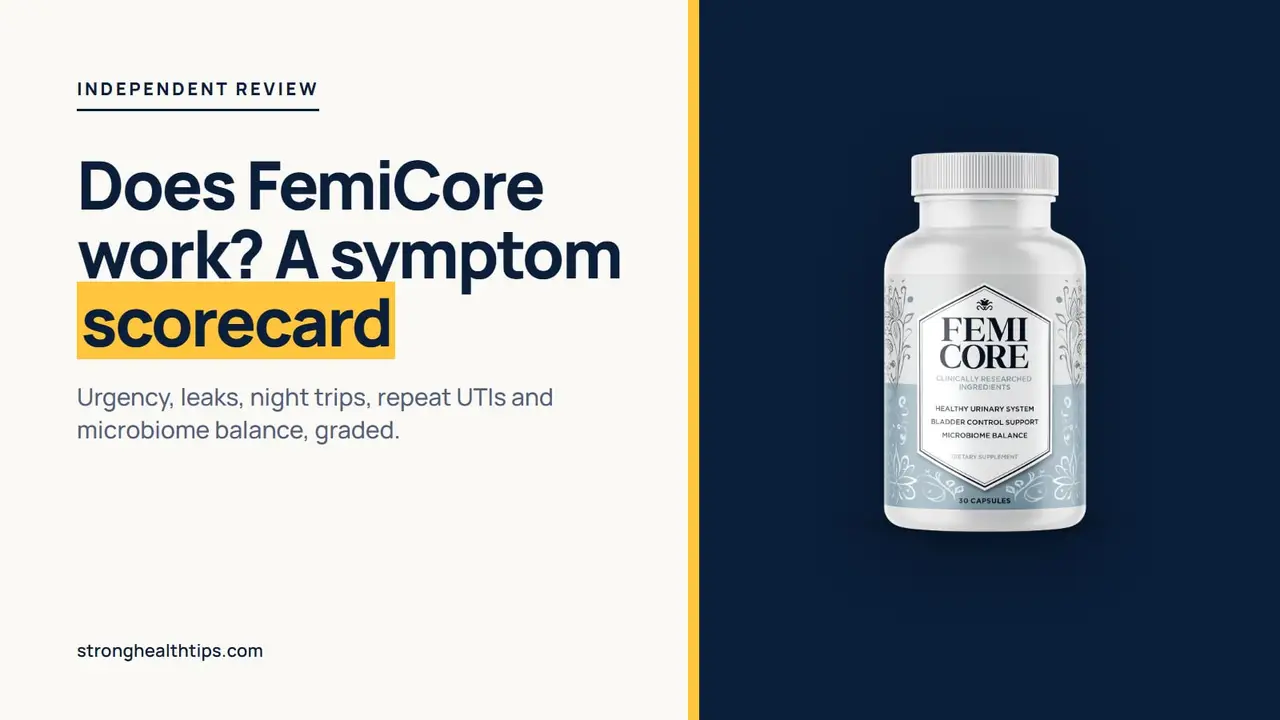
Does FemiCore work? Asked like that, the question has no single answer, because women who search for it are dealing with different problems. One wakes three times a night. Another leaks when she sneezes. A third has had four urinary infections in a year. FemiCore is sold for all of them under one label, but the research behind its nine ingredients is not equally strong for each.
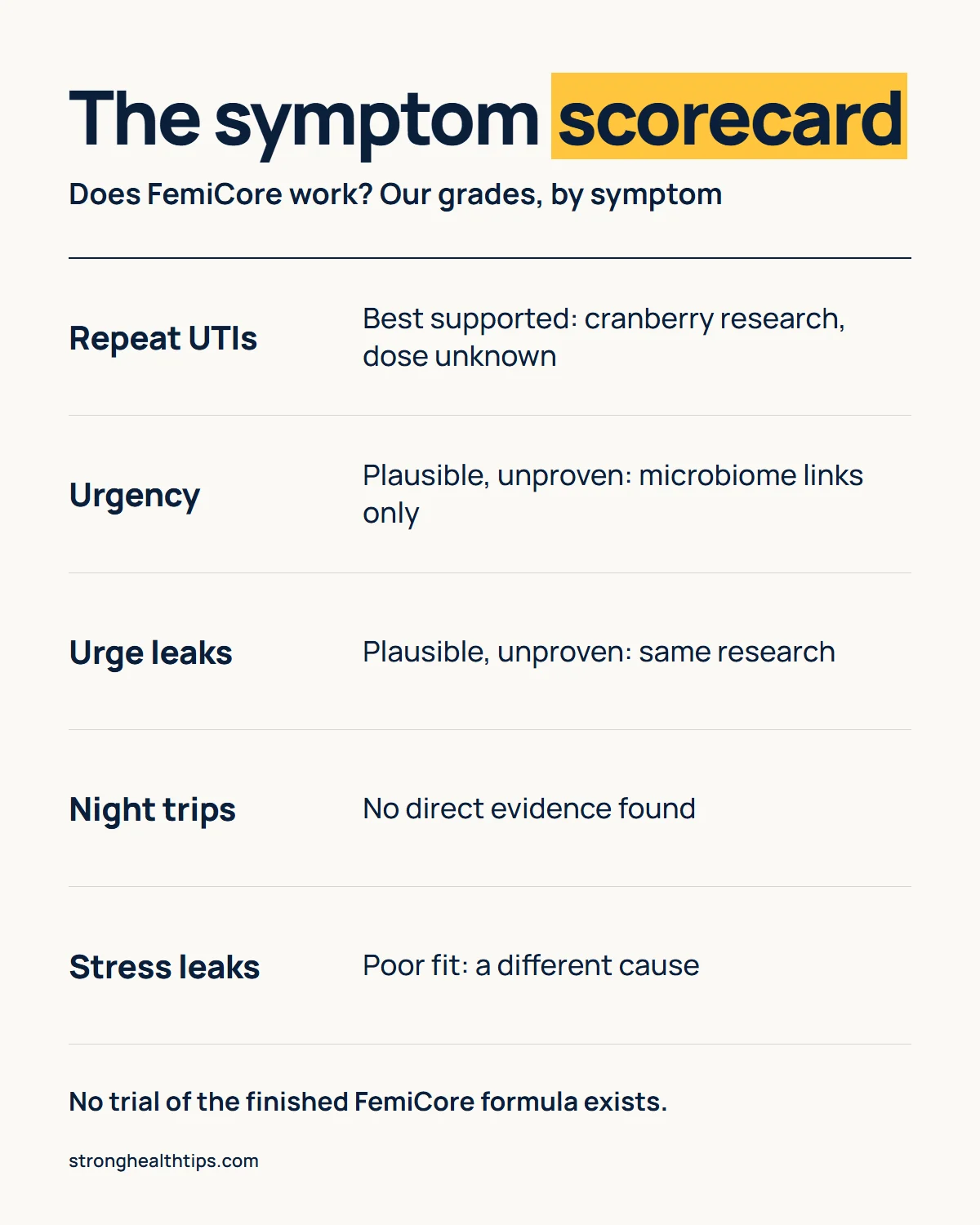
So this page breaks the question apart. We take five symptoms one at a time, say which part of the formula is meant to address each, and grade how close the research gets. One thing applies to every row: no trial of the finished FemiCore formula exists, and the label does not disclose doses. The grades are ours, built from research on single ingredients.
Check your symptom first
Then see the official FemiCore packages and refund terms.
One capsule a morning. 60 days from delivery to ask for a refund.
View FemiCore on the official siteHow we graded each symptom
For each symptom we asked three plain questions. Which ingredient in FemiCore is connected to it? What did the research on that ingredient actually measure? And how big is the step from that research to a woman swallowing one FemiCore capsule a day?
The answers fall into four grades:
- Best supported: human research exists for a closely related outcome, though not for FemiCore itself.
- Plausible, unproven: a real scientific idea, built on associations rather than results.
- No direct evidence: we found nothing that measured this symptom.
- Poor fit: the symptom usually has a cause the formula does not target.
None of these grades says FemiCore will or will not help you personally. They tell you how much the evidence can carry before your own experience takes over.
The scorecard at a glance
| Symptom | Nearest research | The gap | Our grade |
|---|---|---|---|
| Repeat urinary infections | Cranberry review (2023); L. crispatus trial | PAC dose not disclosed; trial used a vaginal product | Best supported |
| Sudden urgency | Bladder microbiome studies | Association only | Plausible, unproven |
| Urge leaks | Same microbiome studies | Association only | Plausible, unproven |
| Night-time trips | Nothing that measured them | No data at all | No direct evidence |
| Leaks on coughing or sneezing | None | Different cause | Poor fit |
| Microbiome balance | Bladder is not sterile | Never measured for FemiCore | Cannot be checked at home |
Urgency: the symptom the pitch is built around
Urgency is the sudden, hard-to-hold need to go. It is also where FemiCore’s story starts. Sequencing work that began around 2012, with Loyola University Chicago among the groups involved, found that the female bladder is not sterile. A few of those studies also noticed lower Lactobacillus levels in women living with urgency incontinence.
FemiCore answers that with five Lactobacillus species. The logic is easy to follow. The proof is missing. Finding fewer Lactobacillus in women with urgency does not show that the shortage causes the urgency, and no study we know of shows that swallowing Lactobacillus changes how urgent the bladder feels. Mimosa pudica is the other ingredient you could link to urgency, since lab and animal work reports an antispasmodic effect, but nobody has tested it in people with bladder symptoms.
Grade: plausible, unproven.
Leaks: two kinds, two different answers
Leaks are not one symptom. The type matters more than anything else on this page.
| Type of leak | When it happens | Fit with FemiCore |
|---|---|---|
| Urge leak | On the way to the toilet, after a sudden urge | Tied to the urgency idea above |
| Stress leak | When you cough, sneeze, laugh, run or lift | Poor fit |
| Mixed | Both of the above | Only the urge part is relevant |
Urge leaks inherit the urgency grade: a plausible idea without proof. Stress leaks are a different matter. They are usually about the support around the bladder rather than its bacteria, and nothing in FemiCore’s ingredient research looked at them. If your leaks only happen with effort or a sneeze, a doctor or pelvic health physiotherapist is a better first stop than any capsule.
Grade: plausible, unproven for urge leaks; poor fit for stress leaks.
Night-time trips
Waking up to pass urine is one of the most tiring bladder problems, and it is easy to assume a bladder supplement covers it. We found no research on any of FemiCore’s nine ingredients that measured night-time trips. If your nights are broken by sudden urges, the urgency idea may be loosely relevant. If you simply produce a lot of urine at night, nothing in the formula is aimed at that.
Grade: no direct evidence.
Test it on your own symptom
Every official order has 60 days from delivery for a refund.
All bottles go back, empty or full. Return postage is paid by you.
See the FemiCore packagesRepeat urinary infections: the strongest corner of the scorecard
This is the one row where human research comes close to the problem. The working compounds in cranberry, A-type proanthocyanidins or PACs, make it harder for E. coli to cling to the lining of the urinary tract. For women who keep getting infections, a 2023 Cochrane review concluded that cranberry products can make repeat episodes less frequent. Older reviews disagreed, and how well it works hinges on how much PAC is taken. On the probiotic side, one small placebo-controlled trial saw fewer repeat infections with Lactobacillus crispatus.
Three limits keep this grade from being a recommendation:
- FemiCore does not disclose its cranberry PAC content, so you cannot tell whether it matches the doses in the studies.
- The L. crispatus trial used a vaginal product, not a capsule you swallow, and probiotic effects are strain-specific. FemiCore lists species without strain codes.
- The research is about preventing repeat infections, not treating one. An active infection, with burning, fever or pain, needs a doctor.
Bearberry is the other urinary ingredient here. Its arbutin is turned into hydroquinone, which ends up in the urine and shows antibacterial activity in lab tests, but the human data are thin and inconsistent. European herbal regulators also limit it to courses of roughly a week, which sits awkwardly with a capsule meant for every day.
Grade: best supported, still unproven for FemiCore itself.
Microbiome balance: a claim you cannot feel
“Microbiome balance” is one of the three phrases on the FemiCore label. It is also the one claim you have no way to check. Nobody has measured what FemiCore does to the bacteria in the bladder, and you cannot see or feel that change. A home routine can only track symptoms: trips, urges, leaks and infections. If those do not move, a claim about balance gives you nothing to hold on to.
Grade: cannot be checked at home.
Reading the scorecard for your own pattern
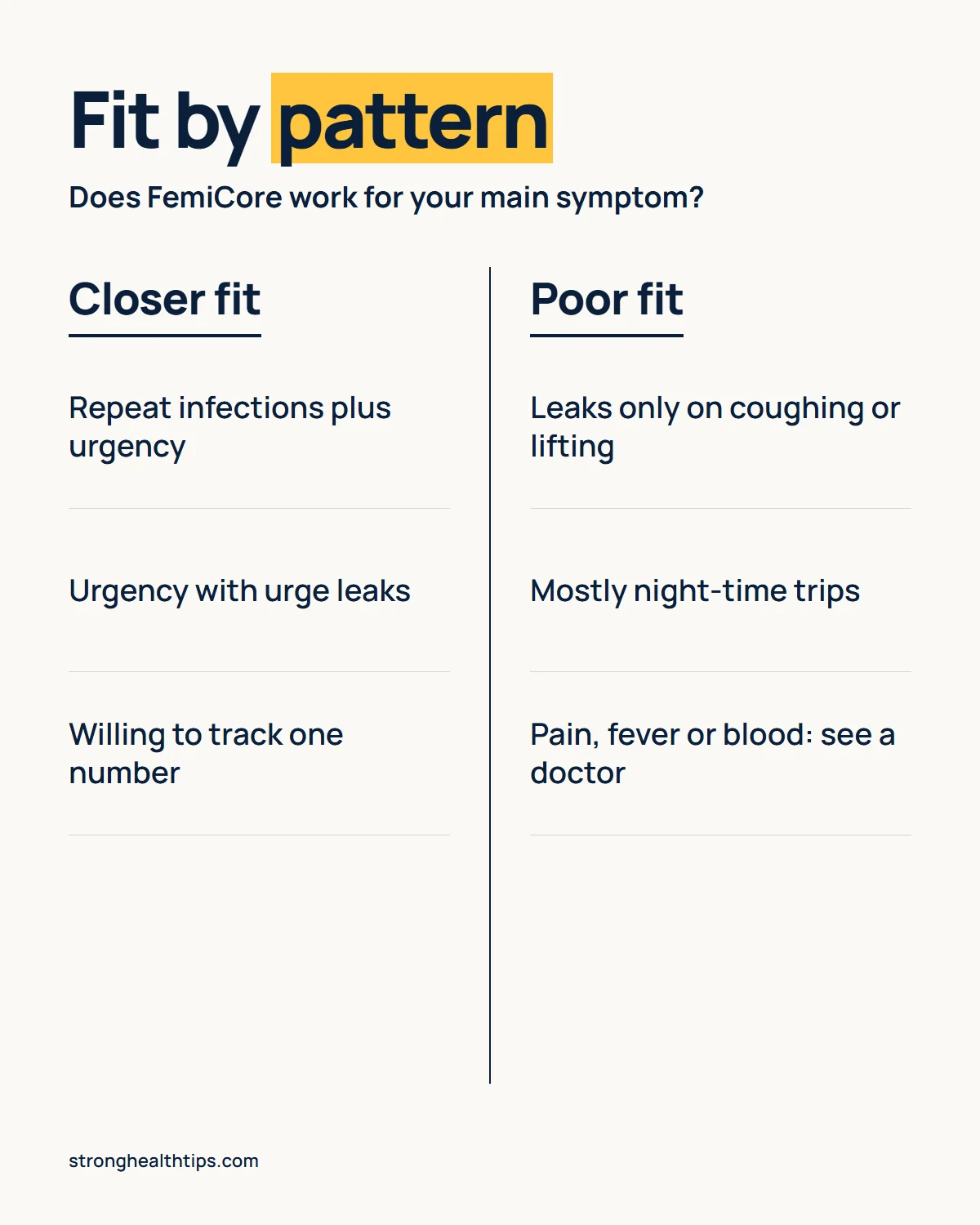
Most women have more than one symptom. This is how the grades combine:
| Your main pattern | What the scorecard suggests |
|---|---|
| Repeat infections plus some urgency | The closest match to the research behind the formula |
| Urgency and urge leaks, no infections | A reasonable personal test with modest expectations |
| Mostly night-time trips | Little to go on; worth a medical check first |
| Leaks only on coughing or exercise | Probably not the right product |
| Any symptom with pain, fever or blood | See a doctor before anything else |
Scoring it yourself
The research cannot finish this scorecard for you, but your own numbers can. Keep it to one symptom and one number:
- Urgency: urgent moments in a day.
- Night-time trips: wake-ups to pass urine, counted each morning.
- Urge leaks: leaks after a sudden urge, with stress leaks noted separately.
- Infections: these come weeks or months apart, so a 60-day test says little either way. Discuss them with your doctor.
Write the number down for two days before your first capsule, then again around day 50. Why day 50 and not day 90, the end of the seller’s suggested 3 months? Because refunds are only available for 60 days after delivery, and day 50 leaves time to claim one, at the cost of nothing more than return postage. Our day-by-day evidence check sets out a longer timeline if you continue.
One number, one test
Three bottles cover the seller’s 3 months for $207, free US shipping.
One-off purchase, no autoship. Six bottles drop to $49 each.
Check official FemiCore pricesWhen the scorecard does not apply
Some symptoms take you out of supplement territory altogether. See a doctor rather than starting or continuing FemiCore if you have:
- Any blood in the urine
- A fever, or shivering chills
- Flank pain
- Burning as you pee
- Bladder control that changes suddenly
- New confusion in an older relative who also has urinary symptoms
Pregnancy, breastfeeding, kidney disease and regular prescriptions all call for a conversation with a doctor or pharmacist first. Berberine may pull blood sugar and blood pressure down, and it slows CYP3A4 and CYP2D6, two enzymes the body uses to clear many drugs. Bearberry interacts with lithium, and cranberry has case reports with warfarin. Our FemiCore side effects guide covers each ingredient’s cautions.
The verdict
Graded symptom by symptom, FemiCore looks strongest for women with repeat urinary infections, reasonable but unproven for urgency and urge leaks, thin for night-time trips and a poor fit for leaks on coughing or sneezing. Its microbiome claim cannot be checked by the person taking it. Across all of them, the same two gaps apply: no trial of the finished formula and no disclosed doses.
Our editorial score for FemiCore overall is 4.2 out of 5, which also weighs value, the refund terms and ease of ordering. For the idea behind the capsule, see our look at the mechanism behind the formula, and for prices, safety and ingredients on one page, visit our FemiCore product hub.
Official website only
From $49 a bottle, with 60 days from delivery to decide.
We are independent, not the seller, and may earn a commission through our links.
Order FemiCore from the official siteQuestions people ask
Does FemiCore work for stress incontinence?
It is a poor fit. Stress leaks happen when you cough, sneeze, laugh or lift, and none of the research behind FemiCore's ingredients looked at them. A doctor or pelvic health physiotherapist is the better first step for that kind of leak.
Can FemiCore stop night-time bathroom trips?
We found no research on any of its ingredients that measured night-time trips. Urgency research may be loosely relevant if your night trips are driven by sudden urges, but there is no direct evidence, and no trial of FemiCore itself.
Should I take FemiCore for a urinary infection I have right now?
No. FemiCore is a supplement, not a treatment. Burning, fever or chills, flank pain or blood in the urine need a doctor. The cranberry research that gives FemiCore its strongest grade is about preventing repeat infections in women prone to them, not about treating an active one.
Which symptom has the best evidence behind it?
Repeat urinary infections. A 2023 Cochrane review found cranberry products can reduce repeat infections in women prone to them, and a small trial of Lactobacillus crispatus cut repeat infections too, although it used a vaginal product. FemiCore does not disclose its cranberry PAC content or its strain codes, so the link is still indirect.
Is there proof that FemiCore balances the bladder microbiome?
No. Since about 2012, studies have shown the female bladder has its own bacteria, and some saw fewer Lactobacillus in women with urgency incontinence. Nobody has measured what FemiCore does to that community, and it is not something you can check at home.
How will I know if it is working for my symptom?
Pick the one number that matches your main symptom, such as night-time trips or urgent moments a day, and write it down for two days before you start. Check the same number again around day 50, which leaves time to use the 60-day refund window if nothing has changed.
Sources
- Wolfe AJ et al. (2012). Evidence of uncultivated bacteria in the adult female bladder. Journal of Clinical Microbiology
- Pearce MM et al. (2014). The female urinary microbiome in women with and without urgency urinary incontinence. mBio
- Williams G et al. (2023). Cranberries for preventing urinary tract infections. Cochrane Database of Systematic Reviews
- Stapleton AE et al. (2011). Lactobacillus crispatus probiotic for prevention of recurrent urinary tract infection. Clinical Infectious Diseases
- NIDDK: Bladder control problems (urinary incontinence) in women
Not medical advice. This guide is general information and does not replace a consultation with a qualified healthcare professional who knows your history. Full disclaimer.
Written by
Strong Health Tips Editorial Team
We research, write and fact-check every guide against current guidance from major health bodies and peer-reviewed studies, then rewrite it in plain English. How we work.