FemiCore Side Effects: An Honest Ingredient-by-Ingredient Safety Check
FemiCore side effects by ingredient: early probiotic bloating, berberine and bearberry cautions, cranberry and warfarin, and who should ask a doctor first.
- Author
- Strong Health Tips Editorial Team
- Published
- Reading time
- 8 min read

Affiliate disclosure: this review contains links to the official FemiCore website. If you buy through them we may earn a commission at no extra cost to you. It does not change our assessment. Details.
A supplement can be well made and still be wrong for you. That is the honest frame for any question about FemiCore side effects. For most healthy women, the formula is gentle: no stimulants, widely used probiotics and familiar plant extracts. But two of its nine ingredients, berberine and bearberry, have real cautions attached, and a few groups of people should not start it without a doctor’s input.
This guide goes through the safety profile ingredient by ingredient, explains what is normal in the first few weeks, and gives a clear checklist of who should ask first. It is not a scare piece and not a sales pitch. It is the information you would want if a friend asked you whether FemiCore is safe to take.
FemiCore side effects at a glance

| Ingredient | What some people notice | Key caution |
|---|---|---|
| Probiotics (5 Lactobacillus strains) | Mild bloating or gas in the first 1 to 2 weeks | Usually settles without action |
| Berberine | Stomach upset, cramping or constipation | Drug interactions; not in pregnancy |
| Bearberry (Uva Ursi) | Nausea in some people | Traditionally short-term only; not in pregnancy or kidney disease |
| Cranberry Extract | Stomach upset in large amounts | Check with your doctor if you take warfarin |
| Mimosa Pudica | Little reported | Limited human safety data |
The headline: digestive changes are the most likely thing you will notice, and drug interactions are the most important thing to rule out before you start.
The first two weeks: what is normal
When you start any probiotic, the bacteria in your gut shift. Many people feel nothing. Some notice:
- Mild bloating or more gas than usual
- Slightly looser or firmer stools
- A feeling of fullness after meals
These effects usually fade within one to two weeks as your gut adjusts. Three things help:
- Take the capsule with breakfast and a full glass of water rather than on an empty stomach.
- Keep everything else steady for the first fortnight. Starting a new diet, a new probiotic yoghurt and FemiCore all at once makes it hard to know what caused what.
- Note it down. A one-line daily note (“bloated after lunch, mild”) tells you quickly whether things are settling or not.
Symptoms that do not fit this pattern, such as persistent pain, diarrhoea that lasts more than a few days, or anything that worries you, are a reason to stop and check with a doctor.
Berberine: the ingredient that needs the most care
Berberine is a plant compound researched mainly for blood sugar and cholesterol. That strength is also its main safety issue.
Stomach effects. Berberine can cause cramping, stomach upset or constipation in some people, particularly at higher doses. FemiCore does not state its berberine dose, so you cannot predict this in advance.
Blood sugar. Because berberine lowers blood glucose, it can add to the effect of diabetes medicines such as metformin or insulin. Signs of low blood sugar include shakiness, sweating, sudden hunger and confusion.
Drug interactions. Berberine slows two liver enzymes (CYP2D6 and CYP3A4) that break down a long list of common medicines. That can raise the level of those drugs in your blood. Examples include some medicines for blood pressure, cholesterol, mood, epilepsy and blood clotting.
Pregnancy. Berberine is not considered safe in pregnancy or breastfeeding.
If you take any regular prescription medicine, this is the single most useful question to ask a pharmacist before starting FemiCore.
Check before you buy
See the full FemiCore label and show it to your pharmacist.
The official page lists all nine ingredients. Every order has a 60-day money-back guarantee.
See the official ingredient labelBearberry: a short-term herb in a long-term product
Bearberry (Uva Ursi) has been used for urinary complaints for generations. Its active compound, arbutin, is converted into a substance with mild antimicrobial effects in the urine.
The caution is about duration. Traditional and regulatory herbal guidance in Europe limits bearberry to short courses, often around a week at a time, and advises against it in pregnancy, breastfeeding, children and people with kidney disease. FemiCore is designed to be taken daily for months. Because the bearberry dose is not stated, we cannot tell you whether the amount is small enough for that to matter. That gap is a fair reason to ask your doctor, especially if you have any kidney condition.
Some people also report nausea with bearberry. Taking the capsule with food may help.
Cranberry and probiotics: generally gentle
Cranberry extract is one of the best-tolerated urinary supplements. In large amounts it can upset the stomach. There have been reports suggesting cranberry might affect warfarin, a blood thinner, so anyone taking warfarin should mention it to the clinic that manages their dose.
The five Lactobacillus strains (crispatus, acidophilus, plantarum, gasseri and casei) have a long safety record in food and supplements. Beyond the early bloating covered above, side effects are uncommon in healthy adults. People with a seriously weakened immune system, for example during chemotherapy, should ask their specialist before taking any probiotic.
Mimosa Pudica has little human research, so there is little safety data either way. That is not a red flag, but it is a gap.
Who should talk to a doctor before taking FemiCore
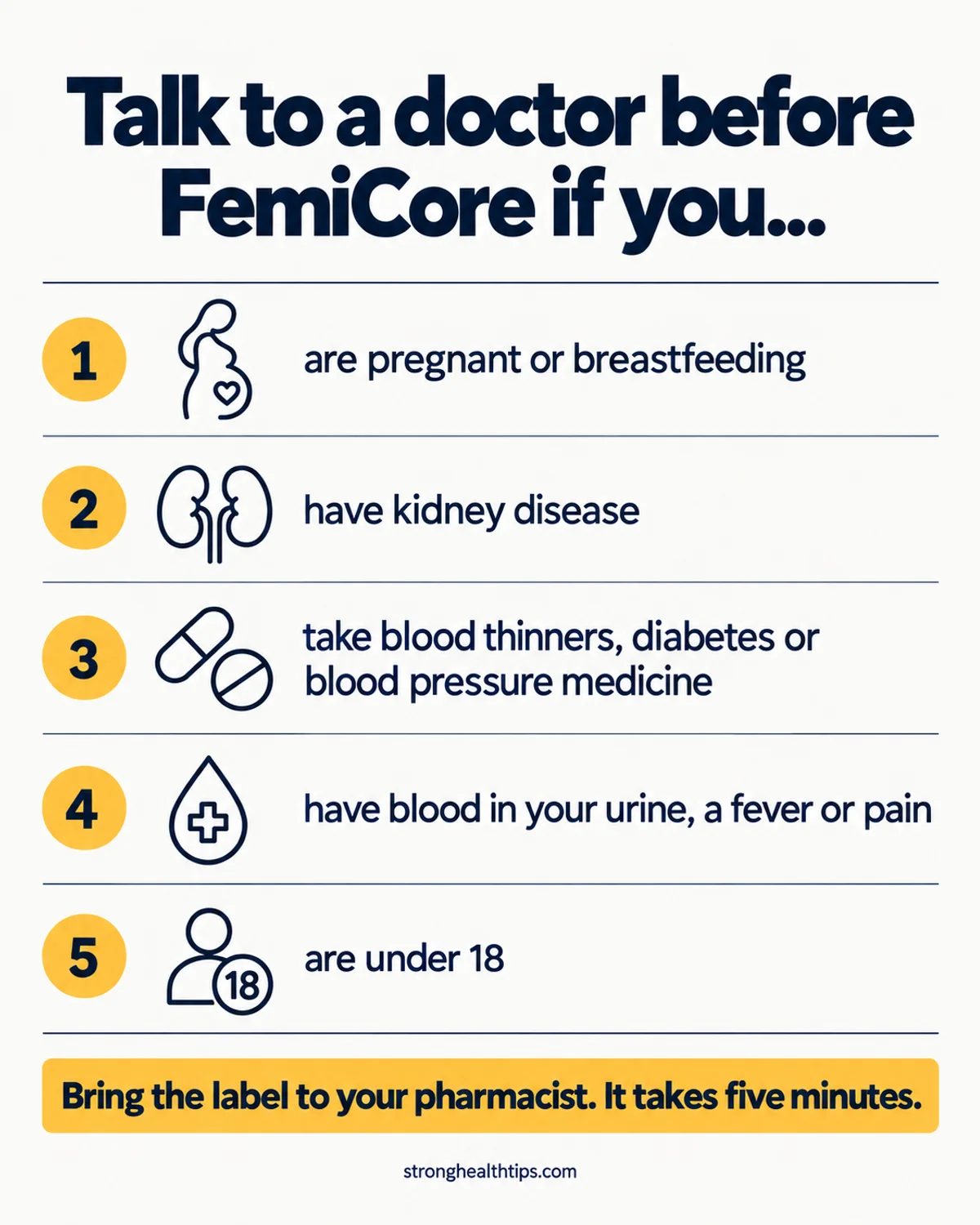
Speak to a doctor or pharmacist first if you:
- Are pregnant or breastfeeding. Berberine and bearberry are both advised against.
- Have kidney disease. Bearberry is traditionally not advised.
- Take blood thinners, diabetes medicine or blood pressure medicine. Berberine and cranberry are the reasons.
- Have blood in your urine, a fever, pain or burning. These need to be checked, not self-treated with a supplement.
- Are under 18. FemiCore is intended for adults.
It also makes sense to check in if you have liver disease, a weakened immune system, or take several medicines.
Cleared to try it?
Start FemiCore with a 60-day money-back guarantee.
Non-GMO, no stimulants, one capsule a day. From $49 per bottle.
Check FemiCore official priceNormal adjustment or a real side effect?
It helps to know the difference before you start, so you neither panic over a little gas nor ignore something that matters.
| Usually normal adjustment | Stop and get advice |
|---|---|
| Mild bloating or gas in weeks 1 to 2 | Bloating or pain that gets worse instead of better |
| Slightly looser or firmer stools for a few days | Diarrhoea lasting more than three days |
| Feeling a bit full after breakfast | Shakiness, sweating or confusion (possible low blood sugar) |
| No change at all | A rash, swelling or trouble breathing |
If you are unsure which column you are in, the safe choice is to pause the capsule and ask a pharmacist. Pausing for a few days costs you nothing, and the 60-day refund still applies as long as you contact support in time.
Low-risk start
Not sure FemiCore suits you? The guarantee covers every package.
Return all bottles within 60 days of delivery for a refund of the purchase price.
See the 60-day guaranteeSymptoms that need a doctor, not a supplement
Bladder problems are common and usually harmless, but some signs point to something that needs proper assessment. Get medical advice promptly if you have:
- Blood in your urine
- Pain or burning when you pass urine, or a fever (possible infection)
- Sudden new incontinence, especially after surgery, an injury or a fall
- Leaks along with numbness in your legs or the area you would sit on
- Waking many times a night with large amounts of urine and unusual thirst
A urinary tract infection needs proper treatment. FemiCore is not a treatment for infection, and waiting to see if a supplement helps can let an infection spread.
A safe way to start
If you have checked the points above and want to try FemiCore, a careful start looks like this:
- Show the ingredients list to a pharmacist if you take any regular medicine.
- Take one capsule with breakfast and a full glass of water.
- Keep a short daily note for the first two weeks about digestion and how you feel.
- Stop and seek advice if you get anything beyond mild, settling bloating.
- Set a day-50 reminder so you can still use the 60-day refund if it does not suit you.
For the full picture on what each ingredient is meant to do, see our FemiCore ingredients list. For the research behind the formula and our overall verdict, read the full FemiCore reviews. And if you decide to buy, our guide to the FemiCore official website explains how to avoid counterfeit stock, which carries its own risks.
The verdict on FemiCore side effects
For most healthy adult women, FemiCore side effects are likely to be mild and short lived, mainly early digestive changes. The real risks are specific and avoidable: berberine interactions with medication, bearberry in pregnancy or kidney disease, and using a supplement to delay care for warning symptoms. Clear those three, start slowly, and keep the guarantee in your back pocket.
Official store only
Buy the genuine formula, with a clear 60-day refund policy.
Counterfeit marketplace bottles carry no guarantee and unknown contents.
Visit the official FemiCore websiteQuestions people ask
What are the most common FemiCore side effects?
The most commonly reported effect is mild bloating, gas or a change in bowel habits during the first one to two weeks, which is typical when starting any probiotic and usually settles on its own. Some people may notice mild stomach upset from berberine. Many users report no side effects at all.
Can FemiCore interact with medication?
It can. Berberine lowers blood sugar and slows liver enzymes that process many drugs, including some blood pressure, cholesterol, antidepressant and blood-thinning medicines. Cranberry may matter if you take warfarin. Anyone on regular prescription medicine should ask a pharmacist or doctor before starting FemiCore.
Is FemiCore safe during pregnancy or breastfeeding?
FemiCore is not recommended during pregnancy or breastfeeding. Berberine and bearberry are both advised against in pregnancy, and there is no safety data for the combined formula in these groups.
Can I take FemiCore with kidney disease?
Bearberry is traditionally not advised for people with kidney disease, so anyone with a kidney condition should not start FemiCore without speaking to their kidney specialist or GP first.
What should I do if I get side effects from FemiCore?
Mild bloating in the first week often settles. If you have persistent stomach pain, diarrhoea, dizziness, signs of low blood sugar, a rash or any symptom that worries you, stop taking it and speak to a doctor or pharmacist. You can still use the 60-day money-back guarantee.
Does FemiCore contain stimulants?
No. The manufacturer states that FemiCore is non-GMO and contains no stimulants, so it should not cause jitteriness, a racing heart or sleep problems the way caffeine-based products can.
Sources
- Stapleton AE et al. (2011). Lactobacillus crispatus probiotic for prevention of recurrent urinary tract infection. Clinical Infectious Diseases
- Williams G et al. (2023). Cranberries for preventing urinary tract infections. Cochrane Database of Systematic Reviews
- Afshar K et al. (2018). Uva-ursi for uncomplicated urinary tract infection (REGATTA). BJGP
- Cicero AFG, Baggioni A (2016). Berberine and its role in chronic disease. Adv Exp Med Biol
- FDA: Tips for dietary supplement users
- NHS: Urinary incontinence
Not medical advice. This guide is general information and does not replace a consultation with a qualified healthcare professional who knows your history. Full disclaimer.
Written by
Strong Health Tips Editorial Team
We research, write and fact-check every guide against current guidance from major health bodies and peer-reviewed studies, then rewrite it in plain English. How we work.