Does FemiCore Really Work? An Evidence Check for Bladder Urgency and Leaks
Does FemiCore really work? What the ingredients can and cannot do, a realistic 12-week timeline, who is likely to benefit and how the 60-day guarantee helps.
- Author
- Strong Health Tips Editorial Team
- Published
- Reading time
- 8 min read
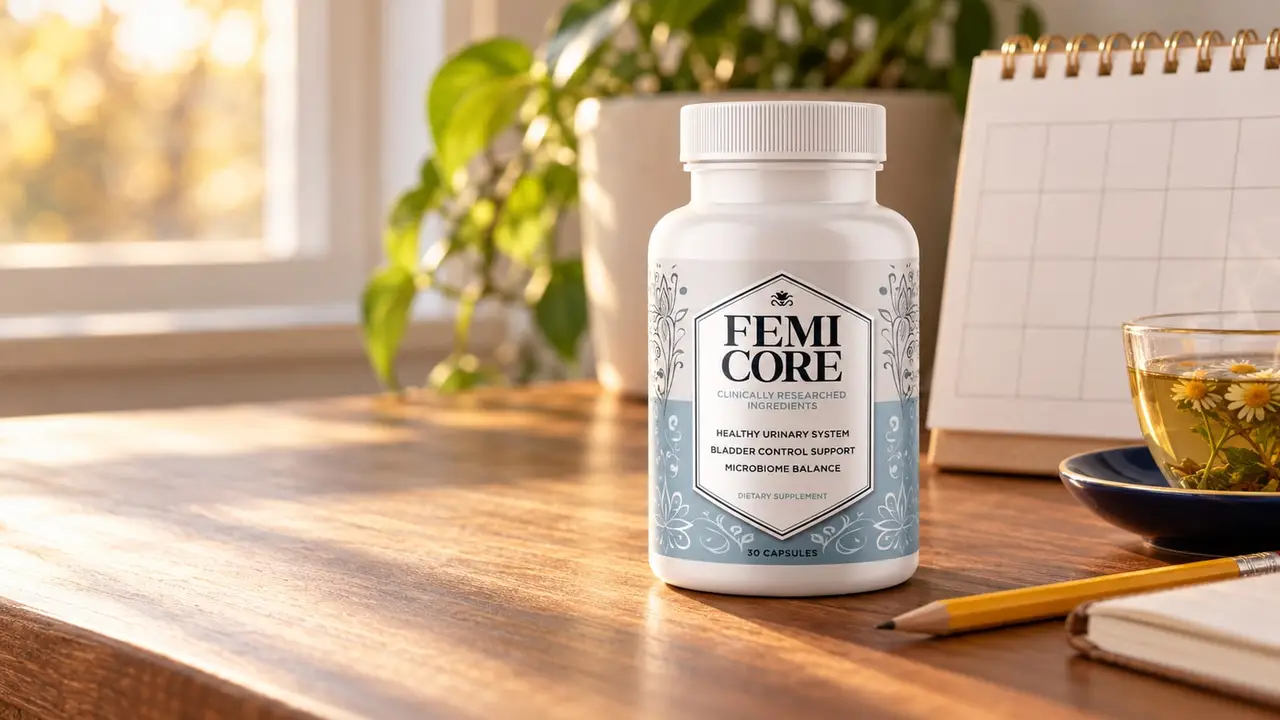
Affiliate disclosure: this review contains links to the official FemiCore website. If you buy through them we may earn a commission at no extra cost to you. It does not change our assessment. Details.
Does FemiCore really work? It is the only question that matters before you spend money on a bladder supplement, and it deserves a straighter answer than most sales pages give. The short version: FemiCore is built on real science, two of its ingredients have meaningful human evidence, and nobody has tested the finished capsule in a trial. So it might help you, it might not, and the way to find out without losing money is a disciplined 12-week test backed by the 60-day guarantee.
This article does not repeat the full product review. Instead it does three things: rates the evidence for each ingredient, sets out a realistic timeline, and helps you work out whether you are the kind of person likely to benefit.
Does FemiCore really work? What “work” should mean
Before looking at evidence, it helps to define success. FemiCore is aimed at urgency (sudden, strong urges to go), night-time trips and the leaks that come with them. A realistic win looks like:
- Fewer trips at night, so you sleep longer between wake-ups
- Urges that feel less sharp and give you more time to reach a toilet
- Fewer “close calls” on walks, at work or in the car
It does not mean a cure, and it is not a substitute for medical care if your symptoms come from an infection, a prolapse, a neurological condition or surgery. Keeping your expectations at this level makes it much easier to judge honestly.
The evidence, ingredient by ingredient
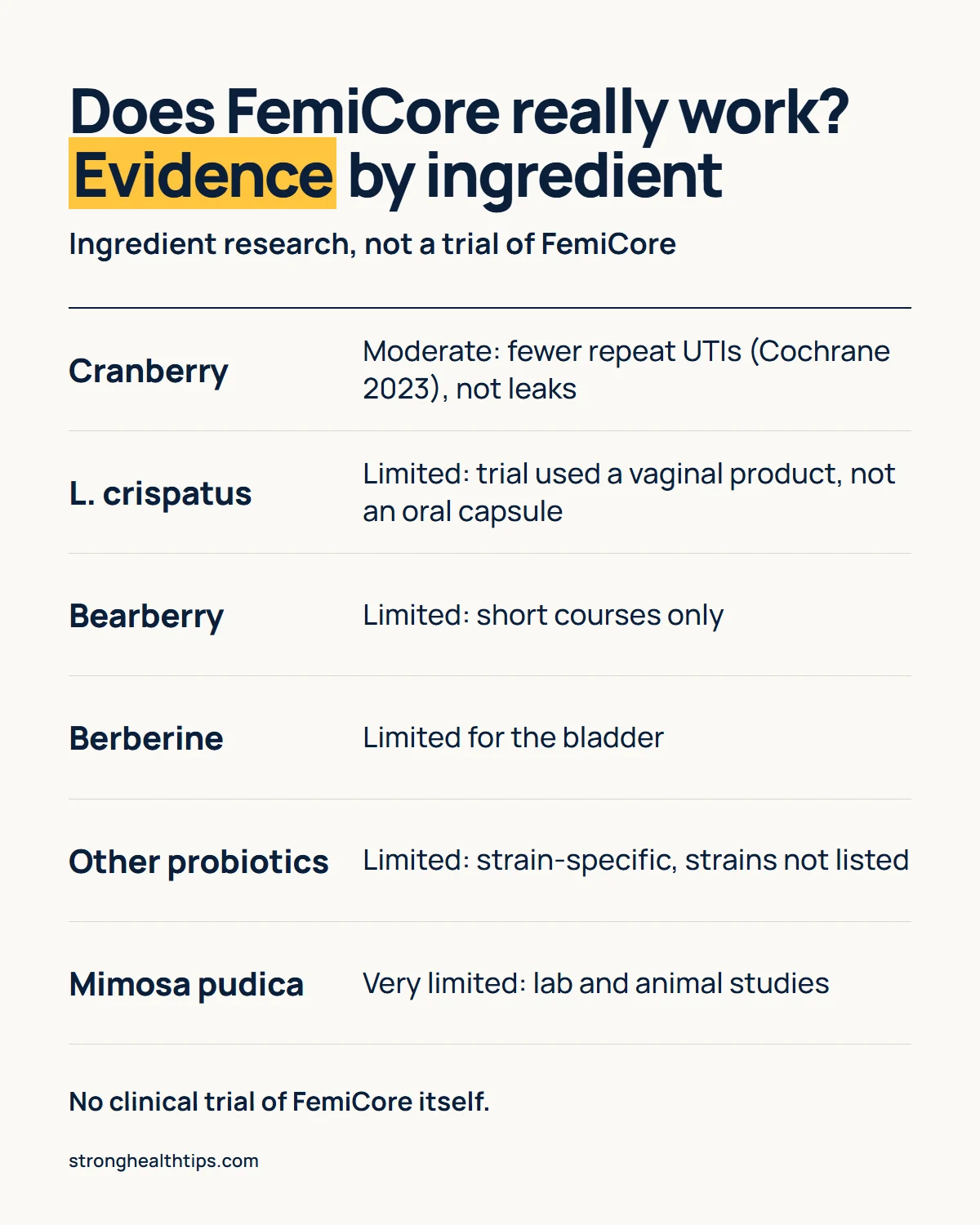
| Ingredient | Evidence strength | What the research actually shows |
|---|---|---|
| Cranberry Extract | Moderate | A 2023 Cochrane review found cranberry products reduce repeat urinary infections in some groups |
| Lactobacillus crispatus | Limited | A small randomised trial (2011) cut repeat infections, but it used a vaginal product, not an oral capsule |
| Bearberry (Uva Ursi) | Limited | Some activity in urinary infections, weaker than antibiotics in a 2018 trial |
| Berberine | Limited for bladder | Strong research in blood sugar; no bladder-control trials |
| Other probiotics | Limited | Good safety record, no bladder-specific trials |
| Mimosa Pudica | Very limited | Traditional use and lab studies only |
The footnote that matters most: no clinical trial of FemiCore itself has been published. All of the evidence above is borrowed from studies of individual ingredients, at doses we cannot compare because the label does not list amounts.
There is also a gap between the questions the research answered and the problem FemiCore targets. Most of the stronger studies measured urinary infections. The link to urgency comes from microbiome research: in 2014, researchers found that women with urgency incontinence were less likely to have a bladder dominated by L. crispatus. That is a genuine and interesting association, but it does not prove that adding L. crispatus by mouth will reduce urgency.
For a full walk-through of each ingredient, see our FemiCore ingredients list.
Test it without the risk
Every FemiCore package has a 60-day money-back guarantee.
Try it, track it, and return all bottles within 60 days if it does not help.
See FemiCore packagesA realistic 12-week timeline
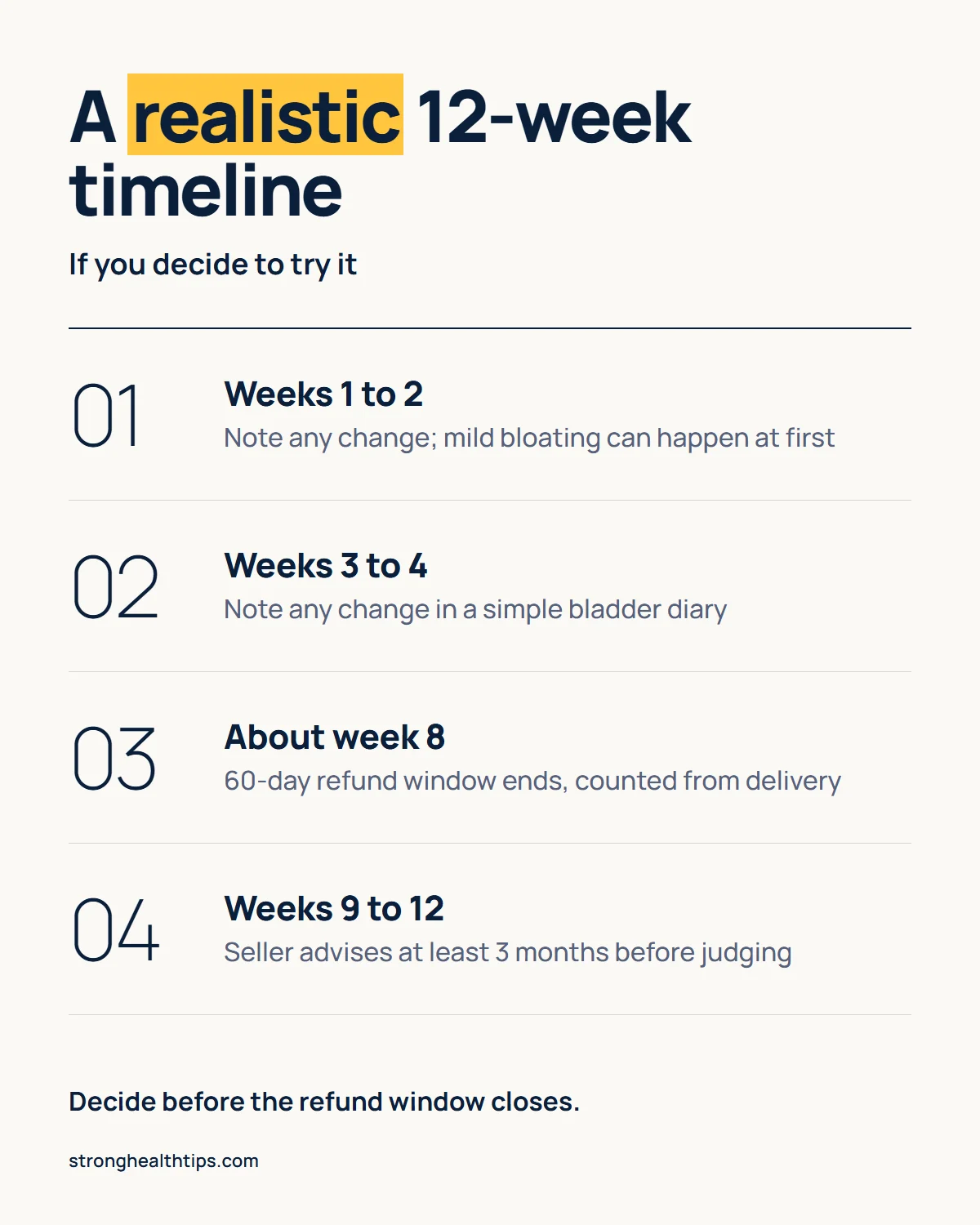
Probiotics change the bacterial balance slowly. No trial of FemiCore shows when, or whether, symptoms change, so this is a plan for watching, not a promise of results:
| Weeks | What to expect |
|---|---|
| 1 to 2 | Note any change. Possibly some mild bloating as your gut adjusts |
| 3 to 4 | Note any change in a simple bladder diary |
| About 8 | The 60-day refund window, counted from delivery, ends |
| 9 to 12 | The seller advises at least 3 months before judging |
The catch is that the guarantee window is 60 days from the day your order is delivered, which is around week 8 or 9 if you start as soon as it arrives. So the useful rule is: decide by day 50. If by then you have seen no change at all in your diary, it is reasonable to return the bottles. If you have seen some improvement, you have a good reason to continue.
Who is likely to benefit, and who is not
Not every bladder problem has the same cause, and FemiCore targets one particular route. Being honest about fit saves money and disappointment.
More plausible fit:
- Adult women whose main problem is urgency or frequent trips, day or night
- Women who have had repeated urinary infections in the past
- Women who have already started the free first-line habits and want an extra layer
Less plausible fit:
- Leaks only when you cough, sneeze, laugh or exercise (stress incontinence). The pelvic floor is the target there, and exercises or a pelvic health physiotherapist usually help far more
- Symptoms that started suddenly, after surgery or childbirth, or with pain, blood or fever. These need assessment first
- Anyone hoping for a result in a week or two
If you are not sure which type you have, a short bladder diary and a GP visit will tell you more than any supplement review. Our guide to FemiCore side effects also covers who should check with a doctor before starting.
Plan a full test
Three bottles covers the full 12-week window, with free US shipping.
$69 per bottle, or $49 per bottle with the 6-bottle package.
Check FemiCore official priceHow to test FemiCore properly
Most people judge a supplement by memory, which is unreliable. Urgency symptoms rise and fall with sleep, stress, caffeine and the weather. A simple structure gives you a real answer:
- Keep a two-day bladder diary before you start. Note the time of each trip, roughly how much you passed, any urges and any leaks. It takes a few minutes a day.
- Hold other things steady. If you also start cutting coffee or a new exercise plan, start them a couple of weeks before FemiCore, not on the same day.
- Take one capsule every morning with a full glass of water. Missing days slows any probiotic effect.
- Repeat the two-day diary at week 6 and week 12. Compare the numbers, not your impressions.
- Use your day-50 reminder to decide whether to keep going or claim the refund.
What would make the evidence stronger
It is worth being clear about what is missing, because it tells you how much weight to put on any promise you read. Our confidence in FemiCore would rise noticeably if the manufacturer:
- Published the dose of each ingredient, especially the cranberry PAC content and the probiotic CFU count, so they could be compared with the studies.
- Named the probiotic strains, since benefits in trials belong to specific strains, not just the species.
- Ran a trial of the finished product in women with urgency, measuring urges, night-time trips and leaks against a placebo.
- Shared real, verifiable customer outcomes rather than a headline review count.
Until then, the honest position is that FemiCore is a plausible formula with a money-back safety net. That is a reasonable basis for a personal trial, and a weak basis for big expectations.
Judge it yourself
Run your own 12-week test, with your money protected for 60 days.
Official website only. One capsule a day, from $49 per bottle.
Visit the official FemiCore websiteHabits that improve the odds
Whatever you decide about FemiCore, the following are free and have the strongest evidence for bladder control:
- Bladder training: when an urge hits, pause, squeeze your pelvic floor a few times and wait a minute before walking calmly to the toilet. Stretch the wait over weeks.
- Pelvic floor exercises: three short sets a day, every day, for three months.
- Caffeine by noon: coffee, tea and cola after lunch make urgency and night trips worse for many people.
- Fluid timing: drink normally during the day and taper in the last two hours before bed. Do not cut fluids overall.
- Sleep and movement: a daily walk and better sleep habits both reduce night-time trips.
Doing these alongside FemiCore means that, even if the capsule does little, you are still likely to improve.
The verdict: does FemiCore really work?
FemiCore has a sound idea and a sensible ingredient list, with moderate evidence for one of its nine components, cranberry, and no trial of the product itself. That puts it in the “worth a careful trial” category rather than the “proven” one. If you are a woman with urgency or night-time trips, use the 12-week plan above, keep the diary, and let the 60-day guarantee carry the risk. For our full scorecard and the research in more depth, read the complete FemiCore reviews, or see a one-page summary on the FemiCore product page.
Your call, your 60 days
Find out if FemiCore works for you, with your money protected.
One-time purchase from the official website. No subscription.
Start your FemiCore trialQuestions people ask
Does FemiCore really work?
It may help some women, but there is no published trial of FemiCore itself. Cranberry has moderate human evidence, mainly for preventing repeat urinary infections. Lactobacillus crispatus has a small trial, but it used a vaginal product, not an oral capsule, so its evidence for FemiCore is limited. Evidence for the other ingredients is limited, and none of the research measured urgency or leaks directly. The honest answer is that it is a reasonable thing to try, not a proven treatment.
How long does FemiCore take to work?
Probiotic formulas work gradually. There is no trial of FemiCore that shows when, or whether, symptoms change, so note any change in a simple diary. The seller advises at least 3 months before judging, and the 60-day refund window, counted from delivery, ends around week 8.
Who is FemiCore most likely to help?
Adult women with urgency symptoms, frequent night-time trips or a history of recurrent urinary infections are the most plausible fit, since that is where the underlying research on the urinary microbiome and cranberry is strongest. Women whose leaks happen only when coughing, sneezing or exercising usually benefit more from pelvic floor exercises.
What if FemiCore does not work for me?
Every package bought on the official website has a 60-day money-back guarantee. Contact support within 60 days of delivery and return all bottles, empty or full, with the packing slip for a refund of the purchase price. Return shipping is at your own cost.
Can I make FemiCore work better?
The habits with the strongest evidence for bladder control are bladder training, pelvic floor exercises, cutting caffeine after noon and timing fluids so you drink less in the two hours before bed. Doing these alongside FemiCore gives you the best overall chance of improvement.
Sources
- Wolfe AJ et al. (2012). Evidence of uncultivated bacteria in the adult female bladder. Journal of Clinical Microbiology
- Pearce MM et al. (2014). The female urinary microbiome in women with and without urgency urinary incontinence. mBio
- Stapleton AE et al. (2011). Lactobacillus crispatus probiotic for prevention of recurrent urinary tract infection. Clinical Infectious Diseases
- Williams G et al. (2023). Cranberries for preventing urinary tract infections. Cochrane Database of Systematic Reviews
- Afshar K et al. (2018). Uva-ursi for uncomplicated urinary tract infection (REGATTA). BJGP
- NIDDK: Bladder control problems in women
Not medical advice. This guide is general information and does not replace a consultation with a qualified healthcare professional who knows your history. Full disclaimer.
Written by
Strong Health Tips Editorial Team
We research, write and fact-check every guide against current guidance from major health bodies and peer-reviewed studies, then rewrite it in plain English. How we work.