How Does FemiCore Work? The Seller's Story Next to What the Research Shows
How does FemiCore work? The idea behind its nine ingredients, the bladder microbiome story, and what research on each ingredient does and does not show.
- Author
- Strong Health Tips Editorial Team
- Published
- Reading time
- 9 min read

Affiliate disclosure: this review contains links to the official FemiCore website. If you buy through them we may earn a commission at no extra cost to you. It does not change our assessment. Details.
How does FemiCore work? The honest answer has two layers. There is the story the product is built around, which is about bacteria living in the bladder and plants traditionally used for urinary comfort. And there is what the research on each ingredient actually shows, which is narrower, patchier and mostly about other problems.
This article puts those two layers side by side. It does not try to tell you whether FemiCore will help you personally; our evidence check on whether FemiCore really works does that, with a timeline. Here the focus is the mechanism: what each part of the capsule is supposed to do, and how far the science goes in backing it up.
Read the label yourself
See the full FemiCore ingredient list on the official site.
Nine ingredients, one capsule a day, 60 days from delivery to ask for a refund.
View FemiCore on the official siteThe story the label tells
The FemiCore label sums up its purpose in three phrases: “Healthy urinary system”, “Bladder control support” and “Microbiome balance”. It also says “Clinically researched ingredients”. That last phrase refers to research on the ingredients in general. No trial of the finished FemiCore product exists.
Reading the ingredient list against those phrases, the pitch has two halves:
- The probiotic half. Five Lactobacillus species, aimed at “microbiome balance”.
- The botanical half. Mimosa pudica, bearberry, cranberry extract and berberine, aimed at the urinary system.
That is our reading of how the pieces fit, based on the label and the ingredients. The seller does not publish doses or a study showing how the combination performs.
Combining the two halves is a sensible commercial idea. It lets one capsule speak to two audiences: women drawn to newer microbiome science, and women who know cranberry and bearberry as long-standing urinary remedies. A combination does not add up the evidence of its parts, though. Each ingredient was studied on its own, for its own purpose, usually at a known dose. Putting nine of them in one capsule at undisclosed amounts creates a new product that none of those studies tested.
The rest of this article takes each half in turn: first the microbiome idea, then what the research says about each ingredient.
The nine ingredients and their role in the pitch
| Ingredient | Half | Role in the pitch, as we read it | Amount on the label |
|---|---|---|---|
| Lactobacillus crispatus | Probiotic | Microbiome balance | Not disclosed |
| L. acidophilus | Probiotic | Microbiome balance | Not disclosed |
| L. plantarum | Probiotic | Microbiome balance | Not disclosed |
| L. gasseri | Probiotic | Microbiome balance | Not disclosed |
| L. casei | Probiotic | Microbiome balance | Not disclosed |
| Cranberry extract | Botanical | Urinary tract support | Not disclosed |
| Bearberry (uva ursi) | Botanical | Traditional urinary herb | Not disclosed |
| Granular berberine | Botanical | Plant compound | Not disclosed |
| Mimosa pudica | Botanical | Herbal extract | Not disclosed |
The last column is the most important one in this article. Every claim about how FemiCore works depends on how much of each ingredient is in the capsule, and the label does not say. For a plain list with background on each one, see our FemiCore ingredients list.
The bladder microbiome: where the idea comes from
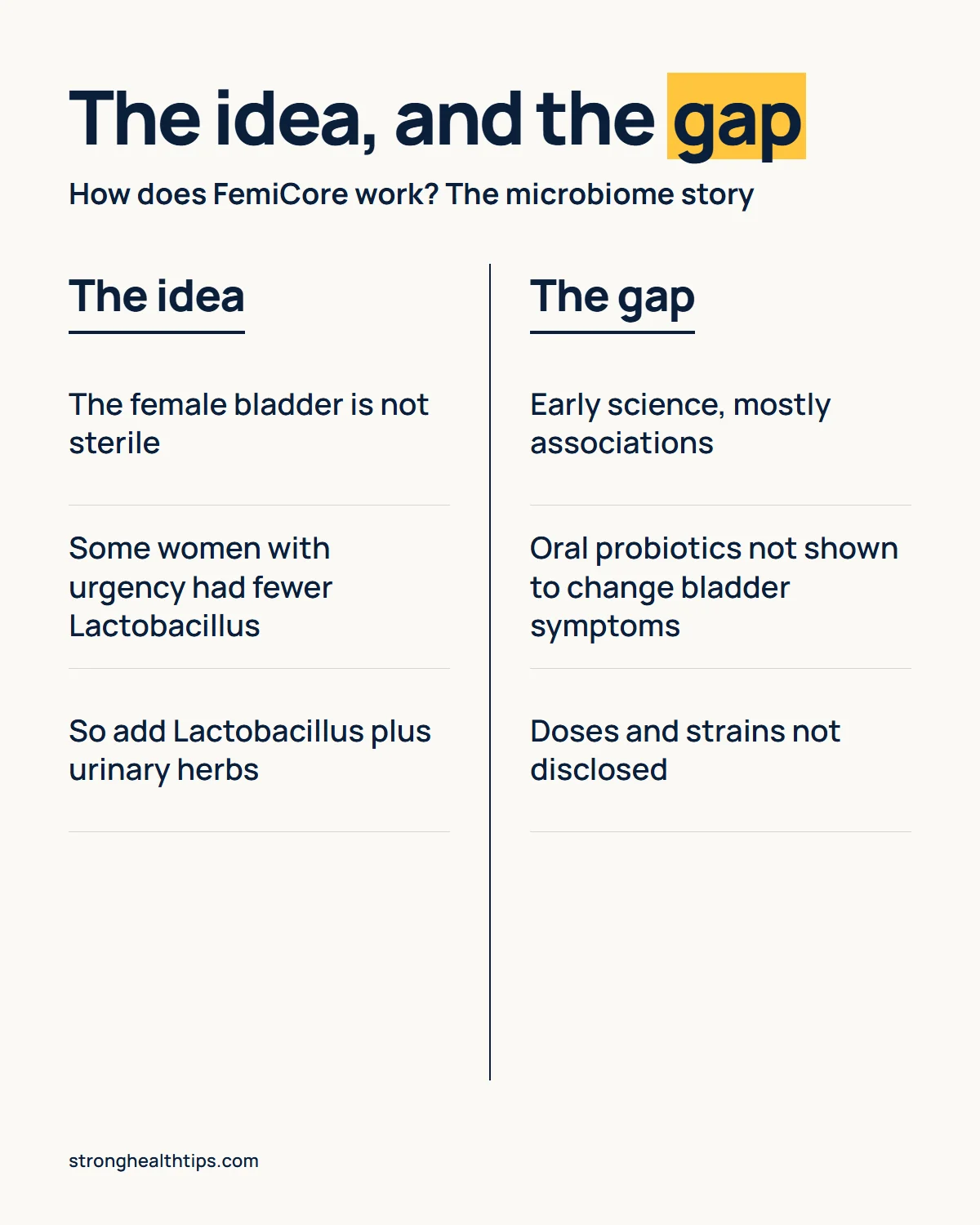
Since about 2012, sequencing studies from Loyola University Chicago and other groups have shown that the female bladder has its own community of bacteria. Some of those studies also saw fewer Lactobacillus in women with urgency incontinence than in women without it.
That is the scientific seed of FemiCore. If women with urgency tend to have fewer Lactobacillus, perhaps adding Lactobacillus could help. It is a reasonable hypothesis. But it is a hypothesis built on associations, and an association does not tell you which came first or whether changing one changes the other. No study we know of shows that taking oral probiotics changes bladder symptoms.
What the research shows for each part
The botanical half and the probiotic half rest on very different kinds of evidence. Grouping them by how solid the mechanism is gives a clearer picture than a simple list.
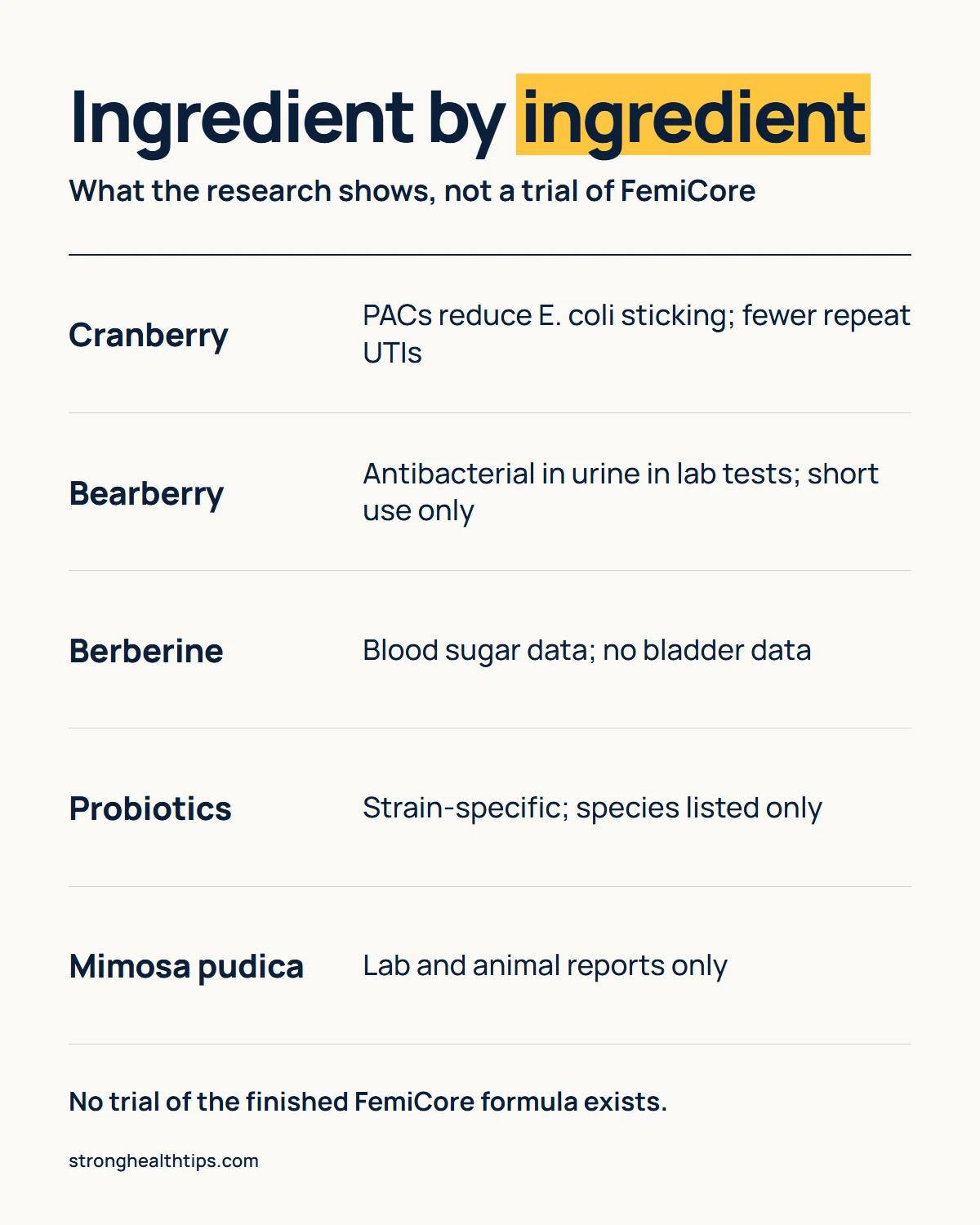
Strongest mechanism: cranberry
Cranberry contains A-type proanthocyanidins (PACs) that reduce the ability of E. coli to stick to the urinary tract wall. In people, a 2023 Cochrane review found that cranberry products can reduce repeat urinary infections in women prone to them. Earlier reviews were mixed, and the effect depends on the PAC dose. Two limits matter for FemiCore: the PAC content is not disclosed, and the research is about infections, not leaks or urgency.
Borrowed mechanism: the probiotics
The probiotic with the most relevant human data is Lactobacillus crispatus. In a small placebo-controlled trial, it reduced repeat urinary infections, but the product in that trial was used vaginally, not swallowed. Probiotic effects are also strain-specific, meaning results from one strain do not automatically apply to another strain of the same species. FemiCore lists species only, with no strain codes and no CFU count, so you cannot match it to any study.
Mechanism with a time limit: bearberry
Bearberry contains arbutin, which the body turns into hydroquinone that ends up in the urine, where it has antibacterial activity in the lab. Human evidence is limited and mixed. European herbal regulators describe it for mild lower urinary complaints in short courses of about a week, not continuous use. FemiCore is taken daily for months, and its arbutin content is not disclosed.
Research pointing elsewhere: berberine
Berberine has good human data, but for blood sugar and cholesterol, in studies using around 1,000 to 1,500 mg a day. Evidence for the bladder is lacking. Berberine also carries most of the formula’s drug-interaction risk, and its dose in FemiCore is not disclosed.
Thinnest evidence: mimosa pudica
Lab and animal studies report anti-inflammatory, antimicrobial and antispasmodic effects. There are no human trials for bladder symptoms. Of the nine ingredients, this one has the least behind it.
Judge it on your own results
Every official FemiCore order has 60 days from delivery for a refund.
All bottles go back with the packing slip. Return postage is paid by you.
Check FemiCore packagesWhere the story and the evidence part ways
Put the pitch and the research next to each other and the gaps are easy to see.
| The pitch | What the research supports | The gap |
|---|---|---|
| Microbiome balance | The bladder has bacteria; some links to urgency | No proof oral probiotics change symptoms |
| Bladder control support | Little direct evidence for any ingredient | Studies looked at infections, not leaks |
| Healthy urinary system | Cranberry for repeat infections in prone women | PAC dose unknown |
| Clinically researched ingredients | Research on single ingredients | No trial of the finished product |
None of this makes the idea worthless. Cranberry and the bladder microbiome are real research areas, and a product combining them is not unreasonable. It does mean the mechanism is a set of plausible steps rather than a demonstrated chain from capsule to result. If you want to find out whether it helps you, follow the seller’s routine of one capsule every morning, and a simple bladder diary kept before you start and again near day 50 will tell you more than any mechanism.
Plausible, not proven
See the official FemiCore packages and refund terms.
From $49 a bottle. Free US shipping on 3 and 6 bottles. One-off purchase.
Visit the official FemiCore siteWhat one capsule can and cannot tell you
FemiCore comes as 30 capsules per bottle, one each morning with a big glass of water. A single capsule holds all nine ingredients, so the amount of each is shared within one daily serving. Without the numbers, there is no way to know whether that serving contains anything close to the amounts used in the studies above, such as the berberine doses in blood sugar research.
These details are not disclosed on the label: individual doses, CFU count, probiotic strain codes, cranberry PAC content, bearberry arbutin content, berberine dose and a certificate of analysis. Those are exactly the details you would need to connect the capsule to the research. Our walkthrough of the FemiCore supplement covers the label line by line.
The safety side of the mechanism
The same properties that give an ingredient a mechanism can also give it side effects or interactions.
- Berberine can cause digestive upset, can lower blood sugar, may lower blood pressure and slows the enzymes CYP3A4 and CYP2D6, which raises the levels of many drugs, such as cyclosporine. It is considered unsafe in pregnancy and breastfeeding.
- Bearberry can cause nausea and harmless green-brown urine. It is meant for short-term use, interacts with lithium and should be avoided in pregnancy, breastfeeding, kidney disease and children.
- Cranberry has case reports of interactions with warfarin, and its oxalate content is relevant to kidney stones.
- Probiotics can cause gas and bloating in the first one to two weeks, and rarely infections in severely immunocompromised people.
If you take regular medication, ask a pharmacist before starting. Blood in the urine, fever or chills, flank pain, burning or a sudden change in bladder control need a doctor, not a supplement.
The bottom line
FemiCore works, on paper, by pairing Lactobacillus probiotics with four urinary-focused plant ingredients, following the discovery that the female bladder has its own bacteria. Cranberry gives that story its firmest footing, for repeat infections. The rest of the mechanism rests on early science, research done for other uses, and doses nobody outside the company can see. Like every supplement, it follows the FDA’s dietary supplement rules rather than the approval process for medicines. Our editorial score is 4.2 out of 5, and our FemiCore product hub has pricing, safety and the full ingredient picture on one page.
Official website only
Try FemiCore with a 60-day refund window, from $49 a bottle.
We are independent, not the seller, and may earn a commission through our links.
Order FemiCore from the official siteQuestions people ask
What is FemiCore supposed to do?
The label describes it as support for a healthy urinary system, bladder control and microbiome balance. It is a dietary supplement, not a treatment for any condition.
Has FemiCore been tested in a clinical trial?
No trial of the finished FemiCore product exists. The label's line about clinically researched ingredients refers to research on the ingredients in general, much of it done for other uses.
Which ingredient in FemiCore has the best evidence?
Cranberry. A 2023 Cochrane review found cranberry products can reduce repeat urinary infections in women prone to them. The effect depends on the PAC dose, which FemiCore does not disclose, and the research is about infections, not leaks or urgency.
Do the probiotics in FemiCore reach the bladder?
That has not been shown. The best-known positive trial for Lactobacillus crispatus used a vaginal product, not an oral capsule. Probiotic effects are also strain-specific, and FemiCore lists species without strain codes.
Why can't I see the dose of each ingredient?
The nine ingredients are in a proprietary blend, and the label lists them without individual amounts. The CFU count, strain codes, cranberry PAC content, bearberry arbutin content and berberine dose are not disclosed either.
Does the FDA review how FemiCore works?
Not in the way it reviews medicines. Like every dietary supplement, FemiCore follows the FDA's supplement rules rather than the approval process for medicines. The seal Made in an FDA registered facility refers to the factory's registration, not to the product or its mechanism.
Sources
- Wolfe AJ et al. (2012). Evidence of uncultivated bacteria in the adult female bladder. Journal of Clinical Microbiology
- Pearce MM et al. (2014). The female urinary microbiome in women with and without urgency urinary incontinence. mBio
- Williams G et al. (2023). Cranberries for preventing urinary tract infections. Cochrane Database of Systematic Reviews
- Stapleton AE et al. (2011). Lactobacillus crispatus probiotic for prevention of recurrent urinary tract infection. Clinical Infectious Diseases
- Cicero AFG, Baggioni A (2016). Berberine and its role in chronic disease. Adv Exp Med Biol
Not medical advice. This guide is general information and does not replace a consultation with a qualified healthcare professional who knows your history. Full disclaimer.
Written by
Strong Health Tips Editorial Team
We research, write and fact-check every guide against current guidance from major health bodies and peer-reviewed studies, then rewrite it in plain English. How we work.