FemiCore Safety Warnings: Who Should Skip It, Interactions to Clear and Signs to See a Doctor
FemiCore safety warnings on one scannable card: who should not take it, drug interactions to clear first, symptoms that need a doctor and label cautions.
- Author
- Strong Health Tips Editorial Team
- Published
- Reading time
- 9 min read

Affiliate disclosure: this review contains links to the official FemiCore website. If you buy through them we may earn a commission at no extra cost to you. It does not change our assessment. Details.
This page collects the FemiCore safety warnings in one place, in a format you can scan in a minute or screenshot for your pharmacist. It covers who should not take the capsule, which medicines need checking first, which symptoms mean you should see a doctor instead, and what the label and the seller say themselves.
It is not a list of what you might feel after starting. For the early bloating, stomach upset and other effects in the first weeks, read our FemiCore side effects guide. This one is about the stop signs.
Show your pharmacist
See the full FemiCore ingredient list on the official site.
Nine ingredients in a proprietary blend. Bring the list to your pharmacy before you order.
View the official ingredient listThe warnings card
Every row below has an ingredient behind it. FemiCore contains nine: Mimosa pudica, bearberry (uva ursi), cranberry extract, granular berberine, and five Lactobacillus species (crispatus, acidophilus, plantarum, gasseri and casei). Berberine and bearberry carry most of the warnings.
| Warning | Applies if you | Ingredient behind it | What to do |
|---|---|---|---|
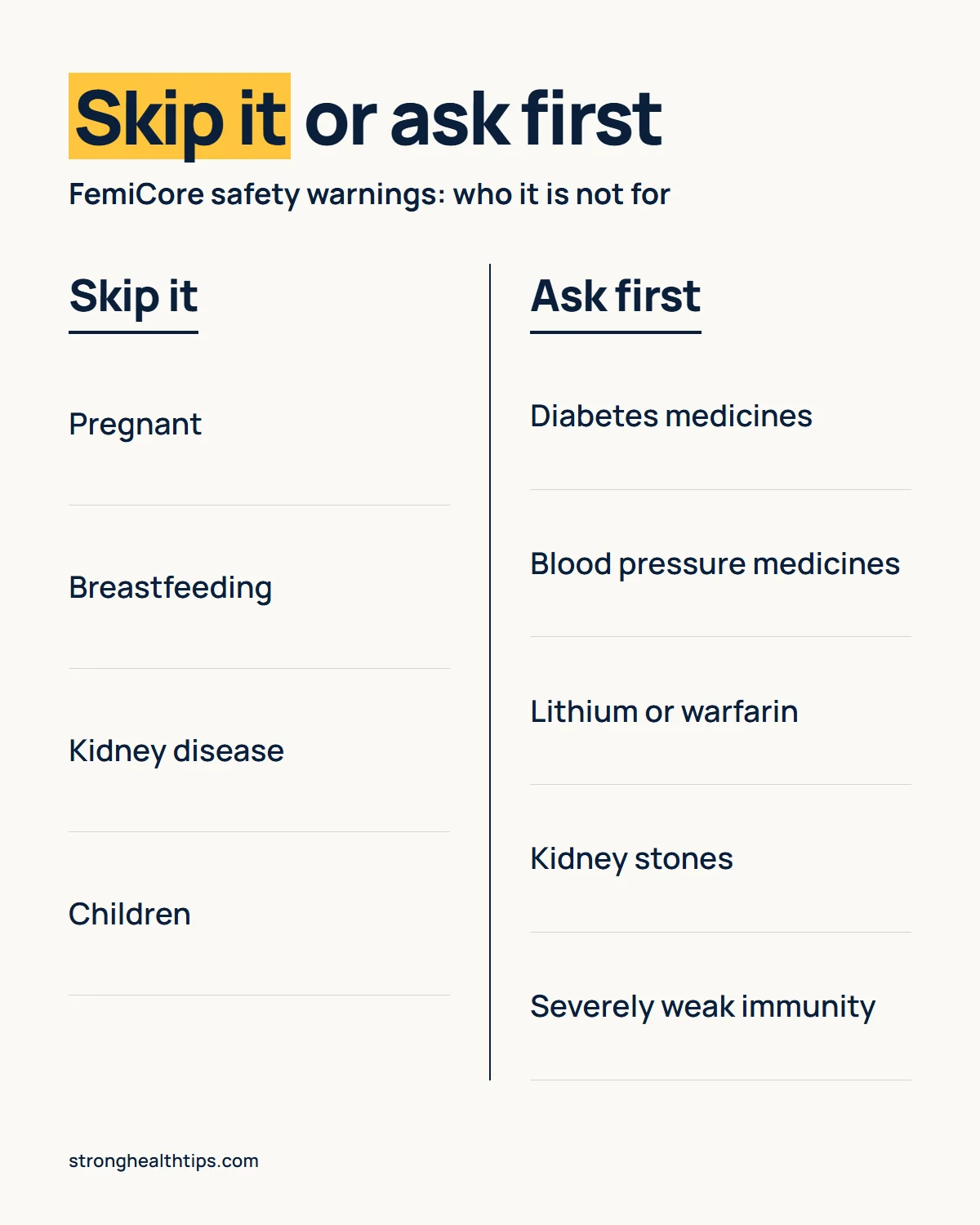
| Do not take | Are pregnant | Berberine, bearberry | Skip it |
| Do not take | Are breastfeeding | Berberine, bearberry | Skip it |
| Do not take | Have kidney disease | Bearberry | Skip it unless your kidney doctor agrees |
| Do not give | To a child | Bearberry | Skip it |
| Check first | Take diabetes medicine | Berberine | Ask your pharmacist or doctor |
| Check first | Take blood pressure medicine | Berberine | Ask your pharmacist or doctor |
| Check first | Take drugs such as cyclosporine | Berberine | Ask your pharmacist or doctor |
| Check first | Take lithium | Bearberry | Ask the prescriber |
| Check first | Take warfarin | Cranberry | Ask the clinic that checks your INR |
| Check first | Are prone to kidney stones | Cranberry | Ask your doctor |
| Check first | Are severely immunocompromised | Probiotics | Ask your specialist |
| See a doctor | Have warning symptoms (below) | Not the capsule | Get care, not a supplement |
Who should not take it
Pregnancy and breastfeeding
Berberine is considered unsafe in pregnancy and while breastfeeding, and bearberry should be avoided in both. There is no safety data for the combined FemiCore formula in either group. This is the clearest warning on the card.
Kidney disease
Bearberry should be avoided by people with kidney disease. Because the bearberry dose in FemiCore is not disclosed, there is no way to say whether the amount is small. If you have any kidney condition, the decision belongs to your kidney specialist.
Children
FemiCore is marketed to women, and bearberry should be avoided in children. Keep the bottle out of reach and do not share it with younger family members.
Interactions to clear first
If you take any regular medicine, the most useful five minutes you can spend is a conversation with a pharmacist, ingredient list in hand.
| Medicine | Ingredient | Why it matters |
|---|---|---|
| Diabetes medicines | Berberine | Berberine can lower blood sugar and add to their effect |
| Blood pressure medicines | Berberine | Berberine may lower blood pressure further |
| Drugs processed by CYP3A4 or CYP2D6, such as cyclosporine | Berberine | Berberine slows these enzymes and can raise drug levels |
| Lithium | Bearberry | A known interaction |
| Warfarin | Cranberry | Case reports of interaction; INR checks matter |
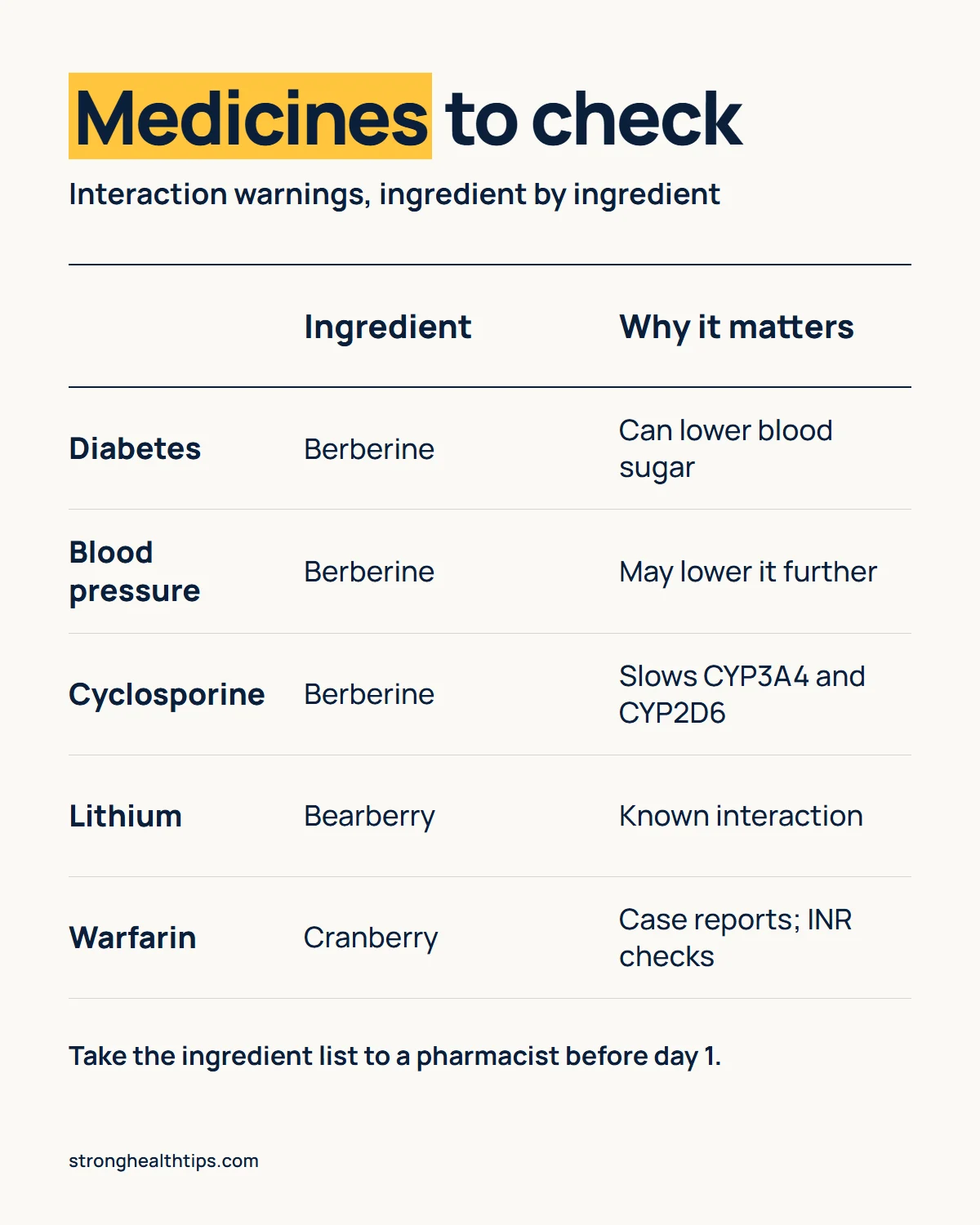
The CYP3A4 and CYP2D6 row is the broadest one. Those two liver enzymes process a long list of common prescriptions, so if you are not sure whether one of yours is on it, assume it might be and ask.
Cleared by your pharmacist?
Official FemiCore orders come with 60 days from delivery to ask for a refund.
From $49 a bottle. One-off purchase, no hidden autoship.
Check official FemiCore pricesConditions that call for a conversation first
Some situations are not a firm no, but they are a reason to ask before you start.
- Kidney stones. Cranberry contains oxalate, which is relevant if you form stones.
- A severely weakened immune system. Rare infections from probiotics have been reported in people who are severely immunocompromised.
- Any diagnosed medical condition. The official site’s own advice is to see a physician if you have one.
- Several medicines at once. The more prescriptions you take, the more likely one of them meets berberine.
Our fit guide on who should use FemiCore looks at the other side of this question: who the product is designed for.
Stop and see a doctor
These symptoms are not a reason to try a supplement. They are a reason to get checked, whether or not you have started FemiCore.
- Blood in your urine
- Fever or chills
- Pain in your side or flank
- Burning when you pass urine
- A sudden change in bladder control
- New confusion in an older relative who also has urinary symptoms
FemiCore is not a treatment for a urinary tract infection, and waiting to see whether a capsule helps can delay care you need.
What the label and the seller say
The seller’s own wording is short. The official site advises speaking to a physician if you are pregnant, nursing, taking medication or have a medical condition. The seller also describes the product as stimulant-free and non-GMO, and the directions are one capsule every morning with a big glass of water.
There is one caution the label does not spell out. European herbal regulators describe bearberry for mild lower urinary complaints in short courses of about a week, not continuous use. FemiCore is designed to be taken every day, and the seller advises at least 3 months. Without the bearberry dose, nobody outside the company can say how that fits the short-course guidance. That gap is worth raising with your doctor if you plan a long course. Our FemiCore how-to-use guide covers the daily routine itself.
A small note to save you a worried phone call: bearberry can turn urine green-brown, which is harmless.
Warnings the label cannot settle
A pharmacist can tell you which ingredients raise a flag. What they cannot tell you is how strong the flag is, because the label does not disclose:
- the dose of berberine, the ingredient with the most interactions
- the arbutin content of the bearberry
- the cranberry PAC content
- the CFU count and strain codes for the probiotics
- a certificate of analysis
That is why the advice on this card leans cautious. When the amount is unknown, the safe answer to “is it enough to matter?” is to assume it might be.
Read before day 1
Check the official FemiCore page, then talk to your pharmacist.
Free US shipping on 3 and 6 bottles. Return all bottles within 60 days of delivery for a refund.
See the FemiCore packagesWhy each ingredient carries the warnings it does
The card is easier to remember once you see which ingredient sits behind which line.
- Berberine is behind most of the medicine warnings. It can lower blood sugar, may lower blood pressure and slows two liver enzymes, CYP3A4 and CYP2D6, which raises the levels of many drugs. It is also considered unsafe in pregnancy and breastfeeding, and it can upset the stomach.
- Bearberry is behind the kidney, children, lithium and duration warnings. It can also cause nausea.
- Cranberry is behind the warfarin and kidney stone lines, through case reports with warfarin and its oxalate content.
- The five Lactobacillus species are behind the immune system line. Gas or bloating in the first one to two weeks is common and is covered in our side effects guide, not here.
- Mimosa pudica has the thinnest human evidence of the nine, so there is little human safety information either way.
If a warning applies and you have already started
Finding a warning that fits you after the bottles have arrived is not a disaster, but it does change what you do next.
- Stop taking the capsules until you have spoken to a pharmacist or doctor.
- Take the bottle with you, so they can see the full ingredient list.
- Tell them how long you have been taking it, and mention any new symptoms, however small.
- Check your refund dates. The refund runs for 60 days from the delivery date, and every bottle must go back, empty or full, with the packing slip and a note. You pay the return postage.
If any of the stop signs above appear, see a doctor first and think about the refund later.
How to use this card
Take a screenshot of the warnings table and the medicines table, then ask your pharmacist three questions:
- Do any of my medicines interact with berberine, bearberry or cranberry?
- Does anything in my medical history, such as kidney problems or stones, rule out bearberry or cranberry?
- Is there anything I should watch for in the first two weeks?
If the answers are clear, and none of the stop signs apply, you can make the decision on the usual grounds: price, evidence and the refund window. Like every supplement, FemiCore follows the FDA’s dietary supplement rules rather than the approval process for medicines, so the safety checks are yours to make before you start.
The bottom line
The FemiCore safety warnings come down to a short list. Skip it in pregnancy, while breastfeeding, with kidney disease and for children. Clear diabetes and blood pressure medicines, drugs such as cyclosporine, lithium and warfarin with a pharmacist first. Treat blood in the urine, fever, flank pain, burning, a sudden change in bladder control or new confusion in an older relative as a reason to see a doctor. Our editorial score for FemiCore is 4.2 out of 5, and our FemiCore product hub has the full picture on one page.
Official website only
Genuine FemiCore, with a written 60-day refund policy.
We are independent, not the seller, and may earn a commission through our links.
Order from the official websiteQuestions people ask
What are the main FemiCore safety warnings?
Do not take it in pregnancy or while breastfeeding, with kidney disease, or give it to children. Check with a pharmacist first if you take diabetes, blood pressure or other regular medicines, lithium or warfarin. Stop and see a doctor for blood in the urine, fever, flank pain, burning or a sudden change in bladder control.
Is FemiCore safe to take with lithium?
Do not combine them without medical advice. Bearberry, one of the nine ingredients, has a known interaction with lithium. If you take lithium, speak to the doctor who prescribes it before starting any product that contains bearberry.
Can children take FemiCore?
No. Bearberry, one of the nine ingredients, should be avoided in children, and FemiCore is marketed to women, not to children. Keep the bottle out of reach like any other supplement.
Does a weakened immune system change the advice?
It can. Probiotics are generally well tolerated, but rare infections have been reported in people who are severely immunocompromised. Anyone in that situation, for example during intensive treatment, should ask their specialist before taking any probiotic product, FemiCore included.
Do the warnings still apply if I only take FemiCore for a few weeks?
Yes. The pregnancy, breastfeeding, kidney and medicine warnings apply from the first capsule, because an interaction does not wait for a long course. Duration matters most for bearberry, which European herbal regulators describe for short courses of about a week, while FemiCore is meant to be taken daily for months.
What does the official FemiCore site itself warn about?
The official site advises speaking to a physician if you are pregnant, nursing, taking medication or have a medical condition. That is standard supplement wording, and it lines up with the cautions for berberine, bearberry and cranberry described in this guide.
Sources
- Cicero AFG, Baggioni A (2016). Berberine and its role in chronic disease. Adv Exp Med Biol
- Afshar K et al. (2018). Uva-ursi for uncomplicated urinary tract infection (REGATTA). BJGP
- FDA: Tips for dietary supplement users
- NHS: Urinary incontinence
- NIDDK: Bladder control problems (urinary incontinence) in women
Not medical advice. This guide is general information and does not replace a consultation with a qualified healthcare professional who knows your history. Full disclaimer.
Written by
Strong Health Tips Editorial Team
We research, write and fact-check every guide against current guidance from major health bodies and peer-reviewed studies, then rewrite it in plain English. How we work.