What Are the Benefits of FemiCore? Each Claim Matched to Its Ingredient and Evidence
What are the benefits of FemiCore? Each claimed benefit matched to the ingredient behind it, with an honest evidence label and what the formula cannot do.
- Author
- Strong Health Tips Editorial Team
- Published
- Reading time
- 8 min read
Affiliate disclosure: this review contains links to the official FemiCore website. If you buy through them we may earn a commission at no extra cost to you. It does not change our assessment. Details.
Supplement pages love long benefit lists. The useful question is narrower: what are the benefits of FemiCore, which ingredient is responsible for each one, and how strong is the evidence behind it? This guide answers that claim by claim, using the nine ingredients on the label and the research that exists on each.
You will see an evidence label next to every benefit. “Moderate” means there is human trial data, though not on FemiCore itself. “Early research” means the science is promising but mostly observational or small. “Limited” means traditional use with little modern testing. If you want the full product review with pricing and pros and cons, read our FemiCore reviews. For a plain introduction, start with what FemiCore is.
Official source
See the full ingredient label and the 60-day guarantee for yourself.
One capsule a day, from $49 per bottle. Sold only on the official website.
View FemiCore on the official siteWhat are the benefits of FemiCore, according to the seller?
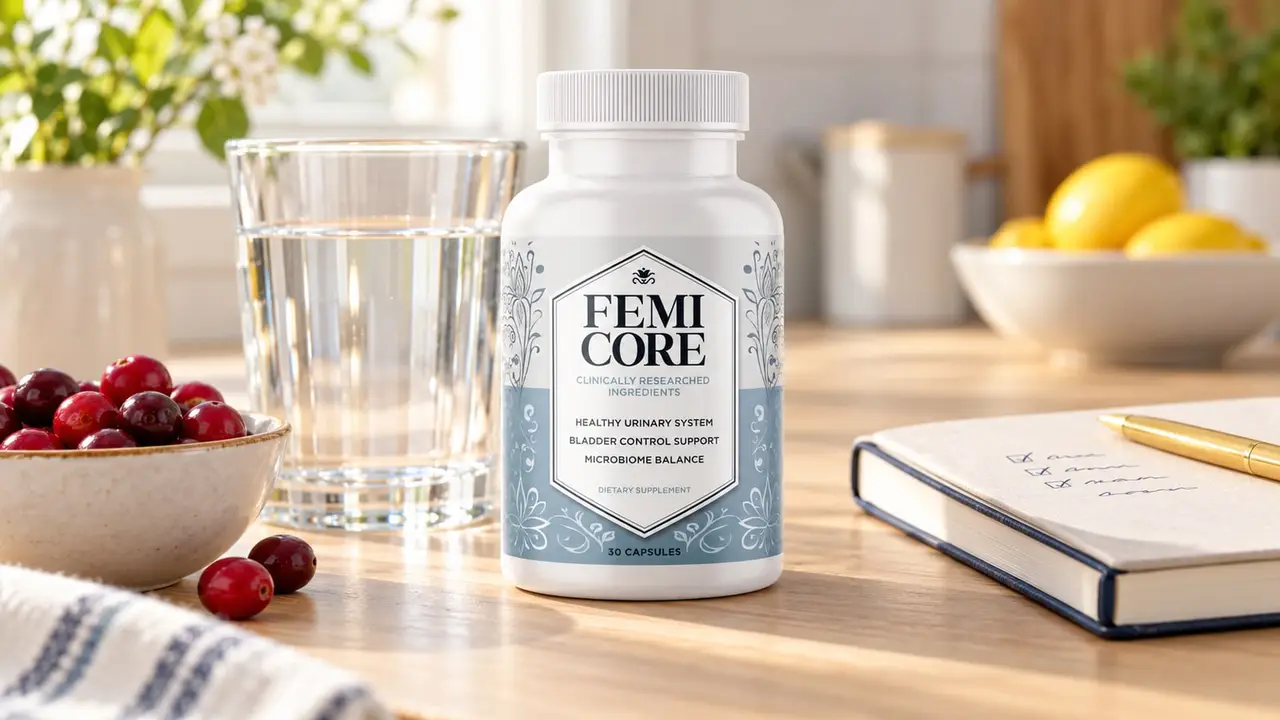
The official page describes FemiCore as a formula for a healthy urinary system, bladder control support and microbiome balance. It is aimed at women who deal with sudden urges, leaks when laughing or lifting, and repeated trips to the bathroom at night.
Those claims rest on one idea: the bladder has its own community of bacteria, and women with urgency symptoms tend to have fewer protective Lactobacillus bacteria. Researchers at Loyola University showed this association in 2014. FemiCore combines five Lactobacillus strains with four botanicals to support that community and keep the urinary tract clean.
The table below is the honest version of the benefit list.
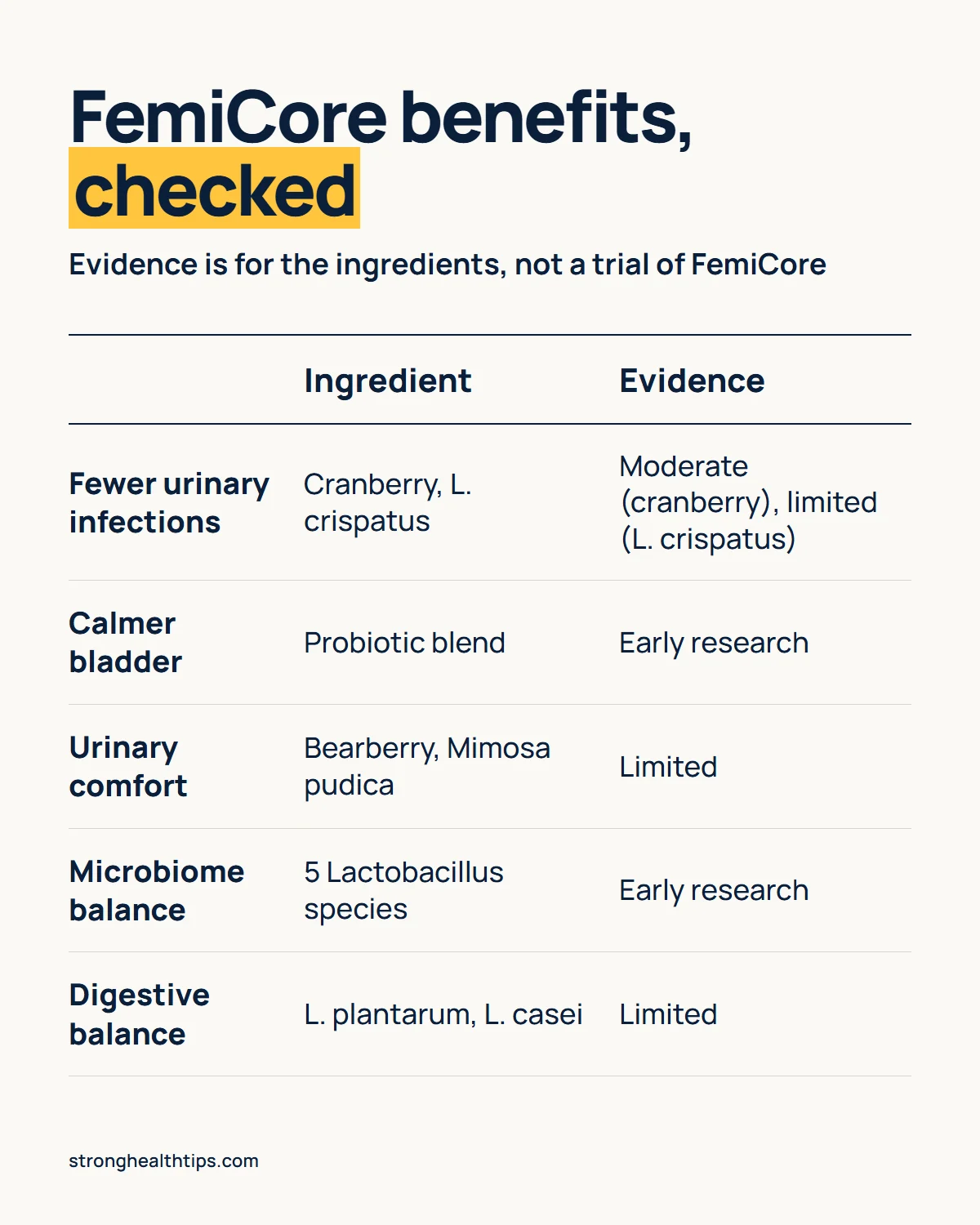
| Claimed benefit | Ingredient behind it | Evidence |
|---|---|---|
| Fewer urinary infections | Cranberry, L. crispatus | Moderate for cranberry, limited for L. crispatus |
| Calmer bladder, fewer urges | Probiotic blend | Early research |
| Urinary tract comfort | Bearberry, Mimosa Pudica | Limited, mostly traditional |
| Microbiome balance | 5 Lactobacillus strains | Early research |
| Digestive balance | L. plantarum, L. casei | Limited |
Benefit 1: Fewer urinary infections
This is where the evidence is strongest, and it is worth being precise about it.
Cranberry. The 2023 Cochrane review pooled 50 trials and found that cranberry products reduce the risk of repeat symptomatic urinary tract infections in women who get them often. The active compounds, proanthocyanidins, make it harder for E. coli to stick to the bladder wall.
Lactobacillus crispatus. A placebo-controlled trial published in 2011 gave women with recurrent infections an L. crispatus preparation. Those who received it had fewer recurrences, especially when the strain took hold.
Two caveats matter for FemiCore. The cranberry benefit depends on dose, and FemiCore does not disclose its doses, which keeps cranberry at “moderate”. The L. crispatus trial used a vaginal suppository rather than an oral capsule, which makes its evidence for an oral product limited. So the ingredient evidence is real, but the product has not been tested to show it delivers the same effect.
Benefit 2: A calmer bladder and fewer sudden urges
This is the benefit most women want, and it has the thinnest direct evidence.
The case is built on the urinary microbiome research. Women with urgency incontinence were less likely to have a bladder dominated by L. crispatus. If restoring that balance calms an over-reactive bladder, a probiotic blend could help. That is a reasonable hypothesis. It has not been proven in a trial measuring urges or leaks.
A practical point: urges also respond strongly to habits. Moving caffeine before noon, timing fluids and bladder training all reduce urgency, often within weeks. If you try FemiCore, do those things too, and keep a simple bladder diary so you can tell what is working.
Low-risk trial
Test the benefits for 60 days with a full money-back guarantee.
Return all bottles within 60 days of delivery if it does not help.
Check FemiCore official priceBenefit 3: Urinary tract comfort
Two of the botanicals target general urinary comfort.
Bearberry (uva ursi) has been used in European herbal medicine for centuries. Its leaf contains arbutin, which the body converts into a compound with mild antimicrobial activity in the urinary tract. The best modern trial, REGATTA, found it reduced antibiotic use in uncomplicated UTI symptoms but did not shorten symptoms as much as antibiotics did. Traditional guidance limits it to short courses.
Mimosa Pudica is a traditional Ayurvedic herb with laboratory evidence of anti-inflammatory activity. There are essentially no human trials for bladder symptoms.
That is why this benefit gets a “limited” label. These ingredients have a long history and some pharmacology, but little modern proof for daily comfort.
Benefit 4: A balanced urinary and vaginal microbiome
FemiCore includes five Lactobacillus strains: crispatus, acidophilus, plantarum, gasseri and casei. L. crispatus and L. gasseri are among the species commonly found in a healthy vaginal microbiome, and the urinary and vaginal communities overlap.
The benefit here is supportive rather than measurable for most people. A Lactobacillus-dominant environment is acidic and less friendly to unwanted bacteria. Whether an oral capsule shifts that balance reliably is still an open question, which is why the label is “early research”.
Benefit 5: Digestive balance
This one is easy to overlook. L. plantarum survives stomach acid well, and both L. plantarum and L. casei are well studied for gut health. Some women notice steadier digestion after a few weeks on a probiotic.
It matters for the bladder too, indirectly. Constipation presses on the bladder and worsens urgency. Anything that keeps digestion regular, including fibre from a balanced plate and a daily walk, takes some pressure off.
What FemiCore does not do
Being clear about limits is part of an honest benefit list.
- It is not a cure for incontinence. It is a dietary supplement. It is not intended to diagnose, treat, cure or prevent any disease.
- It is not a treatment for a urinary tract infection. Burning, pain or cloudy urine need a doctor and usually treatment.
- It does not replace pelvic floor training. For leaks when coughing, sneezing or lifting, pelvic floor exercises are the first-line, best-evidenced fix.
- It is not instant. Probiotic changes build over 8 to 12 weeks.
- It is not a reason to delay care. Blood in the urine, fever or pain need medical assessment.
How to tell whether you are getting the benefits
Benefits that build slowly are easy to over- or under-estimate. A simple routine keeps you honest.
- Keep a two-day bladder diary before you start. Note the time of each bathroom trip, any urges, any leaks and what you drank.
- Change one habit at a time where you can. If you start FemiCore and cut evening coffee the same day, you will not know which helped.
- Repeat the diary at week 6 and week 10. Compare the number of night-time trips, urgent moments and leaks.
- Set a reminder for day 50 after delivery. The 60-day guarantee runs from the day your order is delivered. If the diary shows no change, you still have time to return all bottles.
The same approach is covered in more depth in does FemiCore really work, which looks at who is most and least likely to benefit.
Best value
A full 12-week course costs $207 with the 3-bottle package.
Free US shipping. Six bottles drop the price to $49 each.
See all FemiCore packagesWho is most likely to notice the benefits
Based on where the ingredient evidence is strongest, these women have the most reasonable chance of noticing a difference:
- Women with a history of repeat urinary infections, where cranberry and L. crispatus have their best data.
- Women with urgency or frequent night-time trips who are also working on bladder training.
- Women after menopause, when Lactobacillus levels naturally fall.
Women with pure stress incontinence, where leaks happen only with coughing, sneezing or exercise, are less likely to see much change. The pelvic floor is the target there. Anyone taking medication for blood sugar, blood pressure or blood clotting should check with a pharmacist first, because berberine can interact with these. Our guide to FemiCore side effects covers this in detail.
The bottom line
So, what are the benefits of FemiCore? The most credible one is support against repeat urinary infections, mainly through cranberry, with limited support from L. crispatus. Calmer urges, fewer night trips and a balanced microbiome are plausible but rest on early research. Digestive balance is a possible side benefit, with limited evidence. None of it is a cure, and none of it has been tested in a trial of the capsule itself.
If those trade-offs work for you, a 60 to 90 day trial with a bladder diary and the guarantee as a safety net is a sensible way to find out. The FemiCore product page summarises the formula and packages on one screen.
Official website only
Try FemiCore with a 60-day money-back guarantee.
One-time purchase, no subscription. Free US shipping on 3 and 6 bottles.
Visit the official FemiCore websiteQuestions people ask
What are the main benefits of FemiCore?
The manufacturer positions FemiCore as support for bladder control, a healthy urinary tract and a balanced urinary microbiome. In practice the benefits women look for are fewer sudden urges, fewer night-time bathroom trips and fewer leaks. Those outcomes are plausible from the ingredients but have not been tested in a trial of the product itself.
Which FemiCore ingredient has the best evidence?
Cranberry has the strongest human evidence, from a 2023 Cochrane review showing fewer repeat urinary tract infections in susceptible women. Lactobacillus crispatus has a small placebo-controlled trial for recurrent infections, but it used a vaginal product, not an oral capsule. Both studies looked at infections rather than urgency or leaks.
Can FemiCore cure urinary incontinence?
No. FemiCore is a dietary supplement and is not intended to diagnose, treat, cure or prevent any disease. The best-evidenced approaches for incontinence are pelvic floor training and bladder training, and a supplement can at most support those habits.
How long before FemiCore benefits show?
Probiotic formulas work gradually. Fewer night-time trips is often the first change reported, typically after a few weeks. Changes in daytime urgency and leaks usually need 8 to 12 weeks of daily use, so one bottle is too short to judge.
Does FemiCore help with digestion too?
Possibly. Lactobacillus plantarum and Lactobacillus casei are well studied for gut health, so some women notice steadier digestion. That is a side benefit rather than the product's main purpose.
Can I take FemiCore for a urinary tract infection?
No. A suspected urinary tract infection needs medical assessment and usually treatment. Burning, pain, fever or blood in the urine are reasons to see a doctor, not to start a supplement.
Sources
- Williams G et al. (2023). Cranberries for preventing urinary tract infections. Cochrane Database of Systematic Reviews
- Stapleton AE et al. (2011). Lactobacillus crispatus probiotic for prevention of recurrent urinary tract infection. Clinical Infectious Diseases
- Pearce MM et al. (2014). The female urinary microbiome in women with and without urgency urinary incontinence. mBio
- Afshar K et al. (2018). Uva-ursi for uncomplicated urinary tract infection (REGATTA trial). BJGP
- NHS: Urinary incontinence
Not medical advice. This guide is general information and does not replace a consultation with a qualified healthcare professional who knows your history. Full disclaimer.
Written by
Strong Health Tips Editorial Team
We research, write and fact-check every guide against current guidance from major health bodies and peer-reviewed studies, then rewrite it in plain English. How we work.