FemiCore Reviews: Does This Bladder Control Supplement Work for Women?
FemiCore reviews from a practical angle: what the 9-ingredient probiotic bladder formula does, what research says, honest cons, exact pricing and the habits that help.
- Author
- Strong Health Tips Editorial Team
- Published
- Reading time
- 20 min read
Affiliate disclosure: this review contains links to the official FemiCore website. If you buy through them we may earn a commission at no extra cost to you. It does not change our assessment. Details.
Most FemiCore reviews online are either a sales page in disguise or a one-line “scam or legit?” verdict. Neither is much use if you are a woman who has started planning errands around bathrooms and wants to know, plainly, whether a probiotic capsule can help. This review takes a different angle. Strong Health Tips is a daily-habits site, so we look at FemiCore the way we look at anything: what does it claim, what does the research say about each ingredient, what does it cost, and where does it fit next to the free habits that are proven to improve bladder control?
The short version: the science behind FemiCore’s idea is real and more interesting than most supplement marketing. The product itself has not been through a clinical trial, it hides its doses in a proprietary blend, and it is not a substitute for pelvic-floor work. With those caveats, it is a reasonable, low-risk thing to try for 60 to 90 days if urgency and leaks are wearing you down, especially with a money-back guarantee behind it.
Why bladder control gets worse, and why it is rarely discussed
According to the National Institute of Diabetes and Digestive and Kidney Diseases, urinary incontinence affects women about twice as often as men, and the likelihood rises with pregnancy, childbirth, menopause and age. Population surveys consistently put the figure somewhere between a quarter and a half of women over 40, depending on how it is defined. It is one of the most common health problems women have and one of the least talked about, partly because it feels embarrassing and partly because many women assume it is simply part of getting older.
There are two main patterns, and they matter for deciding what might help:
- Stress incontinence: leaks when you laugh, cough, sneeze, run or lift. This is mostly a pelvic-floor and support problem, and the best-evidenced fix is pelvic-floor muscle training.
- Urgency (or “overactive bladder”): a sudden, strong need to go, sometimes with leaks before you reach the toilet, and often several trips in the night. This is a signalling problem, where the bladder sends “empty now” messages too early and too loudly.
Many women have a mix of both. FemiCore is aimed squarely at the second pattern, urgency, and at the idea that part of what drives it is what is living inside the bladder.
What FemiCore is
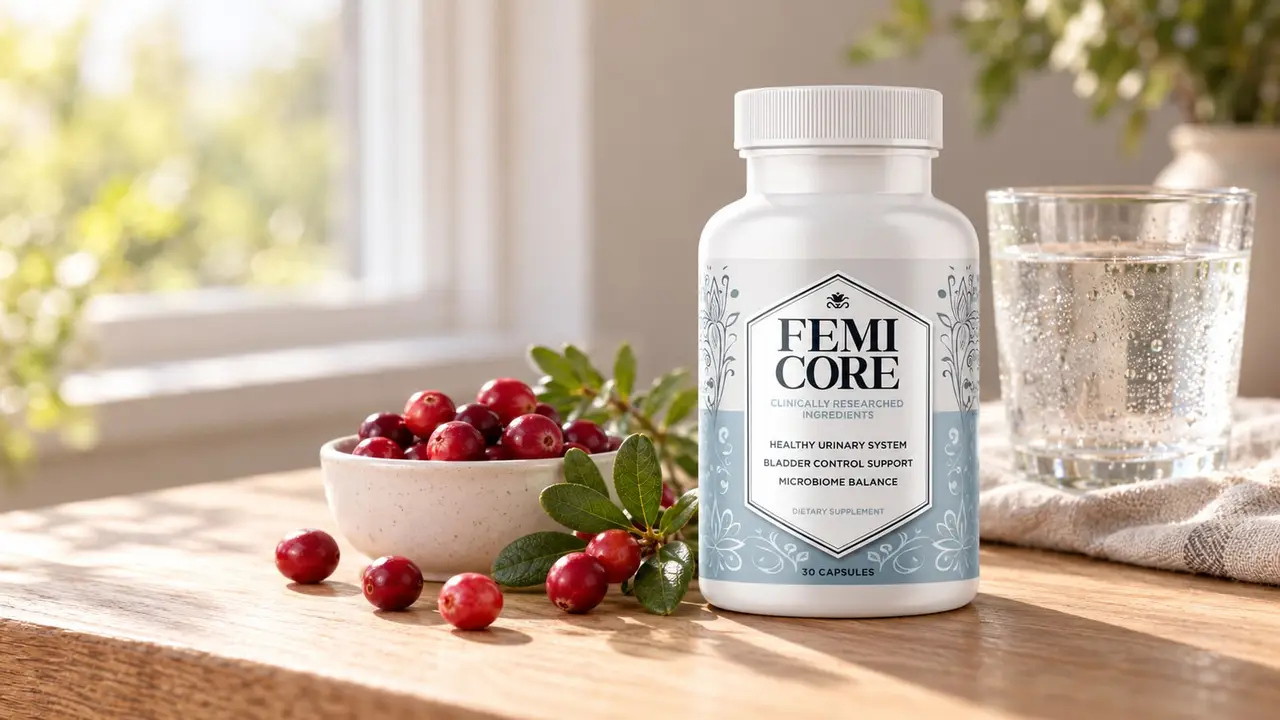
FemiCore is a dietary supplement sold as a once-daily capsule, 30 capsules per bottle, taken each morning with a large glass of water. It is marketed to women with bladder leaks, urgency and night-time trips, and it is sold only through its official website with orders processed by the retailer BuyGoods.
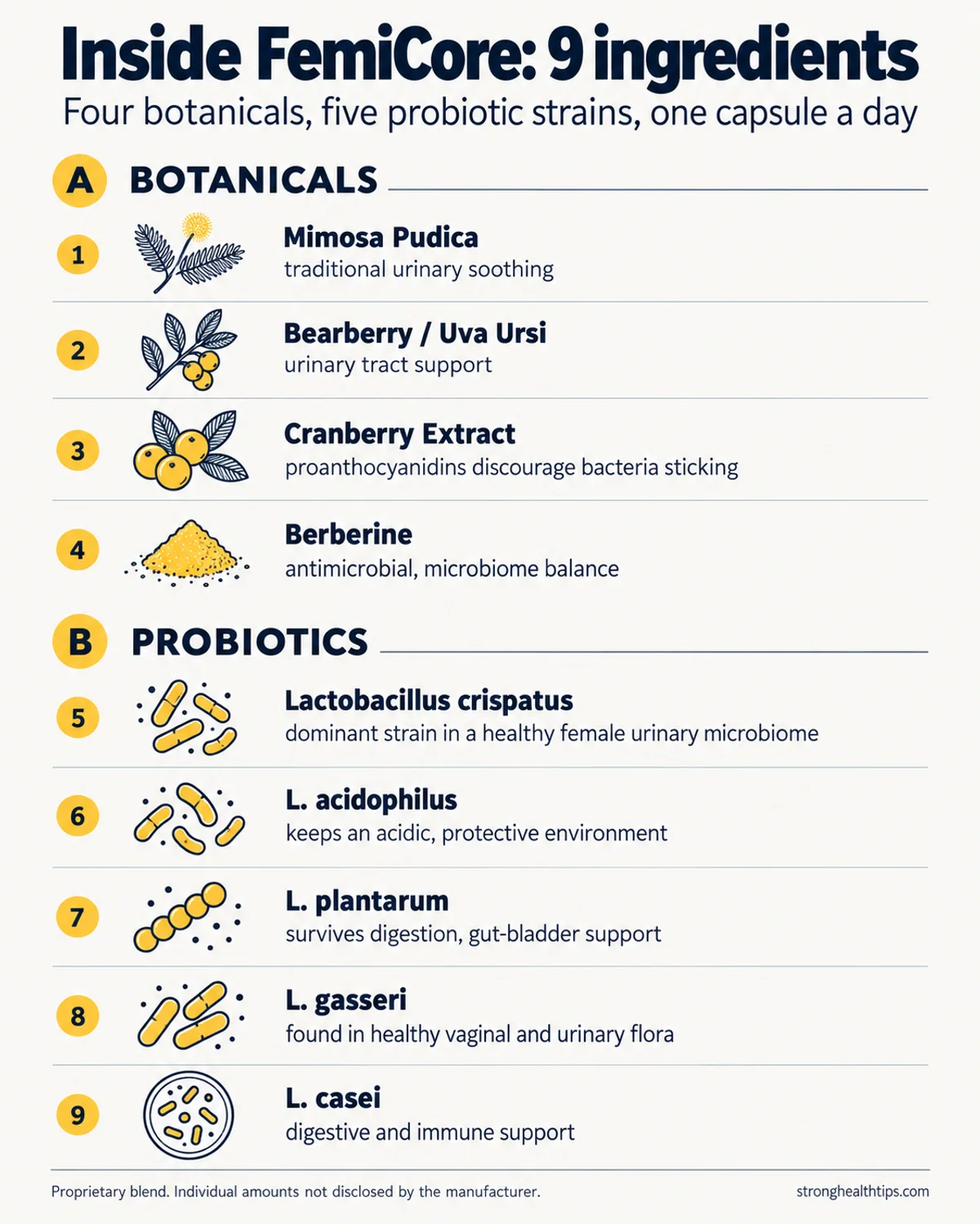
The label lists nine ingredients in a proprietary blend:
| # | Ingredient | Type | What it is included for |
|---|---|---|---|
| 1 | Mimosa Pudica | Botanical | Traditional urinary soothing herb |
| 2 | Bearberry (Uva Ursi) | Botanical | Traditional urinary tract support |
| 3 | Cranberry Extract | Botanical | Proanthocyanidins that discourage bacterial adhesion |
| 4 | Granular Berberine | Botanical alkaloid | Antimicrobial and microbiome-balancing effects |
| 5 | Lactobacillus crispatus | Probiotic | Dominant species in a healthy female urogenital microbiome |
| 6 | Lactobacillus acidophilus | Probiotic | Maintains an acidic, protective environment |
| 7 | Lactobacillus plantarum | Probiotic | Resilient strain, gut-bladder support |
| 8 | Lactobacillus gasseri | Probiotic | Common in healthy vaginal and urinary flora |
| 9 | Lactobacillus casei | Probiotic | Digestive and immune support |
The manufacturer describes the formula as non-GMO, stimulant-free and produced in a GMP-certified, FDA-registered facility in the USA. Note the wording: FDA-registered facility is a statement about the factory, not an FDA approval of the product. No dietary supplement is “FDA approved”, and any page that says FemiCore is should be treated with suspicion.
The idea behind it: your bladder has a microbiome
For most of the twentieth century, medical textbooks said urine was sterile. That turned out to be wrong. In 2012, a team at Loyola University used DNA sequencing on urine collected directly from the bladder and found a community of bacteria that standard lab cultures had been missing entirely (Wolfe et al., Journal of Clinical Microbiology). The bladder, like the gut, has a microbiome.
The next question was whether that microbiome differs in women with bladder symptoms. In 2014, the same group compared women with urgency urinary incontinence to women without it (Pearce et al., mBio). The women with urgency had a more diverse mix of bacteria and were less likely to have a microbiome dominated by Lactobacillus crispatus, which was the typical pattern in symptom-free women. The researchers were careful: this is an association, not proof that low Lactobacillus causes urgency. But it opened the door to the idea that restoring protective bacteria might matter.
That is the premise FemiCore is built on. It is a legitimate, peer-reviewed line of research. What FemiCore has not done is run its own trial showing that this specific nine-ingredient capsule changes the bladder microbiome or reduces leaks. Everything below is therefore an ingredient-by-ingredient assessment, not a product trial.
FemiCore ingredients: what the evidence actually says
Lactobacillus crispatus: the strain with the strongest data
This is the ingredient that makes FemiCore more interesting than the average cranberry pill. L. crispatus is the species most associated with a healthy, symptom-free female urogenital microbiome, and it has been tested in a proper trial. Stapleton and colleagues ran a randomised, placebo-controlled phase 2 study in women with recurrent urinary tract infections (Clinical Infectious Diseases, 2011). Women who received an L. crispatus preparation had fewer recurrences over the follow-up period than those on placebo, and the effect was strongest in women whose urogenital tract became colonised with the strain.
Two honest caveats. First, that study used a vaginal suppository, not an oral capsule, and the dose was known. Oral Lactobacillus can reach the urogenital tract via the gut, but less reliably. Second, the trial was about infection recurrence, not urgency or leaks. The link from “more L. crispatus” to “fewer sudden urges” is plausible from the Loyola data but has not been proven directly.
The other four Lactobacillus strains
L. acidophilus, L. plantarum, L. gasseri and L. casei are all well-studied, generally safe strains with a long history in food and supplements. L. gasseri is one of the species commonly found in a healthy vaginal microbiome. L. plantarum is notable for surviving stomach acid well, which matters for an oral product. Their contribution here is supportive: a broader base of beneficial bacteria, better gut health, and an acidic environment that unwanted bacteria dislike. None of them has specific bladder-control evidence on its own.
Cranberry extract
Cranberry is the most researched urinary botanical, and it has had a bumpy ride in the evidence. For years the consensus was “probably not much use”. Then the 2023 Cochrane review, which pooled 50 trials with more than 8,800 participants, concluded that cranberry products do reduce the risk of symptomatic urinary tract infections in women with recurrent infections, in children, and in people susceptible after procedures (Williams et al., Cochrane Database of Systematic Reviews). The proposed mechanism is proanthocyanidins, compounds that make it harder for E. coli to stick to the bladder wall.
Again, that is infection prevention rather than urgency. But bladder irritation from low-grade bacterial activity is one plausible contributor to urgency, so a cleaner bladder lining is a sensible thing to aim for. The limitation is dose: Cochrane notes that benefits were clearer with adequately dosed products, and FemiCore does not disclose how much cranberry extract is in each capsule.
Bearberry (Uva Ursi)
Bearberry leaf contains arbutin, which the body converts into a compound with mild antimicrobial activity in the urinary tract. It has been used in European herbal medicine for centuries and is approved in Germany for short-term use in mild urinary tract inflammation. The best modern trial, the REGATTA study published in the British Journal of General Practice in 2018, tested uva ursi as an alternative to immediate antibiotics in women with uncomplicated UTI symptoms. Uva ursi reduced antibiotic use but did not shorten symptoms as much as antibiotics did, and there was a slightly higher rate of complications. The takeaway: it is a real urinary herb with real activity, but it is not a replacement for treatment when you have an actual infection, and traditional guidance limits continuous use.
Berberine
Berberine is a yellow alkaloid from plants such as barberry and goldenseal. Most of its research is in blood sugar and cholesterol, where it performs surprisingly well in trials (Cicero and Baggioni, 2016). It also has broad antimicrobial activity and affects the composition of the gut microbiome, which is presumably why it is included here. There is no trial of berberine for bladder control. The important practical point is safety: berberine lowers blood glucose and inhibits liver enzymes (CYP2D6, CYP3A4) that metabolise a long list of common drugs. If you take any regular medication, this is the ingredient to ask your pharmacist about.
Mimosa Pudica
The “sensitive plant” is used in Ayurvedic and traditional medicine for a range of complaints, including urinary ones. It has laboratory evidence of anti-inflammatory and antimicrobial activity but essentially no human trials for bladder symptoms. Treat it as a traditional inclusion rather than an evidence-based one.
The verdict on ingredients
Two ingredients (cranberry and L. crispatus) have solid human research for urinary health, one (bearberry) has decent trial data for a related purpose, one (berberine) is well-researched for other things, and the rest are supportive or traditional. That is a better evidence profile than most bladder supplements. The gap is that none of it is specific to urgency and leaks, and the proprietary blend means you cannot check whether the doses match the studies.
How FemiCore is supposed to work, week by week
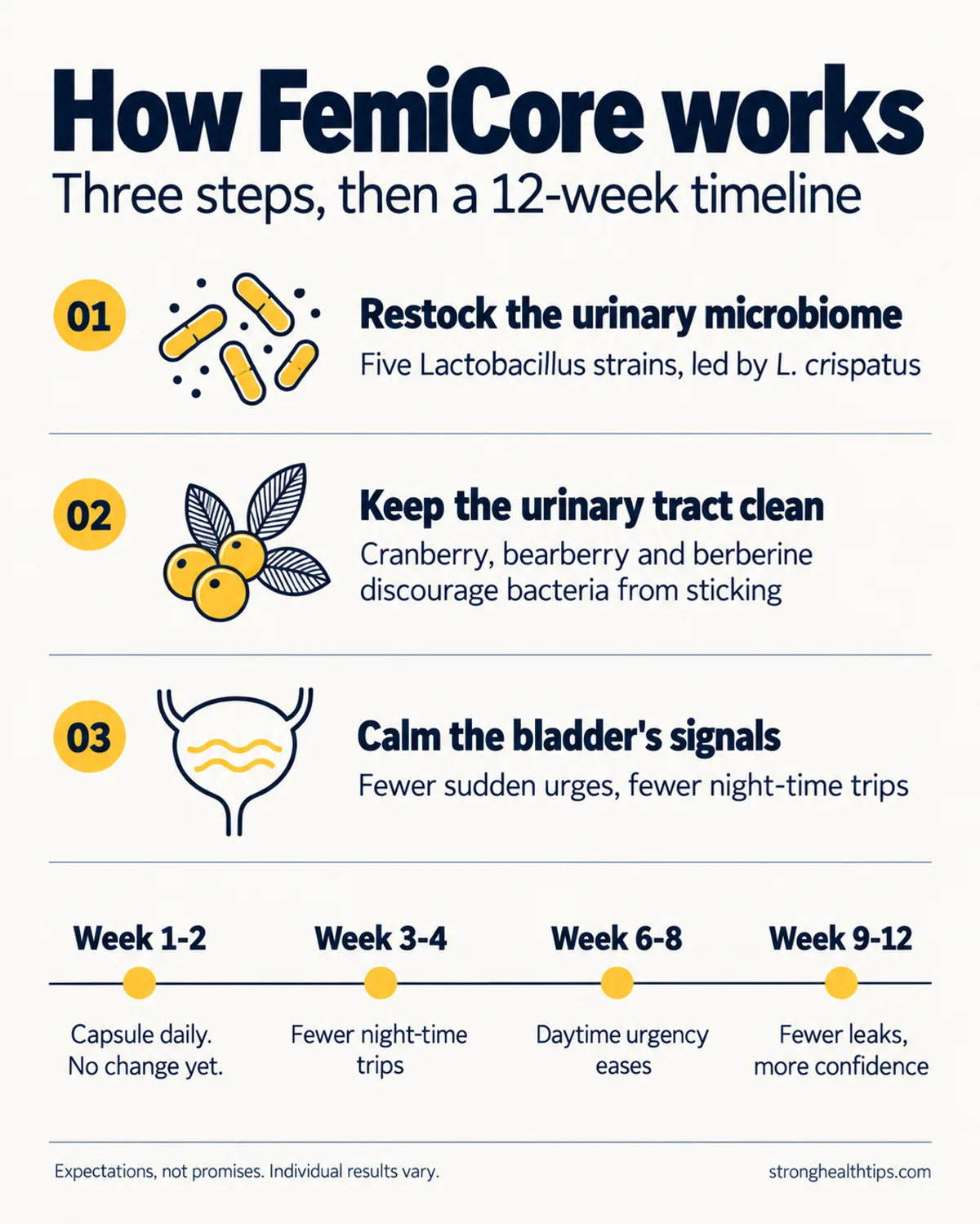
The manufacturer’s explanation runs in three steps: restock the urinary microbiome with Lactobacillus, keep the urinary tract clean with cranberry, bearberry and berberine, and as a result calm the bladder’s over-eager signalling. Customer reports and the maker’s own guidance suggest a rough timeline, which we would frame as expectations rather than promises:
| Period | What women commonly report |
|---|---|
| Week 1 to 2 | Little change in bladder symptoms; some mild digestive adjustment as the probiotics settle |
| Week 3 to 4 | Fewer night-time bathroom trips is often the first thing noticed |
| Week 6 to 8 | Daytime urgency starts to feel less sharp; fewer “drop everything” moments |
| Week 9 to 12 | Fewer leaks, more confidence on longer outings; the maker recommends continuing beyond this point |
Two things to understand about this timeline. First, microbiome changes are slow, which is why a single bottle is a poor test and why the company pushes three- and six-bottle packages. Second, urgency symptoms fluctuate naturally with hydration, caffeine, stress and sleep. If you start FemiCore and also cut your evening coffee, improve your sleep and begin bladder training, you will not know which change did the work. From a practical standpoint, that may not matter; from a “does the capsule work” standpoint, it does.
The habits that do most of the work (with or without FemiCore)
This is where a tips site earns its keep. The interventions below are first-line in NHS and American Urological Association guidance, they are free, and they are what we would want any reader to do regardless of whether they buy a supplement.
1. Bladder training
Urgency is partly a learned reflex: the bladder signals, you rush, and the brain learns that every signal is an emergency. Bladder training reverses that. When an urge hits, stop, stand still or sit, do a few quick pelvic-floor squeezes, breathe slowly, and wait one minute before walking calmly to the bathroom. Over two to three weeks, extend the wait to five minutes, then ten. Alongside this, go to the toilet on a schedule (every two to three hours) rather than “just in case”. Most guidelines consider this the single most effective non-drug approach for urgency.
2. Pelvic-floor muscle training
For stress leaks, nothing beats it. Squeeze the muscles you would use to stop urine mid-stream (but do not practise on the toilet), hold for up to ten seconds, relax for ten, and repeat ten times, three sets a day. Add some quick one-second squeezes. It takes three to six months to see the full effect. If you are not sure you are doing it right, one session with a pelvic-health physiotherapist is worth more than any supplement.
3. Fluid timing, not fluid restriction
Cutting fluids makes urine more concentrated, which irritates the bladder and makes urgency worse. Aim for roughly 1.5 to 2 litres across the day, front-loaded: most of it before mid-afternoon, tapering after dinner, and a last glass about two hours before bed. For night-time trips specifically, this and the caffeine rule below often help more than anything else.
4. Caffeine, alcohol and bladder irritants
Caffeine is a diuretic and a bladder stimulant. Many women find that moving the last coffee or tea to before noon noticeably reduces urgency. Alcohol does the same, and fizzy drinks, artificial sweeteners and very acidic juices irritate some bladders. Try removing one at a time for two weeks to see which, if any, matter for you.
5. Sleep and stress
Poor sleep lowers the threshold at which the bladder’s signals reach your attention and raises overnight urine production. If night-time trips are your main complaint, our guide to sleep hygiene habits is a better first stop than any capsule. Stress does something similar through the nervous system; the slow-breathing techniques in our daily stress guide are the same ones pelvic-health physios teach for calming an urge.
6. Weight, constipation and movement
Extra abdominal weight presses on the bladder; losing even five to ten percent of body weight measurably reduces leaks in trials. Constipation does the same from behind. A daily walk helps with both and strengthens the pelvic floor indirectly. A balanced plate with plenty of fibre keeps things moving.
A simple 12-week plan that combines both
If you want a concrete routine rather than a list of principles, this is the one we would follow. It costs nothing beyond the supplement, and the first four items are worth doing even if you never buy a capsule.
| Weeks | Habits | FemiCore |
|---|---|---|
| 1 to 2 | Keep a two-day bladder diary (times, volumes, urges, leaks, drinks). Move all caffeine before noon. Start pelvic-floor sets, three times daily. | One capsule each morning with a full glass of water. Expect no bladder change yet. |
| 3 to 4 | Begin bladder training: hold each urge for one minute, then walk calmly. Toilet on a two-hour schedule. Last drink two hours before bed. | Continue daily. Note any change in night-time trips in the diary. |
| 5 to 8 | Extend urge holds to five minutes, schedule to three hours. Add a daily 20-minute walk. Review the diary against week one. | Continue daily. This is the window where daytime urgency usually starts to ease, if it is going to. |
| 9 to 12 | Extend holds to ten minutes. Keep pelvic-floor work going; it takes three months to peak. | Continue daily. Compare the diary with week one and decide, honestly, whether the capsule is earning its place. |
The bladder diary is the part most people skip and the part that matters most. Urgency symptoms drift up and down week to week, and memory is a poor judge of whether something is working. Two pages of notes at the start and again at week twelve will tell you more than any review, including this one. If the diary shows a clear improvement, keep doing whatever you are doing. If it shows nothing after twelve weeks of consistent habits and capsules, the guarantee window has passed, which is one more argument for starting the habits two to four weeks before the supplement rather than at the same time.
Where FemiCore fits
Think of the habits above as the structure and FemiCore as a possible add-on to the plumbing. If you have done the habits for a couple of months and urgency is still a problem, or if you want to work on everything at once with a guarantee covering the supplement, that is a reasonable place for it. If you have done none of the habits, start there first; you may find you do not need anything else.
Side effects and who should not take FemiCore
FemiCore has a good safety profile on paper. Its ingredients are widely used, it contains no stimulants, and most users report nothing more than mild bloating in the first week, which is normal when starting a probiotic.
Specific cautions:
- Berberine and medication. Berberine can lower blood sugar and interacts with drugs metabolised by CYP2D6 and CYP3A4, which includes some blood-pressure, cholesterol, antidepressant and blood-thinning medications. If you take any regular prescription, ask a pharmacist before starting.
- Bearberry. Traditional guidance limits uva ursi to short courses, and it is not recommended in kidney disease. FemiCore is designed for daily use over months; without the dose, we cannot say how this squares with that guidance. Another reason to involve a pharmacist if you have kidney concerns.
- Pregnancy and breastfeeding. Not recommended, mainly because of berberine and bearberry.
- Under 18. Not intended for use.
- Symptoms that need a doctor, not a supplement. Blood in the urine, pain or burning, fever, sudden new incontinence, incontinence after pelvic surgery, or leaks accompanied by numbness in the legs or saddle area. These need medical assessment. A supplement is not the answer to a urinary tract infection either; if you suspect one, get it treated.
Honest pros and cons
What we like
- The underlying science (the urinary microbiome and the role of L. crispatus) is real and peer-reviewed, not invented for the sales page.
- Cranberry and L. crispatus have human trial evidence for urinary health; bearberry and berberine have genuine pharmacological activity.
- Once a day, no stimulants, generally well tolerated.
- A 60-day money-back guarantee that is clearly stated and covers all packages.
- One-time purchase with no automatic rebilling.
What we do not like
- Proprietary blend. The single biggest issue. Without per-ingredient doses, you cannot tell whether the cranberry or probiotic amounts match the studies, or whether the bearberry dose is appropriate for long-term daily use.
- No product-specific trial. All evidence is for ingredients, mostly for infection prevention rather than urgency and leaks.
- Marketing tone. The official page uses the language of “breakthrough” and “toxins”, quotes a 19,263-review figure without showing reviews, and leans on scarcity. None of that affects whether the capsule works, but it is worth seeing clearly.
- Oral delivery of urogenital strains is less direct than the vaginal route used in the best L. crispatus trial.
- Only sold online through the official site, so no in-store comparison and the refund requires posting bottles back.
FemiCore pricing: exactly what it costs
Prices below are from the official website at the time of writing. They can change, and only the official site is authoritative.
| Package | Per bottle | Total | Shipping | Supply | Extras |
|---|---|---|---|---|---|
| 2 bottles | $79 | $158 | $9.99 | 60 days | 60-day guarantee |
| 3 bottles | $69 | $207 | Free (US) | 90 days | 60-day guarantee |
| 6 bottles | $49 | $294 | Free (US) | 180 days | 60-day guarantee + 3 bonus guides |
The three bonus guides with the 6-bottle package are digital downloads: “7 Days to Rekindle the Passion in Your Marriage” (listed at $199), “Reset Your Gut: Perfect Digestion While Eating Your Favorite Foods” ($397) and “Unlock Painless Hips & Legs: The Complete Lower Body Mobility Blueprint” ($197). The listed values are the seller’s; treat them as marketing. The gut and mobility guides are at least on-topic.
International shipping: US orders on the 3- and 6-bottle packages are free with 5 to 7 working days delivery. Canada, the UK, Ireland, Australia and New Zealand are $15.95 with 10 to 15 working days.
Which package makes sense? If you are going to try it at all, the 2-bottle package is the floor, because one month is not long enough to judge a probiotic. The 3-bottle package covers the 12-week window the timeline above is built on. The 6-bottle package is the cheapest per bottle by a wide margin, but only worth it if you have already decided to use it for at least six months, or if you are confident you will use the guarantee if it does not help. Note that the guarantee window is 60 days from purchase, not from when you finish the bottles.
Official website only
FemiCore from $49 per bottle, 60-day money-back guarantee.
Free US shipping on 3 and 6 bottles. One-time purchase, no rebilling. The guarantee and bonuses apply only to orders placed through the official site.
The refund policy, in practice
Every package carries a 60-day, 100% money-back guarantee from the purchase date. To use it, contact FemiCore customer support within those 60 days (the details are in the order confirmation email), then return all bottles, empty or full, together with the packing slip. Once received, the purchase price is refunded to the original payment method. Shipping charges, where applied, may not be refunded, and you usually pay the return postage. Keep the packing slip; it is required.
Is FemiCore a scam?
No. “Scam” implies you pay and get nothing, or get something other than what was described. FemiCore is a real product with a real formula, shipped by an established retailer (BuyGoods) with a functioning refund process. The fair criticism is different: it is a supplement with plausible but unproven ingredients, sold with aggressive marketing and a proprietary blend that hides its doses. That makes it a “maybe helps, low risk” product, not a fraud.
Who FemiCore is for, and who should skip it
Worth trying if you:
- Are a woman with urgency, night-time trips or mixed leaks that are affecting daily life.
- Have already started bladder training and pelvic-floor work, or will start them alongside.
- Have had recurrent urinary tract infections in the past, where cranberry and L. crispatus have their best evidence.
- Can commit to a 60- to 90-day course and will use the guarantee if nothing changes.
Skip it or ask your doctor first if you:
- Take medication for diabetes, blood pressure, cholesterol or blood clotting (berberine interaction).
- Have kidney disease (bearberry caution).
- Are pregnant, breastfeeding or under 18.
- Have pain, blood in urine, fever or sudden new symptoms, which need investigation, not a supplement.
- Have pure stress incontinence (leaks only with coughing, sneezing or exercise). The pelvic floor is the target there, and a physiotherapist will help far more.
Our rating
| Area | Score (out of 5) | Why |
|---|---|---|
| Scientific rationale | 4.5 | The urinary microbiome research is genuine and the probiotic choice is sensible |
| Ingredient evidence | 3.5 | Strong for cranberry and L. crispatus, thin for the rest, none specific to urgency |
| Transparency | 2.5 | Proprietary blend, no doses, no product trial, no visible reviews |
| Safety | 4 | Well-tolerated ingredients; berberine and bearberry need medication checks |
| Value | 4 | Fair at $49 per bottle; expensive at $79 plus shipping |
| Guarantee | 4.5 | 60 days, clearly stated, covers every package |
| Overall | 4.2 | A reasonable, low-risk trial for urgency, not a replacement for the habits that work |
Final word
FemiCore reviews tend to swing between hype and dismissal. The honest position is in the middle. The product is built on a real scientific idea, uses ingredients with genuine (if indirect) evidence, and is protected by a straightforward guarantee. It is held back by a proprietary blend and by the absence of any trial of the actual capsule.
If you take one thing from this review, make it this: start bladder training, pelvic-floor exercises, fluid timing and a caffeine cut-off this week, because those are proven and free. If after a couple of months you want to add something, FemiCore is a defensible choice for a 90-day trial, bought from the official site so the guarantee applies, and cleared with a pharmacist if you take any regular medication.
Questions people ask
What is FemiCore and who is it for?
FemiCore is a dietary supplement for women who deal with sudden urges, leaks when laughing or lifting, and repeated night-time bathroom trips. It is a once-a-day capsule containing five Lactobacillus probiotic strains plus Mimosa Pudica, Bearberry (Uva Ursi), Cranberry Extract and Berberine. It is aimed at adult women, particularly after 40 and after menopause, when bladder symptoms become more common.
How does FemiCore work?
FemiCore's approach is to support the urinary microbiome. Research shows the bladder is not sterile and that women with urgency symptoms tend to have fewer protective Lactobacillus bacteria. The probiotic strains are intended to restock those bacteria, while cranberry, bearberry and berberine help keep the urinary tract clean and discourage unwanted bacteria from sticking to its lining. The combined effect is meant to be a calmer bladder with fewer sudden signals.
How long does FemiCore take to work?
Probiotic effects build gradually. Based on the manufacturer's guidance and customer reports, fewer night-time trips are often the first change, typically within two to four weeks. Changes to daytime urgency and leaks usually take 8 to 12 weeks of daily use, which is why the maker recommends a three-month course at minimum.
Does FemiCore have side effects?
Most users report none. Mild bloating or a change in digestion during the first week is common with any probiotic and usually settles. Berberine can lower blood sugar and interacts with liver enzymes that process many medications, so women taking diabetes, blood-pressure, cholesterol or blood-thinning drugs should speak to a pharmacist or doctor first. It is not recommended during pregnancy or breastfeeding.
How much does FemiCore cost?
On the official website: 2 bottles cost $79 each plus $9.99 shipping ($158 plus shipping), 3 bottles cost $69 each with free US shipping ($207), and 6 bottles cost $49 each with free US shipping ($294) plus three digital bonus guides. Each bottle has 30 capsules, a one-month supply.
What is FemiCore's refund policy?
Every package carries a 60-day, 100% money-back guarantee from the purchase date. To claim it you contact customer support within 60 days and return all bottles, empty or full, with the packing slip. The purchase price is refunded to your original payment method; shipping fees may not be refunded.
Where can I buy FemiCore?
FemiCore is only sold through its official website, with orders processed by the retailer BuyGoods. It is not stocked on Amazon, Walmart, eBay or in pharmacies, and products listed there under the name are not covered by the guarantee.
Can FemiCore replace pelvic-floor exercises or medical treatment?
No. Pelvic-floor training is the first-line, best-evidenced treatment for stress incontinence, and bladder training is first-line for urgency. FemiCore is a supplement that may support the urinary microbiome alongside those habits. Anyone with blood in the urine, pain, fever, sudden new incontinence or symptoms after surgery should see a doctor rather than self-treat.
Sources
- Wolfe AJ et al. (2012). Evidence of uncultivated bacteria in the adult female bladder. Journal of Clinical Microbiology
- Pearce MM et al. (2014). The female urinary microbiome: a comparison of women with and without urgency urinary incontinence. mBio
- Stapleton AE et al. (2011). Randomized, placebo-controlled phase 2 trial of a Lactobacillus crispatus probiotic for prevention of recurrent urinary tract infection. Clinical Infectious Diseases
- Williams G et al. (2023). Cranberries for preventing urinary tract infections. Cochrane Database of Systematic Reviews
- Afshar K et al. (2018). Reducing antibiotic use for uncomplicated urinary tract infection in general practice by treatment with uva-ursi (REGATTA): a randomised controlled trial. BJGP
- Cicero AFG, Baggioni A (2016). Berberine and its role in chronic disease. Advances in Experimental Medicine and Biology
- NIDDK: Bladder control problems (urinary incontinence) in women
- NHS: Urinary incontinence
Not medical advice. This guide is general information and does not replace a consultation with a qualified healthcare professional who knows your history. Full disclaimer.
Written by
Strong Health Tips Editorial Team
We research, write and fact-check every guide against current guidance from major health bodies and peer-reviewed studies, then rewrite it in plain English. How we work.