FemiCore Ingredients List: All 9 Explained, and What the Label Leaves Out
The full FemiCore ingredients list: 4 botanicals and 5 probiotics, what each one does, what the research says and what the proprietary label does not disclose.
- Author
- Strong Health Tips Editorial Team
- Published
- Reading time
- 9 min read
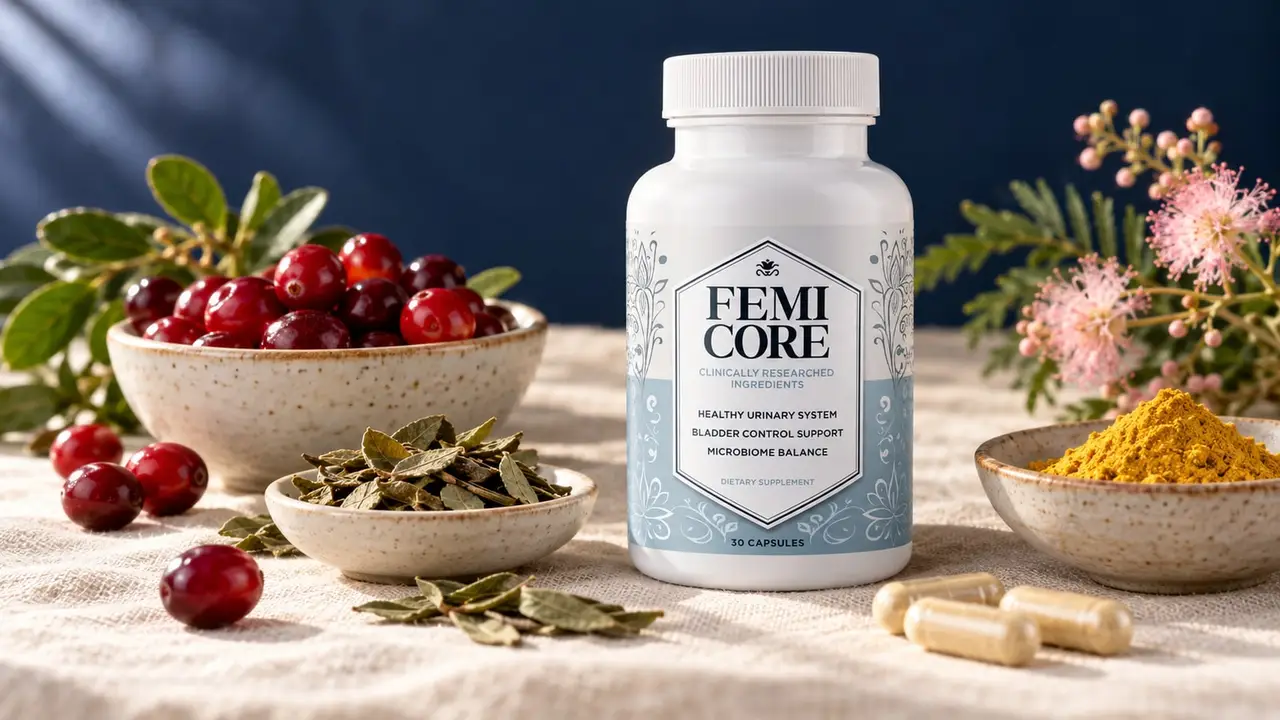
Affiliate disclosure: this review contains links to the official FemiCore website. If you buy through them we may earn a commission at no extra cost to you. It does not change our assessment. Details.
Before you put any supplement in your body, it is worth knowing exactly what is inside it. This guide goes through the FemiCore ingredients list one item at a time: what each ingredient is, why it shows up in a formula aimed at bladder urgency and leaks, how much human research stands behind it, and, just as important, what the label does not tell you.
FemiCore is a once-daily capsule with nine ingredients. Four are plant-based and five are probiotic bacteria. You will not find any vitamins, minerals, caffeine or fillers named on the sales page. That makes the list short enough to understand properly in one sitting.
The FemiCore ingredients list at a glance
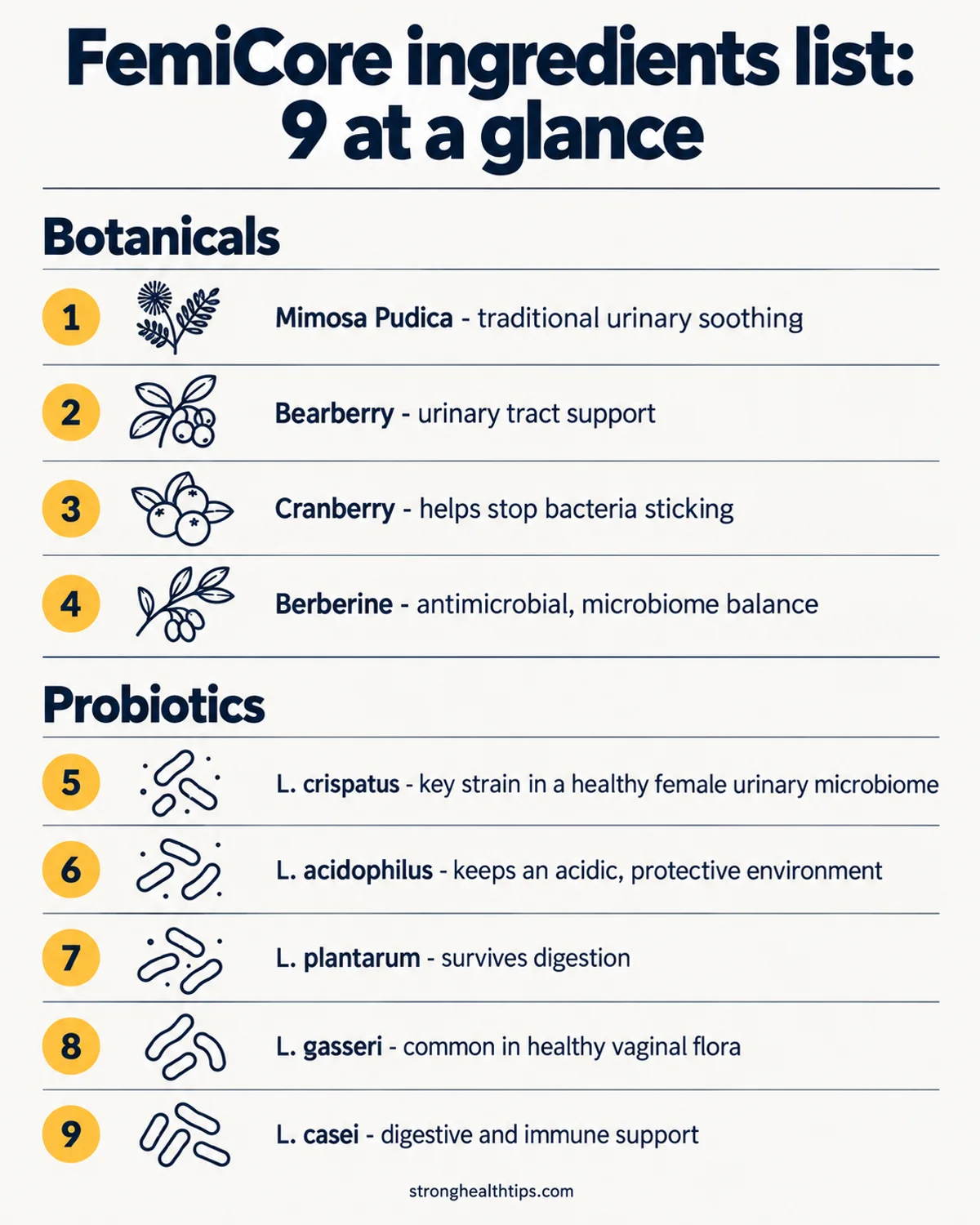
| # | Ingredient | Group | Its job in the formula |
|---|---|---|---|
| 1 | Mimosa Pudica | Botanical | Traditional soothing herb for the urinary tract |
| 2 | Bearberry (Uva Ursi) | Botanical | Long-used urinary herb with mild antimicrobial activity |
| 3 | Cranberry Extract | Botanical | Proanthocyanidins that make it harder for bacteria to stick |
| 4 | Granular Berberine | Botanical | Plant compound with antimicrobial and microbiome effects |
| 5 | Lactobacillus crispatus | Probiotic | Main protective species in a healthy female urinary tract |
| 6 | Lactobacillus acidophilus | Probiotic | Helps keep conditions acidic and unfriendly to unwanted bacteria |
| 7 | Lactobacillus plantarum | Probiotic | Hardy strain that survives digestion well |
| 8 | Lactobacillus gasseri | Probiotic | Common in healthy vaginal and urinary flora |
| 9 | Lactobacillus casei | Probiotic | Supports digestive and immune balance |
The logic behind the mix is simple. The probiotics are there to restock the “good” bacteria that research links to a calmer bladder, and the botanicals are there to keep the urinary tract clean while that happens. Whether the doses are enough to do either job is a separate question we come back to below.
The four botanicals
Mimosa Pudica
Mimosa Pudica is the “sensitive plant” whose leaves fold up when touched. It appears in Ayurvedic and other traditional systems for a range of complaints, including urinary discomfort. Laboratory studies show anti-inflammatory and antimicrobial activity, but there are essentially no human trials for bladder symptoms. Treat it as a traditional inclusion rather than an evidence-based one.
Bearberry (Uva Ursi)
Bearberry leaf contains arbutin, which the body converts into a compound with mild antimicrobial action in the urine. It has been used in European herbal medicine for generations. The most useful modern study, the REGATTA trial in 2018, tested it in women with uncomplicated urinary infection symptoms. It reduced antibiotic use but did not clear symptoms as fast as antibiotics. Practical point: traditional guidance limits bearberry to short courses, and FemiCore is designed for daily use over months. Without a stated dose, that is worth raising with a pharmacist.
Cranberry Extract
Cranberry is the best-researched urinary botanical. A 2023 Cochrane review of 50 trials found that cranberry products reduce the risk of symptomatic urinary tract infections in women with recurrent infections, in children and in people after certain medical procedures. The active compounds are proanthocyanidins (PACs), which make it harder for E. coli to cling to the bladder wall. The benefit in trials depended on getting enough PACs, and FemiCore does not state its PAC content.
Granular Berberine
Berberine is a bright yellow compound found in plants such as barberry and goldenseal. Most of its research is in blood sugar and cholesterol, where results are genuinely interesting. It also has broad antimicrobial effects and shifts the make-up of gut bacteria, which is likely why it is in a microbiome-focused product. There is no human research on berberine for bladder control. It is also the ingredient on this list most likely to interact with prescription drugs.
See the label yourself
The full ingredient panel is shown on the official FemiCore page.
Check it against this list, then decide. Every order has a 60-day money-back guarantee.
View the FemiCore labelThe five probiotic strains
Lactobacillus crispatus
This is the most important name on the list. Research from Loyola University found that the bladder has its own community of bacteria, and that women without urgency symptoms were more likely to have a bladder microbiome dominated by L. crispatus. A separate randomised trial in 2011 gave women with recurrent urinary infections an L. crispatus preparation and saw fewer repeat infections than with placebo. Two caveats: that trial used a vaginal suppository rather than a swallowed capsule, and it measured infections, not urgency or leaks.
Lactobacillus acidophilus
One of the most widely used probiotic species in food and supplements. It produces lactic acid, which keeps the local environment acidic and less welcoming to unwanted bacteria. There is no bladder-specific research on it alone.
Lactobacillus plantarum
A tough strain known for surviving stomach acid and bile, which matters for a capsule you swallow. It is well studied for gut health and is likely included to help the overall probiotic dose arrive intact.
Lactobacillus gasseri
A species commonly found in a healthy vaginal microbiome. It is part of the same protective family as L. crispatus and adds breadth to the probiotic mix.
Lactobacillus casei
Common in fermented dairy products and studied mainly for digestive and immune support. Its role here is supportive rather than bladder-specific.
What the FemiCore label tells you, and what it does not
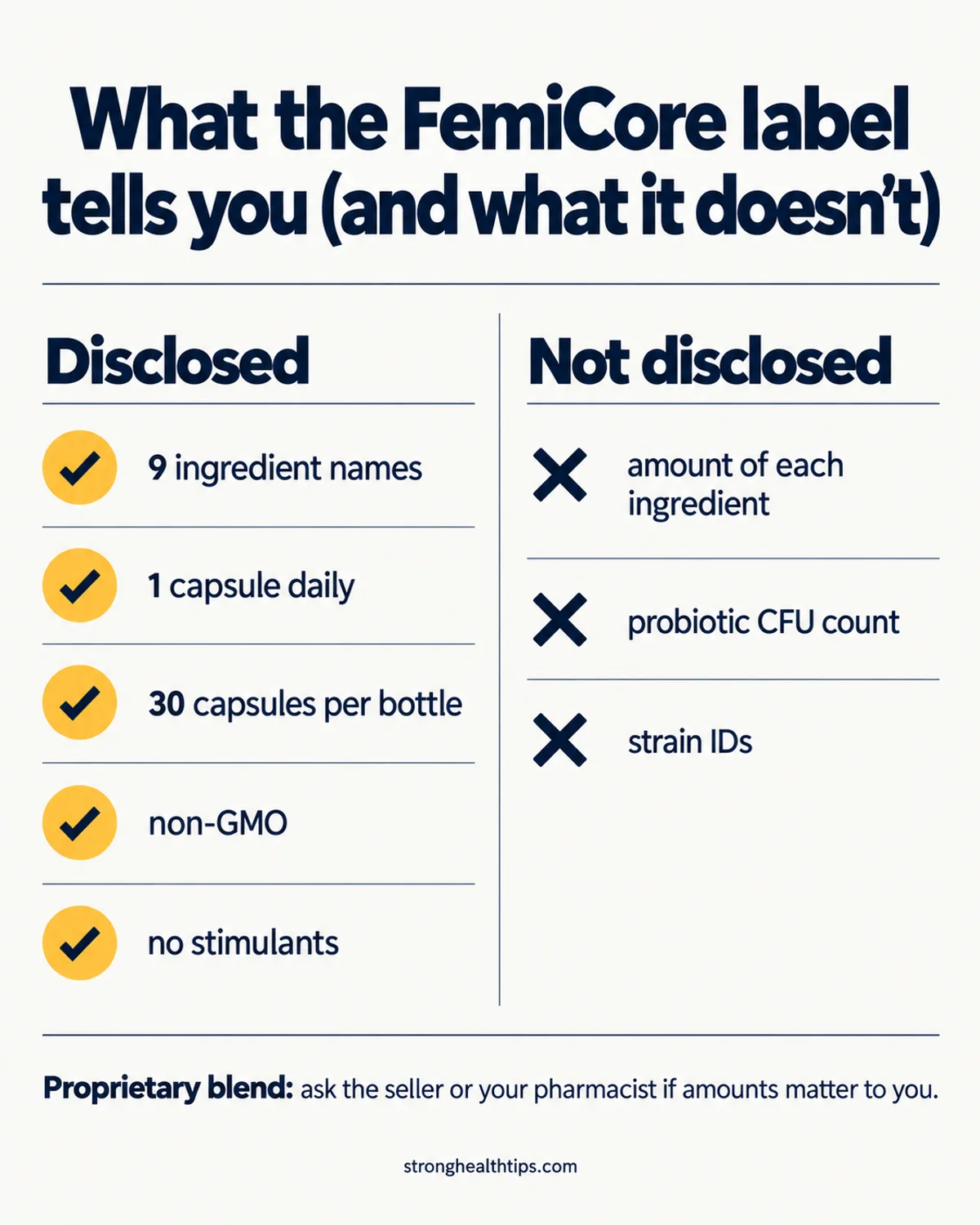
FemiCore uses a proprietary blend. That is legal and common in the supplement industry, but it limits what you can check for yourself.
| Disclosed | Not disclosed |
|---|---|
| All 9 ingredient names | The amount of each ingredient |
| 1 capsule daily | The probiotic count (CFU) |
| 30 capsules per bottle | The specific strain IDs |
| Non-GMO, no stimulants | The cranberry PAC content |
Why the missing details matter in practice:
- Amounts: cranberry and probiotic studies used specific doses. Without the numbers, you cannot tell whether FemiCore matches them.
- CFU count: probiotic products normally state how many live organisms they contain at the time of manufacture or expiry. Without it, you cannot compare FemiCore with other probiotics.
- Strain IDs: benefits often belong to a particular strain (for example, the crispatus strain used in the 2011 trial), not the species in general.
None of this makes the product unsafe or fake. It means you are trusting the manufacturer on the doses, and the 60-day guarantee is your main protection if the formula does not do enough for you.
How the ingredients are meant to work together
The formula follows a “restock and clean” idea:
- Restock. Five Lactobacillus strains aim to rebuild the protective bacteria that are often low in women with urgency symptoms.
- Clean. Cranberry, bearberry and berberine aim to discourage unwanted bacteria from settling in the urinary tract while the good bacteria take hold.
- Soothe. Mimosa Pudica is included for its traditional calming use.
This sequence is why FemiCore is meant to be taken every day for 8 to 12 weeks rather than as a quick fix. Our full FemiCore reviews go deeper into the research behind each step and give an overall verdict.
Nine ingredients, one capsule
Try the full formula for 60 days with a money-back guarantee.
One-time purchase from $49 per bottle. Free US shipping on 3 and 6 bottles.
Check FemiCore official priceIngredients to check if you take medication
Most of the list is low risk for healthy adults. Two items deserve a quick conversation with a pharmacist before you start:
- Berberine can lower blood sugar and slows enzymes (CYP2D6 and CYP3A4) that break down many common drugs, including some for blood pressure, cholesterol, mood and blood clotting.
- Bearberry is traditionally used short term and is not advised in pregnancy or kidney disease.
Cranberry is worth mentioning to your doctor if you take warfarin. Probiotics can cause mild bloating in the first week or two. If you want the full safety picture, our guide to FemiCore side effects walks through each ingredient in more detail.
A practical way to do this: take a screenshot of the ingredient table above, show it to your pharmacist when you next collect a prescription, and ask “is there anything here that clashes with what I take?” It takes two minutes and costs nothing.
How to read the list as a buyer
If you are comparing FemiCore with other bladder supplements, use the ingredients list as a filter rather than a scorecard:
- Look for the strongest-evidence ingredients first. Cranberry and L. crispatus are the two with real human data. FemiCore has both.
- Check whether doses are stated. Products that list cranberry PACs and probiotic CFUs let you compare directly. FemiCore does not, which is its main weakness.
- Watch for medication clashes. Berberine-containing products need more care than plain cranberry or plain probiotic products.
- Check the guarantee. When doses are hidden, a clear refund policy matters more. FemiCore offers 60 days on every package.
For a one-screen summary of the formula and packages, see the FemiCore product page. If you decide to buy, our guide to the FemiCore official website shows how to make sure you get the genuine product.
Genuine product only
Get the real nine-ingredient formula from the official store.
Not sold on Amazon or Walmart. Orders are processed by BuyGoods.
Visit the official FemiCore storeThe bottom line on the FemiCore ingredients list
The list is sensible and built around real science: the urinary microbiome, L. crispatus and cranberry are all genuine research areas. It is also incomplete in one important way, because the proprietary blend hides every dose. That leaves you with a reasonable formula you cannot fully audit. If you are comfortable with that trade-off, clear the berberine and bearberry question with a pharmacist, take it daily for at least 8 weeks, and use the 60-day guarantee if it does not help.
Ready to try it?
FemiCore from $49 per bottle, 60-day money-back guarantee.
One capsule each morning. 30 capsules per bottle.
Order FemiCore from the official siteQuestions people ask
What is on the FemiCore ingredients list?
FemiCore lists nine ingredients: Mimosa Pudica, Bearberry (Uva Ursi), Cranberry Extract, Granular Berberine, Lactobacillus crispatus, Lactobacillus acidophilus, Lactobacillus plantarum, Lactobacillus gasseri and Lactobacillus casei. They are combined in one capsule as a proprietary blend.
How much of each ingredient is in FemiCore?
The manufacturer does not publish the amount of each ingredient. FemiCore uses a proprietary blend, so the label shows the ingredient names but not individual doses, the probiotic colony-forming unit (CFU) count or specific strain identifiers.
Which FemiCore ingredient has the strongest evidence?
Cranberry has the largest body of research, including a 2023 Cochrane review that found cranberry products reduce the risk of repeat urinary tract infections in some groups. Lactobacillus crispatus has a smaller but well-designed trial in women with recurrent infections. None of the research tested FemiCore itself.
Does FemiCore contain stimulants or GMOs?
According to the manufacturer, FemiCore is non-GMO and contains no stimulants. The official site also displays seals for 'GMP Certified', 'Manufactured in USA with imported ingredients' and 'Made in an FDA registered facility', though it does not name the facility. That describes the factory standards, not an FDA approval of the product.
Is there anything on the FemiCore ingredients list I should check with a doctor?
Yes, mainly berberine and bearberry. Berberine can lower blood sugar and interacts with liver enzymes that process many common drugs. Bearberry is traditionally limited to short courses and is not advised in pregnancy or kidney disease. A pharmacist can check the list against your medications in a few minutes.
Sources
- Wolfe AJ et al. (2012). Evidence of uncultivated bacteria in the adult female bladder. Journal of Clinical Microbiology
- Pearce MM et al. (2014). The female urinary microbiome in women with and without urgency urinary incontinence. mBio
- Stapleton AE et al. (2011). Lactobacillus crispatus probiotic for prevention of recurrent urinary tract infection. Clinical Infectious Diseases
- Williams G et al. (2023). Cranberries for preventing urinary tract infections. Cochrane Database of Systematic Reviews
- Afshar K et al. (2018). Uva-ursi for uncomplicated urinary tract infection (REGATTA). BJGP
- Cicero AFG, Baggioni A (2016). Berberine and its role in chronic disease. Adv Exp Med Biol
Not medical advice. This guide is general information and does not replace a consultation with a qualified healthcare professional who knows your history. Full disclaimer.
Written by
Strong Health Tips Editorial Team
We research, write and fact-check every guide against current guidance from major health bodies and peer-reviewed studies, then rewrite it in plain English. How we work.