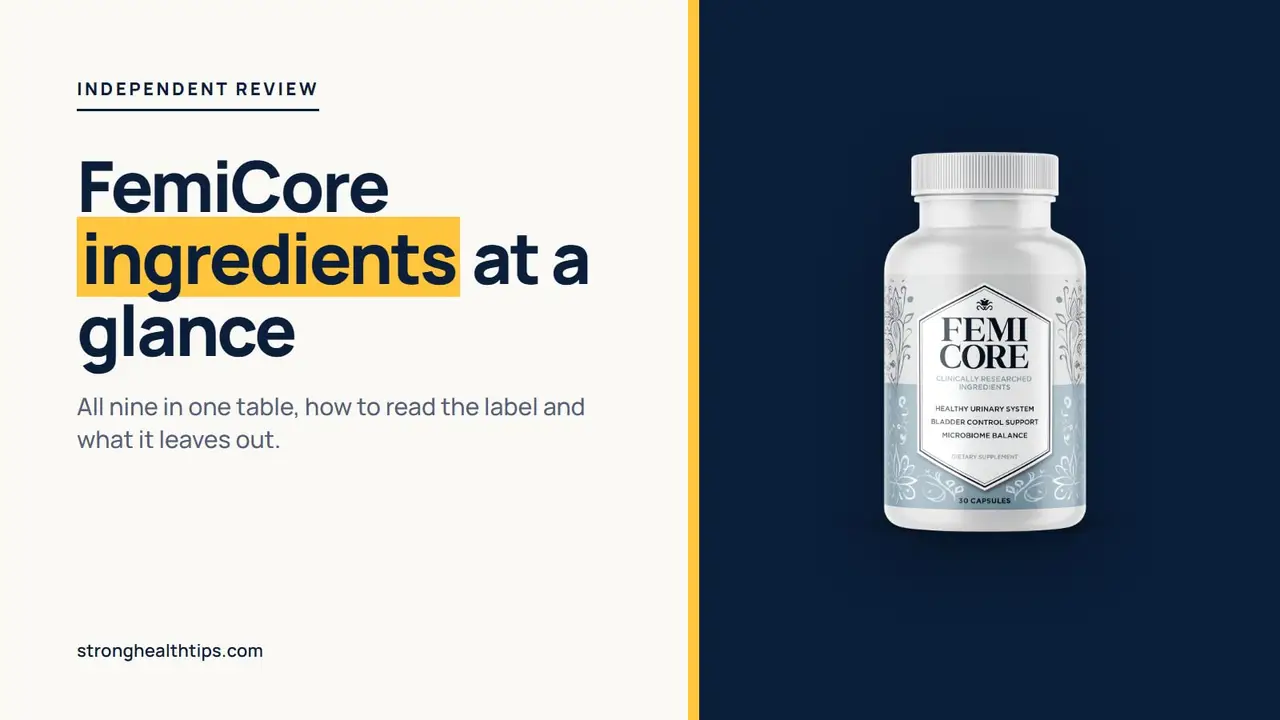
FemiCore Ingredients: The Whole Formula in One Table, Plus How to Read the Label
FemiCore ingredients on one screen: all nine in a single table, a short guide to reading the label, and the details the bottle does not list.
- Author
- Strong Health Tips Editorial Team
- Published
- Reading time
- 9 min read
Affiliate disclosure: this review contains links to the official FemiCore website. If you buy through them we may earn a commission at no extra cost to you. It does not change our assessment. Details.
This page puts the FemiCore ingredients on one screen. You get all nine in a single table with one line each, a quick method for reading the label on the bottle, and a plain list of what that label leaves out. It is built for the moment you have the bottle or the sales page open and want an answer in two minutes, not twenty.
If you want the long version, with a section for every ingredient and the research behind it, read our FemiCore ingredients deep dive. Everything below comes from the official product information and the published research on each ingredient. We have not tested the capsules ourselves.
Check the label at the source
See the FemiCore ingredient panel on the official site.
Compare it with the table below. One-off purchase, 60 days from delivery to ask for a refund.
View the official FemiCore labelAll nine in one table
Read across a row and you have the essentials for that ingredient: what kind of ingredient it is, the short version of the evidence, and whether it carries a caution.
| # | Ingredient | Type | One-line summary | Caution? |
|---|---|---|---|---|
| 1 | Mimosa pudica | Plant | Lab and animal reports only; no human bladder trials | None noted |
| 2 | Bearberry (uva ursi) | Plant | Arbutin turns into an antibacterial compound in urine; human data limited and mixed | Yes: short courses only |
| 3 | Cranberry extract | Plant | Best human data: fewer repeat UTIs in prone women | Yes: warfarin, kidney stones |
| 4 | Granular berberine | Plant compound | Good data for blood sugar and cholesterol; none for the bladder | Yes: many drug interactions |
| 5 | Lactobacillus crispatus | Probiotic | A vaginal product cut repeat UTIs in a small trial | Rare: weak immunity |
| 6 | Lactobacillus acidophilus | Probiotic | Common probiotic; effects are strain-specific | Rare: weak immunity |
| 7 | Lactobacillus plantarum | Probiotic | Common probiotic; effects are strain-specific | Rare: weak immunity |
| 8 | Lactobacillus gasseri | Probiotic | Common probiotic; effects are strain-specific | Rare: weak immunity |
| 9 | Lactobacillus casei | Probiotic | Common probiotic; effects are strain-specific | Rare: weak immunity |
Those nine names are the full list the official site gives, and the seller describes the capsule as free of stimulants and non-GMO.
Plants on one side, bacteria on the other
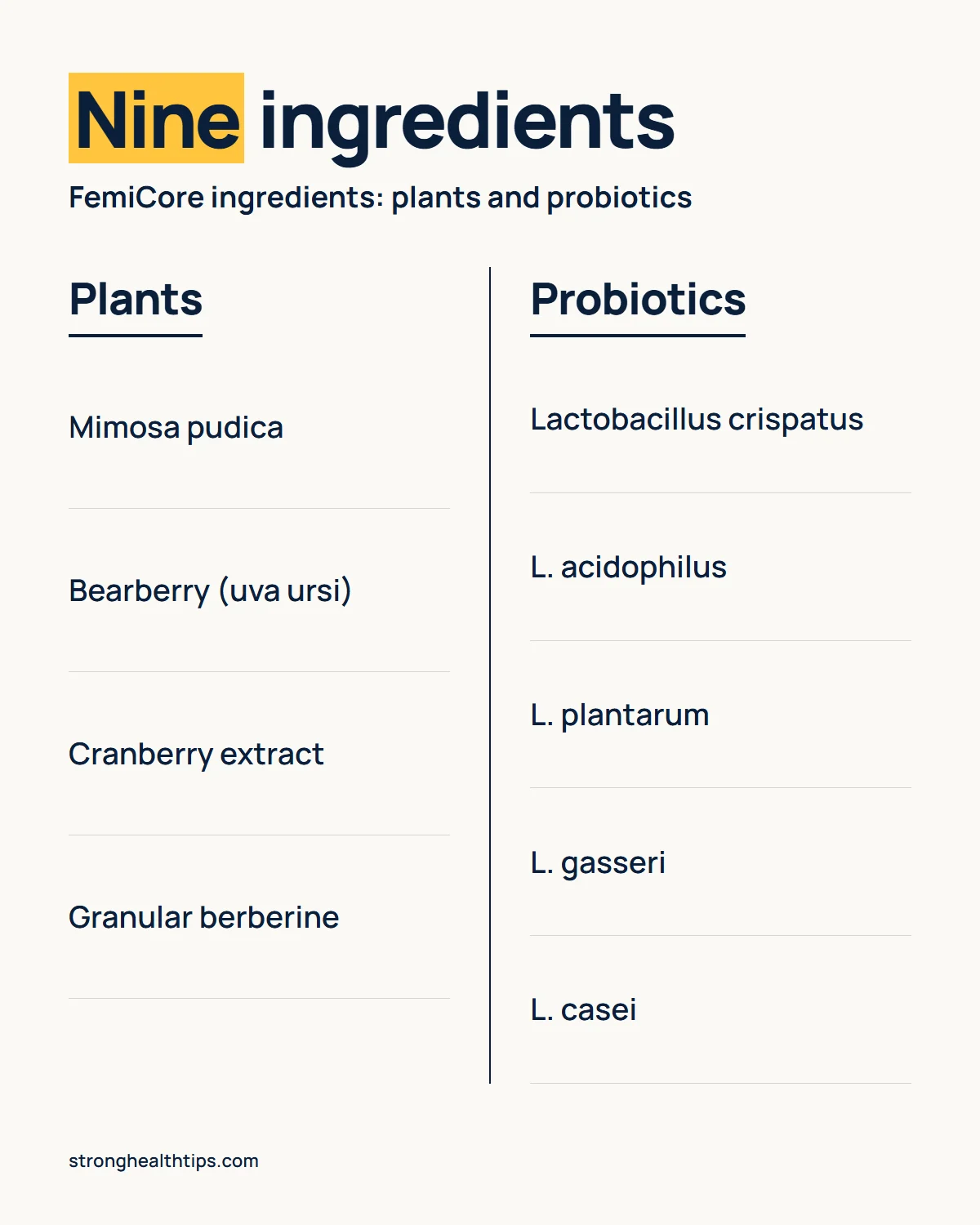
The nine names split cleanly into two families, and each family has a different job in the seller’s pitch.
The plant side is the urinary herb tradition: cranberry and bearberry are both linked to the urinary tract, berberine is a broad plant compound, and Mimosa pudica is a traditional herb. These four are the “keep things clean” half of the idea.
The bacteria side is the newer science. Since about 2012, sequencing studies from Loyola University Chicago and others have found that the female bladder is not sterile, and some studies saw fewer Lactobacillus in women with urgency incontinence. Five Lactobacillus species are the formula’s answer to that finding.
Neither half has been tested together in a trial. That is the single most important line to keep in mind when you read the table above.
Reading the FemiCore label in six steps
A supplement bottle has more on it than the ingredient list. Here is how to read the FemiCore label from the front panel down, and what each part can and cannot tell you.
- The three promises on the front. The label says “Healthy urinary system”, “Bladder control support” and “Microbiome balance”. These are aims, not measured results, and they describe support rather than a cure or treatment.
- “Clinically researched ingredients”. This points to research on the ingredients in general. No trial of the finished FemiCore formula exists, so read it as “the ingredients have been studied somewhere”, not “this capsule was tested”.
- The serving line. One capsule a day, 30 capsules per bottle, so one bottle is one month. The seller adds: take it every morning with a big glass of water.
- The blend line. All nine ingredients appear under one proprietary blend. You see the names, never the amounts.
- The seals. The official site shows GMP Certified, Made in USA with imported ingredients, Natural ingredients, Made in an FDA registered facility and Non-GMO. The manufacturer and certifier are not named. “FDA registered facility” refers to the factory’s registration. Like every supplement, FemiCore follows the FDA’s dietary supplement rules rather than the approval process for medicines.
- The caution. The official site advises seeing a physician if you are pregnant, nursing, on medication or have a medical condition. Take that line seriously, for the reasons in the caution table below.
Nine ingredients, one capsule a day
Packages from $49 to $79 a bottle on the official site.
Free US shipping on 3 and 6 bottles. No hidden autoship.
Check FemiCore pricesWhat the label does not list
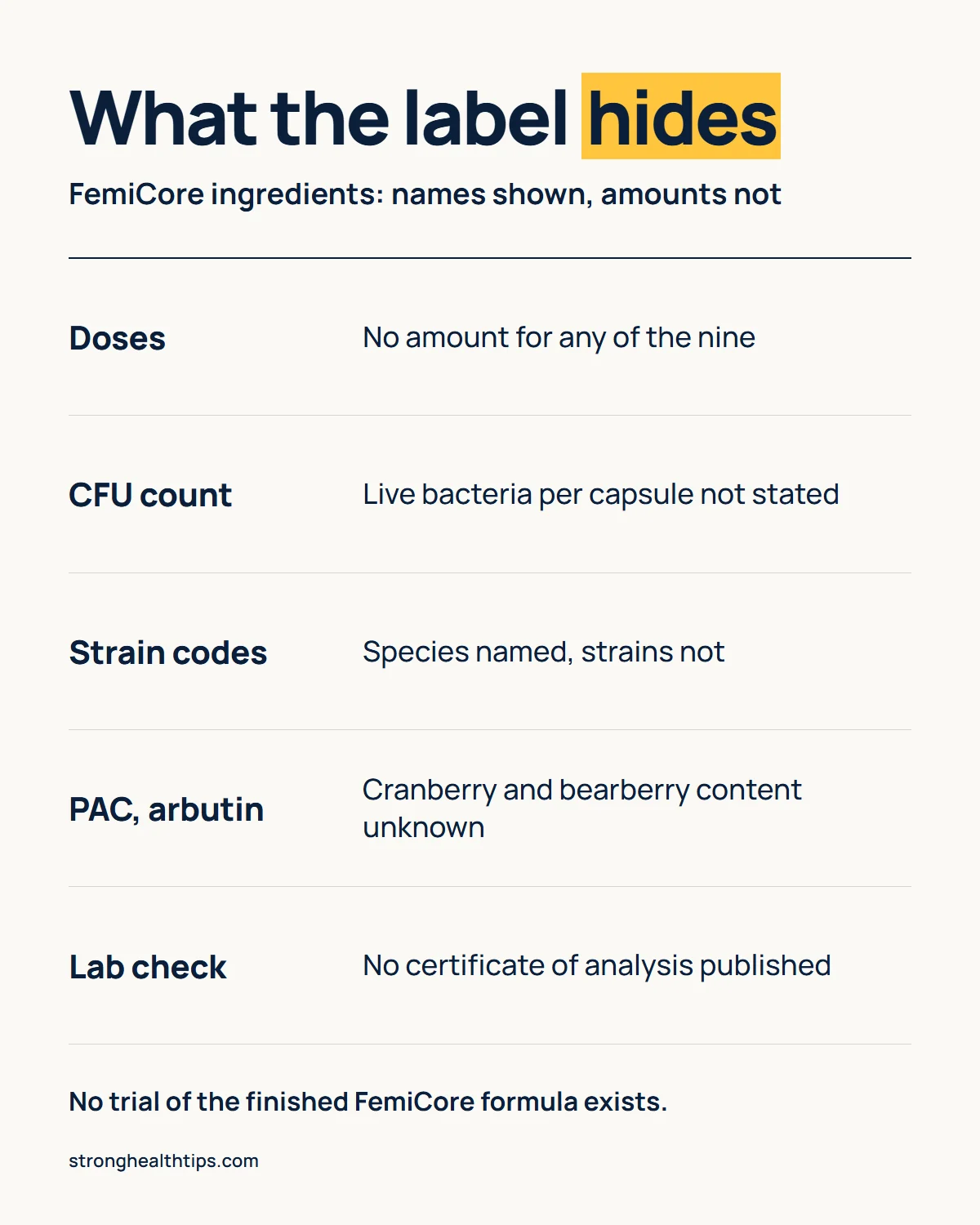
This is the part most quick summaries skip. The gaps matter because the research on several ingredients depends on the amount, and without amounts you cannot match the capsule to the studies.
| Not disclosed | Why it matters |
|---|---|
| Amount of each ingredient | You cannot compare any dose with the research |
| Probiotic count (CFU) | You cannot tell how many live bacteria a capsule holds |
| Strain codes | Probiotic effects are strain-specific; only species are named |
| Cranberry PAC content | The cranberry effect depends on the PAC dose |
| Bearberry arbutin content | You cannot judge the bearberry exposure |
| Berberine dose | Human studies used about 1,000 to 1,500 mg a day for blood sugar; FemiCore’s amount is unknown |
| Certificate of analysis | No published lab check of what is in the capsule |
None of these gaps means the product is unsafe or fake. They mean you are trusting the maker on amounts, and that the 60-day refund, counted from the delivery date, is your practical protection if the capsule does nothing for you.
Ingredients with a caution attached
Most of the list is gentle. Three ingredients deserve a short conversation with a pharmacist before day 1, and the probiotics carry one rare caution.
| Ingredient | Caution | Who should ask first |
|---|---|---|
| Berberine | Can lower blood sugar and blood pressure; slows CYP3A4 and CYP2D6, which raises the levels of many drugs, such as cyclosporine; unsafe in pregnancy and breastfeeding | Anyone on regular medicines, especially for diabetes |
| Bearberry | Short-term use only; nausea; harmless green-brown urine; lithium interaction | Pregnant or breastfeeding women, kidney disease, anyone on lithium |
| Cranberry | Case reports with warfarin; contains oxalate | Warfarin users (INR checks), anyone prone to kidney stones |
| Probiotics | Rare infections in severely immunocompromised people | Anyone with a severely weakened immune system |
Probiotics can also cause gas or bloating in the first one or two weeks, and some people get an upset stomach. For the full safety picture, ingredient by ingredient, see our guide to FemiCore side effects.
Label words, decoded
A few words on the FemiCore label and sales page sound more precise than they are. Here is what each one tells you, and where it stops.
| Word on the label or site | What it tells you | What it does not tell you |
|---|---|---|
| Proprietary blend | Which ingredients are in the capsule | How much of each |
| Uva ursi | It is another name for bearberry | The arbutin content |
| Granular berberine | Berberine is in the blend | The dose, or why “granular” matters |
| Cranberry extract | A concentrated cranberry ingredient | The PAC content the research depends on |
| Lactobacillus crispatus and the others | Which species are included | Which strains, or how many live bacteria |
| Natural ingredients | A badge shown on the official site | Who checked it, or by what standard |
| Made in USA with imported ingredients | Where the capsule is made | Where each ingredient comes from |
| GMP Certified | A manufacturing badge shown on the site | The name of the factory or the certifier |
None of these words is misleading on its own. Together they make the label look fuller than it is. The useful habit is to ask one question of each: “how much, and who says so?” On the FemiCore label, the answer to both parts is usually “not stated”.
What you will not find in the capsule
Knowing what is absent is useful too. Going by the seller’s description:
- No stimulants. The seller says the capsule contains none.
- Non-GMO. The seller says the ingredients are non-GMO, and the site shows a Non-GMO seal.
- No medicine. FemiCore is a dietary supplement. It is not a treatment for urinary infections, incontinence or any other condition.
If you notice blood in your urine, fever or chills, pain in your side, burning when you pass urine or a sudden change in bladder control, see a doctor. Those symptoms need a diagnosis, not a capsule.
When one screen is not enough
This table answers “what is in it”. It does not answer “will it work for me” or “how does it fit together”. For those questions:
- The mechanism, part by part, is in how FemiCore is supposed to work.
- The full ingredient research is in our nine-ingredient deep dive.
- Packages, ingredients, safety and our verdict in one place are on our FemiCore product hub.
Buy from the source
Only the official site sells FemiCore with the refund policy.
Marketplace listings are not authorized by the seller and may be fakes or old stock.
Go to the official FemiCore storeThe bottom line
FemiCore’s ingredient list is short and readable: four plant ingredients and five Lactobacillus species, one capsule a day. The idea behind the mix is real but early, cranberry carries the best human evidence, and Mimosa pudica the least. The label’s weak point is not what it names but what it hides: no amounts, no CFU count, no strain codes and no published lab check.
If you take regular medicines, are pregnant or breastfeeding, or have kidney disease, show this table to a pharmacist before you order. If none of that applies and the gaps do not put you off, buy from the official site, note the delivery date, and judge it before the 60-day refund window closes. Our editorial score for FemiCore is 4.2 out of 5, our own judgment rather than a customer rating.
Decide with the label in front of you
Genuine FemiCore, official prices, a written refund policy.
We are independent, not the seller, and may earn a commission through our links.
Order from the official websiteQuestions people ask
How many ingredients does FemiCore have?
Nine. Four come from plants: Mimosa pudica, bearberry (uva ursi), cranberry extract and granular berberine. Five are probiotic bacteria: Lactobacillus crispatus, L. acidophilus, L. plantarum, L. gasseri and L. casei. All nine are listed together in a proprietary blend.
Which FemiCore ingredients are probiotics?
The five Lactobacillus species: L. crispatus, L. acidophilus, L. plantarum, L. gasseri and L. casei. The label names the species only, with no strain codes and no count of live bacteria.
Is there a CFU count on the FemiCore label?
No. The number of live bacteria per capsule, usually given as CFU, is not disclosed. Neither are the amounts of the four plant ingredients.
What does clinically researched ingredients mean on FemiCore?
It refers to research on the ingredients in general, such as studies on cranberry or on Lactobacillus crispatus. No trial of the finished FemiCore capsule exists, so the phrase does not mean the product itself was tested.
Why is bearberry in a product taken every day?
The seller does not explain it. European herbal regulators describe bearberry for short courses of about a week for mild lower urinary complaints, not for continuous use, and the bearberry dose in FemiCore is not disclosed. If you plan to take it for months, ask a pharmacist.
Where can I see the FemiCore ingredient label for myself?
On the official FemiCore website, which is the only authorized seller. Our links go there. Marketplace listings may show old or copied photos, so the official page is the one to check.
Sources
- Williams G et al. (2023). Cranberries for preventing urinary tract infections. Cochrane Database of Systematic Reviews
- Stapleton AE et al. (2011). Lactobacillus crispatus probiotic for prevention of recurrent urinary tract infection. Clinical Infectious Diseases
- Wolfe AJ et al. (2012). Evidence of uncultivated bacteria in the adult female bladder. Journal of Clinical Microbiology
- FDA: Tips for dietary supplement users
Not medical advice. This guide is general information and does not replace a consultation with a qualified healthcare professional who knows your history. Full disclaimer.
Written by
Strong Health Tips Editorial Team
We research, write and fact-check every guide against current guidance from major health bodies and peer-reviewed studies, then rewrite it in plain English. How we work.