The Genius Switch Safety Check: Listening Rules, Who Should Ask a Doctor and How to Read the Pitch
Safety notes for The Genius Switch audio track: volume, driving, epilepsy and hearing cautions, the unverified presenter, acted testimonials and the Terms.
- Published
An 8-minute digital audio track you play daily on headphones, sold for $39 with four digital bonuses and a 90-day refund window. Not an app, not a game.
- $39 one-time price
- 90-day refund
- Cognitive Support
Our editorial score: 3.0/5 (ours, not a customer rating) How we score
Check the price on the official store
Affiliate disclosure: this page contains affiliate links for The Genius Switch. If you buy through them we may earn a commission at no extra cost to you. It does not change our assessment, and we do not publish customer ratings or testimonials we cannot verify. How we review.
At a glance
- Refund window
- 90 days
- 90 days from purchase (Terms and ClickBank checkout)
- Price
- $39
- one-time digital purchase
- Category
- Cognitive Support
- Our score
- 3.0 / 5
- editorial, not a customer rating
Claim reality check
| The Genius Switch says | What we found |
|---|---|
| "Whole brain activation" | The seller's own term, not a clinical one. Roger Sperry's 1981 Nobel Prize, which the video cites, was for split-brain research. |
| "It starts working the very first time you listen" | No published study tests this track. Binaural-beat research is mixed: a medium effect in a 2019 meta-analysis, little brainwave entrainment in a 2023 review. |
| "It has nothing to do with brain waves" | Yet the sales page lists studies on 40 Hz binaural beats and gamma stimulation as its references. |
| "18,456 everyday Americans helped" | The seller's own figure. The Terms say testimonials may be acted out by avatars or actors. |
| "Regular price $200" | A seller reference price. The track costs $39, with tax and local currency added at checkout. |
The Genius Switch is one 8-minute audio file that you play through headphones. There is nothing to swallow and nothing to install, so “is it safe” splits into two practical questions. Can the listening routine itself cause a problem? And can the sales pitch push you into a poor health or money decision? This page answers both with tables and checklists you can work through in a few minutes.
Safety at a glance
Quick facts:
- What it is: a single 8-minute digital audio track, emailed after checkout and played in any media player.
- How the seller says to use it: headphones on, eyes closed, 8 minutes a day. The presenter says missing a day is “okay”.
- Main listening risks: loud volume through headphones, and listening when you need to stay alert.
- Who should check with a doctor first: people with epilepsy, a seizure history or a hearing problem.
- What it is not: a treatment for any condition. The site says it is not intended to diagnose, treat, cure, or prevent any disease.
- What we could not check: who the presenter is, and whether the people in the testimonials are real customers.
Listening safety: our rules
These rules are our own advice, based on general caution for any audio-entrainment product. The seller does not publish safety guidance of its own beyond the disclaimer.
| Situation | Our advice | Why |
|---|---|---|
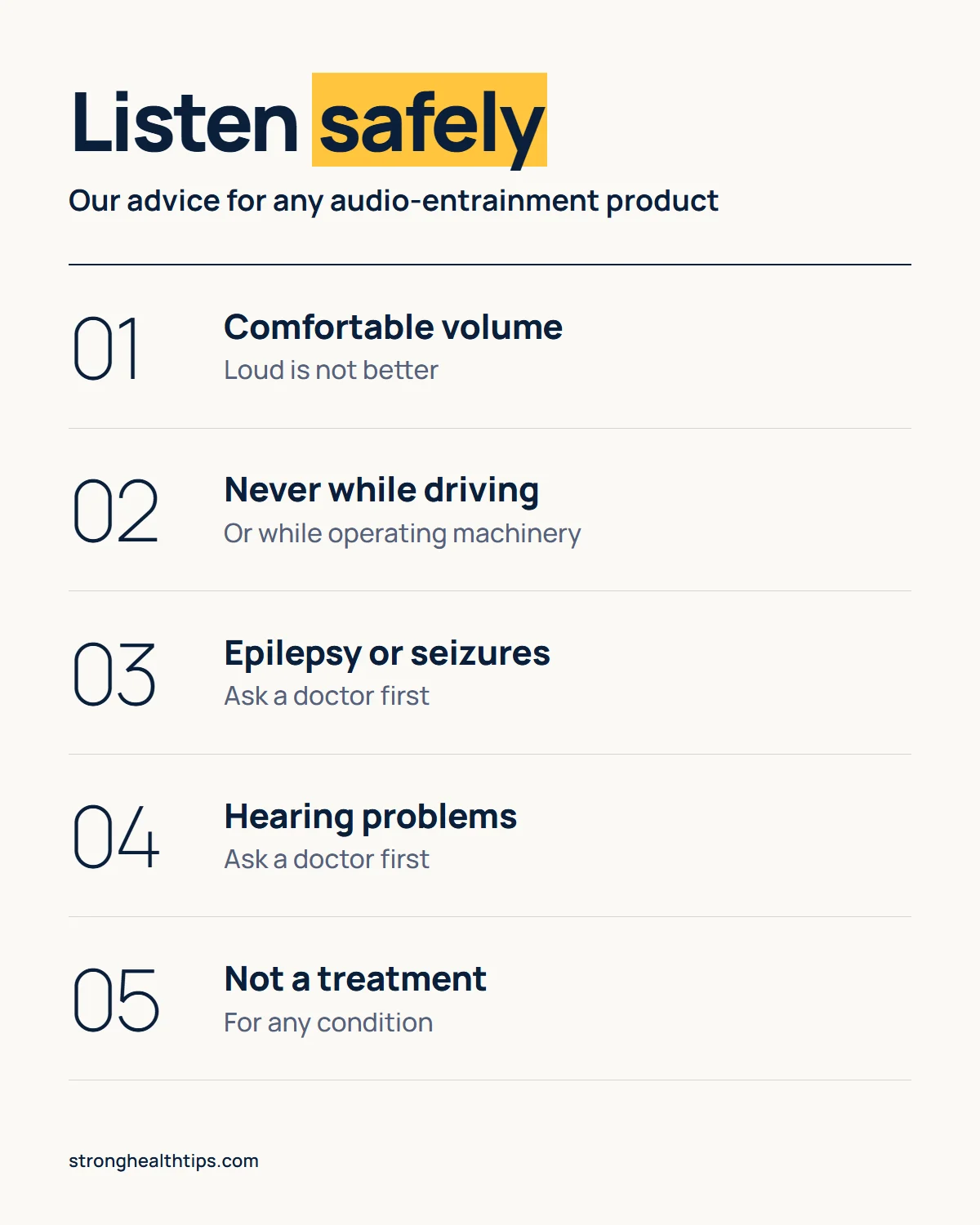
| Setting the volume | Start low and stop at comfortable; a normal voice in the room should still reach you | Loud sound through headphones adds up and can damage hearing over time |
| Driving or operating machinery | Never listen | The routine asks you to close your eyes and relax |
| Epilepsy or a seizure history | Ask a doctor before the first session | Rhythmic audio has not been safety-tested for this track in any group |
| Hearing problems, tinnitus or hearing aids | Ask a doctor or audiologist first | Headphone listening may not suit your ears |
| Feeling dizzy, anxious or unwell while listening | Stop and take the headphones off | No session is worth pushing through discomfort |
| Children | Leave it to adults | The video mentions kids’ grades as a claimed result, but nothing tests the track in children |
Eight minutes a day is a small dose of sound. The point of the table is not to make the track sound dangerous. It is that the few real risks are easy to avoid if you set up the session properly.
Who should talk to a doctor first
In our guidance, these readers should get a professional opinion before pressing play, or before relying on the track for anything:
- Anyone with epilepsy or a history of seizures.
- Anyone with hearing loss, tinnitus or a hearing aid.
- Anyone hoping the track will fix headaches, joint pain, weight, smoking, memory or mood. The video tells anecdotes about all of these, but they are claims, not evidence.
- Parents thinking of using it for a child’s schoolwork.
- Anyone who has a new or worsening symptom. That needs a diagnosis, and a sound file cannot give one.
What the seller’s own Terms say
The Terms of Service have a section titled “For Entertainment Purposes Only”. It reads: “brain entrainment is not an exact science and we recommend that you do not treat it as such. The products are provided for entertainment purposes only.”
That line matters for safety. The video promises eureka moments, faster learning, a 17 lb weight loss story and pain easing, but the legal text frames the same product as entertainment. When a sales video and its Terms point in different directions, base your health decisions on the Terms. The site’s standard disclaimer says the same thing in other words: it is not intended to diagnose, treat, cure, or prevent any disease.
The science framing has its own mismatch. The video says the method “has nothing to do with brain waves”, while the sales page lists studies on 40 Hz binaural beats and gamma stimulation as references. Research on binaural beats in general is mixed, and no published study tests this track. Our benefits page goes through each claim against that research.
The seller's offer
Read the seller's Terms and disclaimer for yourself
The official page links its Terms, including the entertainment-only section quoted above.
See the official pageThe presenter: what we could not verify
The video is fronted by the presenter, who introduces himself as Dr. Daniel Barone, a New York City neurologist, under a “Top NYC Brain Doctor” headline. We could not verify his identity or what role, if any, he had in making the track. So we do not treat the title, the headline or the story as evidence of anything.
He also leans on Roger Sperry. Sperry did win the 1981 Nobel Prize, but it was for split-brain research. “Whole brain activation” is the seller’s term, not a clinical one, and the Nobel Prize says nothing about this product.
Reading the testimonials with care
The video presents several success stories: “Lisa, a nurse from San Diego”, “Matthew in Houston”, “Ellie from Manhattan” and “Joyce Webb from Tempe”. Right next to those names belongs the seller’s own caveat. Per the Terms, feedback may be acted out by digital avatars or actors, some people featured may be “early supporters, friends, or family members of the company’s founders”, and the results shown are “exceptional results and may not reflect the experience of a typical customer”.
The same goes for the seller’s figure of “18,456 everyday Americans” helped and its “stacks of five star reviews”. Both are the seller’s numbers and could not be verified. The FTC’s endorsement guides, listed in our sources, explain why connections and typical results matter when you weigh an advertised story.
| Pitch element | What it is | How to treat it |
|---|---|---|
| Named success stories | Seller testimonials that may be acted out | Advertising, not independent reviews |
| “18,456 everyday Americans” | Seller figure | Unverified |
| Casino and luck stories | Anecdotes in the Q and A | The presenter himself says “there is of course no evidence to support that the genius switch caused that” |
| “Top NYC Brain Doctor” | Headline about the presenter | Identity and involvement not verified |
Money safety in brief
Paying safely is part of the picture. The genuine order goes through a ClickBank checkout at thegeniusx.pay.clickbank.net, and your card statement shows CLKBANK*GeniusSwitch. The Terms and the checkout both give 90 days from purchase for a refund. A separate refund page on the site describes a 60-day policy for “NeuroActivate” bottles, which does not fit a digital track, so keep your ClickBank receipt. Look-alike sellers are covered on our where to buy page, and the support contacts are on our official website guide.
Before you start: a checklist
- Decide where you will listen: seated or lying down, not in a car, not near machinery.
- Set your device volume low before you press play, then adjust to a comfortable level.
- If you have epilepsy, a seizure history or a hearing problem, get a doctor’s view first.
- Write down what you hope to notice, such as focus at work or calmer evenings, so you can judge it honestly later.
- Keep any treatment or medicine you already use. The track is not a substitute.
- Save the ClickBank receipt and note the purchase date, since the 90 days count from it.
- Set a reminder about two weeks before day 90 to decide whether to keep it.
The seller's offer
Checked the list and still want to try it?
One $39 track by email, with a 90-day refund window in the Terms and at the ClickBank checkout.
View the offerIf something feels wrong
- During a session: stop, take the headphones off and sit quietly for a minute.
- If symptoms continue: contact a doctor, and mention that you were listening to an audio-entrainment track.
- If you no longer want it: request a refund within 90 days of purchase through ClickBank order support (1-800-390-6035) or product support at [email protected]. There is nothing to post back.
For how we weigh safety information in a review, see our methodology. Our full verdict is on the review page, and similar products are grouped under cognitive support.
The seller's offer
Go to the genuine order page
Payment runs through ClickBank and the track arrives by email, with nothing shipped.
Open the order pageThe Genius Switch Official Pricing
The price as listed on the official order page when we checked. It is a one-time digital purchase with nothing shipped; any add-ons are optional, and tax and the amount in your currency show at checkout. The crossed-out figure is the seller's own "regular" price, a reference price rather than what anyone pays.
The Genius Switch audio track
$39$200
One-time price
Seller lists a $161 saving
- 8-minute digital audio track
- 4 digital bonuses
- Emailed right after checkout
- 90-day money-back guarantee
Other cognitive support products
All in this categoryThe Genius Song
A short digital audio track (the seller says about 7 minutes) played daily on headphones, sold for $39 with digital bonuses and a 90-day refund window. Not an app, not a game.
3.5 / 5 our score $39
Decided?
See the current The Genius Switch price and guarantee
$39 one-time, tax and local currency shown at checkout. Refund window: 90 days from purchase (Terms and ClickBank checkout).
Check The Genius Switch on the official siteQuestions people ask
Can listening to The Genius Switch harm my hearing?
Eight minutes is short, but any audio played loudly through headphones adds to your noise exposure, and loud noise is a known cause of hearing loss. Set it at a level you could happily hold a conversation over, and never turn it up hoping for a stronger effect.
Is The Genius Switch safe for people with epilepsy?
Nobody can say, because no study has tested the track at all. As a general caution for audio-entrainment products, our advice is to ask your doctor before starting if you have epilepsy or any history of seizures.
Can I listen to The Genius Switch while driving or working?
Not while driving or operating machinery. The routine asks you to close your eyes and relax for 8 minutes, so do it seated or lying down somewhere safe.
Is Dr. Daniel Barone really behind The Genius Switch?
The presenter introduces himself as Dr. Daniel Barone, a New York City neurologist. We could not verify his identity or his involvement, so his appearance in the video is not evidence that the track works or is safe for you.
Are the people in The Genius Switch video real customers?
The video presents Lisa, a nurse from San Diego, Matthew in Houston, Ellie from Manhattan and Joyce Webb from Tempe. The seller's Terms say this feedback may be acted out by avatars or actors, that some people featured may be friends or family of the founders, and that the results shown are not typical. Read them as advertising, not as independent reviews.
Can The Genius Switch replace treatment for pain, anxiety or memory problems?
No. The site's disclaimer says it is not intended to diagnose, treat, cure, or prevent any disease, and its Terms say the products are for entertainment purposes only. Keep any treatment you already have and see a doctor about new symptoms.
Is The Genius Switch legit or a scam?
The purchase itself is real: a ClickBank checkout, a card statement line reading CLKBANK*GeniusSwitch and a 90-day refund window in the Terms and at checkout. The marketing claims are a separate question, and none of them has been tested in a published study of the track.
Sources
- NIDCD: Noise-induced hearing loss
- FTC: Guides concerning the use of endorsements and testimonials in advertising
- Garcia-Argibay M et al. (2019). Efficacy of binaural auditory beats in cognition, anxiety, and pain perception: a meta-analysis. Psychological Research
- FTC: Shopping online, avoiding scams and protecting your payment
Not medical advice. This page is general information and does not replace a consultation with a qualified healthcare professional who knows your history. Full disclaimer.
Written by
Strong Health Tips Editorial Team
We check every claim against the seller's own pages, terms and refund policy, and against published research, then write it up in plain English. Our methodology.