The Genius Switch Benefits: Each Seller Promise Set Against the Research and the Fine Print
Each benefit The Genius Switch promises, from focus and memory to luck and weight loss, checked against binaural-beat research and the seller's own words.
- Published
An 8-minute digital audio track you play daily on headphones, sold for $39 with four digital bonuses and a 90-day refund window. Not an app, not a game.
- $39 one-time price
- 90-day refund
- Cognitive Support
Our editorial score: 3.0/5 (ours, not a customer rating) How we score
Check the price on the official store
Affiliate disclosure: this page contains affiliate links for The Genius Switch. If you buy through them we may earn a commission at no extra cost to you. It does not change our assessment, and we do not publish customer ratings or testimonials we cannot verify. How we review.
At a glance
- Refund window
- 90 days
- 90 days from purchase (Terms and ClickBank checkout)
- Price
- $39
- one-time digital purchase
- Category
- Cognitive Support
- Our score
- 3.0 / 5
- editorial, not a customer rating
Claim reality check
| The Genius Switch says | What we found |
|---|---|
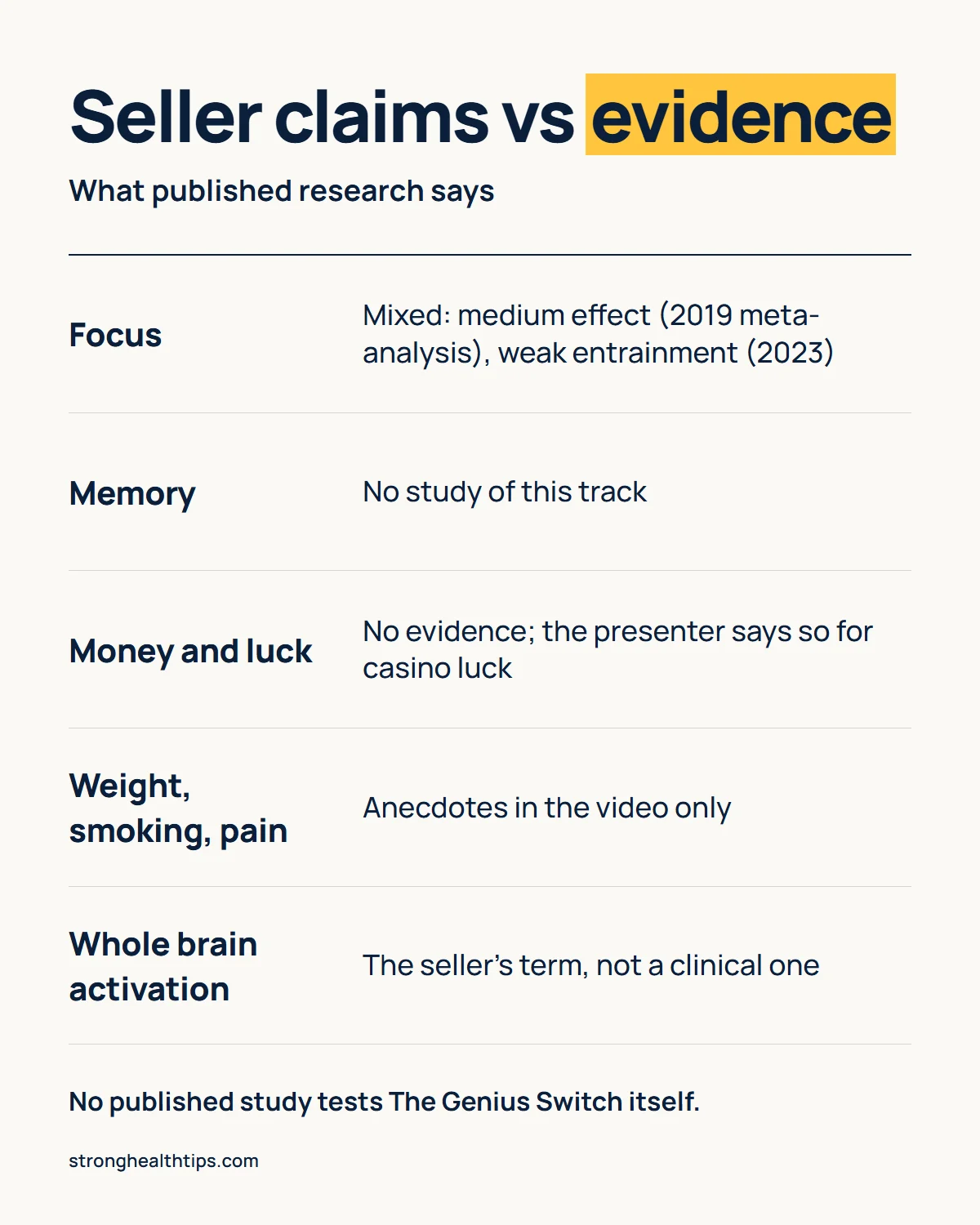
| "Whole brain activation" | The seller's own term, not a clinical one. Roger Sperry's 1981 Nobel Prize, which the video cites, was for split-brain research. |
| "It starts working the very first time you listen" | No published study tests this track. Binaural-beat research is mixed: a medium effect in a 2019 meta-analysis, little brainwave entrainment in a 2023 review. |
| "It has nothing to do with brain waves" | Yet the sales page lists studies on 40 Hz binaural beats and gamma stimulation as its references. |
| "18,456 everyday Americans helped" | The seller's own figure. The Terms say testimonials may be acted out by avatars or actors. |
| "Regular price $200" | A seller reference price. The track costs $39, with tax and local currency added at checkout. |
The Genius Switch sales video promises a lot for an 8-minute audio track. This page puts every promise in one table, sets it next to what is realistic, and shows the evidence or basis for each. After the table come the research the seller leans on, the places where the seller’s own words undercut the pitch, and a fair way to judge the track for yourself.
Promise by promise
Every row starts with the seller’s claim, attributed to the seller. The middle column is our view of what a buyer can reasonably expect.
| Seller’s promise | What is realistic | Evidence or basis |
|---|---|---|
| “Whole brain activation” by syncing the two halves of the brain | A label for the experience, not a measurable outcome | The seller’s own term, not a clinical one; Sperry’s 1981 Nobel was for split-brain research |
| Better focus and attention | Possibly a calm, focused few minutes while you listen | Mixed research on binaural beats in general; none of this track |
| Better memory and faster learning | No reason to expect a lasting change | A 2019 meta-analysis found a medium effect that included memory; nothing on this track |
| Insights and “eureka moments” | Quiet time can leave room to think, which is not unique to this track | Anecdotes in the video only |
| Luck and “synchronicities” | Nothing to expect | The presenter says there is “no evidence” the track caused casino wins |
| Promotions, pay rises and money | Nothing to expect from the track itself | No study; seller stories only |
| Better relationships | Nothing to expect from the track itself | No study; seller stories only |
| Weight loss, including a 17-pound story | Not a weight-loss method | A single anecdote told in the video |
| Quitting smoking and curbing cravings | Not a quit-smoking method | Anecdotes in the video only |
| Easing headaches and joint pain | Not a pain treatment | Anecdotes in the video; the site says it is not intended to treat any disease |
| Better grades for children | Nothing to expect | No study; seller claim only |
| Works “the very first time you listen” | You will hear 8 minutes of audio; any effect is unknown | Seller statement, no data |
| A difference within two to three days, results within a couple of weeks | No basis for a timeline | Seller statement, no data |
The pattern is clear. The closer a promise gets to money, luck or health, the thinner the support becomes, down to nothing at all. Our review scorecard shows how this gap weighs on our overall score.
What binaural-beat research can and cannot tell you
The sales page cites research on 40 Hz binaural beats and gamma stimulation. A binaural beat is the pulse a listener perceives when each ear hears a slightly different steady tone through headphones. Here is what two key papers on the topic actually cover.
Ross and Lopez, 2020
This was a small lab study in which 40 Hz binaural beats were tested during training on an attention task called the attentional blink, a short lapse in attention when two targets appear close together. The paper’s title reports that the beats enhanced that training. It is a narrow lab measure of attention. It says nothing about memory in daily life, career success, luck, weight or pain, and it did not use The Genius Switch.
Garcia-Argibay and colleagues, 2019
This meta-analysis pooled 22 studies of binaural beats. It reported a medium average effect on memory, attention, anxiety and pain perception, with results that depended on the beat frequency and on when people listened. The overall effect was fairly consistent. It, too, did not involve this track. A 2023 systematic review of brainwave entrainment was less positive: of 14 studies, 5 supported entrainment, 8 contradicted it and 1 was mixed.
The gap that matters
| Question | Answer |
|---|---|
| Is there research on binaural beats? | Yes, with mixed results: a medium effect in a 2019 meta-analysis, little entrainment in a 2023 review |
| Did any of it test The Genius Switch? | No published study tests this track |
| Does the seller say what is on the track? | No technical description is published |
| Can the cited studies show what this track does? | No, because they tested other audio under lab conditions |
Even strong research on binaural beats as a category would not prove that one commercial track works. A specific product needs its own testing to back specific claims, and none exists here.
The brain-wave contradiction
The video and the sales page do not agree on what the product is. Early in the video, the presenter, who introduces himself as Dr. Daniel Barone, says this at-home ritual “has nothing to do with brain waves”. He goes on to call sound waves an “incomplete” method and says the answer “isn’t brain pills or brainwaves”. We could not verify his identity or his involvement with the product.
Yet the references on the sales page are studies on 40 Hz binaural beats and gamma stimulation, which is research on exactly the kind of brain-wave audio the video seems to rule out. We are not suggesting anything beyond what the documents show. The point for a buyer is simple: the seller cannot lean on binaural-beat studies as support while also saying the method is something else. Since the seller does not describe the track, we cannot say which description is closer to the truth.
Whole brain activation and the Nobel Prize
The video opens by tying the product to “a forgotten study that won the Nobel Prize”. That refers to Roger Sperry, who shared the 1981 Nobel Prize in Physiology or Medicine for his split-brain research, which showed how the two halves of the brain specialize in different tasks.
Sperry’s prize was not for anything called whole brain activation. That phrase is the seller’s own term, not a clinical one. Borrowing a real prize gives the pitch an air of science that the prize itself does not provide.
The seller's offer
Read the promises in the seller's own words
The order page shows the claims, the $39 price and the 90-day guarantee, so you can weigh them against this table.
View the sales pageIn the seller’s own words
Two passages from the seller’s materials do more to set expectations than any review.
The casino answer. In the question section of the video, the presenter is asked whether the track will help at the casino. After mentioning customer stories about luck at slots, roulette and sports betting, he says: “there is of course no evidence to support that the genius switch caused that”. The same logic applies to the promises about promotions, pay rises and money, which rest on stories rather than data.
The Terms. Under the heading “For Entertainment Purposes Only”, the seller’s Terms of Service say: “brain entrainment is not an exact science and we recommend that you do not treat it as such. The products are provided for entertainment purposes only.” The same Terms say that marketing feedback may be acted out by avatars or actors, that some people giving testimonials may be friends or family of the founders, and that the results shown are not typical.
Read together, these two passages describe the product more modestly than the rest of the video does. That modest version is the one to plan around.
Health promises: weight, smoking and pain
The video’s health promises rest on stories, not studies. It describes a colleague who lost 17 pounds, says customers no longer want to drink, smoke or eat bad foods, and suggests that lower stress lets aches and joint pains fade. None of this has been tested for the track.
What this means in practice:
- The Genius Switch is not a treatment for any condition. The site states it is “not intended to diagnose, treat, cure, or prevent any disease”.
- For weight, smoking, headaches or joint pain, a doctor can point you to approaches with real evidence behind them.
- Do not stop or delay any treatment because of something in the video.
- If you have epilepsy, a seizure history or hearing problems, ask a doctor before using any audio-entrainment product.
The safety page covers listening safety in full.
A realistic expectation, and a fair way to test it
What can 8 minutes a day with headphones and closed eyes plausibly offer? A short, regular pause in a busy day, which many people find pleasant. That is worth something, but it is not what the video sells, and a free track or a few minutes of quiet can offer the same kind of pause. The comparison page looks at those alternatives.
If you decide to try it, judge it fairly:
- For two weeks before you start, write one line a day about sleep, mood and focus.
- Listen once a day for 8 minutes at a comfortable volume, never while driving.
- Keep the same daily notes for the next few weeks.
- Compare the two sets of notes around day 60 to 75, before the 90-day refund window closes.
- If you notice nothing, ask for a refund through ClickBank, using the order number on your receipt.
The seller's offer
Willing to test it on modest terms?
One $39 payment, the track by email and 90 days under the Terms to decide whether it earns its place.
See the $39 offerFor what the order contains, see the What’s Included page, and for the cost per day, the price page.
The Genius Switch Official Pricing
The price as listed on the official order page when we checked. It is a one-time digital purchase with nothing shipped; any add-ons are optional, and tax and the amount in your currency show at checkout. The crossed-out figure is the seller's own "regular" price, a reference price rather than what anyone pays.
The Genius Switch audio track
$39$200
One-time price
Seller lists a $161 saving
- 8-minute digital audio track
- 4 digital bonuses
- Emailed right after checkout
- 90-day money-back guarantee
Other cognitive support products
All in this categoryThe Genius Song
A short digital audio track (the seller says about 7 minutes) played daily on headphones, sold for $39 with digital bonuses and a 90-day refund window. Not an app, not a game.
3.5 / 5 our score $39
Decided?
See the current The Genius Switch price and guarantee
$39 one-time, tax and local currency shown at checkout. Refund window: 90 days from purchase (Terms and ClickBank checkout).
Check The Genius Switch on the official siteQuestions people ask
What benefits does The Genius Switch promise?
The video promises eureka moments, faster learning, better memory, luck and synchronicities, promotions and money, better relationships, weight loss, quitting smoking, easing headaches and joint pain, and better grades for children. All of these are the seller's claims.
Is The Genius Switch scientifically proven?
No. No published study tests The Genius Switch track. The studies cited on the sales page are about 40 Hz binaural beats and gamma stimulation in general, and that research is mixed: a 2019 meta-analysis found a medium effect on some outcomes, while a 2023 review found most studies showed no brainwave entrainment.
What did the Ross and Lopez 2020 study look at?
It was a small lab study in which 40 Hz binaural beats were tested during training on an attention task known as the attentional blink. Its title reports that the beats enhanced that training. It did not test The Genius Switch, memory, luck or health.
Can The Genius Switch help with weight loss, smoking or pain?
The only support for these is stories told in the sales video, such as a 17-pound weight-loss anecdote. The track is not a treatment for any condition, and the site says it is not intended to diagnose, treat, cure, or prevent any disease. Talk to a doctor about weight, smoking or pain.
How soon does the seller say you will notice something?
The video says it starts working the first time you listen, that many customers notice a difference within two to three days and that most people see results within a couple of weeks. These are the seller's statements, with no study behind them.
Sources
- Ross B, Lopez MD (2020). 40-Hz binaural beats enhance training to mitigate the attentional blink. Scientific Reports
- Garcia-Argibay M et al. (2019). Efficacy of binaural auditory beats in cognition, anxiety, and pain perception: a meta-analysis. Psychological Research
- The Nobel Prize: Roger W. Sperry, Physiology or Medicine 1981, facts
- FTC: Guides concerning the use of endorsements and testimonials in advertising
- Ingendoh RM et al. (2023). Binaural beats to entrain the brain? A systematic review of the effects of binaural beat stimulation on brain oscillatory activity. PLOS ONE
Not medical advice. This page is general information and does not replace a consultation with a qualified healthcare professional who knows your history. Full disclaimer.
Written by
Strong Health Tips Editorial Team
We check every claim against the seller's own pages, terms and refund policy, and against published research, then write it up in plain English. Our methodology.