FemiCore Ingredients: A Reference Sheet for All Nine, With the Evidence and the Gaps
All nine FemiCore ingredients in one reference sheet: what each one is, what research shows, how strong it is for bladder control and what the label leaves out.
- Published
A once-a-day capsule for women sold for bladder control and urinary health, with cranberry, bearberry, berberine and five probiotic species in an undisclosed-dose blend.
- From $49/bottle
- 60-day refund
- Women's Wellness
Our editorial score: 4.2/5 (ours, not a customer rating) How we score
Check the price on the official store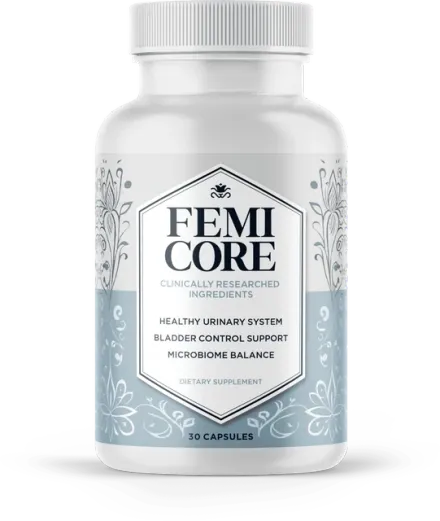
At a glance
- Refund window
- 60 days
- 60 days from delivery
- Lowest per bottle
- $49
- in the 6 bottles package
- Category
- Women's Wellness
- Our score
- 4.2 / 5
- editorial, not a customer rating
Claim reality check
| FemiCore says | What we found |
|---|---|
| "Clinically researched ingredients" | Some ingredients have been studied, mostly for other uses. No trial has tested the finished FemiCore formula. |
| "Bladder control support" | No ingredient has solid human evidence for leaks or urgency. Cranberry was studied for repeat UTIs, which is a different problem. |
| "Made in an FDA registered facility" | The seal refers to the factory, which is registered with the FDA. Like every supplement brand, FemiCore follows the FDA's dietary supplement rules rather than the approval process used for medicines. |
| "Regular price $179 per bottle" | A seller reference price. On the official store FemiCore costs $49 to $79 per bottle, depending on the package. |
This page is a lookup sheet for the FemiCore formula. Every ingredient gets the same three checks: what it is, what the research we reviewed shows, and what the label does not tell you. If you would rather read the story of the formula from start to finish, our longer article on the FemiCore ingredients list covers it in prose.
Three rules for reading this sheet
Keep these in mind for every entry below.
- Ingredient research is not product research. The label says “Clinically researched ingredients”. That refers to the ingredients in general. No trial of the finished FemiCore formula exists.
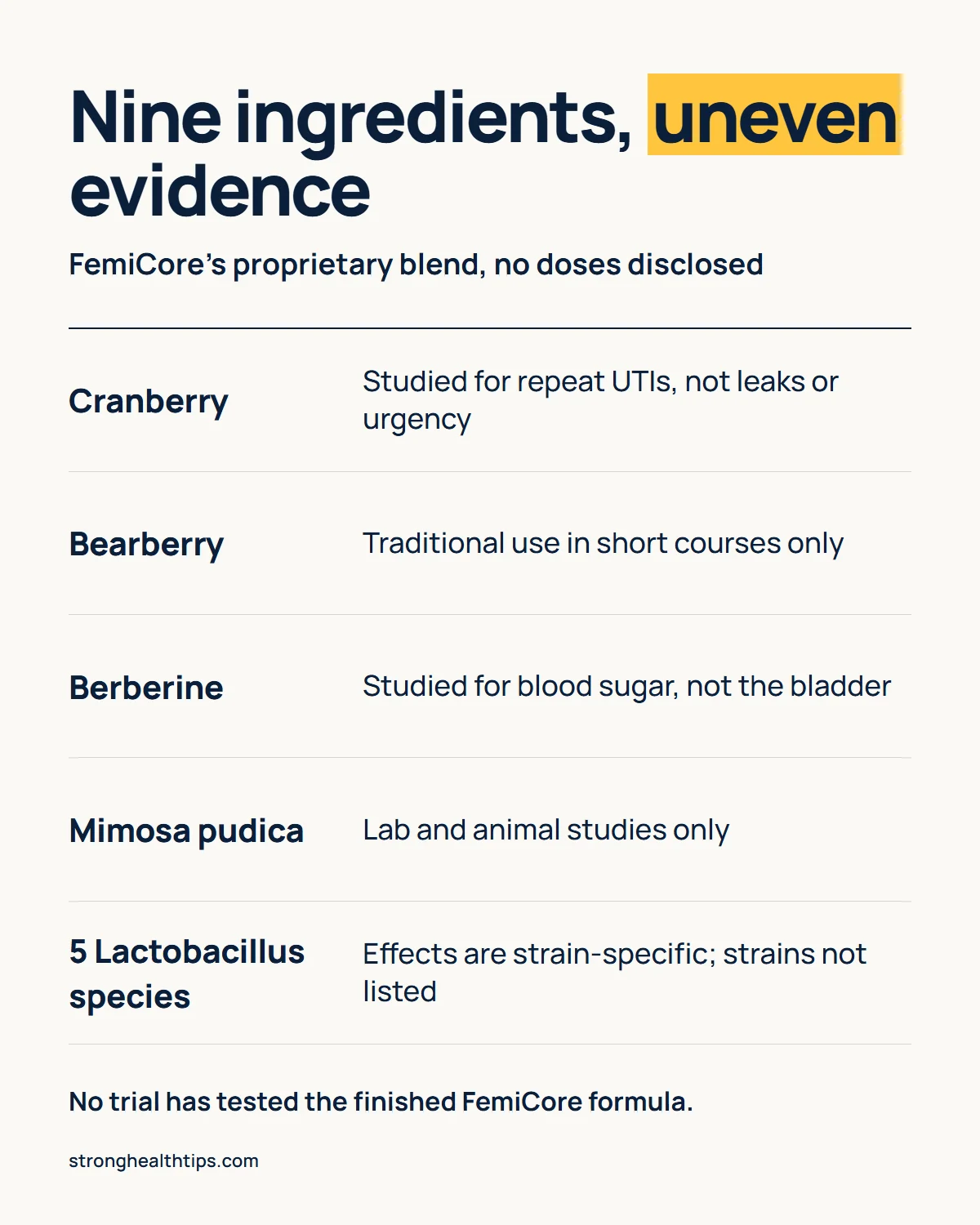
- No amounts are given. All nine sit in a proprietary blend, so we cannot check any of them against the amounts used in studies.
- Most of the human data is about infections. Cranberry, bearberry and the best Lactobacillus crispatus trial looked at urinary tract infections. FemiCore is marketed mainly for bladder control, and none of that research measured leaks or urgency.
Quick facts on the capsule:
- Format: 30 capsules per bottle, one bottle lasts one month
- How the seller says to take it: 1 capsule every morning with a big glass of water
- Blend: proprietary, ingredient names only
- Seller statements: no stimulants, non-GMO
- Label claims: “Healthy urinary system”, “Bladder control support”, “Microbiome balance”
Summary table
| # | Ingredient | Group | Best human evidence we found | Relevance to bladder control | Amount on label |
|---|---|---|---|---|---|
| 1 | Mimosa pudica | Plant | None (lab and animal only) | Not studied in people | Not shown |
| 2 | Bearberry (uva ursi) | Plant leaf | Limited and mixed, for urinary infection | Not studied for leaks | Not shown |
| 3 | Cranberry extract | Fruit extract | 2023 Cochrane review on repeat UTIs | Studied for infections, not leaks | Not shown, no PAC figure |
| 4 | Granular berberine | Plant compound | Good data for blood sugar and cholesterol | Bladder evidence lacking | Not shown |
| 5 | Lactobacillus crispatus | Probiotic | Small trial of a vaginal product for repeat UTIs | Indirect | No CFU, no strain code |
| 6 | Lactobacillus acidophilus | Probiotic | Not tested for bladder symptoms in what we reviewed | Unknown | No CFU, no strain code |
| 7 | Lactobacillus plantarum | Probiotic | Not tested for bladder symptoms in what we reviewed | Unknown | No CFU, no strain code |
| 8 | Lactobacillus gasseri | Probiotic | Not tested for bladder symptoms in what we reviewed | Unknown | No CFU, no strain code |
| 9 | Lactobacillus casei | Probiotic | Not tested for bladder symptoms in what we reviewed | Unknown | No CFU, no strain code |
The seller's offer
Compare this sheet with the label on the official page
The seller's page shows the same nine ingredient names, so you can check them against this table yourself.
View the FemiCore labelThe four plant ingredients
Mimosa pudica
What it is. A plant ingredient, listed first in the blend.
What research shows. Lab and animal studies report anti-inflammatory, antimicrobial and antispasmodic effects. We found no human trials for bladder symptoms. Of the nine ingredients, this one has the thinnest evidence.
Not disclosed. The amount per capsule.
Bearberry (uva ursi)
What it is. A leaf herb that contains arbutin. In the body, arbutin is turned into hydroquinone, which ends up in the urine and is antibacterial in lab tests.
What research shows. Human evidence is limited and mixed. European herbal regulators accept it as a traditional remedy for mild lower urinary complaints, but only in short courses of about a week, not for continuous use.
The mismatch. FemiCore is a daily capsule, and the vendor advises taking it for at least 3 months. Without a stated amount, you cannot tell how that sits with short-course guidance. Our FemiCore safety page covers who should avoid bearberry.
Not disclosed. The bearberry amount and its arbutin content.
Cranberry extract
What it is. A fruit extract whose A-type proanthocyanidins (PACs) reduce how well E. coli bacteria stick to the urinary tract.
What research shows. The 2023 Cochrane review found cranberry products can reduce repeat UTIs in women who are prone to them. Earlier reviews were mixed, and the effect depends on the PAC dose. It was studied for infections, not for leaks or urgency.
Not disclosed. The extract amount and the PAC content, which is the number that matters most for cranberry.
Granular berberine
What it is. A plant compound.
What research shows. Berberine has good human data for blood sugar and cholesterol, from studies using roughly 1,000 to 1,500 mg a day. Evidence for the bladder is lacking.
Why it matters for safety. Berberine accounts for most of the possible drug interactions in this formula, including with diabetes medicine and drugs broken down by the CYP3A4 and CYP2D6 liver enzymes.
Not disclosed. The berberine dose.
The five probiotic species
Lactobacillus crispatus
What it is. A Lactobacillus species, and the one with the most relevant research behind it.
What research shows. Since about 2012, sequencing studies from Loyola University Chicago and others have found that the female bladder is not sterile. Some of those studies saw fewer Lactobacillus in women with urgency incontinence. Separately, a small placebo-controlled trial found an L. crispatus product reduced repeat UTIs. That product was used vaginally, not swallowed, and it measured infections, not bladder control.
Not disclosed. The CFU count and the strain code.
L. acidophilus, L. plantarum, L. gasseri and L. casei
What they are. Four more Lactobacillus species, named by species only.
What research shows. In the research we reviewed for this page, none of these four was tested for bladder symptoms. The wider urinary microbiome idea is plausible but early. It does not show that swallowing probiotics changes bladder symptoms.
Why strain codes matter. Probiotic effects are strain-specific. A species name tells you the family, not the exact organism that was studied.
Not disclosed. CFU counts and strain codes for all four.
What the label leaves out
These are the items we looked for and could not find on the label or the official site:
- Individual doses for all nine ingredients
- The probiotic CFU count
- Probiotic strain codes
- Cranberry PAC content
- Bearberry arbutin content
- Berberine dose
- A certificate of analysis
| Missing item | Why it matters to you |
|---|---|
| CFU count | You cannot tell how many live bacteria a capsule holds or compare it with another probiotic |
| Strain codes | Effects are strain-specific, so research on a species may not apply |
| Cranberry PAC content | The cranberry effect depends on PAC dose |
| Bearberry arbutin content | Bearberry guidance is for short courses, and the amount decides how much that matters |
| Berberine dose | Human studies used about 1,000 to 1,500 mg a day, and the dose also shapes interaction risk |
| Certificate of analysis | There is no published test result showing what is actually in the capsule |
If those gaps matter to you, there is a simple way to act on them:
- Write down the three numbers that matter most to you, for example CFU count, PAC content and berberine dose.
- Ask the seller’s support team for them before you order.
- If you take regular medicine, show the nine names to your pharmacist, with berberine at the top.
- Decide with the answers in hand, or without them if none come back.
The seller's offer
Read the full ingredient panel before you decide
The official page lists the blend, and every package comes with a 60-day refund window counted from delivery.
See the ingredient panelSeals shown next to the ingredients
The official site shows five seals: GMP Certified, Made in USA with imported ingredients, Natural ingredients, Made in an FDA registered facility, and Non-GMO. The site does not name the manufacturer or the certifier. “Made in an FDA registered facility” refers to the factory’s registration with the FDA. The FDA does not pre-approve supplements of any brand, so the seal is about where FemiCore is made. Our FemiCore official website guide explains how to read each seal.
What this means for the formula as a whole
The two ingredients with the most relevant human data, cranberry and L. crispatus, were studied for repeat infections. The ingredient with good human data, berberine, was studied for something else. The rest have little or no human research for the bladder. That is the honest shape of the evidence. To see how each seller claim lines up with it, read the FemiCore benefits page. For how we weigh ingredient evidence, see our methodology, and for our verdict, see the FemiCore review.
Official FemiCore packages
Prices as listed on the official store when we checked. The crossed-out figure is the seller's own "regular" price, a reference price rather than what anyone pays.
2 bottles

$158$358
$79 per bottle
Seller lists a $200 saving
- 2-month supply
- US shipping $9.99
- 60-day refund from delivery
3 bottles
$207$537
$69 per bottle
Seller lists a $330 saving
- 3-month supply
- Free US shipping
- 60-day refund from delivery
6 bottles
$294$1074
$49 per bottle
Seller lists a $780 saving
- 6-month supply
- Free US shipping
- 3 bonus guides
- 60-day refund from delivery
Decided?
See the current FemiCore price and guarantee
$49 to $79 per bottle, depending on the package. Refund window: 60 days from delivery.
Check FemiCore on the official siteQuestions people ask
Is FemiCore a probiotic or an herbal supplement?
It is both. Four of the nine ingredients are plant based (Mimosa pudica, bearberry, cranberry extract and berberine) and five are Lactobacillus probiotic species, all in one capsule.
Why does the FemiCore label not show doses?
The ingredients sit in a proprietary blend, which lists names without amounts. That means you cannot compare any ingredient with the amounts used in studies, including the berberine studies that used about 1,000 to 1,500 mg a day.
Does "clinically researched ingredients" mean FemiCore was tested in a trial?
No. The phrase refers to research on the individual ingredients in general. We found no trial of the finished FemiCore formula for bladder control or any other outcome.
Which FemiCore ingredient has the weakest evidence?
Mimosa pudica. The reports we found are lab and animal studies describing anti-inflammatory, antimicrobial and antispasmodic effects, with no human trials for bladder symptoms.
Is the cranberry in FemiCore enough to prevent urinary infections?
Nobody outside the company can say, because the PAC content is not disclosed and the 2023 Cochrane review found the effect depends on PAC dose. Cranberry is also a prevention idea, not a treatment for an infection you already have.
Sources
- Williams G et al. (2023). Cranberries for preventing urinary tract infections. Cochrane Database of Systematic Reviews
- Afshar K et al. (2018). Uva-ursi for uncomplicated urinary tract infection (REGATTA trial). BJGP
- Cicero AFG, Baggioni A (2016). Berberine and its role in chronic disease. Adv Exp Med Biol
- Stapleton AE et al. (2011). Lactobacillus crispatus probiotic for prevention of recurrent urinary tract infection. Clinical Infectious Diseases
- Pearce MM et al. (2014). The female urinary microbiome in women with and without urgency urinary incontinence. mBio
- Wolfe AJ et al. (2012). Evidence of uncultivated bacteria in the adult female bladder. Journal of Clinical Microbiology
Not medical advice. This page is general information and does not replace a consultation with a qualified healthcare professional who knows your history. Full disclaimer.
Written by
Strong Health Tips Editorial Team
We check every claim against the seller's own pages, terms and refund policy, and against published research, then write it up in plain English. Our methodology.