The Genius Song by Dr Lake: The Pen Name, the Credentials and What They Mean for You
The Genius Song by Dr Lake, checked: the site's disclaimer says Robert Lake is a pen name. How the NASA and clinic claims compare and what it means.
- Author
- Strong Health Tips Editorial Team
- Published
- Reading time
- 10 min read
Affiliate disclosure: this review contains links to the official The Genius Song website. If you buy through them we may earn a commission at no extra cost to you. It does not change our assessment. Details.
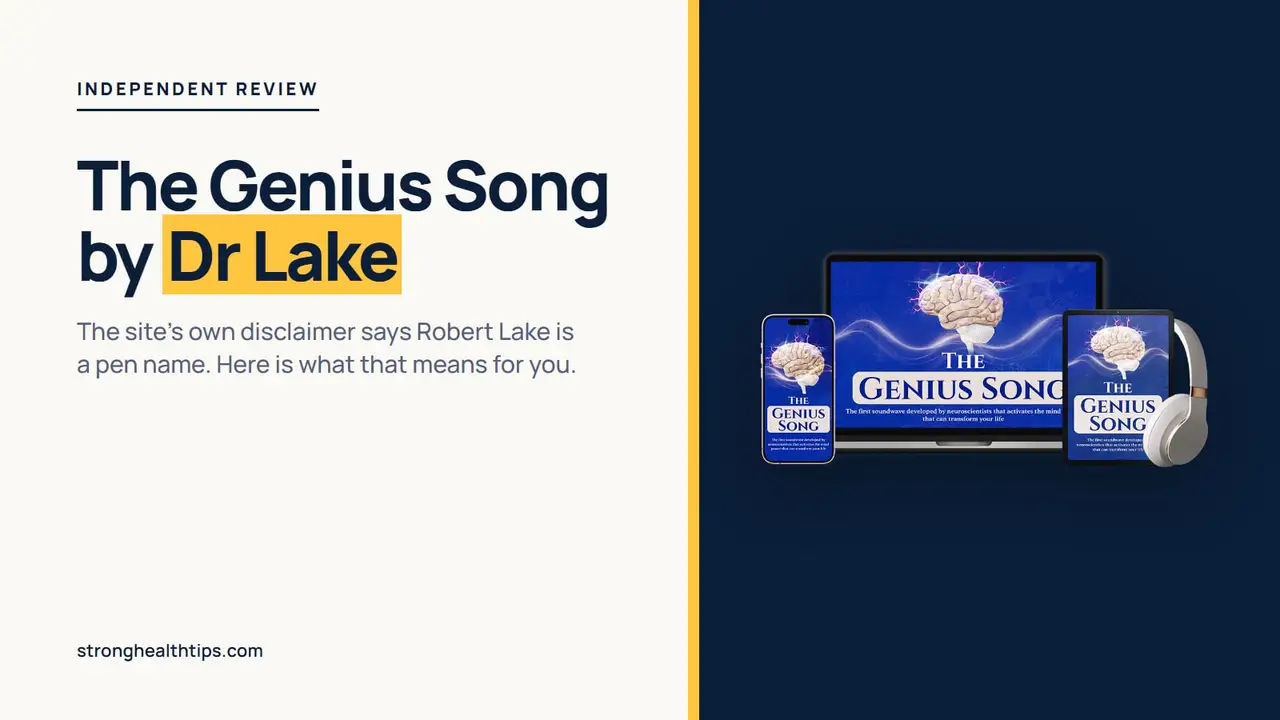
The sales video takes less than two minutes to introduce its narrator: “My name is doctor Robert Lake.” That line is why so many people search for the Genius Song by Dr Lake. They want to know who the man is, and whether his background makes a $39 audio track more believable. The answer starts somewhere most viewers never scroll to, the small print at the bottom of the sales page.
This guide puts the presenter’s claims about himself next to the seller’s own disclaimer and Terms of Sale. It explains what a pen name does and does not tell you, and what to weigh instead when the expert in an advert cannot be identified.
Before you decide
A short digital audio track, $39 one-time, sold through ClickBank.
The seller’s Terms and the ClickBank checkout both give a 90-day refund window.
Visit the official websiteWhat the disclaimer actually says
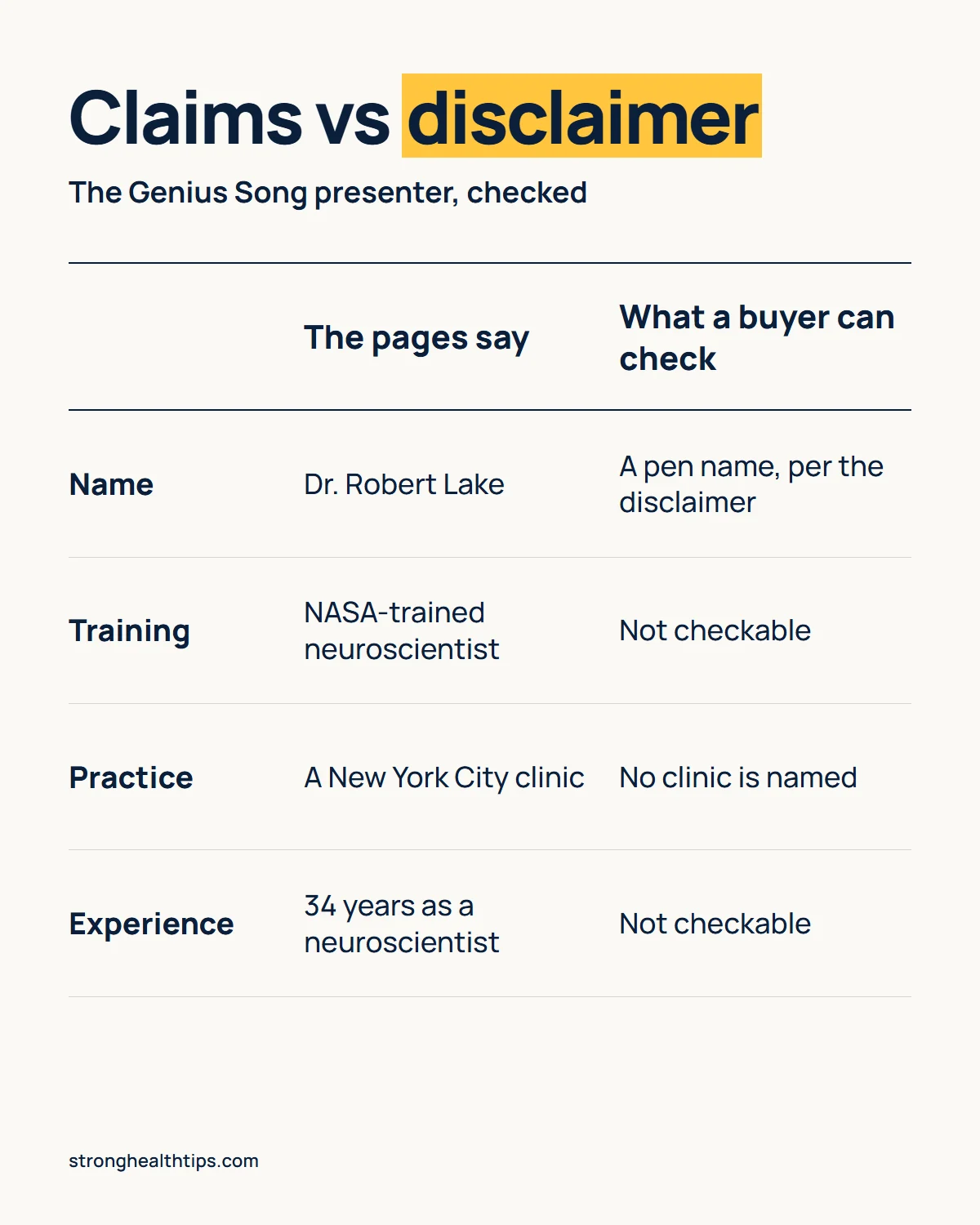
At the foot of the seller’s sales page and its text version sits a short paragraph. It reads: “Robert Lake is a pen name used with the consent of our leading neuroscientist, who wishes to maintain personal privacy for himself and his family.” The text version writes “Dr. Robert Lake”. The next sentence adds: “The qualifications and credentials attributed to this name are genuine and verified.”
So the accurate way to describe him is as the presenter, who uses the pen name Dr. Robert Lake (the site says so in its disclaimer). By the seller’s own account, the name on screen does not belong to a real person. The “leading neuroscientist” behind it is not named anywhere we looked. The line that the credentials are “genuine and verified” arrives with no detail an outsider could test. Verified by whom, and against which records, is not said.
None of this is hidden, in the sense that it is printed on the page. But the video runs for more than 39 minutes and never says it aloud, and the paragraph sits below the order section, where few viewers look.
The credentials claimed for the presenter
Claims about the presenter come from three places: the video, the text version of the sales page and that page’s headline. Here is what each one says.
| Claim | Where it appears | Can a buyer check it? |
|---|---|---|
| “Top NASA Scientist” | Headline of the text page | No, the real person is not named |
| “NASA-Trained Neuroscientist” | Text page, under the name | No |
| A “New York City clinic” | Video, at about 18 minutes | No, no clinic is named |
| “Thirty four years as a neuroscientist” | Video, at about 24 minutes | No |
| “Consulted corporations and worked with celebrities and athletes” | Video, at about 24 minutes | No |
| A lab team (“my PhDs”) built the track | Video, at about 9 minutes | No |
Any of these may be true of the real person. The point is narrower. With a pen name in place, there is no public record to compare them with. A real name lets you look up papers, a license or a clinic listing. A pen name closes that door, and the disclaimer says it does so on purpose.
The story also shifts between versions of the pitch. In the video, the breakthrough begins when a colleague hands the presenter “a stunning report from Princeton”. On the text page, the same moment involves “a forgotten study by NASA”. A credential that moves between two versions of the same advert is harder to lean on, not easier.
Why a seller might use a pen name
The disclaimer gives one reason: privacy for the neuroscientist and his family. That is a reasonable wish on its own terms. Plenty of experts would rather not attach their real name to a long sales video.
From the buyer’s side, though, a pen name changes what the presenter’s authority is worth. The text page has him say: “My reputation is everything, and I would only ever attach my name to a product if I 100% believe in it.” That promise only works if you know whose reputation is on the line. When the name is invented, the reputation behind it cannot be tested, so it should count for little in your decision.
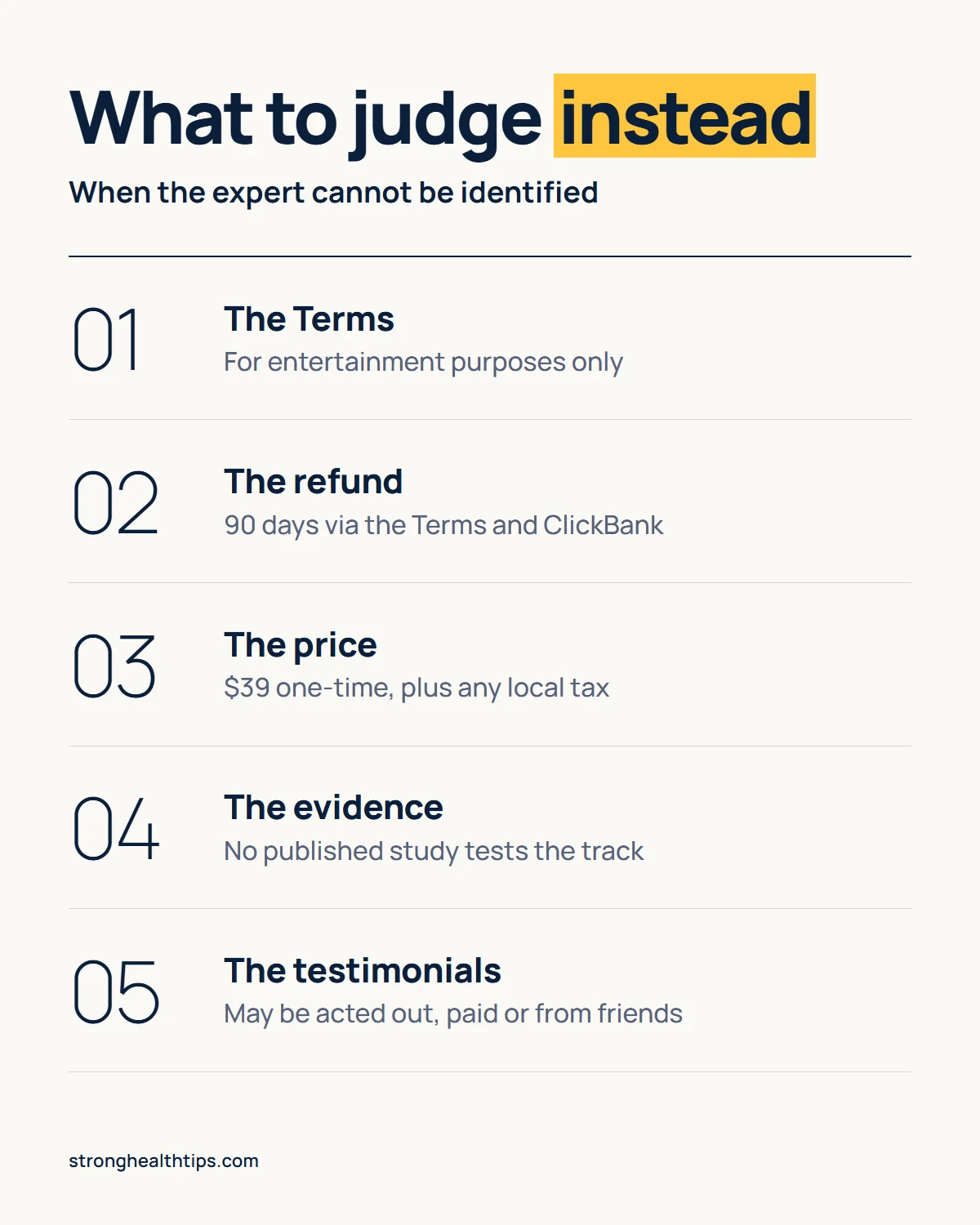
The Terms of Sale take the same approach to everyone else in the marketing. They say names “have been changed to protect the privacy of those involved”, that “We use pen names for this purpose”, and that “Some aspects of the marketing have been dramatized for entertainment effect.”
The testimonials follow the same rules
The video features listeners such as “Rachel, a nurse from Tustin, California”, “Michael in Dallas” and “Hannah from Manhattan”, and its question-and-answer section names people from several cities. The Terms explain how to read all of them:
- Names “have been changed”, and the seller uses pen names.
- Feedback may be acted out by “digital representations, avatars, or actors”.
- People were “compensated” for letting the seller highlight their experiences.
- Some testimonial givers may be “early supporters, friends, or family members of the company’s founders”, which the Terms disclose as a “material connection”.
- The results shown “are exceptional results and may not reflect the experience of a typical customer”.
Add the presenter’s pen name, and nearly every person in the marketing is either anonymous, dramatized or tied to the company. That does not prove the stories are false. It does mean none of them is independent evidence. The FTC’s guides on endorsements and testimonials exist because connections like these change how a reasonable buyer should read an advert.
Read the fine print yourself
The disclaimer and the Terms are on the seller’s own site.
$39 one-time. Refund requests within 90 days, under the Terms and at ClickBank.
Check the current price on the official siteWhat the presenter says the track does
Who he is matters less than what he promises, and the promises are large. The video says adults’ “gamma” brain wave has been switched off by modern life. It says a sound wave using “brain entrainment” can switch it back on “by connecting several regions of your brain to each other”, and that the result fits into a “seven minute sound wave”. Claimed outcomes run from eureka moments, faster learning and better memory to luck, money, promotions, weight loss, quitting smoking and migraines that disappear. “It starts working the very first time you listen to it,” he says.
The opening goes further: “MIT found that all lucky, wealthy, successful people have this one brain wave in their mind at all times.” We found no published study that shows this.
On one story the presenter is careful. Describing a win at a casino, he says “there is, of course, no evidence to support that the genius song caused that”. The same caution fits the whole list. No published study tests The Genius Song track. Research on brain-wave audio in general is mixed: a 2019 meta-analysis of binaural beats found a medium overall effect on some outcomes, while a 2023 review found most studies did not show entrainment.
The seller’s Terms hold two statements side by side. One says “All claims regarding brainwave entrainment, focus, and mental energy are substantiated by established scientific research.” The other, under the heading “For Entertainment Purposes Only”, says “brain entrainment is not an exact science” and that “The products are provided for entertainment purposes only.” The second is the frame we would use.
What to judge instead of the name
When the expert cannot be identified, base the decision on the parts of the offer you can check.
- The product. A digital audio track the seller says lasts 7 minutes, used with headphones once a day. The seller describes delivery both as a download sent by email and as a “Private Audio Portal” with login details, so expect one or both.
- The price. The Terms of Sale state $39. The order box shows $200, $100 and $49 crossed out; those are the seller’s reference prices.
- The refund. The Terms allow refunds on digital products requested within 90 days, and the ClickBank checkout states a 90-day window. A separate refund page on the site, at /TOS/refunds/, is a leftover policy for “NeuroActivate” bottles, with 60 days and an Ohio return address. It does not fit a digital track, so use ClickBank’s route.
- The bonuses. They differ between the seller’s pages. The video promises “three free bonuses” but names four: “The Genius Child” audio for kids, a classic book on financial success, a guided visualization from a creator the seller calls top-rated on the Calm app, and a printable infographic of five habits. The text page promises four and lists three, without The Genius Child.
- The fine print. Entertainment purposes only, buyers must be 18 or older, and buying adds you to email lists that may promote third-party offers.
Where the presenter’s video actually sits
Our links pass through ClickBank to the seller’s site. The official site’s home page currently features the seller’s related audio, The Genius Wave, and The Genius Song presentation is on the same site’s /video/ page. The seller’s pages describe them as separate products, so check that the checkout names The Genius Song before you pay. The checkout lists the card statement as CLKBANK*Genius Song, and ClickBank order support is on 1-800-390-6035. Product questions go to [email protected].
If you want to try it
Go in for the audio, not for the presenter’s title.
Keep your ClickBank receipt so the 90-day refund stays easy to use.
Visit the official websiteListening safely, whoever made it
A pen name says nothing about safety, so here is our own advice for any brain-wave audio:
- Keep the volume comfortable. Long exposure to loud sound through headphones can damage hearing, as the NIDCD explains.
- Never listen while driving or operating machinery. The video asks you to close your eyes and relax; do that sitting or lying somewhere safe.
- Epilepsy, a seizure history or hearing problems: ask a doctor first. That includes tinnitus and hearing aids.
- Do not use it in place of treatment. The site’s own line says the product “is not intended to diagnose, treat, cure or prevent any disease”.
For the company and support contacts behind the track, see who stands behind The Genius Song. For how the seller’s testimonials hold up against its Terms, see the testimonials, checked, and for our full scorecard, our complete verdict.
If stress is the real reason you are looking, the free basics in our guide on how to manage daily stress are worth trying alongside, or before, any track.
Our verdict on the Dr Lake question
The Genius Song by Dr Lake is really The Genius Song by an unnamed neuroscientist, presented under a pen name the site discloses in its footer. The credentials attached to that name may be real, but you cannot check them, so they should not be the reason you buy.
What remains is checkable: a $39 track the seller says runs 7 minutes, a real ClickBank checkout, a 90-day refund window in two places, and a Terms page that calls the product entertainment. Our editorial score, which is ours and not a customer rating, is 3.5 out of 5. The price, the checkout and the refund terms lift it; the anonymous presenter, the dramatized testimonials and the unproven claims hold it back.
If the idea of a short daily listening habit appeals to you, it is a modest, refundable experiment. If you were persuaded mainly by the NASA and clinic story, read this page again before you pay.
We are independent, not the seller, and we may earn a commission if you buy through our links.
Decide on the facts
$39, ClickBank checkout, 90 days to change your mind.
The seller’s Terms call the product entertainment. Our score: 3.5 out of 5.
Check the current price on the official siteQuestions people ask
Does the site say who Dr. Robert Lake really is?
No. It only says the name is not real. The disclaimer at the foot of the seller's sales pages says Robert Lake is a pen name used with the consent of the company's leading neuroscientist, who wants privacy for himself and his family. The real person is not named, so we cannot confirm who presents the video or what his background is.
Is the presenter really a NASA scientist?
The text version of the sales page calls him a NASA-Trained Neuroscientist, and its headline says Top NASA Scientist. Because the name is a pen name and the real person is not named, nobody outside the company can check that. Treat it as an unverified seller claim.
Where on the site is the pen-name disclaimer?
In the footer of the sales video page and of the text version, below the order section. The same paragraph says the qualifications and credentials attributed to the name are genuine and verified, without saying who verified them or how.
Does a pen name mean the audio does nothing?
No. The name tells you nothing about the audio either way. No published study tests the track, so the only real test is your own experience inside the 90-day refund window.
Are the people in the video testimonials real?
The Terms say names are changed, feedback may be acted out by digital representations, avatars or actors, some people were compensated, some are early supporters, friends or family of the founders, and the results shown are exceptional. Read the stories as advertising, not as independent reports.
How do I get my money back if the track is not for me?
The Terms allow refunds on digital products requested within 90 days of the initial purchase, and the ClickBank checkout states the same 90-day window. Contact ClickBank order support on 1-800-390-6035 with the order number from your receipt. Ignore the site's NeuroActivate bottle refund page; it does not fit a digital track.
Sources
- FTC: Guides concerning the use of endorsements and testimonials in advertising
- Garcia-Argibay M et al. (2019). Efficacy of binaural auditory beats in cognition, anxiety, and pain perception: a meta-analysis. Psychological Research
- Ingendoh RM et al. (2023). Binaural beats to entrain the brain? A systematic review of the effects of binaural beat stimulation on brain oscillatory activity. PLOS ONE
- NIDCD: Noise-induced hearing loss
- FTC: Shopping online, avoiding scams and protecting your payment
Not medical advice. This guide is general information and does not replace a consultation with a qualified healthcare professional who knows your history. Full disclaimer.
Written by
Strong Health Tips Editorial Team
We research, write and fact-check every guide against current guidance from major health bodies and peer-reviewed studies, then rewrite it in plain English. How we work.