Reviews on The Genius Song: Seven Big Claims Checked One by One Against the Evidence
Reviews on The Genius Song, taken claim by claim: memory, focus, luck, money, weight, smoking and pain, with what a review can show and what the evidence says.
- Author
- Strong Health Tips Editorial Team
- Published
- Reading time
- 10 min read
Affiliate disclosure: this review contains links to the official The Genius Song website. If you buy through them we may earn a commission at no extra cost to you. It does not change our assessment. Details.
If you are reading reviews on The Genius Song, you have probably noticed that they talk about very different things. One person mentions sharper recall, another a lucky break, another a lost habit. That is because the sales video itself attaches a short audio track to a long list of outcomes. A star rating cannot tell you which of those outcomes hold up, so this article does something more useful: it takes the seven biggest claims one at a time and asks two questions of each. What could a review honestly tell you about it, and what does the evidence say?
We worked from the seller’s own material only: the 39-minute sales video, the written sales page, the Terms and the ClickBank checkout. We did not buy the track, so we report the seller’s descriptions of it as descriptions.
Before the claims
One audio track the seller says runs about 7 minutes. $39 once, 90 days to ask for a refund.
Sold through a ClickBank checkout, shown in your local currency plus tax.
Visit the official websiteWhy sorting by claim beats counting stars
A review usually blends three things: the experience of listening, the experience of buying, and a belief about cause and effect. The first two are easy to report honestly. The third is where almost every audio product falls apart, because the person writing has no way to know what would have happened anyway.
So when you read a glowing or a scathing account, it helps to ask which of the three it is really about. “It arrived in minutes and the refund went through” is checkable. “I got promoted the week I started listening” is a coincidence until someone tests it properly.
The seven claims and where they come from
Here is each claim in the seller’s own framing, with the rough point in the sales video where it appears.
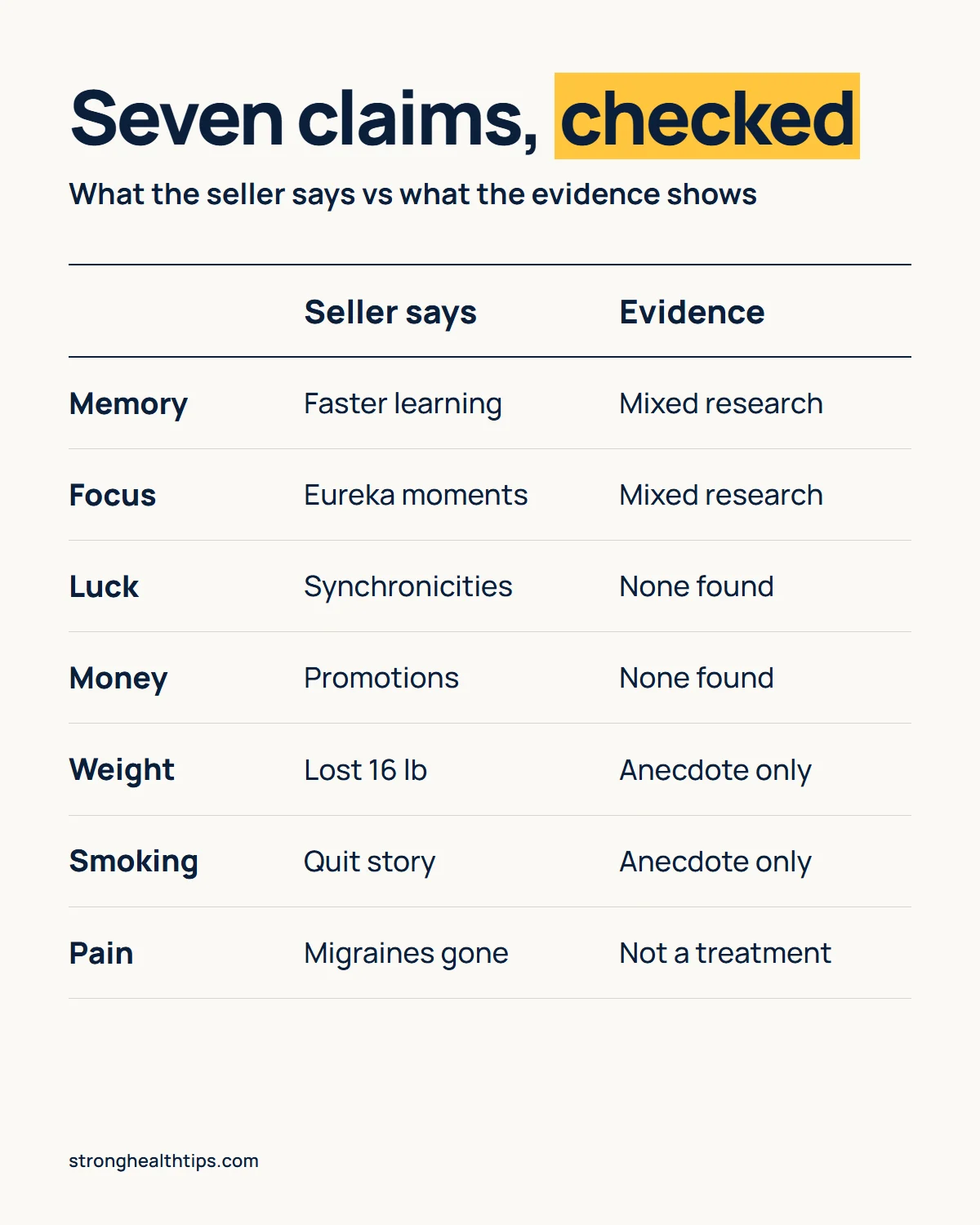
| Area | What the seller says | Where |
|---|---|---|
| Memory | Faster learning and better memory | Throughout the video |
| Focus | Eureka moments; problems solved “with little to no effort” | Throughout the video |
| Luck | Lucky breaks and “synchronicities” | Throughout; casino story near 29 minutes |
| Money | “Abundance”, promotions, a signing bonus, a business that let someone quit a job | Around 9 to 14 minutes |
| Weight | A colleague who lost 16 pounds | About 10 minutes |
| Smoking | A colleague who quit smoking | About 10 minutes |
| Pain | Migraines that disappeared; joint pains | About 9.5 and 32 minutes |
The video also sets a timetable: “It starts working the very first time you listen”, many customers notice a difference “within the first two to three days”, and most daily listeners “begin to see results within a couple weeks”. Those are the seller’s statements, not measured results.
The seven claims, one at a time
Memory and learning
What a review can tell you: whether the listener felt clearer or more alert afterwards, which is a fair and personal observation.
What the evidence says: gamma waves are real brain rhythms, roughly 30 to 100 Hz, that research links to attention and memory processing. That is a long way from showing that a recording can switch them on in a lasting way. A 2019 meta-analysis of binaural auditory beats found a medium overall effect on cognition, anxiety and pain perception, but a 2023 review found that most studies did not show the brain falling into step with the beat. Nobody has published a study of this track.
Focus and “eureka moments”
What a review can tell you: that seven quiet minutes with eyes closed felt good. Many people find any short pause calming, and that is worth something.
What the evidence says: long-term meditators have been recorded producing high-amplitude gamma activity during mental practice (Lutz and colleagues, 2004). That finding is about years of meditation training, not about listening to a track, and it does not show that gamma causes insight.
Luck
What a review can tell you: nothing about cause. Luck is the outcome a single story is least able to explain.
What the evidence says: the video opens with the line that “MIT found that all lucky, wealthy, successful people have this one brain wave”. We found no published study that shows this. And the presenter, describing a casino win, says it himself: “there is, of course, no evidence to support that the genius song caused that.”
Money and promotions
What a review can tell you: very little. A raise depends on an employer, a market and years of work.
What the evidence says: no study connects any brain-wave product to income. The money stories in the video, such as “Michael in Dallas” and “Hannah from Manhattan”, are part of the marketing that the Terms describe in plain words, which we cover below.
Weight loss
What a review can tell you: whether a listener happened to lose weight in the same period. It cannot separate the track from diet, activity or chance.
What the evidence says: the 16-pound story is an anecdote told by the presenter about a colleague. There is no trial behind it, and the site’s own line says the product “is not intended to diagnose, treat, cure, or prevent any disease”.
Quitting smoking
What a review can tell you: that someone quit, which is great news for them, but not why.
What the evidence says: none on this track. An audio product the seller sells for entertainment is not a quit plan, so if you are trying to stop, talk to your doctor about support.
Pain and migraines
What a review can tell you: that a listener had fewer headaches for a while. Headaches come and go for many reasons.
What the evidence says: the meta-analysis title includes pain perception, but the overall picture for auditory beats remains mixed, and nothing tests this recording. Persistent migraines or joint pain belong with a doctor.
What a review can and cannot prove
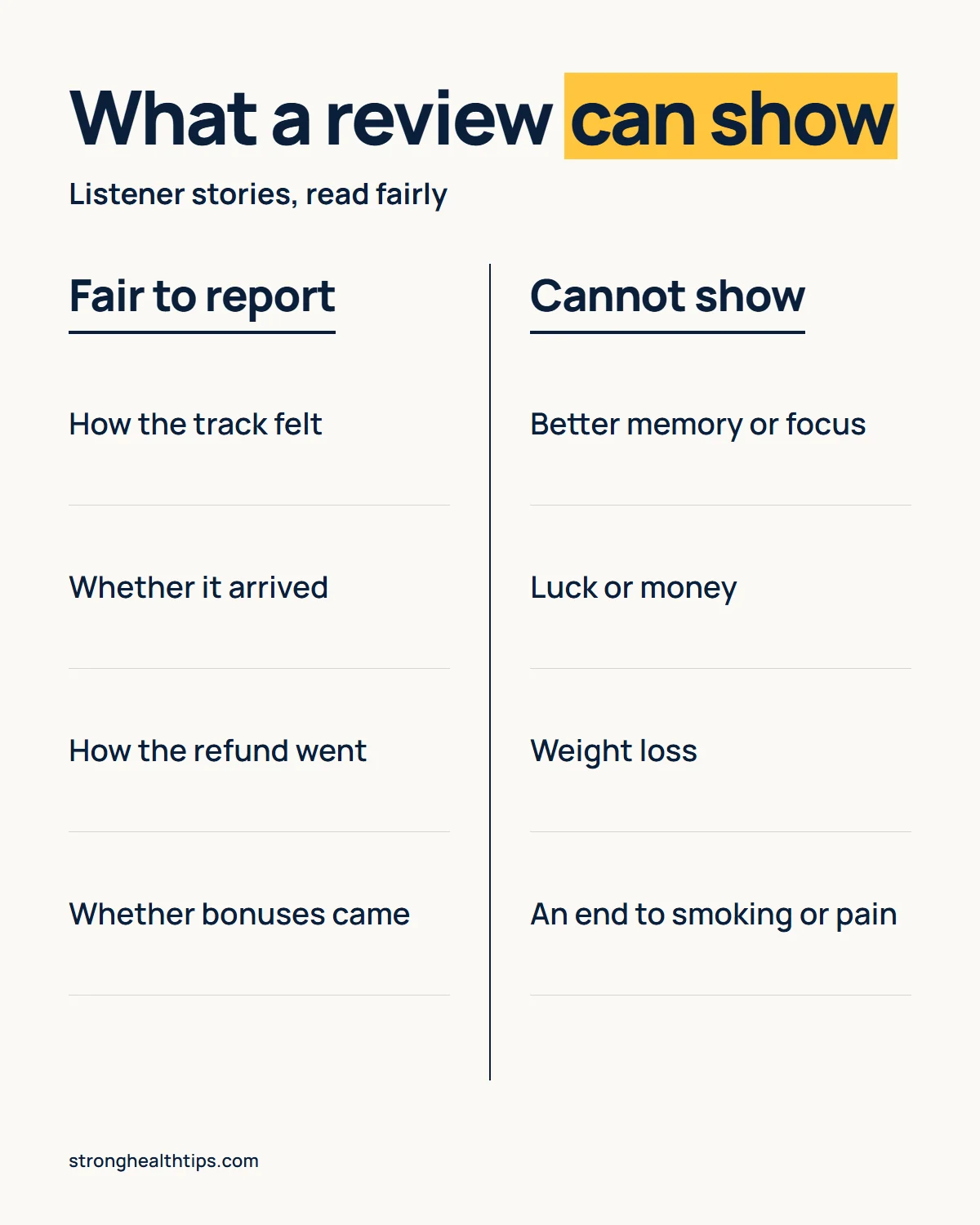
Put together, the seven claims fall into two groups.
| A review can fairly report | A review cannot show |
|---|---|
| How the track felt to listen to | That it raised memory or focus |
| Whether it arrived after checkout | That it caused luck or money |
| How easy the refund was | That it caused weight loss |
| Whether the bonuses showed up | That it ended smoking or pain |
That split applies to praise and complaints alike. A one-star post blaming the track for a bad month is as weak as a five-star post crediting it for a good one.
Judge it yourself
If you try it, judge how it feels, not what happens to your bank balance.
Refund requests within 90 days under the Terms and the ClickBank checkout.
Check the current price on the official siteWho is speaking in the seller’s own testimonials
The video is fronted by the presenter, who uses the pen name Dr. Robert Lake (the site says so in its disclaimer). The written page calls him a “NASA-Trained Neuroscientist”, but the disclaimer at the foot of the same page says the name is a pen name, so we do not treat any of those credentials as established.
The people quoted are just as hard to pin down. The video names “Rachel, a nurse from Tustin, California”, among others, and the FAQ section attributes questions to listeners in several cities. The Terms explain how to read all of them. They say names “have been changed”, that “some aspects of the marketing have been dramatized”, that feedback may be acted out by “digital representations, avatars, or actors”, that people were “compensated” for letting the seller highlight their experiences, and that some may be “early supporters, friends, or family members of the company’s founders”. They also call the results “exceptional” and not typical.
The seller’s customer figures do not line up either. The video says the track has helped “eighteen thousand three hundred sixty six” Americans, while the headline of the written page says 19,389. Neither number is verified.
The fine print that frames every claim
Two lines in the Terms sit side by side and are worth reading together. A section headed “For Entertainment Purposes Only” says “brain entrainment is not an exact science” and that “the products are provided for entertainment purposes only”. The same document also claims that all claims about brainwave entrainment, focus and mental energy “are substantiated by established scientific research”. The first sentence is the one that matches what we found.
Other details matter if you are weighing a purchase:
- The bonuses differ between the seller’s pages. The video promises “three free bonuses” and then names four: an audio for children called “The Genius Child”, an old book on financial success, a guided visualization from a creator on the Calm app, and a printable infographic of five habits. The written page promises four and lists three, without the children’s audio.
- Delivery is described two ways. The video says the track is emailed within minutes; the written page talks about a “Private Audio Portal” with login details by email. We cannot tell you which you get.
- The refund is 90 days. That comes from the Terms and the ClickBank checkout. A separate page at /TOS/refunds/ describes NeuroActivate bottles and does not fit a digital product, so use ClickBank’s refund route.
If you want to look at the offer yourself, note one oddity first. The official site’s home page currently features the seller’s related audio, The Genius Wave, and The Genius Song presentation is on the same site’s /video/ page. They are presented as separate products: a 12-minute theta audio on the home page and a 7-minute gamma track on /video/.
Know where you land
The home page shows a different audio. The Genius Song presentation sits on the /video/ page.
Statement line: CLKBANK*Genius Song. Keep the ClickBank receipt.
Visit the official websiteListening safely
This is our advice for any audio track sold for the brain. Keep the volume at a comfortable level; the NIDCD notes that loud sound over time can damage hearing. Do not listen while driving or operating machinery. If you have epilepsy, a history of seizures or a hearing problem, ask a doctor first. And if stress is what sent you searching, our guide on how to manage daily stress has free habits with far more support behind them. Better sleep helps memory and focus too, and our sleep hygiene habits cost nothing to try.
Our reading of the claims
Taken claim by claim, the pattern is clear. The parts of the offer you can check, such as the price, the checkout and the 90-day refund, hold up. The outcomes in the video do not have evidence behind them, and two of the seller’s own sentences say as much: the casino remark and the entertainment-only line in the Terms.
For our overall verdict with a score for each area, see our full review, and for how to judge the other review pages you will find online, our guide to third-party verdicts.
That leaves a modest use. A short daily pause with headphones and closed eyes may feel pleasant, and the refund window makes the experiment cheap to undo. Our editorial score, which is ours and not a customer rating, is 3.5 out of 5: a refundable, low-cost audio product whose marketing runs far ahead of the research.
We are independent, not the seller, and we may earn a commission if you buy through our links. It does not change your price. If you decide to try it, start from the official website, keep your receipt and judge the track on how it feels, not on what the video promised.
Health note: No audio track treats migraines, pain, weight or smoking. Take ongoing symptoms to a doctor, keep the volume comfortable and never listen while driving.
The short version
Checkable parts hold up. The seven big claims do not have evidence behind them.
$39 one-time via ClickBank, 90-day refund window, entertainment-only per the Terms.
See the official siteQuestions people ask
Can one listener's story prove the track improved their memory?
No. A story can tell you how someone felt after listening, but memory changes with sleep, stress, practice and many other things. Only a controlled study could separate the track from everything else, and no published study tests this track.
Does the seller really claim it helps with weight and smoking?
Yes, in the sales video. It mentions a colleague who lost 16 pounds and another who quit smoking. These are anecdotes told by the presenter, not results from a study, and the site's own disclaimer says the product is not intended to diagnose, treat, cure, or prevent any disease.
Are the people quoted in the video independent customers?
We cannot treat them that way. The seller's Terms say names have been changed, that feedback may be acted out by digital representations, avatars or actors, that people were compensated, and that some may be early supporters, friends or family members of the company's founders.
What does the presenter say about the luck stories?
When he describes a casino win, the presenter says: 'there is, of course, no evidence to support that the genius song caused that.' That line is a useful filter for every other luck or money story in the video.
Is there research on gamma brain waves at all?
Yes. Gamma waves are real brain rhythms linked in research to attention and memory processing. MIT researchers have studied 40 Hz light and sound stimulation, mostly in mice bred to model Alzheimer's disease, with small early human trials. None of that work is about luck, money or this track.
How do I get my money back if the track does nothing for me?
The Terms allow refund requests on digital products within 90 days of purchase, and the ClickBank checkout states the same 90 days. Contact ClickBank order support on 1-800-390-6035 with the order number from your receipt. Ignore the separate refund page about NeuroActivate bottles.
Sources
- Garcia-Argibay M et al. (2019). Efficacy of binaural auditory beats in cognition, anxiety, and pain perception: a meta-analysis. Psychological Research
- Ingendoh RM et al. (2023). Binaural beats to entrain the brain? A systematic review of the effects of binaural beat stimulation on brain oscillatory activity. PLOS ONE
- Iaccarino HF et al. (2016). Gamma frequency entrainment attenuates amyloid load and modifies microglia. Nature
- Lutz A et al. (2004). Long-term meditators self-induce high-amplitude gamma synchrony during mental practice. PNAS
- FTC: Guides concerning the use of endorsements and testimonials in advertising
- NIDCD: Noise-induced hearing loss
Not medical advice. This guide is general information and does not replace a consultation with a qualified healthcare professional who knows your history. Full disclaimer.
Written by
Strong Health Tips Editorial Team
We research, write and fact-check every guide against current guidance from major health bodies and peer-reviewed studies, then rewrite it in plain English. How we work.