FemiCore Formula, Critiqued: The Proprietary Blend, Its Two Halves and What a Clear Label Would Show
FemiCore formula critiqued: a nine-ingredient proprietary blend, probiotic and botanical parts, why hidden doses matter and what a clear label would show.
- Author
- Strong Health Tips Editorial Team
- Published
- Reading time
- 9 min read
Affiliate disclosure: this review contains links to the official FemiCore website. If you buy through them we may earn a commission at no extra cost to you. It does not change our assessment. Details.
The FemiCore formula can be judged in two ways. One is to ask whether it works, which needs a trial that does not exist. The other is to judge it the way you would judge any design: look at the choices its makers took, ask what each choice gains and what it costs, and compare the label with what a fully open label would show. This page does the second.
It is a critique, not a mechanism explainer. If you want the science story behind the capsule, see our look at how the formula is meant to work. If you want background on each ingredient one by one, our FemiCore ingredients list covers all nine.
Judge the label yourself
See the full FemiCore ingredient list on the official site.
Nine ingredients, one capsule a day, 60 days from delivery to ask for a refund.
View FemiCore on the official siteThe brief the formula was built to
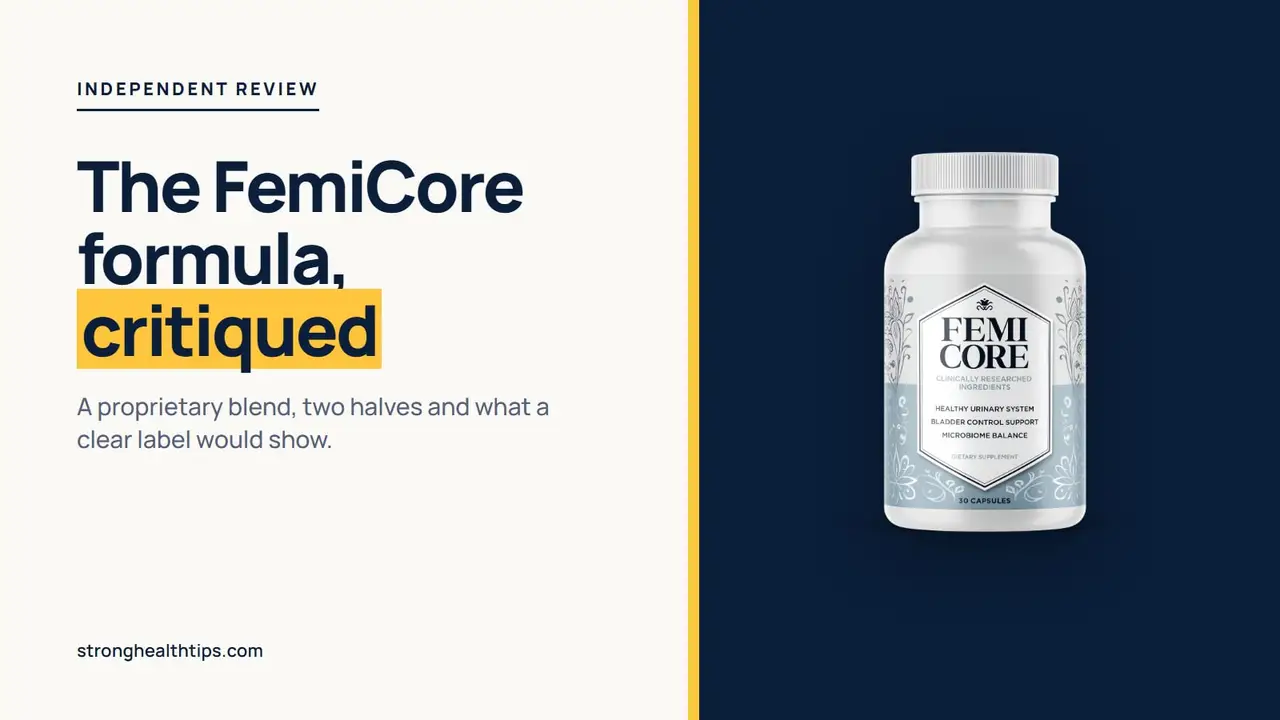
Three short label phrases set the goal: “Healthy urinary system”, “Bladder control support” and “Microbiome balance”. A fourth, “Clinically researched ingredients”, points to studies of the individual ingredients; the finished FemiCore formula has never been through a trial of its own. The seller describes the formula as free of stimulants and non-GMO.
To meet that brief, the makers chose nine ingredients and one capsule a day:
| Part | Ingredients | Amount given |
|---|---|---|
| Probiotic | L. crispatus, L. acidophilus, L. plantarum, L. gasseri, L. casei | None |
| Botanical | Mimosa pudica, bearberry (uva ursi), cranberry extract, granular berberine | None |
Every design choice below follows from that table.
Choice 1: a proprietary blend
All nine ingredients sit in a proprietary blend. The label names them but gives no amount for any of them.
What it may gain the seller: the seller gives no reason, but a blend keeps the exact recipe private and the label short.
What it costs you: almost every useful comparison. You cannot set FemiCore’s cranberry next to the cranberry in the studies. You cannot tell whether the capsule is mostly probiotic or mostly plant extract. And when you take regular medicines, your pharmacist has names to work with but no amounts.
A proprietary blend is not a sign that a product is fake. It is a sign that you are being asked to trust the maker on the numbers.
Choice 2: two formulas in one capsule
FemiCore is, in effect, a probiotic product and an herbal urinary product combined. That lets one capsule speak to two ideas at once: the newer bladder microbiome research and the long-standing use of cranberry and bearberry.
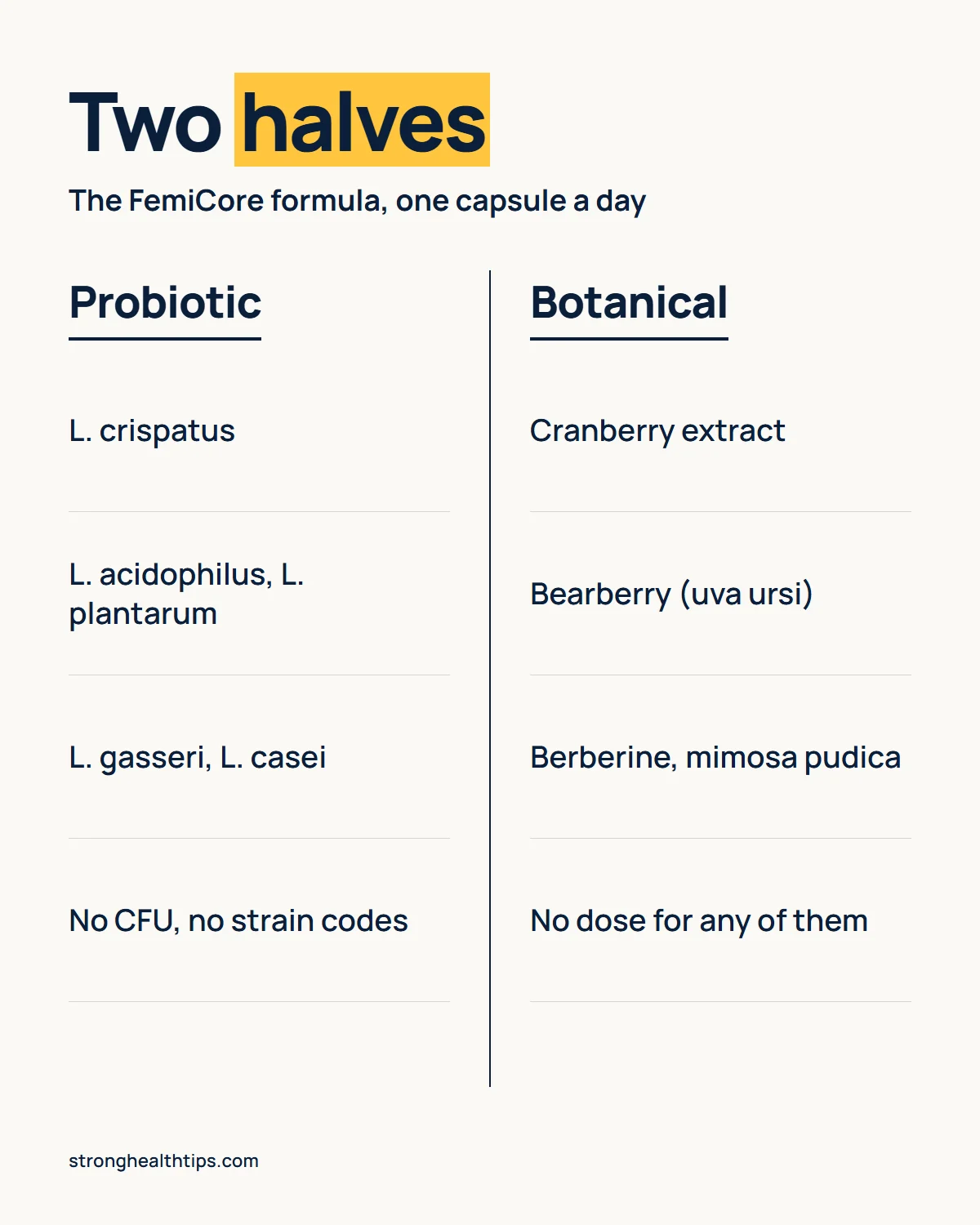
The design cost is that each half is less specified than it would be in a stand-alone product.
| Probiotic half | Botanical half | |
|---|---|---|
| What is named | Five Lactobacillus species | Four plant ingredients |
| What is missing | CFU count, strain codes | Doses, cranberry PAC content, bearberry arbutin content |
| Best evidence | A small L. crispatus trial, vaginal product | Cranberry, 2023 Cochrane review, repeat infections |
| Main open question | Do oral probiotics change bladder symptoms? | Are the doses close to the studies? |
Choice 3: nine ingredients in one daily capsule
One capsule a day is easy to follow. It also forces nine ingredients to share whatever room a single capsule has, and the label does not say how that room is divided.
Berberine shows why this matters. Where it does have solid human data, for blood sugar and cholesterol, the studies gave people roughly 1,000 to 1,500 mg a day. Whether one capsule, shared with eight other ingredients, holds anything like that is a question the label cannot answer. The same goes for cranberry, whose effect on repeat infections depends on the PAC dose.
Choice 4: species, not strains
Probiotic effects are strain-specific: a result from one strain of L. crispatus does not automatically carry over to another strain of the same species. The most relevant trial, in which L. crispatus reduced repeat urinary infections, used a specific strain in a vaginal product, not a capsule you swallow.
FemiCore names species only. That design choice means no probiotic study, positive or negative, can be matched to what is in the bottle.
Plausible, not proven
Every official FemiCore order has 60 days from delivery for a refund.
All bottles go back with the packing slip. Return postage is paid by you.
See the FemiCore packagesChoice 5: a short-course herb in a daily product
Bearberry has a long traditional use for the urinary tract. The body converts its arbutin into hydroquinone, which reaches the urine and kills bacteria in lab tests; studies in people are few and point in different directions. European herbal regulators accept it for mild lower urinary complaints, but only as a course of roughly a week.
FemiCore is designed for daily use, with the seller advising at least 3 months. That is the clearest tension inside the formula, and the undisclosed arbutin content makes it impossible to judge how much it matters. Bearberry should also be avoided in pregnancy, breastfeeding, kidney disease and children, and it interacts with lithium.
Choice 6: a drug-interacting compound in the mix
Of the nine ingredients, berberine carries most of the interaction risk. It may push blood sugar and blood pressure down, and by slowing the CYP3A4 and CYP2D6 enzymes it lets many drugs, cyclosporine among them, build up to higher levels. Pregnant and breastfeeding women should not take it.
Including it is a defensible choice, but it is the choice that makes dose disclosure most important. A pharmacist weighing an interaction wants a number, and this label does not give one. Cranberry adds a smaller concern of its own, with case reports involving warfarin.
Where the design earns credit
A critique should be fair to the strong points as well. Four stand out:
- Every ingredient is named. You may not see amounts, but you can see exactly what you would be swallowing, which is what your pharmacist needs to start a check.
- The anchor ingredient is a sensible one. Cranberry is the best-studied of the nine for the urinary tract, with a 2023 Cochrane review behind it for repeat infections in women prone to them.
- The idea is current. The probiotic half follows sequencing research, from about 2012 onwards, showing that the female bladder has its own bacteria.
- The routine is simple. One capsule a day, with no stimulants according to the seller, is easy to follow consistently.
Our design scorecard
These grades judge the design only. They are ours, and they are separate from our overall editorial score of 4.2 out of 5, which also weighs value, the refund terms and ease of ordering.
| Design area | What works | What it costs you | Our grade |
|---|---|---|---|
| Ingredient selection | Includes cranberry and a microbiome-based idea | Mimosa pudica has lab and animal data only | Good |
| Dose disclosure | All nine names listed | No amounts at all | Weak |
| Probiotic specification | Five species named | No CFU count, no strain codes | Weak |
| Long-term suitability | One simple daily capsule | Bearberry is meant for short courses | Fair |
| Interaction clarity | Seller advises a physician for those on medication | Berberine dose unknown | Fair |
| Testing | Ingredient research exists | No trial of the finished product | Weak |
What a transparent label would show
The gap between FemiCore’s label and a fully open one is easiest to see side by side.
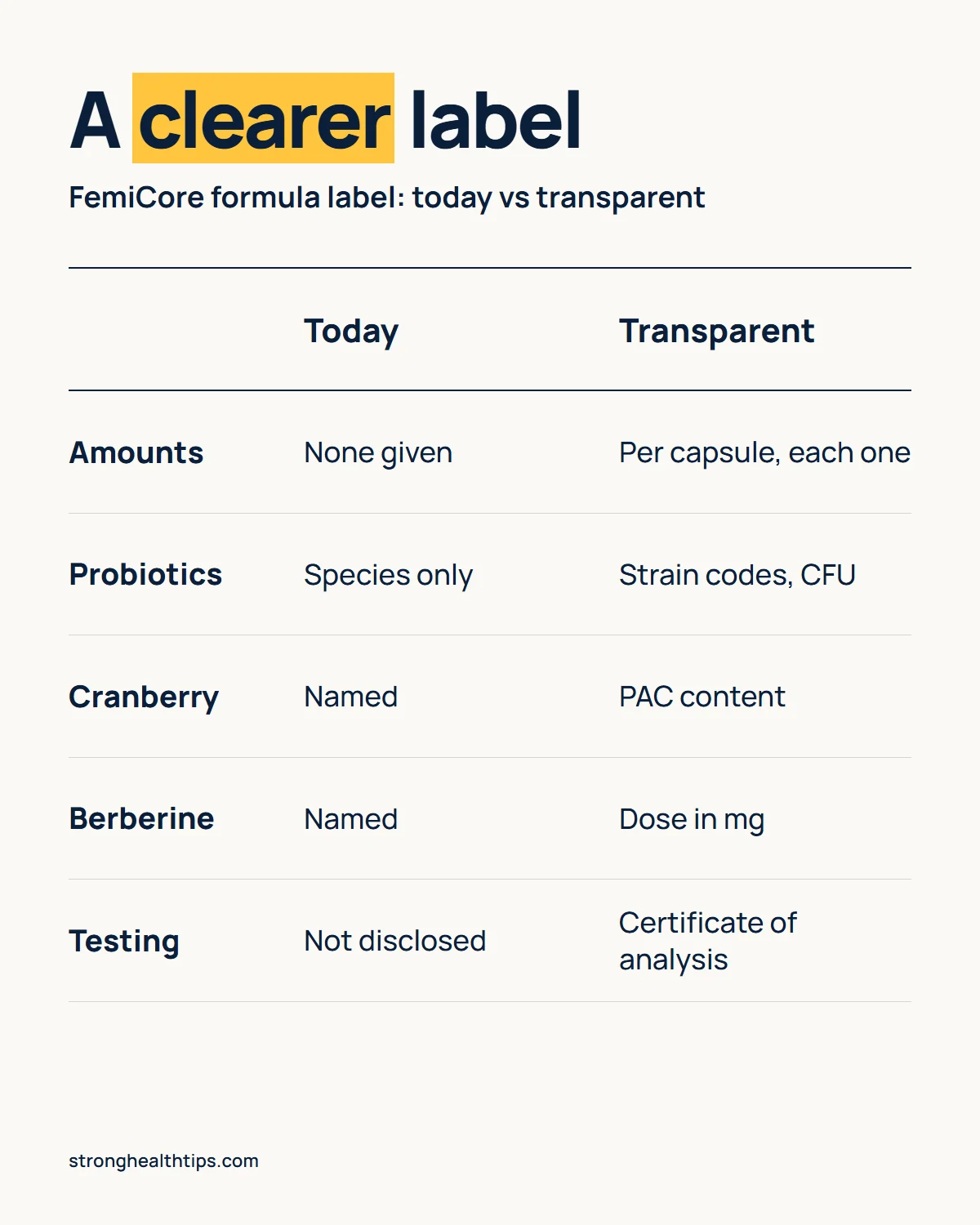
| Label item | FemiCore today | A transparent label |
|---|---|---|
| Each ingredient | Named | Named, with an amount per capsule |
| Probiotic count | Not disclosed | CFU count, ideally at expiry |
| Probiotic identity | Species only | Strain codes for each |
| Cranberry | Named | PAC content |
| Bearberry | Named | Arbutin content |
| Berberine | Named | Dose in mg |
| Batch testing | Not disclosed | A certificate of analysis on request |
| Seals | GMP and other seals shown on the site | The manufacturer and certifier named |
Nothing in the right-hand column is exotic. It is simply what anyone would need to line the capsule up against the studies it borrows from.
How to use this critique before you buy
You do not have to accept the gaps silently. Three steps turn them into a decision:
- Ask the seller. Email support and request the amount of each ingredient, the CFU count, the strain codes and a certificate of analysis.
- Take the answer to a pharmacist, especially if you take medicines for blood sugar, blood pressure or clotting, or take lithium or cyclosporine.
- If no numbers come back, decide whether a trial is still worth it to you, knowing that the 60-day refund, counted from delivery, is then your main protection. Read the directions and cautions in our line-by-line look at the directions before day 1.
Ask, then decide
From $49 a bottle, one-off purchase, no autoship.
Free US shipping on 3 and 6 bottles.
Check official FemiCore pricesThe bottom line
As a design, the FemiCore formula picks reasonable ingredients and then hides the numbers that would let anyone check them. Cranberry gives it a credible anchor and the bladder microbiome gives it a modern story. The proprietary blend, the species-only probiotics, a short-course herb in a daily product and an undisclosed berberine dose are the costs. As a supplement, it sits under the FDA’s dietary supplement rules, not the approval route used for medicines. A clearer label would not prove the formula works, but it would let you and your pharmacist judge it. Our FemiCore product hub puts the formula next to prices and safety in one place.
Official website only
Try the formula with 60 days from delivery to decide.
We are independent, not the seller, and may earn a commission through our links.
Order FemiCore from the official siteQuestions people ask
What is a proprietary blend?
It is a group of ingredients listed together under one name, without the amount of each. FemiCore's label names all nine ingredients but gives no individual doses, so you can see what is in the capsule but not how much.
Why does it matter that the doses are not listed?
Because the research behind each ingredient used known amounts. Cranberry's effect depends on its PAC dose, and berberine's human studies used around 1,000 to 1,500 mg a day. Without FemiCore's numbers, you cannot tell whether a capsule comes anywhere near the amounts that were studied.
Is the probiotic part or the plant part better supported?
The plant part holds the formula's best-supported ingredient, cranberry, for repeat urinary infections. The probiotic part rests on early microbiome research and a small L. crispatus trial that used a vaginal product, and FemiCore lists species without strain codes.
Does the blend contain enough berberine to matter?
Nobody outside the company can say, because the berberine dose is not disclosed. That cuts both ways: it may be too little to match the studies, and its effect on medicines cannot be estimated either.
Can I ask the seller for the amounts?
Yes. Email support before you buy and ask for the amount of each ingredient, the CFU count, the strain codes and a certificate of analysis. If you get numbers, a pharmacist can compare them with the research. If you do not, the 60-day refund is your main protection.
Is a proprietary blend a red flag on its own?
Not on its own. It does not mean a product is fake or unsafe. It means you are trusting the maker on the amounts, which matters more when an ingredient can interact with medicines, as berberine can.
Sources
- Williams G et al. (2023). Cranberries for preventing urinary tract infections. Cochrane Database of Systematic Reviews
- Stapleton AE et al. (2011). Lactobacillus crispatus probiotic for prevention of recurrent urinary tract infection. Clinical Infectious Diseases
- Pearce MM et al. (2014). The female urinary microbiome in women with and without urgency urinary incontinence. mBio
- Cicero AFG, Baggioni A (2016). Berberine and its role in chronic disease. Adv Exp Med Biol
- FDA: Dietary supplements
Not medical advice. This guide is general information and does not replace a consultation with a qualified healthcare professional who knows your history. Full disclaimer.
Written by
Strong Health Tips Editorial Team
We research, write and fact-check every guide against current guidance from major health bodies and peer-reviewed studies, then rewrite it in plain English. How we work.