Eastern vs Western Astrology: Side by Side, Plus the Eastern Astrology Language Reading
Eastern vs Western astrology: calendar, animal year vs sun sign, elements and charts, plus how the Eastern Astrology Language Reading starts you off.
- Author
- Strong Health Tips Editorial Team
- Published
- Reading time
- 9 min read
Affiliate disclosure: this review contains links to the official Eastern Astrology Language Reading website. If you buy through them we may earn a commission at no extra cost to you. It does not change our assessment. Details.
Eastern vs western astrology is a comparison of two traditions that look alike at first glance, because both divide people into twelve groups, and then turn out to work in different ways. This guide explains how each system is built: the calendar it uses, the unit it assigns to you, its elements and the chart it draws. It does not pick a winner. Both are rich cultural practices that millions of people enjoy. If the Eastern side catches your eye, the Eastern Astrology Language Reading is an easy way in, starting with a free quiz.
Eastern vs western astrology at a glance
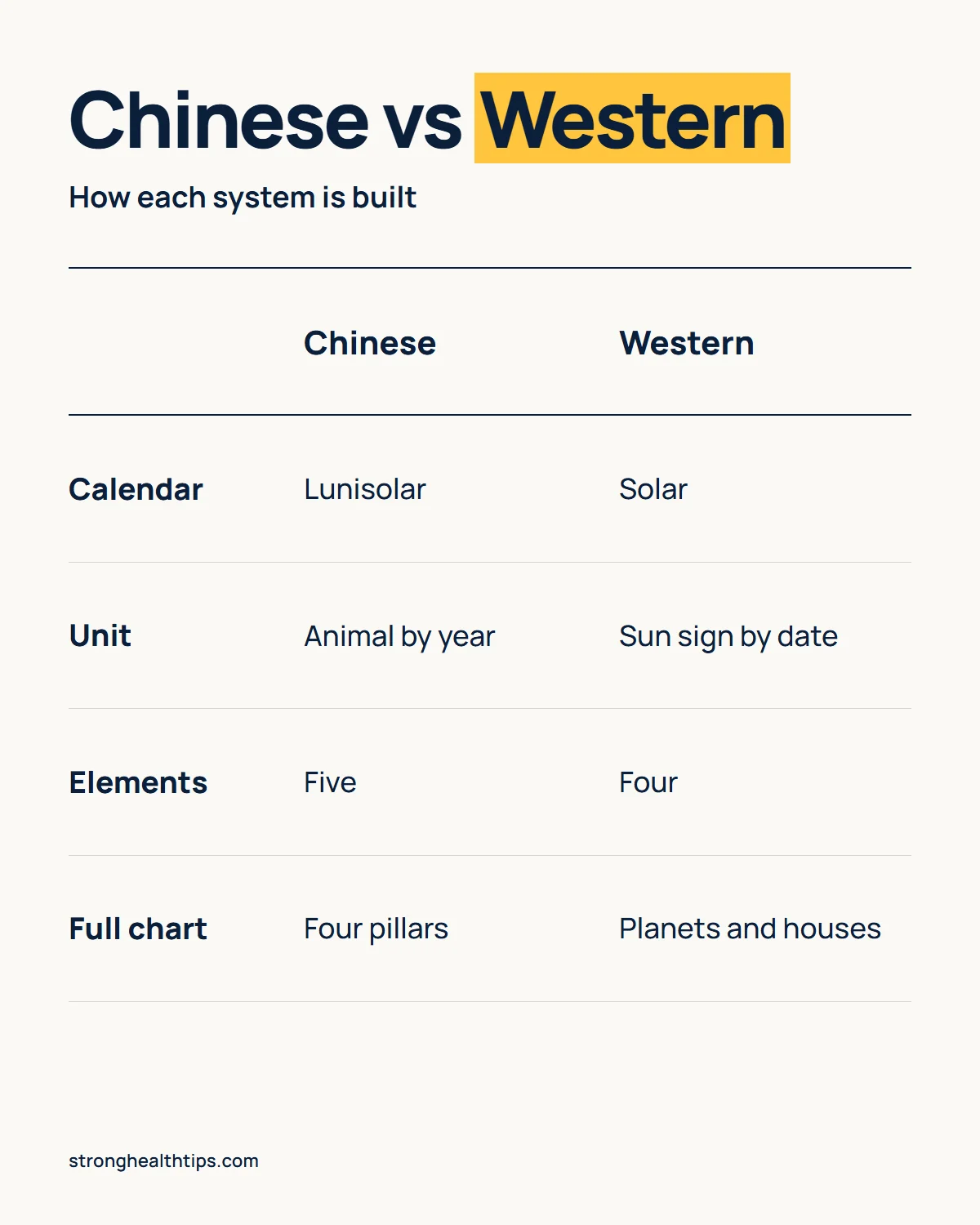
| Feature | Chinese (Eastern) | Western |
|---|---|---|
| Calendar basis | Lunisolar: months follow the moon, adjusted to the sun | Solar: the sun’s yearly path |
| Popular unit | Animal for your birth year | Sun sign for your birth date |
| Cycle length | 12 years (60 with elements and yin and yang) | 1 year |
| Elements | Wood, fire, earth, metal, water | Fire, earth, air, water |
| Full chart | Four pillars (BaZi) | Natal chart with planets and houses |
| Birth data needed | Date, ideally time | Date, time and place |
The rest of this article takes each row in turn. For more on the Chinese side, see our introduction to the tradition and the guide to the four pillars.
Curious about the Eastern side
Start your free Eastern Astrology Language Reading and see your animal and element.
Nine quick questions and a first reading on screen. The full chart is optional.
Start your free readingCalendar basis: the moon and sun versus the sun alone
The Chinese calendar is lunisolar. Its months follow the phases of the moon, and an extra month is added from time to time so the calendar stays in step with the seasons. Lunar New Year, which falls between late January and mid-February, is the start of the popular zodiac year. In BaZi, the month and year boundaries usually follow the sun’s position through the seasons instead, which is why a practitioner may give a different answer from a popular guide for people born in January or early February.
Western astrology is tied to the sun. The tropical zodiac is anchored to the March equinox, and the sun spends roughly a month in each of the twelve signs, starting with Aries around March 21. Your sun sign is simply the sign the sun occupied on your birth date.
The unit: an animal for your year, a sign for your month
This is the difference most people notice.
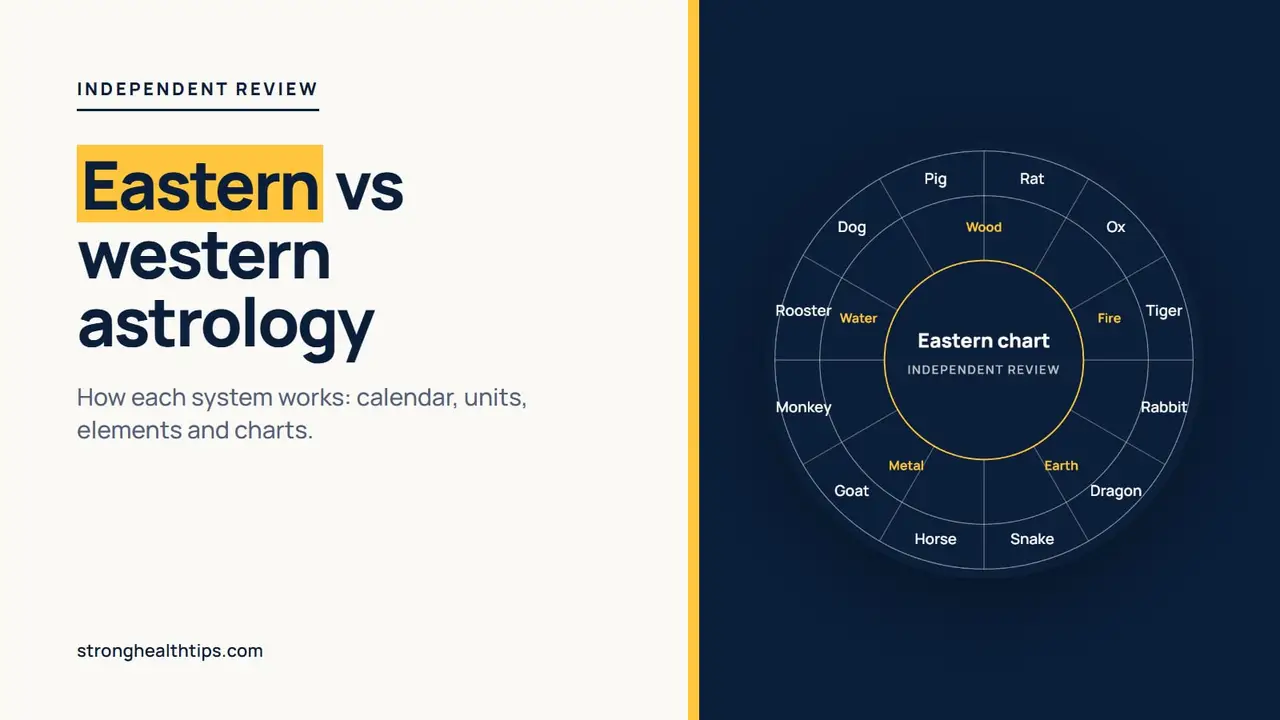
- Chinese: the popular zodiac gives you one animal for your whole birth year, from the cycle Rat, Ox, Tiger, Rabbit, Dragon, Snake, Horse, Goat, Monkey, Rooster, Dog, Pig. Everyone born in the same year shares it, as our guide to finding your year sign explains.
- Western: the popular zodiac gives you one sun sign for your birth date, which changes about once a month. Twelve signs share out each year.
Both are the tip of an iceberg. A full BaZi chart gives you four animals, one each for the year, month, day and hour of birth. A full Western chart places the moon and the planets in signs too, so a person has a sun sign, a moon sign, a rising sign and more.
Elements: five phases versus four
Western astrology has four elements, fire, earth, air and water, and each element is shared by three signs. Signs are also grouped into three modalities, cardinal, fixed and mutable, which describe how a sign is said to start, hold or change things.
Chinese astrology has five elements, wood, fire, earth, metal and water, and pairs them with yin and yang. Combining the twelve animals with the elements and yin and yang gives a 60-year cycle, so a “Wood Dragon” year returns only every sixty years. The Chinese elements are described less as temperaments and more as phases in cycles, where each element is said to feed or restrain another.
Charts: four pillars versus a wheel
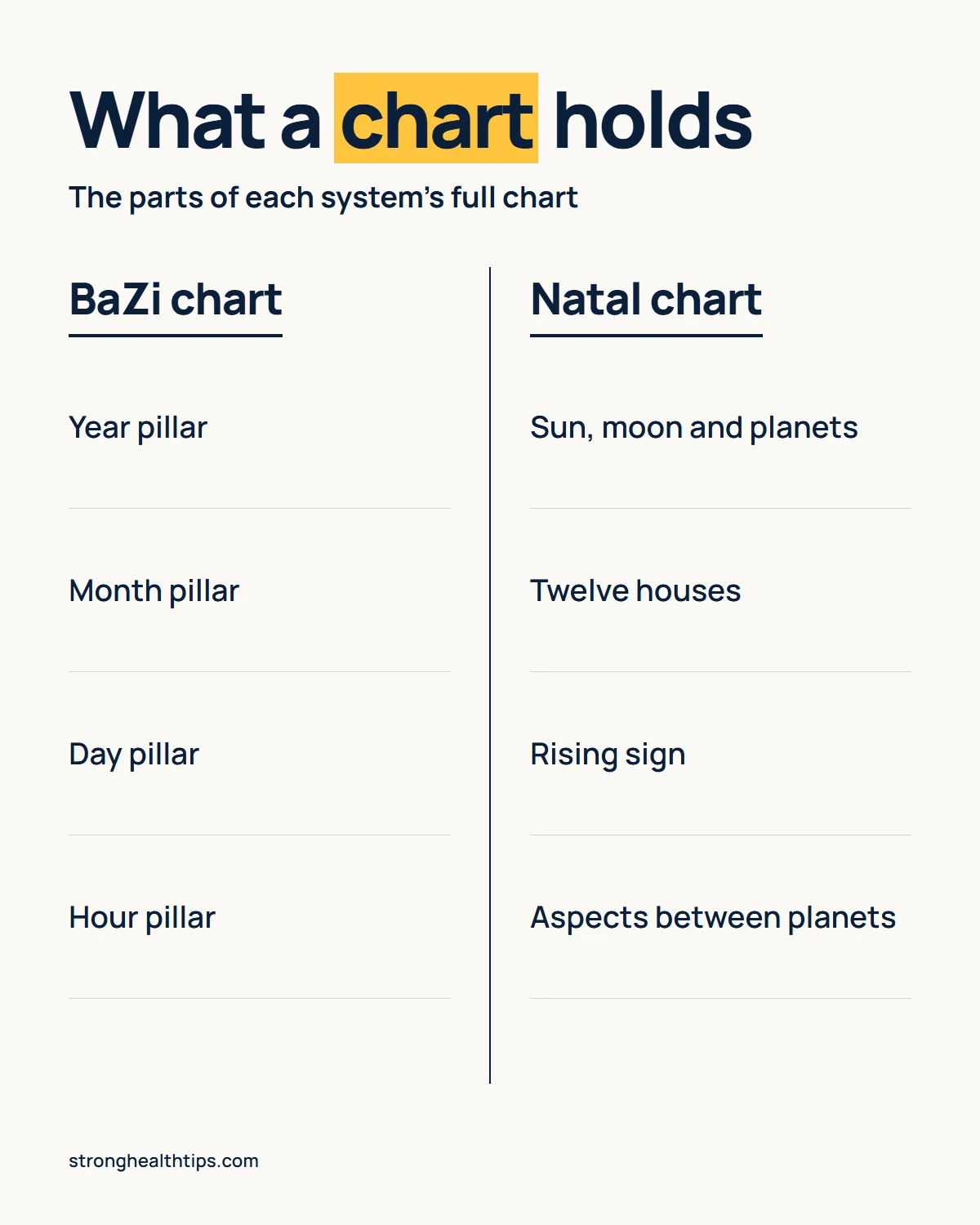
A BaZi chart is a small grid. Four pillars, for year, month, day and hour, each hold a heavenly stem and an earthly branch, giving eight characters. Practitioners look at the balance of elements and at the day stem, treated as the self.
A Western natal chart is a wheel. It places the sun, moon and planets in the twelve signs and in twelve houses, which depend on the exact time and place of birth, then notes the angles, called aspects, between planets. The rising sign, or ascendant, is the sign on the eastern horizon at the moment of birth.
Time and compatibility: two more ways they differ
Both traditions look beyond the birth moment, but they do it differently.
- Timing. Western astrology compares the planets’ current positions with your natal chart, which is where talk of transits and “Mercury retrograde” comes from. Chinese astrology looks at the animal of the current year, and BaZi practitioners also use ten-year “luck cycles” worked out from the chart.
- Compatibility. Western astrology compares two people’s charts, or in popular form their sun signs and elements. Chinese astrology compares animals, using friendly groupings and traditional clashing pairs that sit six signs apart.
In both systems the popular version is far simpler than the technical one. A magazine sun sign and a birth-year animal are the shortest summaries of much larger systems, which is exactly why people enjoy digging deeper.
How each is used in daily life
Western sun-sign horoscopes are a staple of magazines, apps and social media, and people often use them to talk about personality and compatibility. The Chinese zodiac is part of New Year greetings, family gatherings and gifts, and some families consult a traditional almanac for auspicious dates or look at animals when thinking about a match. In both cases, many people treat the practice lightly, as a conversation starter, a piece of culture and a prompt for personal reflection.
A ready-made reading in the Chinese tradition
If the Chinese side appeals, the Eastern Astrology Language Reading is one way to explore it. The seller describes it as a personal reading built from your birth date and quiz answers, drawing on your zodiac animal and element, the BaZi “four pillars” idea and named “stars” such as the Wealth Star and the Peach Blossom Star. It follows the Chinese system, so it pairs nicely with the sun sign you already know.
If you want a ready-made reading
Get your Eastern Astrology Language Reading: Essential $19 or VIP $47.
Start with the free quiz, then choose. 60-day money-back guarantee through ClickBank.
Get your Eastern chartHow it works
- Take the 9-question quiz with your first name, email and birth date.
- See your free reading on the page, with your animal, element and themes.
- Choose Essential or VIP if you want the full chart.
- Receive it by email. The seller describes a 50+ page chart.
| Essential | VIP | |
|---|---|---|
| Price | $19 | $47 (the seller’s regular price is $97) |
| Delivery | Email, 48 to 72 hours | Email, 12 hours |
| Extras | Two optional add-ons | Three bonuses, priority support |
| Review | Not stated | The seller says it is personally reviewed |
The VIP bonuses are The Bad Energy Clearing Kit ($67), Your Soulmate Compatibility Map ($47) and Morning Energy Activation Audio ($33), at the values the seller states. Tax or local currency is added at checkout.
Your 60-day guarantee
The strongest reason to try it is the guarantee. The Eastern Astrology Language Reading is sold through ClickBank with a 60-day money-back guarantee under the seller’s Terms and the ClickBank checkout. Read your chart and decide, and if it is not for you, email [email protected] or contact ClickBank on 1-800-390-6035 or at clkbank.com. Order only through the official route, keep your receipt and avoid copycat sites. The FTC’s page on shopping online is a handy reference for general safe-buying habits.
The fuller version
Claim the VIP Eastern Astrology Language Reading: three bonuses, 12-hour delivery, priority support.
$47 on the seller’s order page, against a regular price of $97.
Claim the VIP readingWho will enjoy it
- You enjoy Western horoscopes and want a Chinese zodiac view alongside your sun sign.
- You like a personal, reflective read on love, money, timing or purpose.
- You want a thoughtful gift or a conversation starter.
- You like to try a free reading before deciding to pay.
The bottom line
The two systems share a love of twelve-part cycles and little else. Chinese astrology gives you an animal for your year, five elements and a four-pillar chart on a lunisolar calendar. Western astrology gives you a sun sign for your date, four elements and a wheel of planets and houses on a solar one. Learning how each works is a pleasant way to enjoy two cultural traditions, and the Eastern Astrology Language Reading is a friendly next step on the Chinese side. We are independent, we are not the seller, and we may earn a commission if you use our links.
Good to know
- It is a digital reading delivered by email. The seller says readings are created from your details using astrological calculations and software, for entertainment and personal reflection.
- Results and experiences vary. Astrology is not a substitute for professional, medical or financial advice.
- The quiz asks for your name, email and birth date and needs the email box ticked to continue; you can unsubscribe from the emails at any time.
Ready when you are
Start the Eastern Astrology Language Reading with the free quiz.
Essential $19. VIP $47. 60-day money-back guarantee.
Questions people ask
How can I try the Eastern side with the Eastern Astrology Language Reading?
The Eastern Astrology Language Reading starts with a free 9-question quiz and a first reading built from your birth date. If you want more, Essential ($19) and VIP ($47, against the seller's regular $97) deliver a 50+ page chart by email, with a 60-day money-back guarantee through ClickBank.
What is the main difference between Chinese and Western astrology?
The calendar and the unit. Chinese astrology follows a lunisolar calendar and gives each year an animal and an element. Western astrology follows the sun's path through twelve signs and gives each birth date a sun sign.
Do both systems have twelve signs?
Yes, but they are different twelves. Chinese astrology has twelve animals that rotate by year, while Western astrology has twelve zodiac signs that rotate through each year.
Is a Chinese zodiac animal the same as a sun sign?
No. A sun sign comes from where the sun stood on your birth date. An animal is assigned to the whole birth year by a repeating twelve-year cycle.
Which system needs my birth time?
Both need it for a full chart. A Western natal chart needs time and place for houses and the rising sign, and a BaZi chart needs time for the hour pillar. Sun sign and birth-year animal need only the date.
Do the two systems use the same elements?
No. Western astrology uses fire, earth, air and water. Chinese astrology uses wood, fire, earth, metal and water, which it treats as phases that feed or restrain each other.
Can I enjoy both?
Yes. Many people know their sun sign and their zodiac animal and enjoy both as cultural lore. They are two separate stories, and part of the fun is comparing them.
Sources
Not medical advice. This guide is general information and does not replace a consultation with a qualified healthcare professional who knows your history. Full disclaimer.
Written by
Strong Health Tips Editorial Team
We research, write and fact-check every guide against current guidance from major health bodies and peer-reviewed studies, then rewrite it in plain English. How we work.