Eastern Astrology: Animals, Elements, BaZi and the Eastern Astrology Language Reading
Eastern astrology explained: the 12 animals, five elements and BaZi, plus how the Eastern Astrology Language Reading turns your birth date into a chart.
- Author
- Strong Health Tips Editorial Team
- Published
- Reading time
- 8 min read
Affiliate disclosure: this review contains links to the official Eastern Astrology Language Reading website. If you buy through them we may earn a commission at no extra cost to you. It does not change our assessment. Details.
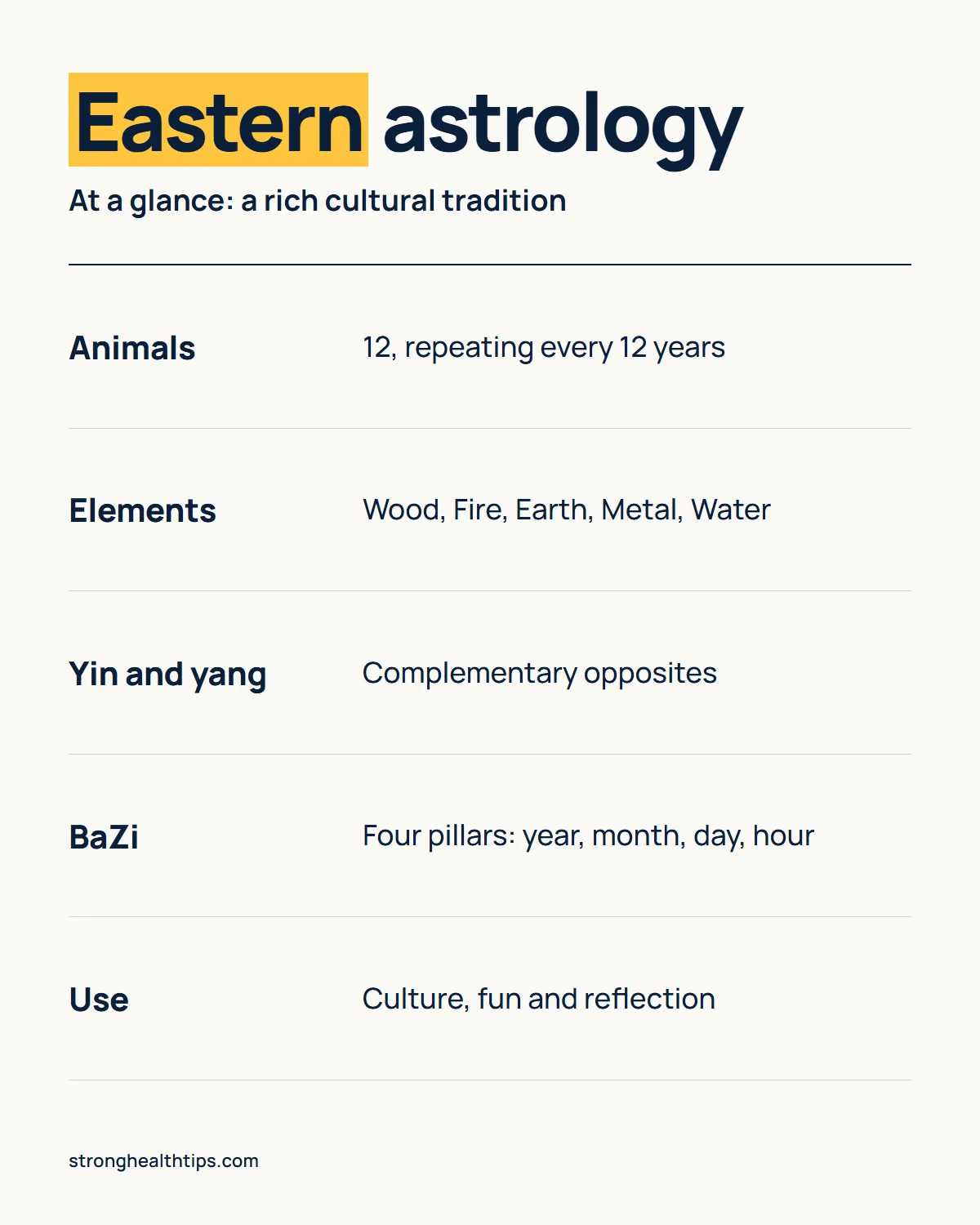
You have probably seen the animal of your birth year on a restaurant placemat and wondered what it all means. Eastern astrology, in its best-known form, is the Chinese system of twelve zodiac animals, five elements, yin and yang, and birth-date calculations. It has been part of festivals, family conversations and personal reflection for a very long time, and it is easy to start exploring. This guide explains the pieces in plain language and shows where to go next, including the Eastern Astrology Language Reading, a personal chart that starts with a free quiz.
Curious about your own chart
The Eastern Astrology Language Reading starts with a free 9-question quiz and a first reading in about a minute.
One option we cover below. A longer chart is optional.
Start your free readingWhere Eastern astrology comes from
“Eastern” is a loose label. In everyday use it points to Chinese astrology, which is also followed, with local variations, in places such as Japan, Korea and Vietnam. Indian Vedic astrology is a different system with its own zodiac and methods, and it is not covered here.
The Chinese tradition is built from calendar cycles. Instead of the sun moving through twelve sky regions during the year, as in the Western zodiac, the Chinese cycle moves through twelve animals over twelve years and layers a set of elements on top. A popular folk story explains the order: the animals raced to the Jade Emperor, and the order in which they arrived became the order of the years.
The twelve animals
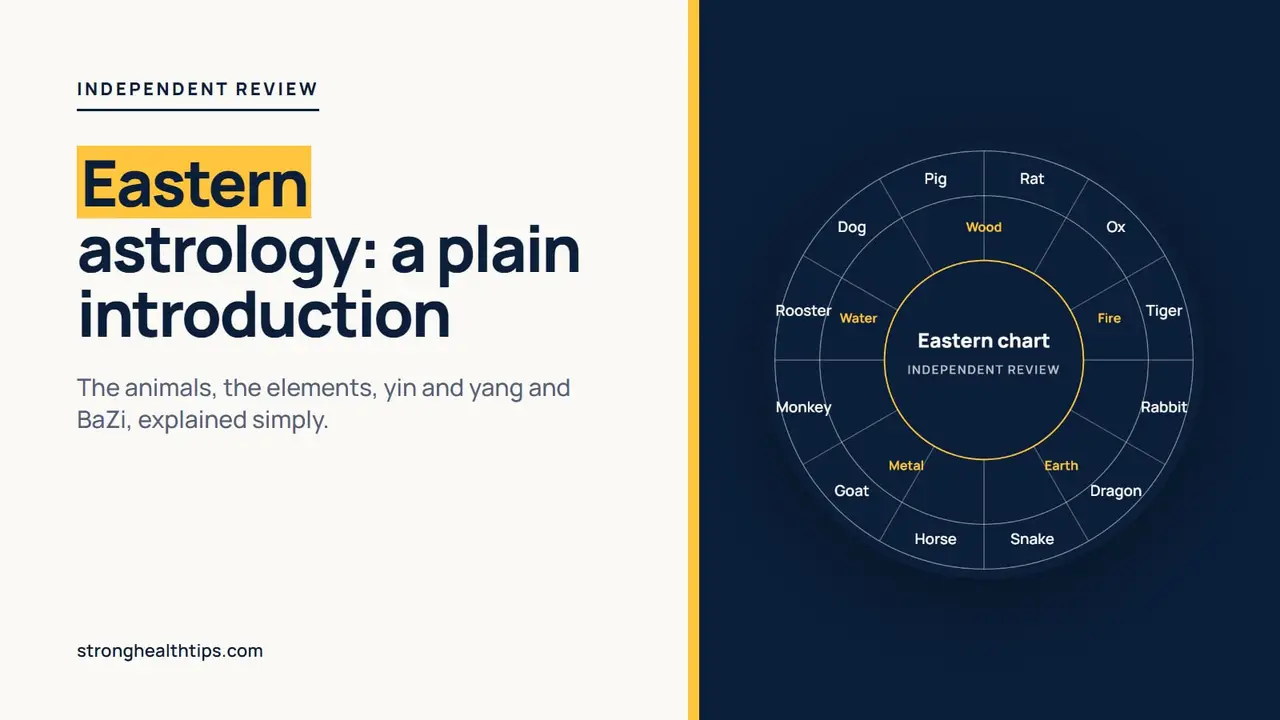
The animals always run in the same order: Rat, Ox, Tiger, Rabbit, Dragon, Snake, Horse, Goat (also called Sheep), Monkey, Rooster, Dog and Pig. After the Pig, the cycle begins again with the Rat. Which animal you “are” depends on your birth year, and the popular version changes at Lunar New Year, a date that falls between late January and mid-February. That is why people born in January or early February sometimes belong to the previous year’s animal.
Each animal also carries a yin or yang character, alternating down the line.
| Position | Animal | Polarity | Position | Animal | Polarity |
|---|---|---|---|---|---|
| 1 | Rat | Yang | 7 | Horse | Yang |
| 2 | Ox | Yin | 8 | Goat | Yin |
| 3 | Tiger | Yang | 9 | Monkey | Yang |
| 4 | Rabbit | Yin | 10 | Rooster | Yin |
| 5 | Dragon | Yang | 11 | Dog | Yang |
| 6 | Snake | Yin | 12 | Pig | Yin |
Tradition attaches personality ideas to each animal, such as boldness for the Tiger or patience for the Ox. These are part of the cultural lore, shared in families and festivals, and a lot of the fun is comparing notes with friends.
The five elements
The second layer is the five elements: Wood, Fire, Earth, Metal and Water. They are not chemical elements. They are five phases that describe how things change and relate to each other, and they appear across Chinese medicine, feng shui, calendars and astrology.
Tradition describes two main relationships. In the generating cycle each element feeds the next. In the controlling cycle each element holds another in check.
| Element | Feeds | Holds in check |
|---|---|---|
| Wood | Fire | Earth |
| Fire | Earth | Metal |
| Earth | Metal | Water |
| Metal | Water | Wood |
| Water | Wood | Fire |
Combine the five elements with the twelve animals, each element appearing in a yin and a yang form, and you get the sixty-year cycle that gives names like “Fire Horse” or “Wood Dragon.” After sixty years the same pairing returns.
How to find your animal and element
Finding your animal takes a minute:
- Look up your birth year in a zodiac table, or count in twelves from a year you know.
- If you were born in January or early February, check the date of Lunar New Year in your birth year. Before that date, you belong to the previous year’s animal.
- Your element follows from the last digit of your birth year in the traditional calendar, with each element covering two consecutive years, one yang and one yin.
- Put the two together and you have a name such as “Wood Dragon” or “Water Rabbit.”
From there you can read about your animal’s traditional character, find which animals are said to get along with yours, and explore how your element fits the picture. Part of the pleasure is that every family and community has its own stories to add.
Yin and yang
Yin and yang are the idea that complementary opposites depend on each other: dark and light, rest and activity, soft and firm. In astrology they are a labeling system. The animals alternate between yang and yin, and so do the elements in their paired forms. The idea is balance, not good versus bad, and neither side is better.
BaZi: the four pillars
BaZi, meaning “eight characters,” is the more detailed side of the tradition. It describes a person by four moments: the year, month, day and hour of birth. Each moment is a pillar, and each pillar has two characters, a heavenly stem tied to an element in its yin or yang form, and an earthly branch, which is one of the twelve animals. Four pillars of two characters make eight.
A few details set BaZi apart from the popular animal-year version:
- Months follow the solar terms of the traditional calendar rather than the months on a wall calendar.
- Many practitioners start the year at the beginning of spring in early February, not at Lunar New Year.
- The hour of birth matters. Each animal also rules a two-hour block of the day, with the Rat covering 11 pm to 1 am.
- Practitioners often begin with the stem of the day pillar, sometimes called the day master, and then look at how the other elements around it balance.
See it applied to you
Get your Eastern Astrology Language Reading: a personal chart built from your birth date.
The seller describes a 50+ page chart, delivered by email.
Get your Eastern chartHow people use it in daily life
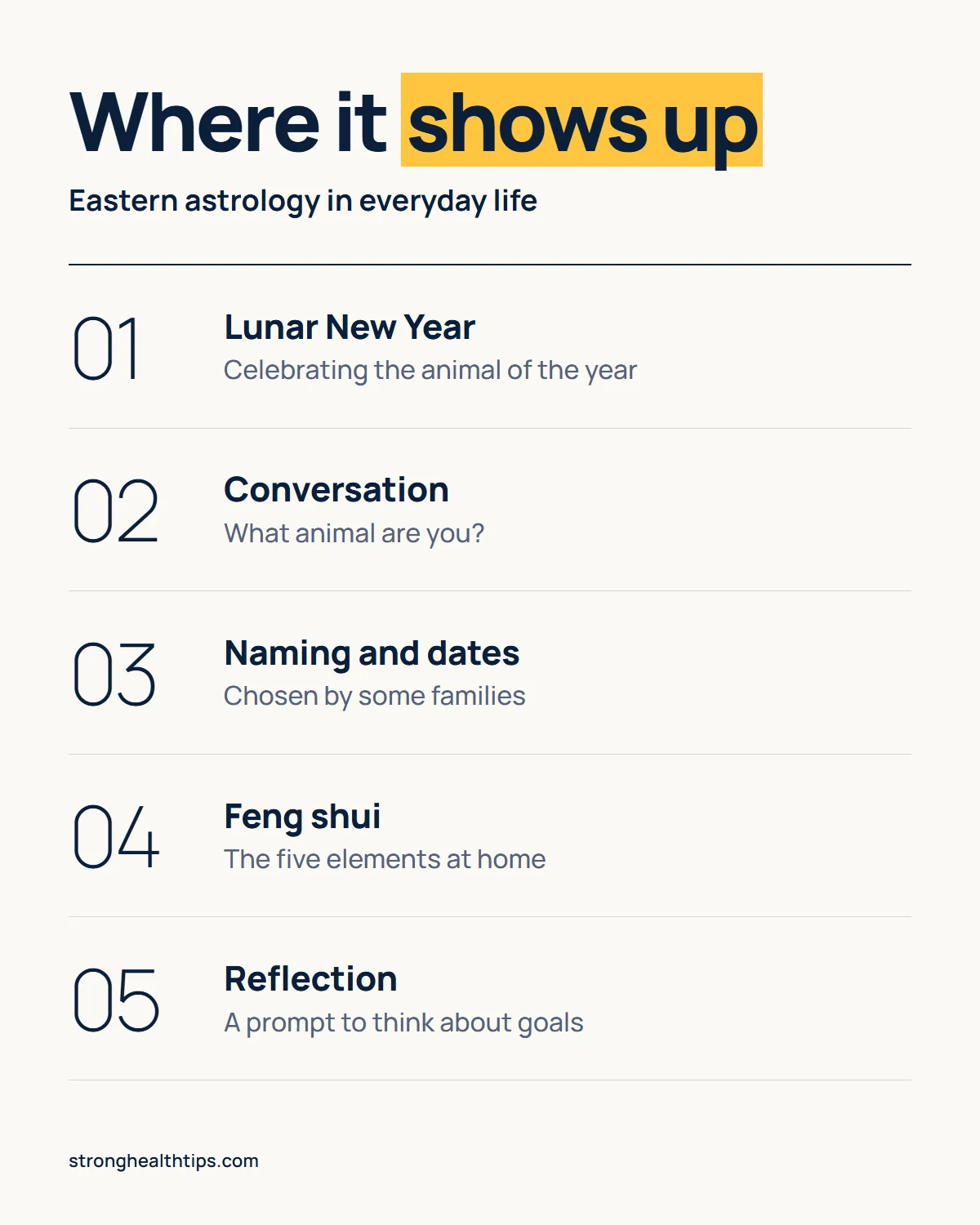
For most people the tradition is cultural and personal:
- Festivals. Each Lunar New Year celebrates the animal of the incoming year, with decorations, greetings and family meals.
- Conversation. Asking “what animal are you?” is a common icebreaker, and the answer often draws a laugh or a family story.
- Personal choices. Some families consult the calendar for naming children, picking wedding dates or opening a business.
- The year of your own animal. Some people regard the year that matches their own animal as special and wear red for luck.
- Feng shui. The five elements also guide how some people arrange rooms and choose colors.
- Reflection. Many people use their animal and element as a prompt to think about their strengths, habits and goals.
Exploring your own chart online
The easiest way to try it is online. Plenty of sites explain the animals for free, and some offer personal readings. One example is the Eastern Astrology Language Reading (the seller calls its chart the Eastern Destiny Chart). The seller describes it as a reading built from your birth date and quiz answers, drawing on your zodiac animal and element, the four pillars idea and named “stars” such as the Wealth Star and Peach Blossom Star. It works like this:
- Take a 9-question quiz with your name, email and birth date.
- See your free first reading on the page.
- Choose Essential ($19, email delivery in 48 to 72 hours) or VIP ($47, against the seller’s regular $97, with three bonuses, 12-hour delivery and priority support).
- Receive your 50+ page chart by email.
It is sold through ClickBank with a 60-day money-back guarantee, which makes trying it a low-pressure decision. Tax or local currency is added at checkout. For details, see our guides to ordering it safely, the reading itself and our full verdict. We are independent, we are not the seller, and we may earn a commission if you use our links.
Try it with 60 days behind you
Claim the VIP Eastern Astrology Language Reading: three bonuses, 12-hour delivery and priority support.
$47 on the seller’s order page; Essential is $19.
A good way to enjoy it
If Eastern astrology interests you, the richest route is often cultural: learn the animals and festival stories, ask older relatives what their families do, read about how the elements show up in other traditions, and treat any reading as a mirror for your own thoughts. Stay curious, share it with friends, and enjoy the stories.
Good to know
- An online reading is a digital product delivered by email. The seller says readings are created from your details using astrological calculations and software, for entertainment and personal reflection.
- Results and experiences vary. Astrology is not a substitute for professional, medical or financial advice.
- The quiz asks for your name, email and birth date and needs the email box ticked to continue; you can unsubscribe from the emails at any time.
Your animal, your element
Start the Eastern Astrology Language Reading with the free quiz and see your Eastern chart.
Optional full chart from $19. 60-day money-back guarantee.
Start your free readingQuestions people ask
What is Eastern astrology?
The term most often refers to Chinese astrology, a cultural tradition built on twelve animals, five elements, yin and yang, and the BaZi system of four pillars. Other Asian traditions, such as Indian Vedic astrology, are separate systems with their own methods. If you want a personal take on the Chinese system, the Eastern Astrology Language Reading starts with a free quiz.
How many animals are in the Chinese zodiac?
Twelve, in a fixed order: Rat, Ox, Tiger, Rabbit, Dragon, Snake, Horse, Goat (also called Sheep), Monkey, Rooster, Dog and Pig. The order repeats every twelve years.
What is BaZi?
BaZi means eight characters. It describes the year, month, day and hour of birth as four pillars, each made of two characters, so eight in all. Practitioners study how the elements and animals in those pillars interact.
How do I find my element?
Your element follows from your birth year. Each element appears in a yin and a yang form, and the elements combine with the animals in a sixty-year cycle, which gives names such as Fire Horse or Wood Dragon.
Can I get an Eastern reading online?
Yes. Many are free, and some paid ones offer a longer personal chart by email. One example is the Eastern Astrology Language Reading, which starts with a free 9-question quiz and offers Essential at $19 or VIP at $47 with a 60-day money-back guarantee through ClickBank.
Is Eastern astrology only for entertainment?
For most people it is a mix of culture, tradition and fun. Many use it as a prompt for personal reflection, and it is best enjoyed that way rather than as a substitute for professional advice.
Sources
Not medical advice. This guide is general information and does not replace a consultation with a qualified healthcare professional who knows your history. Full disclaimer.
Written by
Strong Health Tips Editorial Team
We research, write and fact-check every guide against current guidance from major health bodies and peer-reviewed studies, then rewrite it in plain English. How we work.