VisiFlora Ingredients Explained: Meet the Cast Behind the Capsule
VisiFlora ingredients explained in five groups: carotenoids, botanicals, bioflavonoids, helpers and vitamins, with label amounts and the seller's soft roles.
- Author
- Strong Health Tips Editorial Team
- Published
- Updated
- Reading time
- 7 min read
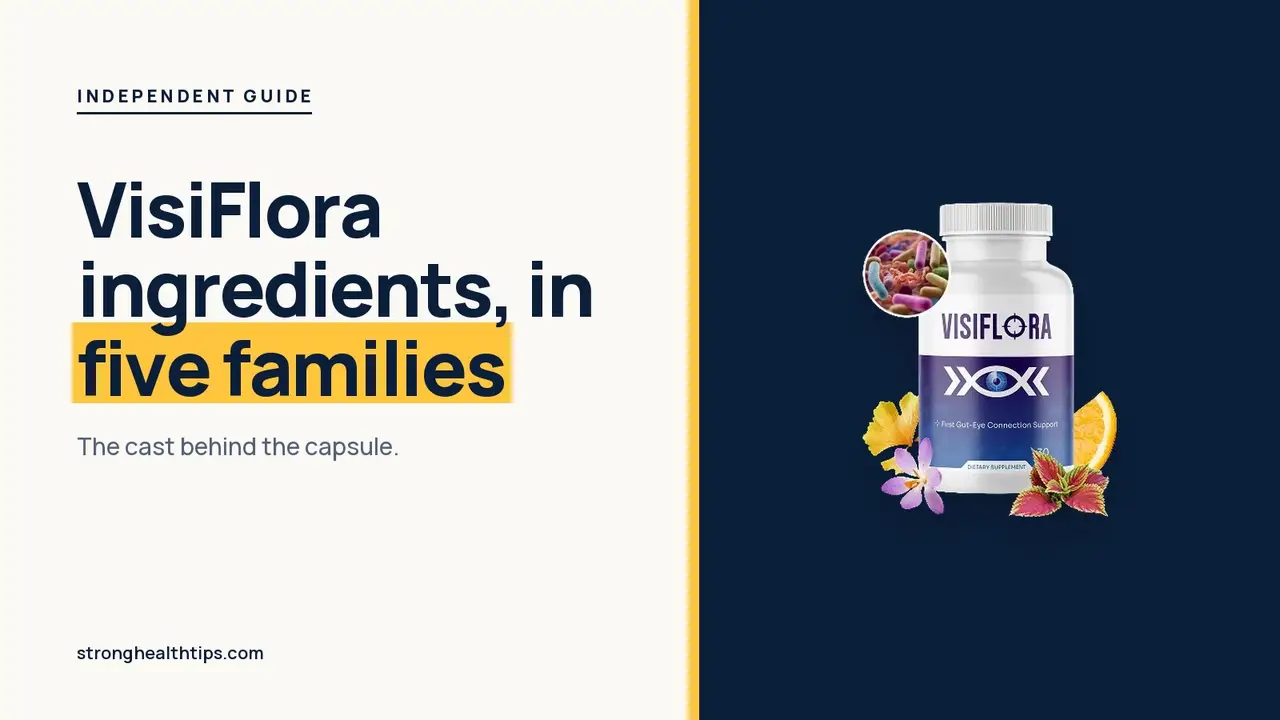
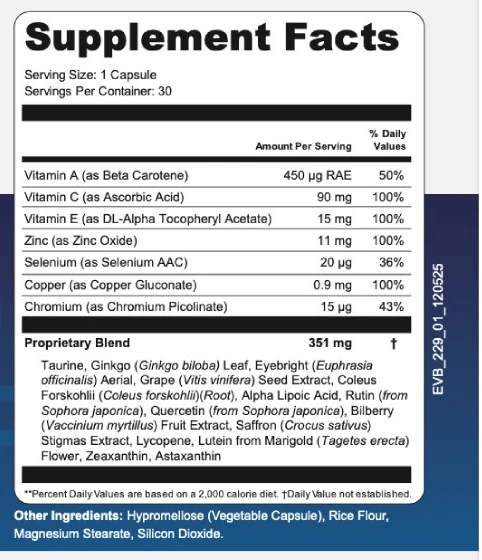
A label can feel like a wall of Latin names, so we sorted VisiFlora’s into groups you can actually picture. Below you will find the five families that its ingredients fall into, what each one is, the soft role the seller gives it and the exact amount where the label provides one. We will be clear about one limit from the start: the fourteen-name blend is listed with a single total, so where we cannot give a dose, we do not guess.
See the label on the order page
Compare our groups with the supplement-facts panel.
Seven nutrients with amounts and a fully named blend.
View the VisiFlora label and offerThe big picture
Each capsule carries seven vitamins and minerals with printed amounts, and a proprietary blend of fourteen named ingredients that adds up to 351 mg. The capsule shell is hypromellose, a vegetable material, and the other ingredients are rice flour, magnesium stearate and silicon dioxide. The seller says the formula is built on research into the gut-eye connection. We pass that along as the seller’s framing, and below we describe each family in the seller’s soft terms.
Family one: the carotenoids
Carotenoids are the orange, yellow and red pigments found in many plants, and four named ingredients come from this family.
- Lutein, taken from marigold, and zeaxanthin are a close pair that often appear together on eye-wellness labels.
- Astaxanthin is described by the seller as a potent carotenoid antioxidant.
- Lycopene, the red pigment best known from tomatoes, is an antioxidant.
Beta carotene also belongs here, though it sits in the vitamin list: it is the form in which the label supplies vitamin A, at 450 mcg RAE per capsule, or 50% of the daily value. Amounts for lutein, zeaxanthin, astaxanthin and lycopene are inside the blend total and are not printed.
Family two: berries and botanicals
Four plant ingredients make up this group.
- Bilberry fruit extract, which the seller notes is rich in anthocyanins, the pigments that give dark berries their color.
- Saffron stigma extract, which the seller calls a carefully studied botanical extract.
- Eyebright, a traditional botanical that the seller says has long been used for eye comfort.
- Ginkgo leaf, which the seller pairs with coleus below as an ingredient for healthy microcirculation and nutrient delivery to the eyes.
These are the “traditional” names on the panel, and they are where the formula leans most on long use rather than on lab nutrients.
Family three: the bioflavonoids
Three ingredients belong to the bioflavonoid family, which the seller describes as supporting the small vessels around the eyes.
- Grape seed extract
- Rutin, taken from Sophora japonica
- Quercetin, also from Sophora japonica
Again, amounts sit inside the 351 mg total.
Family four: the helpers
Three ingredients do not fit neatly elsewhere, so we call them helpers.
- Coleus forskohlii root, which the seller groups with ginkgo for circulation and nutrient delivery.
- Taurine, which the seller describes as supporting cellular hydration.
- Alpha lipoic acid, an antioxidant.
A fully named formula
Fourteen ingredients in the blend, and every name is on the label.
Sixty days from delivery to decide for yourself.
Check today’s VisiFlora priceFamily five: the vitamins and minerals
These are the seven that come with printed amounts.
| Nutrient | Amount per capsule | Share of daily value | The seller’s description |
|---|---|---|---|
| Vitamin C | 90 mg | 100% | helps neutralize oxidative stress |
| Vitamin E | 15 mg | 100% | helps neutralize oxidative stress |
| Zinc | 11 mg | 100% | an essential mineral |
| Copper | 0.9 mg | 100% | an essential mineral |
| Selenium | 20 mcg | 36% | an essential mineral |
| Chromium | 15 mcg | 43% | supports healthy metabolic function |
| Vitamin A | 450 mcg RAE | 50% | supplied as beta carotene |
How to read a proprietary blend
The word “proprietary” simply means the maker keeps the recipe for the blend private. What the label does give you is useful all the same.
- The names. You can see exactly which fourteen ingredients are in there, so you can check each against your own situation or your doctor’s advice.
- The total. 351 mg per capsule tells you the blend is a modest-sized part of the capsule, not a handful of grams.
- The order. Labels usually list blend ingredients from most to least by weight, but this one is not obliged to, so we do not read anything into the sequence.
What you cannot tell is how much of any single name you are getting, and we will not pretend otherwise. If that matters to you, write to the seller’s support email and ask. Our VisiFlora fact sheet lists the contact route.
A mini glossary for the label
- mcg RAE: micrograms of vitamin A activity, the unit the label uses for vitamin A.
- % daily value: how much of a typical day’s recommended amount one capsule supplies.
- Extract: a concentrated form of a plant, such as bilberry fruit or grape seed.
- Hypromellose: a plant-derived material used to make the vegetarian capsule shell.
- Magnesium stearate and silicon dioxide: common helpers that keep powders flowing during filling.
- DV not established: the label’s way of saying that no daily value has been set for the blend.
How the pieces are meant to work together
The seller’s idea is that the pieces support one another. Antioxidant vitamins sit next to antioxidant pigments, traditional botanicals sit beside bioflavonoids and a few helper ingredients round things out. That is a design story, and we do not claim to have tested it. We simply find the families easier to remember than a list of fourteen names, and we hope you do too.
What the research does and does not say
Some of these ingredients have been studied on their own, and we list five items at the foot of this page: a review of lutein, zeaxanthin and beta-carotene in eye health, a lab study of how beta-carotene turns into vitamin A in human eye cells, a lab study of eyebright extract and human corneal cells, a review of lycopene as an antioxidant and a review of the gut-eye link. They are background reading on ingredients. None is a study of VisiFlora, and none can say what it will do for you.
A word for people on medication
Several of these names are worth a chat with your doctor or pharmacist if you take regular medicine. Ginkgo, coleus forskohlii, quercetin and grape seed extract are the main ones, particularly for people on blood thinners, blood-pressure medicine or diabetes medicine, and for anyone planning surgery. The label itself asks you to consult a physician before use if you take medication or have a medical condition. Our side-effects page covers it in full, and our safety page summarizes it.
Putting it together
Seen in families, the formula is easier to hold in your head: carotenoids, berries and botanicals, bioflavonoids, helpers and a short list of vitamins and minerals. For the whole label as a table, see our ingredients list, and for the overall picture our VisiFlora product summary.
If you would like to go deeper on any single ingredient after reading this, the sensible next steps are the supplement-facts image on the order page and a short conversation with your pharmacist. Pharmacists are used to questions like “what does this plant do alongside my regular medicine,” and they can answer in a minute. Bring the label with you, or a photo of it, and ask about the four names we flagged. That small step turns a page of Latin names into something you can use.
Read the label, then decide
The whole formula is named, and the trial runs sixty days from delivery.
One capsule a day with a meal and a glass of water.
Get VisiFlora todayGood to know
- The roles above are the seller’s, and the research linked is about ingredients, not VisiFlora.
- The blend gives a 351 mg total with no single doses.
- Taking medicine every day? Mention VisiFlora to your doctor or pharmacist before the first capsule.
Questions people ask
What are the main VisiFlora ingredients?
Astaxanthin, lutein, zeaxanthin, lycopene, bilberry, saffron, eyebright, ginkgo, grape seed extract, rutin, quercetin, coleus forskohlii, taurine and alpha lipoic acid in the blend, plus vitamins A, C and E, zinc, selenium, copper and chromium.
Does the label give the dose of each blend ingredient?
No. It gives a total of 351 mg for the 14-ingredient blend. Only the seven vitamins and minerals show individual amounts.
How much vitamin C is in a capsule?
90 mg, which the label shows as 100% of the daily value. Vitamin E is 15 mg, also 100%.
Is there research on these ingredients?
Yes, on several of them individually, and we link five items. None is a study of VisiFlora itself.
Are any of the ingredients a concern with medicines?
Ginkgo, coleus forskohlii, quercetin and grape seed extract are worth raising with your doctor if you take blood thinners, blood-pressure or diabetes medicine, or plan surgery.
What is the capsule made of?
Hypromellose, a vegetable capsule, with rice flour, magnesium stearate and silicon dioxide as the other ingredients.
Sources
- A review of lutein, zeaxanthin and beta-carotene in eye health (Antioxidants, 2020)
- Lab study of how beta-carotene is converted into vitamin A in human eye cells (Invest Ophthalmol Vis Sci, 2005)
- Eyebright extract and human corneal cells, in vitro tests (Balkan Med J, 2014)
- Lycopene: A Potent Antioxidant with Multiple Health Benefits (J Nutr Metab, 2024)
- A review of the gut-eye link (Ophthalmic Res, 2022)
Not medical advice. This guide is general information and does not replace a consultation with a qualified healthcare professional who knows your history. Full disclaimer.
Written by
Strong Health Tips Editorial Team
We research, write and fact-check every guide against current guidance from major health bodies and peer-reviewed studies, then rewrite it in plain English. How we work.