The Genius Song Reviews: The Seller's Own Testimonials, Checked Against Its Terms
The Genius Song reviews from the sales video, checked against the seller's own Terms: who is quoted, what the fine print says about names, actors and payment.
- Author
- Strong Health Tips Editorial Team
- Published
- Reading time
- 10 min read
Affiliate disclosure: this review contains links to the official The Genius Song website. If you buy through them we may earn a commission at no extra cost to you. It does not change our assessment. Details.
The Genius Song reviews that most people meet first are not on a review site at all. They sit inside the seller’s own 39-minute sales video: a nurse from California, a man in Dallas, a woman from Manhattan, a montage of unnamed voices and a string of listener questions read out by first name and city. This article takes those stories one at a time and puts them next to the seller’s Terms, which say a surprising amount about where its testimonials come from.
The product itself is simple to describe. The Genius Song is a digital audio track that the seller says lasts about 7 minutes, sold for $39 through ClickBank. What follows is about the praise around it, and how much weight that praise can carry.
Before the stories
One audio track, $39 once, 90 days to ask for a refund.
Sold through ClickBank. The bonuses differ between the seller’s pages.
Visit the official websiteWho is quoted in the sales video
The video is narrated by the presenter, who uses the pen name Dr. Robert Lake (the site says so in its disclaimer). That disclaimer, in the footer of the sales page and of its text version, reads: “Robert Lake is a pen name used with the consent of our leading neuroscientist”. So the voice introducing every testimonial is itself using a name that is not his own. The video and the text page describe him as a neuroscientist with NASA training and a New York City clinic. We could not verify any of that, and we do not treat it as fact.
Here is who he quotes, with the point in the video where each story appears.
| Who | Where in the video | What the story claims |
|---|---|---|
| Unnamed voices | 00:43 to 01:12 | “My brain feels smart again”, “Money just appears in my life now”, a grandson with straight A’s |
| Colleagues of the presenter | 09:23 to 10:17 | A finished book, migraines gone, a son from C to A, an engagement, 16 pounds lost, quitting smoking, a promotion |
| “Rachel, a nurse from Tustin, California” | 12:21 | Within two weeks, “a new woman”, kinder at home and learning French |
| “Michael in Dallas” | 13:17 to 14:09 | A wife who says he seems sharper, and an Amazon business that let him quit his job |
| “Hannah from Manhattan” | 14:12 | A family “curse” of bad luck lifted, a better marriage and a promotion |
| Listener questions | 25:41 onward | Sofia, Olivia, Ray, Amy, Damon, Brian, Liz and Russell, each with a city |
After Rachel’s story, the narrator says “Five stars.” It is read aloud. There is no star rating attached to any source a viewer could look up.
What the seller’s Terms say about these stories
The Terms page on the same site, last updated on 20 January 2026, has several passages about testimonials. Read together, they change how the video sounds.
| The Terms say | What it means while you watch |
|---|---|
| Names “have been changed” and “We use pen names” | “Rachel” or “Hannah” may not be anyone’s real name |
| “Some aspects of the marketing have been dramatized for entertainment effect” | The telling of a story may be polished or staged |
| Feedback may be acted out by “digital representations, avatars, or actors” | The voice or face may not belong to the person in the story |
| People were “compensated” for letting the seller highlight their experiences | Some stories were paid for |
| Some givers may be “early supporters, friends, or family members of the company’s founders” | Some speakers may have a personal tie to the business |
| Testimonials “are exceptional results and may not reflect the experience of a typical customer” | The stories show the best cases, by the seller’s own account |
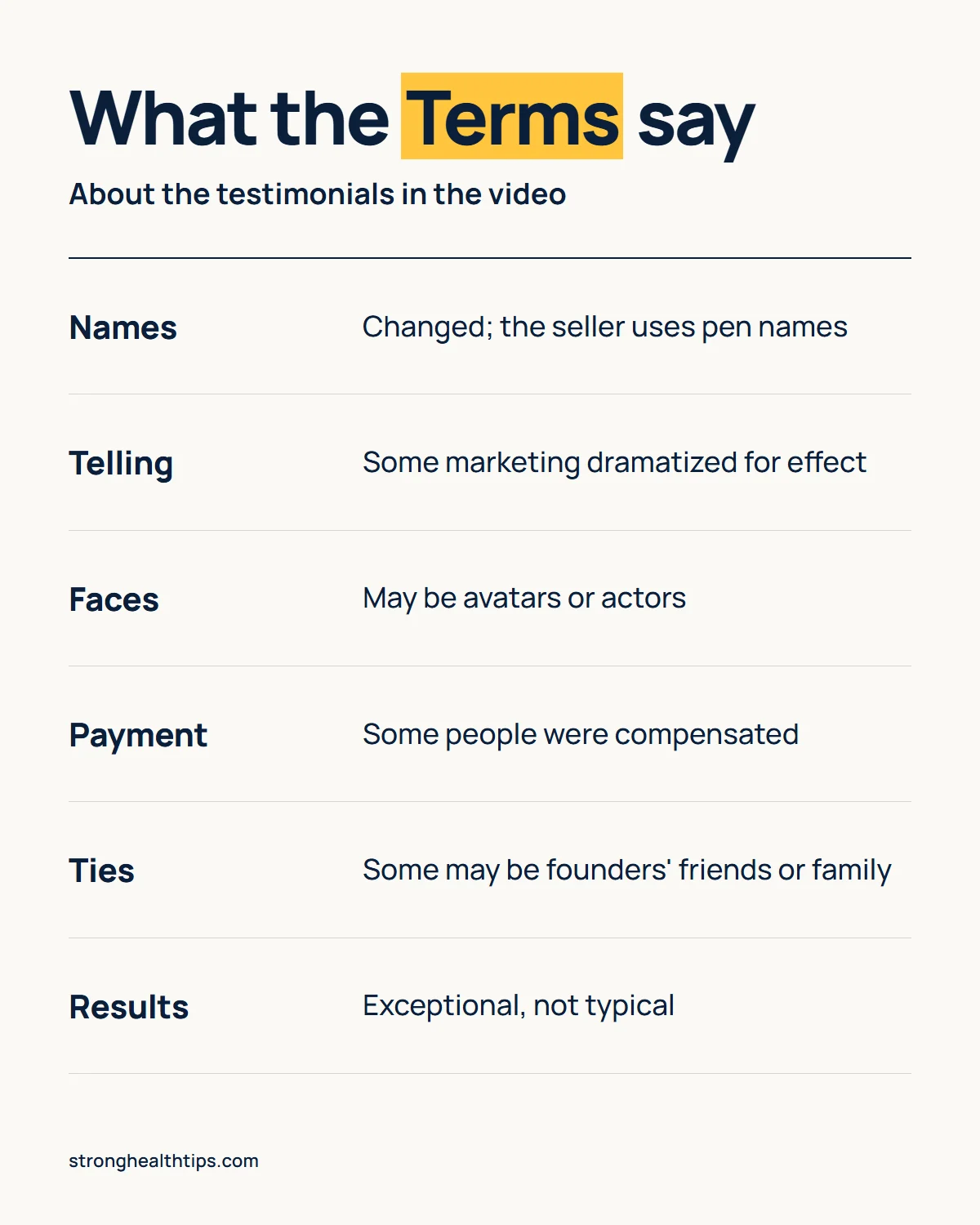
To be fair to the seller, the same Terms also state that “All accounts come from real people” and that, while the person shown may be an avatar or actor, “the substance of the experience and the results described are genuine”. We have no way to test either statement. What the Terms make plain is that the names, faces and voices in the video cannot be treated as independent customers.
The numbers wrapped around the praise
Three figures do a lot of work in the video.
- “Eighteen thousand three hundred sixty six everyday Americans” helped so far (10:27). The text page body says 18,366 too, but its headline says “19,389 Americans”. Two pages from one seller, two different counts.
- “Thousands of five star reviews” (20:07). We found no place where these reviews can be read. The video says the track is sold only through the seller’s own website, so there is no Amazon or Spotify listing where public ratings would collect.
- “Hundreds of emails like this” (14:56), said straight after Hannah’s story.
None of these figures can be checked from outside, and the first one is not even consistent within the seller’s own pages. We treat all three as unverified seller statements.
The most useful sentence in the video
Amy in Las Vegas asks whether the track will help at the casino. The presenter’s answer includes this line: “there is, of course, no evidence to support that the genius song caused that”. It is about slot machines and roulette, but it describes every story in the video equally well. A story told after someone listened to a track is not evidence that the track caused the change.
The Terms go further. A section headed “For Entertainment Purposes Only” says “brain entrainment is not an exact science” and that “the products are provided for entertainment purposes only”. In the same document, the seller claims that its brainwave entrainment claims “are substantiated by established scientific research”. We found no published study that tests The Genius Song itself. Broader research on binaural beats is mixed: a 2019 meta-analysis in Psychological Research found a medium overall effect on things like attention and anxiety, and a 2023 review found most studies did not show the brainwave change. Either way, that is a long way from a promotion or a new marriage.
Judge it yourself
Your own 7 minutes tell you more than any story in the video.
$39 one-time plus local tax. Refund requests within 90 days.
Check the current price on the official siteWhat we could verify, and what we could not
We read the sales page, its text version, the full caption file of the video, the Terms, the separate refund page and the ClickBank checkout. We did not buy the track. This is where that leaves each claim.
| Claim | Status |
|---|---|
| The stories appear in the video at the times above | Verified from the captions |
| Rachel, Michael and Hannah are real, independent buyers | Not verifiable; the Terms say names are changed |
| The presenter is a NASA-trained neuroscientist | Not verifiable; the site calls the name a pen name |
| 18,366 Americans helped | Not verifiable; another page says 19,389 |
| Thousands of five star reviews | Not found anywhere we could check |
| The results described | No published study tests the track |
| A 90-day refund window | Verified in the Terms and at the ClickBank checkout |
How to read a testimonial written by the seller
The US Federal Trade Commission’s guides on endorsements expect advertisers to disclose material connections, such as payment or a family tie, and not to imply that exceptional results are typical. Here, the disclosures exist, but they live in the Terms rather than in the video where the stories are told. Few viewers will read both.
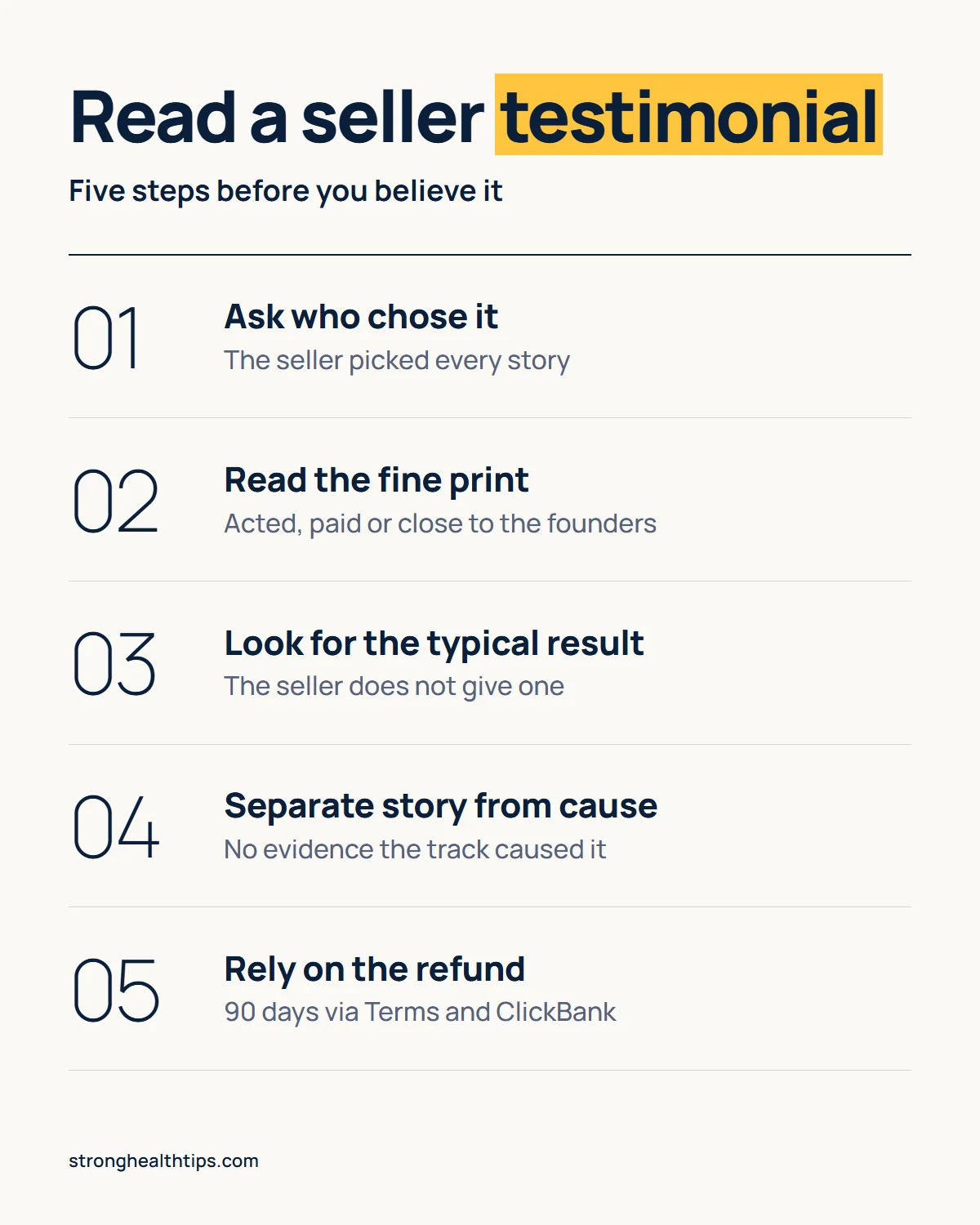
A simple way to handle stories like these:
- Ask who chose it. Every testimonial in the video was picked by the seller to sell the product.
- Read the fine print. Here, the Terms say the stories may be acted, paid for or told by people close to the founders.
- Look for the typical result. The seller does not give one. It says the results shown “may not reflect the experience of a typical customer”.
- Separate the story from the cause. Engagements, promotions and good grades have many causes. The presenter himself says there is no evidence the track caused a casino win.
- Rely on the refund window, not the story. The protection you can actually check is the 90-day refund route.
If the stories still make you curious
Curiosity is a fair reason to try a $39 audio track, as long as you know what you are getting. The official site’s home page currently features the seller’s related audio, The Genius Wave, and The Genius Song presentation is on the same site’s /video/ page. The two are different products on the seller’s own pages, a 12-minute theta audio and a 7-minute gamma track, so check the product name at checkout.
A few more facts worth having before you pay:
- Delivery. The seller describes it two ways: the video says the track is emailed within minutes for you to download, while the text page talks about login details for a “Private Audio Portal”. We cannot confirm which one buyers get, or whether it is both.
- Bonuses. They differ between the seller’s pages. The video promises “three free bonuses” and then names four, including a kids’ audio called The Genius Child. The text page promises “4 free bonuses” and lists three: a classic book on attracting money, a guided visualization and a printable infographic.
- Refund. Use the 90 days in the Terms and at the ClickBank checkout. The site’s separate /TOS/refunds/ page is a leftover policy for NeuroActivate bottles (60 days, unopened bottles, a return address in Ohio) and does not fit a digital track. Request a refund through ClickBank on 1-800-390-6035 or at clkbank.com, and keep your receipt. The card statement reads CLKBANK*Genius Song.
- Listening safety, our advice. Keep the volume comfortable, never listen while driving or operating machinery, and ask a doctor first if you have epilepsy, a seizure history or hearing problems.
Keep your receipt
90 days to change your mind, through ClickBank.
Check that the checkout names The Genius Song before you pay.
Visit the official websiteOur take on the testimonials
The stories in the video are marketing. By the seller’s own Terms, they may use changed names, dramatized delivery, actors or avatars, paid participants and people close to the founders, and they show exceptional results rather than typical ones. That does not prove any single story false. It does mean none of them works as a review.
Our editorial score for The Genius Song is 3.5 out of 5. It is our own rating, not a customer average, and the testimonials are part of why it is not higher. For the full area-by-area scorecard, read our verdict on the track. If calmer days are what drew you to the video, the free habits in our guide on how to manage daily stress are a good place to start, and they cost nothing.
If you decide to try the track, start from the official website and judge it by how your own listening feels. We are independent, not the seller, and we may earn a commission if you buy through our links.
Health note: No audio track replaces medical care, and the seller’s own site says the product is not intended to diagnose, treat, cure or prevent any disease. Keep the volume comfortable, do not listen while driving or operating machinery, and ask a doctor first if you have epilepsy, a seizure history or hearing problems.
Our score: 3.5 out of 5
A refundable $39 track, sold with stories you cannot check.
Not an app or a game. ClickBank order support: 1-800-390-6035.
Check the current price on the official siteQuestions people ask
Are the people in the sales video real customers?
We cannot tell. The seller's Terms say all accounts come from real people, but also that names are changed, that some marketing is dramatized and that feedback may be acted out by avatars or actors. Nothing in the video lets you check who anyone is.
Why do the Terms mention avatars and actors?
The Terms say the seller may use digital representations, avatars or actors to act out the verbatim feedback of users, to protect their privacy. That means the face or voice you see in marketing may not belong to the person whose story it is.
Were the people quoted paid?
Some may have been. The Terms say the seller compensated people for permission to highlight their experiences. A separate passage says some testimonial givers may be early supporters, friends or family members of the founders, and that most of those were not compensated.
Can I contact Rachel, Michael or Hannah to check their stories?
No. Only first names and cities are given, and the Terms say names in the marketing have been changed. There is no way to reach or confirm any of them.
How many people does the seller say it has helped?
The video says 18,366 everyday Americans, and the text page body repeats 18,366, but the text page headline says 19,389. Neither figure is backed by anything we could check, and they do not match each other.
What protects me if my own experience is different?
The refund window. The Terms allow refund requests on digital products within 90 days of the initial purchase, and the ClickBank checkout also states 90 days. Contact ClickBank order support on 1-800-390-6035 with your order number.
Sources
- FTC: Guides concerning the use of endorsements and testimonials in advertising
- Garcia-Argibay M et al. (2019). Efficacy of binaural auditory beats in cognition, anxiety, and pain perception: a meta-analysis. Psychological Research
- Ingendoh RM et al. (2023). Binaural beats to entrain the brain? A systematic review of the effects of binaural beat stimulation on brain oscillatory activity. PLOS ONE
- NIDCD: Noise-induced hearing loss
Not medical advice. This guide is general information and does not replace a consultation with a qualified healthcare professional who knows your history. Full disclaimer.
Written by
Strong Health Tips Editorial Team
We research, write and fact-check every guide against current guidance from major health bodies and peer-reviewed studies, then rewrite it in plain English. How we work.