The Genius Song Reviews Online: How to Read Third-Party Verdicts, Ours Included
The Genius Song reviews online, sorted: affiliate review pages (ours too), video reviews, signs of paid or copied reviews, and a checklist for any verdict.
- Author
- Strong Health Tips Editorial Team
- Published
- Reading time
- 9 min read
Affiliate disclosure: this review contains links to the official The Genius Song website. If you buy through them we may earn a commission at no extra cost to you. It does not change our assessment. Details.
Search for The Genius Song reviews and you will get a mix of written verdicts, video reviews and pages that look a lot like the sales video with a new headline. This guide is about those third-party pages: who writes them, how they make money, how to spot one that was copied or paid for, and a checklist you can run on any of them, including this one.
First, the product they are all discussing. The Genius Song is a digital audio track that the seller says lasts about 7 minutes, sold for $39 through ClickBank by Happy Consumer LLC, a company based in Puerto Rico. Everything else, from the claims to the testimonials, is where reviews start to disagree.
The thing being reviewed
One audio track, $39 once, 90 days for refund requests.
Sold through ClickBank. Not an app, not a game, not a subscription.
Visit the official websiteThe kinds of pages you will find
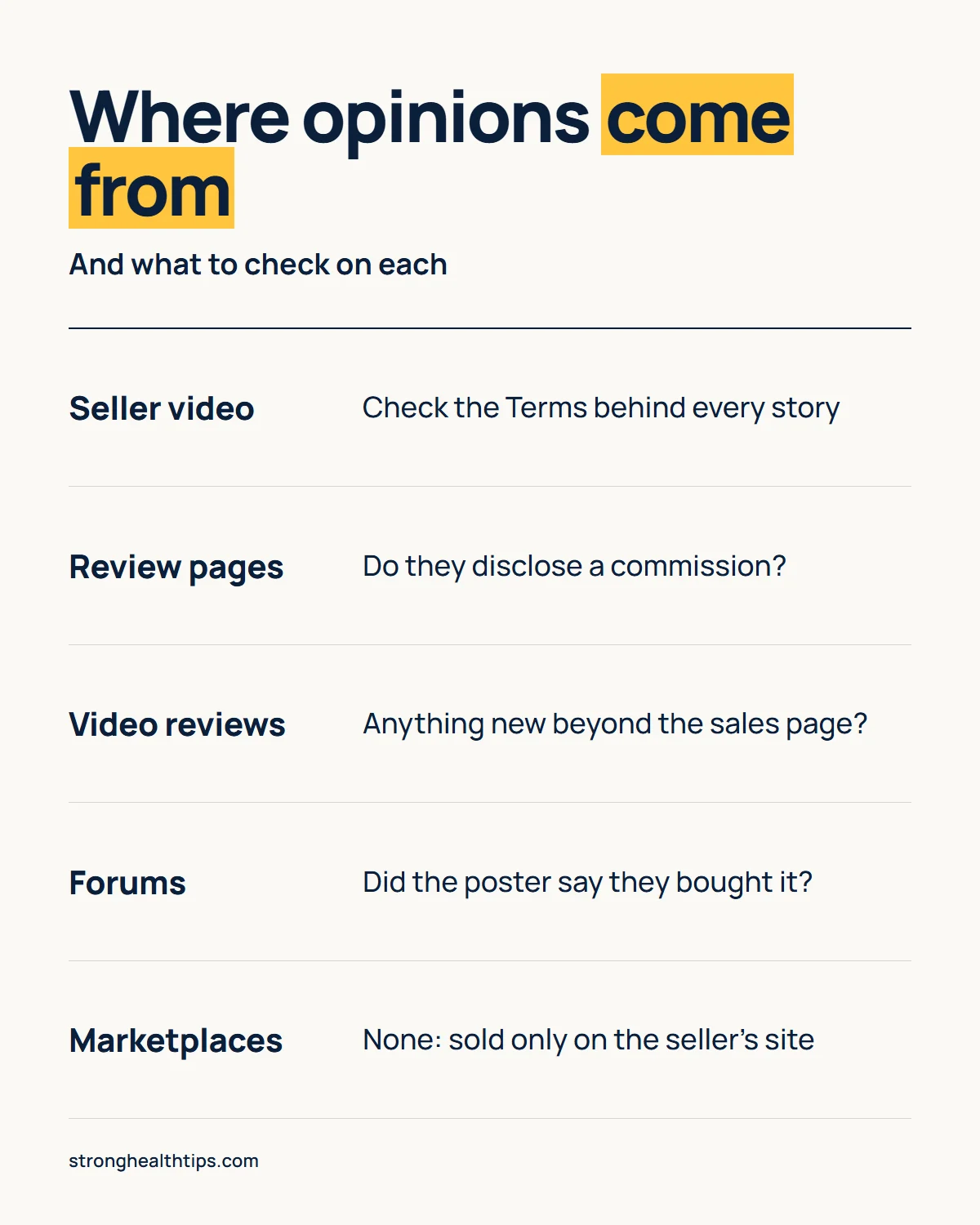
Not every source of opinion works the same way. Before you weigh what a page says, it helps to know what kind of page it is.
| Source | How it usually earns | What to check |
|---|---|---|
| The seller’s own video and pages | Sales of the product | The Terms, which qualify every testimonial |
| Written review pages | A commission when you buy through their link | Whether they disclose it, and whether they cite the Terms |
| Video reviews | Ad revenue, a commission, or both | Whether they show anything you cannot see on the sales page |
| Comments and forums | Nothing, usually | Whether the poster says they bought it, and when |
| Marketplaces such as Amazon | Not applicable here | The seller says the track is only sold on its own website |
We are one of those pages
It would be odd to write a guide to judging review pages without being honest about our own. Strong Health Tips is independent, not the seller, and we may earn a commission if you buy through our links. Every button on this page uses a ClickBank link with a tracking code that tells the seller our page sent you. You pay the same $39 either way.
What we try to do with that conflict is simple. We base every statement on the seller’s own sales page, its text version, the sales video’s captions, the Terms and the ClickBank checkout. We label the seller’s claims as claims. And we publish our own editorial score, 3.5 out of 5, as ours, not as a customer rating. You can see how we got there in our full scorecard.
Why there are no marketplace ratings to lean on
With many products, you can cross-check review pages against hundreds of public ratings on a big marketplace. That is not possible here. In the sales video, the presenter says “We only offer the Genius song direct through this website”, and nothing on the site, the checkout or the video offers it on Amazon, YouTube or Spotify.
The seller does make a ratings claim of its own: the video says the track “has thousands of five star reviews from customers”. We found nowhere those reviews can be read. ClickBank, which processes the payment, is not a review source either. The site’s own footer says ClickBank’s role as retailer “does not constitute an endorsement, approval or review” of the product.
So if a page shows you a star average or a count of reviews, ask where it came from. If it does not say, it is not data.
Signs a page copied the sales video
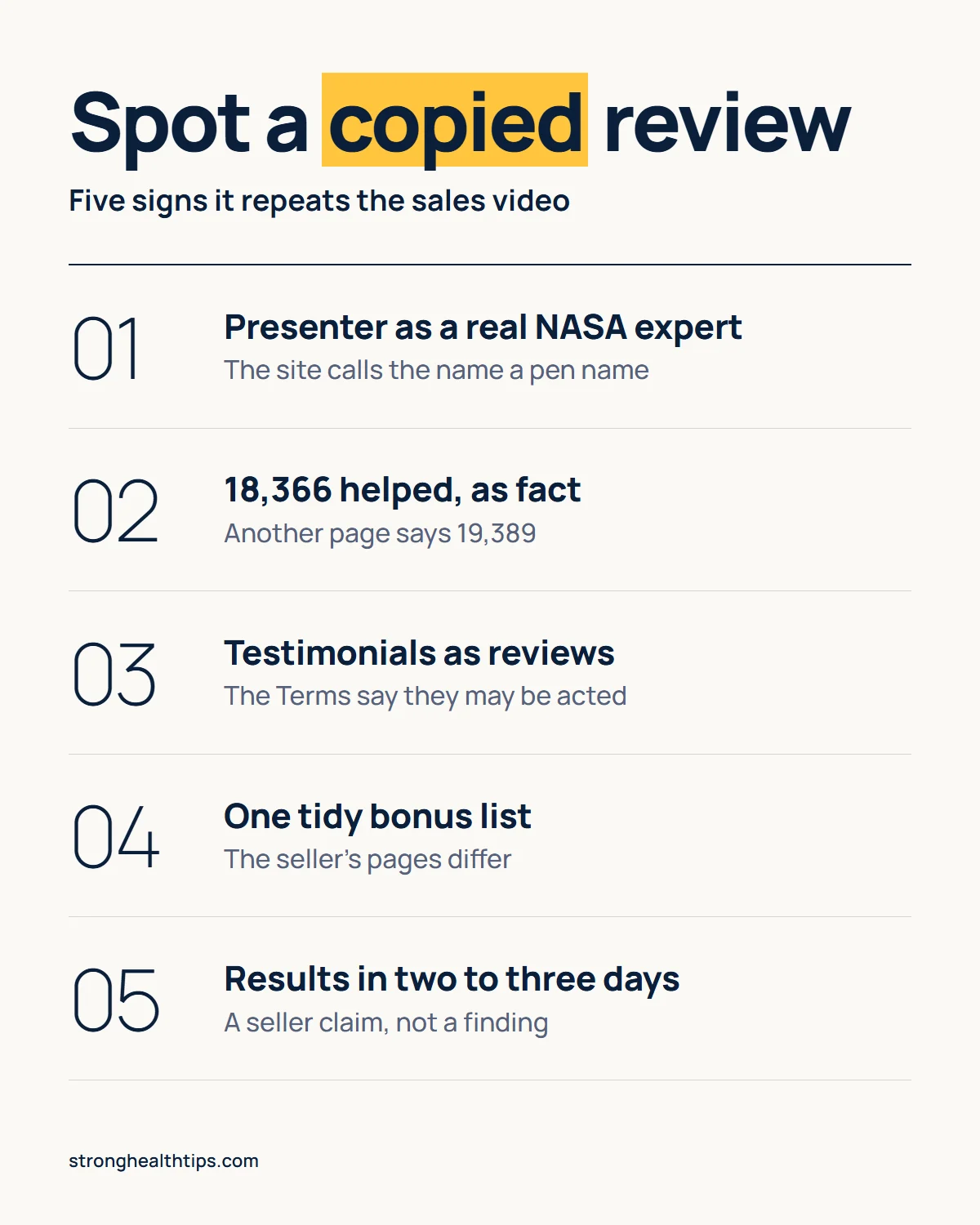
A page that copied the seller’s material tends to repeat it without the parts the seller put in the small print. Watch for these:
- The presenter as a verified expert. The video is fronted by the presenter, who uses the pen name Dr. Robert Lake (the site says so in its disclaimer). A page calling him a real NASA scientist has not read that disclaimer.
- Customer numbers as fact. The video says 18,366 everyday Americans were helped, and the text page headline says 19,389. A page that states either number as fact has not noticed they disagree.
- Testimonials as reviews. Rachel the nurse, Michael in Dallas and Hannah from Manhattan come from the sales video. The Terms say names are changed and feedback may be acted out by avatars or actors.
- Research claims passed along. Lines like “MIT found that all lucky, wealthy, successful people have this one brain wave” come from the video. We found no published study showing that.
- Results with a timetable. The video says customers notice a difference “within the first two to three days”. A review that repeats this as a promise is repeating marketing.
- One bonus list. The bonuses differ between the seller’s pages. The video says “three free bonuses” and names four, and the text page says “4 free bonuses” and lists three. A page with one tidy list has probably copied one source.
Go to the source
Read the seller’s pages and Terms yourself before you trust a summary.
The Terms page sits in the footer of the official site.
Check the current price on the official siteSigns a review was paid or prompted
The US Federal Trade Commission’s guides on endorsements say that a material connection between a reviewer and a seller, such as payment, should be disclosed, and that ads should not present exceptional results as typical. Those principles make a handy test for any page.
- No disclosure. If a page links to the order page but never says it can earn from your purchase, be wary.
- Only good news. A review with no drawbacks has skipped the obvious ones: no study of the track, a pen name, and a refund page written for another product.
- Urgency borrowed from the seller. “This thirty nine dollar price is not guaranteed beyond today” is the video’s line. A reviewer repeating it is selling, not reviewing.
- Exceptional stories as normal. The seller’s own Terms say its testimonials “are exceptional results and may not reflect the experience of a typical customer”. A review that presents them as typical has dropped that warning.
The seller’s own testimonials are a special case. Its Terms say it compensated people for permission to highlight their experiences, and that some testimonial givers may be early supporters, friends or family members of the founders. We take those stories apart one by one in our look at the seller’s testimonials.
Video reviews and uploads of the track
Video reviews can be useful when they show you something new, such as the checkout or an unedited screen recording. Many simply replay parts of the sales video with commentary. A video review is also not the track. If someone offers the full audio on a video or streaming site, the seller says it is not the same thing: the presenter says the technology in the track “cannot be found anywhere else, including on YouTube or Spotify”. The Terms add that a purchase is for personal use only, with no right to share or redistribute it.
A checklist for any review you read
Run these ten questions on any page, ours included.
- Does it say whether it earns a commission?
- Does it name its sources, such as the Terms or the checkout?
- Does it mention the pen-name disclaimer?
- Does it quote the Terms’ “for entertainment purposes only” line?
- Does it separate the seller’s claims from what is known?
- Does it say no published study tests the track?
- Does it get the refund right: 90 days in the Terms and at the ClickBank checkout?
- Does it note that the /TOS/refunds/ page is a leftover NeuroActivate bottle policy?
- Does it say the bonuses differ between the seller’s pages?
- Does it give any listening safety advice?
A page that passes most of these has probably read the material. A page that passes none of them has probably copied it.
What a fair write-up should tell you
Here is the short version of what we think any honest page should cover, so you can check whether you have the full picture.
Where it is sold. The official site’s home page currently features the seller’s related audio, The Genius Wave, and The Genius Song presentation is on the same site’s /video/ page. They are separate products on the seller’s own pages, so make sure the checkout names The Genius Song.
How it arrives. The seller describes delivery in two ways: the video says the track is emailed for you to download, and the text page speaks of a “Private Audio Portal” with login details by email. We could not confirm which buyers receive.
The refund. The Terms allow refund requests on digital products within 90 days of the initial purchase, and the ClickBank checkout says 90 days as well. Ignore the /TOS/refunds/ page, a leftover policy for NeuroActivate bottles with 60 days and an Ohio return address, and use ClickBank’s route: 1-800-390-6035 or clkbank.com. The card statement reads CLKBANK*Genius Song.
The safety basics, as our advice. Keep the volume comfortable, never listen while driving or operating machinery, and ask a doctor first if you have epilepsy, a seizure history or hearing problems.
If you still want to try it
$39 once through ClickBank, with 90 days to ask for a refund.
Check the product name at checkout and keep your receipt.
Visit the official websiteOur short take
Reading reviews of this track is mostly an exercise in spotting what was left out. The seller’s own fine print carries the most important facts: the presenter’s name is a pen name, the testimonials may be acted or paid, and the products are “provided for entertainment purposes only”. Any review that skips those is giving you less than the seller’s own Terms do.
Our own view, for what it is worth, is 3.5 out of 5: a cheap, refundable experiment sold with claims that no study supports. If you want the verdict without the detail, try our five-minute version. If you decide to try it, go through the official website and judge the track on your own listening, not on anyone’s review.
We are independent, not the seller, and we may earn a commission if you buy through our links.
Health note: No audio track replaces medical care, and the seller’s own site says the product is not intended to diagnose, treat, cure or prevent any disease. Keep the volume comfortable, do not listen while driving or operating machinery, and ask a doctor first if you have epilepsy, a seizure history or hearing problems.
Our score: 3.5 out of 5
Judge the track by your own listening, not by anyone’s review.
$39 one-time plus local tax. ClickBank order support: 1-800-390-6035.
Check the current price on the official siteQuestions people ask
Are the review pages I find independent?
Independent of the seller, perhaps, but rarely free of money. Many pages that review digital products like this one earn a commission when a reader buys through their link, and so do we. That does not make a page wrong, but it should be disclosed clearly.
Why do so many pages send me to the same order page?
Because affiliate links for this product run through ClickBank's hop system and end on the seller's own website. The tracking code in the link tells the seller which page sent you. You pay the same price either way.
Can I trust star ratings on a review page?
Only if the page says where they come from. The track is not sold on a marketplace that collects public ratings, and the seller's claim of thousands of five star reviews could not be checked. A star rating without a stated source is decoration.
What does a copied review look like?
It repeats the sales video's figures and stories as facts: 18,366 people helped, a NASA-trained neuroscientist, Rachel the nurse from Tustin. It skips the Terms, which say the presenter's name is a pen name and testimonials may be acted or paid.
Is a YouTube or Spotify upload the real track?
The seller says no. In the video, the presenter says the track is only offered through the seller's website and that tracks on YouTube or Spotify are not the same. The Terms also sell the track for personal use only, without rights to share or redistribute it.
What should a fair write-up mention?
At least the pen-name disclaimer, the testimonial disclosures in the Terms, the 'for entertainment purposes only' line, the 90-day refund through the Terms and ClickBank, the leftover NeuroActivate refund page, and the fact that the bonuses differ between the seller's pages.
Sources
Not medical advice. This guide is general information and does not replace a consultation with a qualified healthcare professional who knows your history. Full disclaimer.
Written by
Strong Health Tips Editorial Team
We research, write and fact-check every guide against current guidance from major health bodies and peer-reviewed studies, then rewrite it in plain English. How we work.