The Last Wish Reviews Online: How to Tell a Useful Review From a Paid or Copied One
The Last Wish reviews online, sorted: affiliate pages like ours, video reviews and forum posts, how to spot a paid or copied review, and a checklist.
- Author
- Strong Health Tips Editorial Team
- Published
- Reading time
- 9 min read
Affiliate disclosure: this review contains links to the official The Last Wish website. If you buy through them we may earn a commission at no extra cost to you. It does not change our assessment. Details.
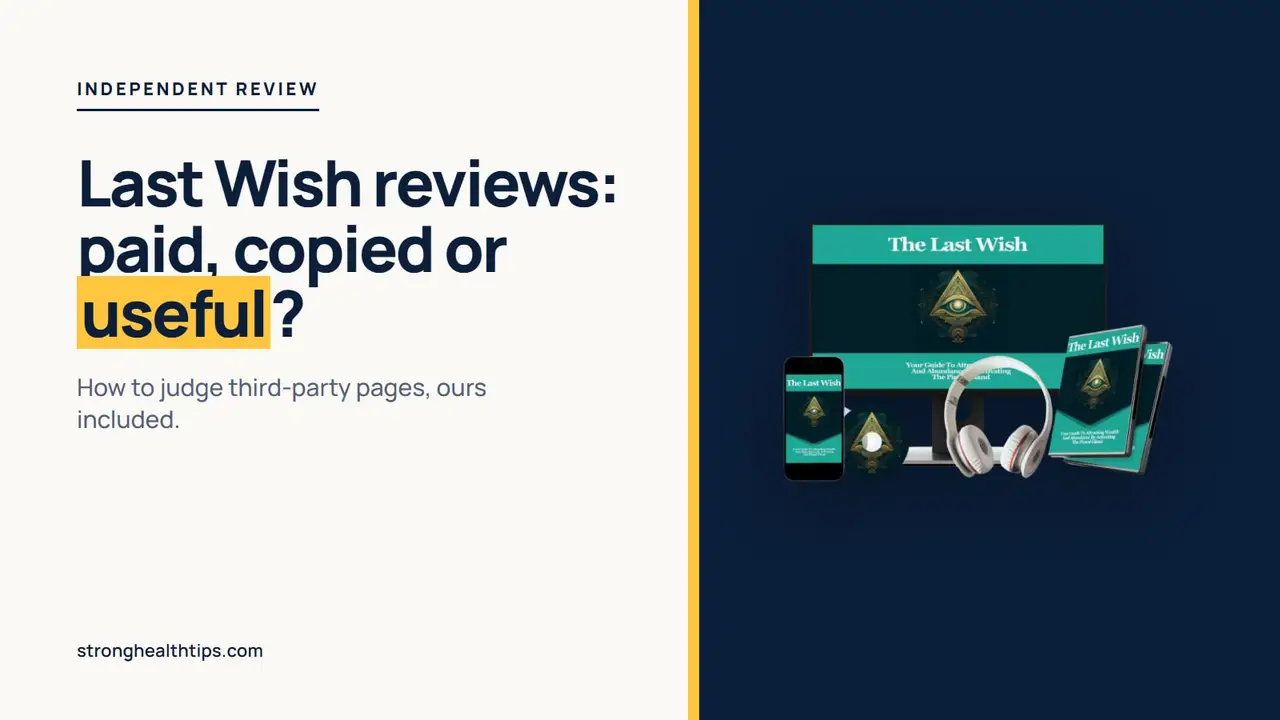
Type last wish reviews into a search engine and you will get two kinds of results mixed together. Some are about the animated film or the fantasy novel with the same name. The rest are about The Last Wish audio recordings sold at messageofmanifestation.org, and that is what this page covers. Many of those pages look independent but earn money when you buy, and some do little more than retell the sales video. This guide explains what kinds of review you will find, how they are paid, the signs that one was copied or paid for, and a checklist you can run on any of them, including this one.
Our own position first. We are an affiliate review site: we are independent, not the seller, and we may earn a commission if you buy through our links. Hold us to the same checklist.
Before you read any review
Most pages about this product earn a commission. Ours does too.
Check each one against the seller’s own Terms, which are blunt.
Visit the official websiteWhat kind of page are you reading?
The first question is not what a review says but what it is. Each type has its own incentives.
| Type of page | How it usually earns | What to check |
|---|---|---|
| Affiliate review page | A commission when a reader buys | Is the commission disclosed near the top? |
| Video review | An affiliate link in the description, or ads | Does it show anything beyond the sales video? |
| Forum or social post | Often nothing, sometimes a tracked link | Does the poster say they bought it, and when? |
| The seller’s pages | The sale itself | The Terms say testimonials are not verified |
| This page | A commission through our links | Is every fact tied to the seller’s own pages? |
How affiliate review pages are paid
The Last Wish is sold through ClickBank. A review page links to the order page with a tracking code, and if a reader buys, the page owner may earn a commission. That is how we are paid. It is a common way to fund review sites, and it does not make a review dishonest by itself. It does create a pull toward enthusiasm, which is why the US Federal Trade Commission’s guides on endorsements expect the money connection to be disclosed clearly, not buried.
A careful affiliate page should still tell you the things that make a sale less likely. In this case that means the Terms’ “For Entertainment Purposes Only” heading, the gap between the 60-day refund and the other promises in the funnel, the unverified narrator, and the extras offered at checkout. If a page that earns from the sale tells you all of that, it is at least trying to be useful.
Signs a review copied the sales video
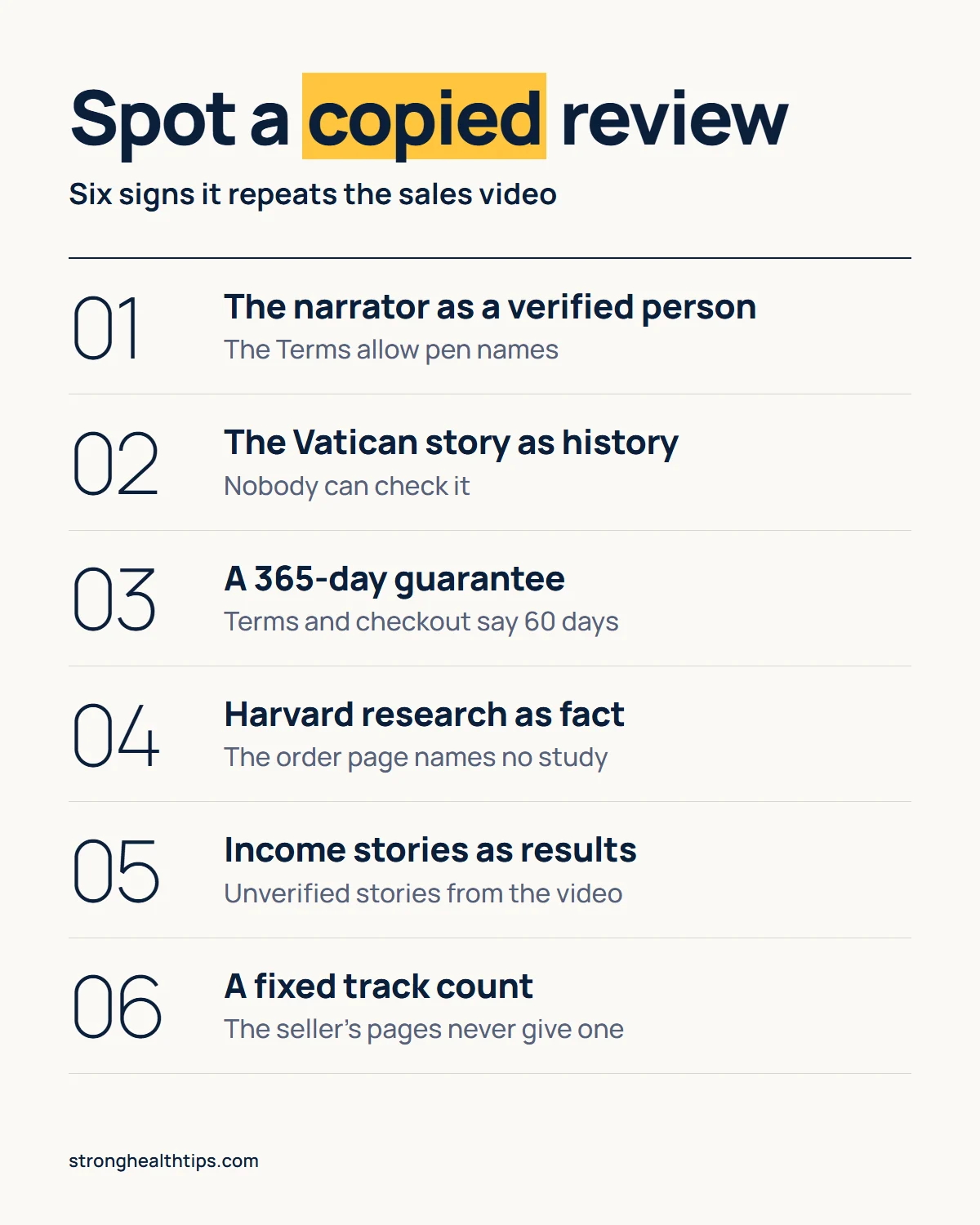
The sales video is about 26 minutes long and packed with memorable details. Pages that copy it tend to repeat the same handful of points as if they were facts. Watch for these.
- The narrator presented as a verified millionaire. The video is told by the narrator, who calls himself Danny Kelly. The seller’s Terms say names may be pen names and scenarios may be dramatized. A review that presents him as a confirmed real person has not read the Terms.
- The Vatican story told as history. The priest, “Father Michael”, and the parchment from a prayer book dating to 309 AD are the narrator’s story. Nobody can check them. A review should say so.
- “Backed by Harvard and University of Michigan” repeated as fact. The order page names no study, author or link.
- A 365-day guarantee. That number comes from a badge. The Terms and the ClickBank checkout both say 60 days.
- The income stories as results. The $3,617 day of commissions, the $10,137 IRS refund and the $2,000 scratch-off win are unverified stories from the video. Nobody should promise them to you.
- An exact track list or running time. The seller’s pages disagree, 11 minutes each night in the video against “under 7 minutes” on the order page, and never give a count.
- A CD, an app or a book. The mockup shows discs and cases, but the checkout sells a “Digital Product”.
Signs a review may be paid or incentivized
Copying is one problem; payment is another. The seller’s own Terms say testimonials “may have been compensated or incentivized” and that “We do not verify the accuracy of testimonials”. Keep that in mind when you see quoted praise, and look for these signals:
- Every link is tracked, but nothing is disclosed. A tracked link is fine. Hiding it is not.
- No downside at all. A page that never mentions the entertainment-only Terms, the refund conflicts or the upsells is selling, not reviewing.
- Star ratings with no source. Ask whose rating it is. Our 3.0 out of 5 is our own editorial score, and we label it that way. The seller’s pages show no customer ratings.
- Near-identical wording across sites. If several “independent” reviews share the same sentences, they likely share a source.
- Pressure borrowed from the funnel. Lines such as “the price ends tonight” echo the countdown timer and “Today Only” price on the sales pages, which are sales tactics.
What the fine print says
”For Entertainment Purposes Only”, in the seller’s own Terms.
$37.44 through ClickBank, with 60 days to ask for a refund.
Check the current priceWatching video reviews
Video reviews can add something written pages cannot: a look at the real checkout, the access email or the audio itself. Many simply replay the pitch over stock footage. Before you trust one, ask:
- Does the reviewer show proof of purchase, or only clips of the sales video?
- Do they show how the product was delivered? The seller does not show the delivery method before purchase, so this is real information if they have it.
- Do they mention the optional add-on, “The Wealth Wave Technique”, whose checkout image is labeled “Wealth Miracle: The Guided Recordings”, and the upsells named in the Terms, The Abundance Brain Accelerator at $97.19 and The Abundance Sequence at $47.19?
- Do they say the price is $37.44 plus local currency and tax, rather than repeating “Normally $309.77”, which is the seller’s reference price?
- Does the description disclose an affiliate link?
The evidence any honest review should mention
A trustworthy review does not need to mock anyone’s beliefs to be clear about the evidence. Many people find meaning in prayer and spiritual practice, and that deserves respect. The product’s specific claims are another matter.
- The pineal gland. It makes melatonin and helps set the sleep-wake cycle; light at night lowers melatonin. Calcification is common with age. There is no evidence that sound “activates” the gland or that decalcifying it affects money or luck. The video’s claim that the gland “has a retina in it” does not hold for humans, and its “cherubim” and “cerebrum” link is wordplay, since “cherub” is Hebrew and “cerebrum” is Latin.
- Manifestation. Outcomes are not evidence-based. Research supports picturing the steps toward a goal and mental contrasting with if-then plans, not wishes or a gland causing money.
- Audio research. The Terms describe “brain entrainment techniques”, but the pages do not say what technique the recordings use. On binaural beats generally, a 2019 meta-analysis by Garcia-Argibay and colleagues found a medium overall effect on some outcomes, while a 2023 review by Ingendoh and colleagues found most studies did not show brainwave entrainment. No study tests The Last Wish.
- The fair positive. A short, quiet listening routine in a dark room may feel relaxing, like any wind-down habit.
A checklist before you trust a review
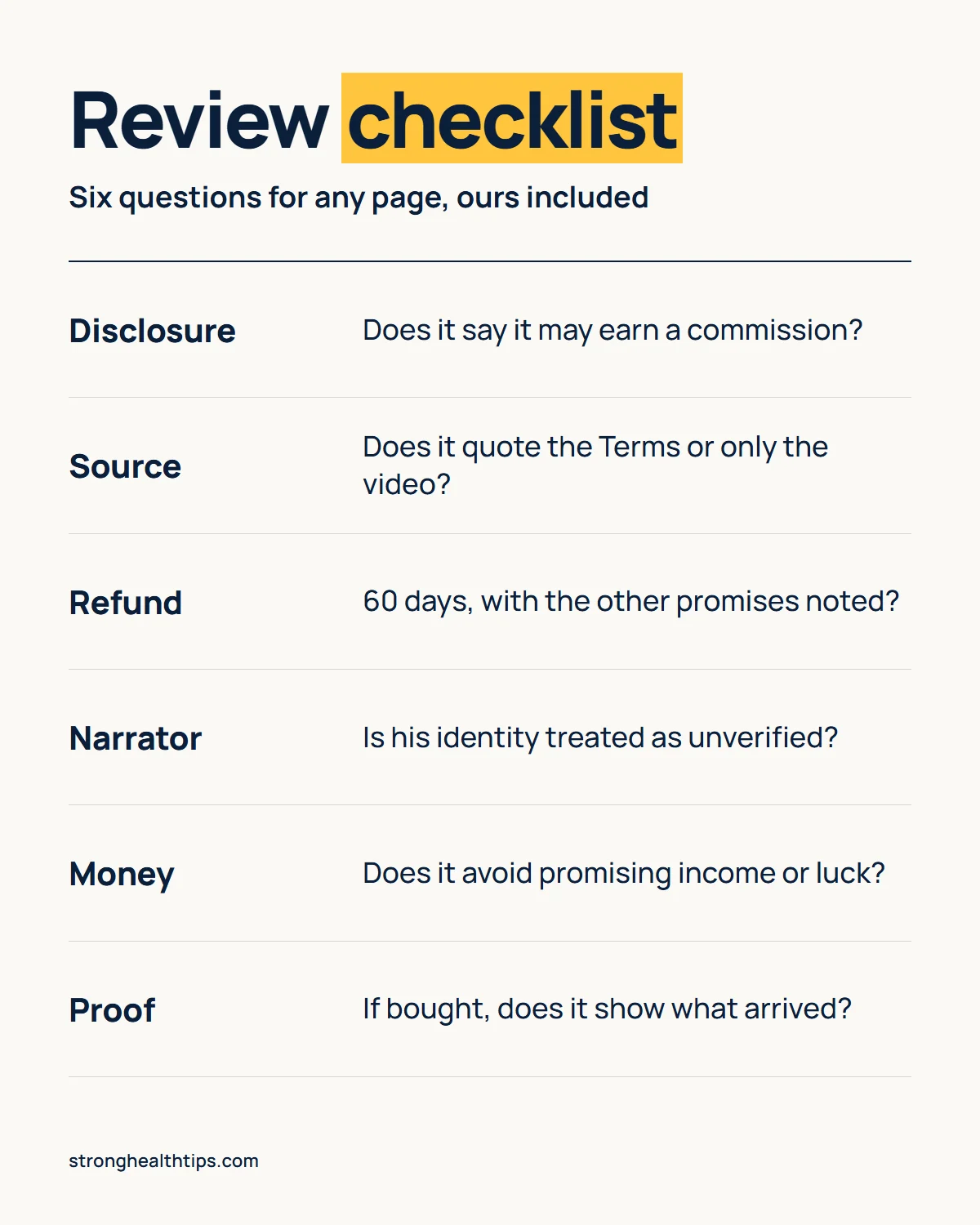
Run any page through these six questions. A good review passes most of them.
- Disclosure. Does it say near the top that it may earn a commission?
- Source. Does it quote the Terms and the checkout, or only the video?
- Refund. Does it say 60 days, and mention the 365-day badge and the abundant-life.co pages with 90-day rules as conflicts?
- Narrator. Does it treat the narrator’s identity and the priest story as unverified?
- Money. Does it avoid promising income, luck or a windfall?
- Proof. If the writer claims to have bought it, do they show what arrived?
For our answers to those questions, see our testimonial and verification check, our scored verdict and our look at how the nightly routine and gifts hold up over 60 days.
Check it at the source
Read the seller’s own pages and the Terms before any review.
Digital recordings, three gifts, optional extras at checkout.
See the official order pageThe facts that do not depend on any review
Some things you can confirm yourself on the seller’s pages and checkout, whatever any reviewer says:
- The price in the Terms is $37.44, one time. The checkout adds local currency and tax.
- Refunds: 60 days in the Terms and at checkout. Use ClickBank’s route at clkbank.com or 1-800-390-6035, and keep the receipt. The statement shows CLKBANK*TheLastWish. Product support is [email protected].
- The three gifts are The Last Wish Official Guide, The Pineal Gland Decalcification Plan and The Wealth Scripts.
- The Terms say buyers may be added to email lists, including third-party offers, with an unsubscribe link in each email.
Where this leaves you
No review, ours included, can tell you that the recordings will bring money, because nothing can show that. What reviews can do is save you from surprises: the extras at checkout, the refund conflicts, the email lists. If you try it, try it as entertainment, with money you can spare.
If money is tight, that matters more than anything above. A written budget, a nonprofit credit counselor and the FTC’s guide on getting out of debt are better first steps. Do not spend money you need. For low-cost ways to ease stress, see our guide to managing daily stress.
Entertainment disclaimer: the seller’s Terms say the product is “For Entertainment Purposes Only”. We are independent, not the seller, and we may earn a commission through our links. No recording can promise money, luck or love.
Decide on the facts
$37.44 once, entertainment only, 60 days to ask for a refund.
Skip the add-on and upsells unless you want them.
Questions people ask
Are the review pages about this product independent?
Many are affiliate pages that earn a commission when a reader buys through their links, and that includes ours. Earning a commission does not make a page dishonest, but it should be disclosed clearly, as the FTC's endorsement guides expect. Check for that disclosure first.
Why do so many pages say the same things?
Pages that copy the sales video tend to repeat the same points: the narrator's story, the priest and parchment, the research line and the income figures. Those points come from one source, the seller, so seeing them many times does not make them more reliable.
Is the 365-day guarantee some pages mention correct?
The sales pages show a 365-day badge, but no text on the site supports it. The seller's Terms and the ClickBank checkout both say 60 days. A footer link also leads to another company's terms with stricter 90-day rules. Go by the 60 days and keep your ClickBank receipt.
Do any reviews prove the recordings work?
No. No published study tests these recordings, and the 'Harvard and University of Michigan' claim on the order page names no study. Personal stories cannot show that listening caused a money event, and the seller's Terms call the product entertainment.
How can I tell if a video review is just a sales pitch?
Check whether the reviewer shows anything beyond the seller's own video, such as the checkout or what actually arrived, whether they mention the refund terms and the optional extras, and whether the description discloses an affiliate link.
What should a trustworthy review include?
A clear disclosure, the Terms' entertainment line, the 60-day refund with the conflicting promises noted, the $37.44 price with local tax, the optional add-on and upsells, and plain language that the narrator's identity and the income stories are unverified.
Sources
- FTC: Guides concerning the use of endorsements and testimonials in advertising
- FTC: Shopping online, avoiding scams and protecting your payment
- Garcia-Argibay M et al. (2019). Efficacy of binaural auditory beats in cognition, anxiety, and pain perception: a meta-analysis. Psychological Research
- Ingendoh RM et al. (2023). Binaural beats to entrain the brain? A systematic review of the effects of binaural beat stimulation on brain oscillatory activity. PLOS ONE
- FTC: How to get out of debt
Not medical advice. This guide is general information and does not replace a consultation with a qualified healthcare professional who knows your history. Full disclaimer.
Written by
Strong Health Tips Editorial Team
We research, write and fact-check every guide against current guidance from major health bodies and peer-reviewed studies, then rewrite it in plain English. How we work.