The Last Wish Reviews: What the Testimonials Can and Cannot Tell You
The Last Wish reviews, checked: the sales pages show no testimonials, the Terms say they may be paid and are not verified, and this is what we could confirm.
- Author
- Strong Health Tips Editorial Team
- Published
- Reading time
- 10 min read
Affiliate disclosure: this review contains links to the official The Last Wish website. If you buy through them we may earn a commission at no extra cost to you. It does not change our assessment. Details.
Searching for The Last Wish reviews usually means one thing: you want to hear from people who bought it before you spend $37.44. That is a sensible instinct. The trouble is that this product gives you very little to work with. The seller’s pages show no customer testimonials, and the seller’s own Terms explain why any testimonial you do find should be read with care. So this page does the next best thing. It looks at what the review evidence actually is, sets out what we could verify from the seller’s pages and checkout, and marks clearly where the facts run out.
A note on who we are: we are independent, not the seller, and we may earn a commission if you buy through our links. That does not change anything below.
The short version
No testimonials to read, and fine print that says not to rely on them anyway.
Digital audio recordings, $37.44 through ClickBank, sold for entertainment.
Visit the official websiteWhere the testimonials should be, and what is there instead
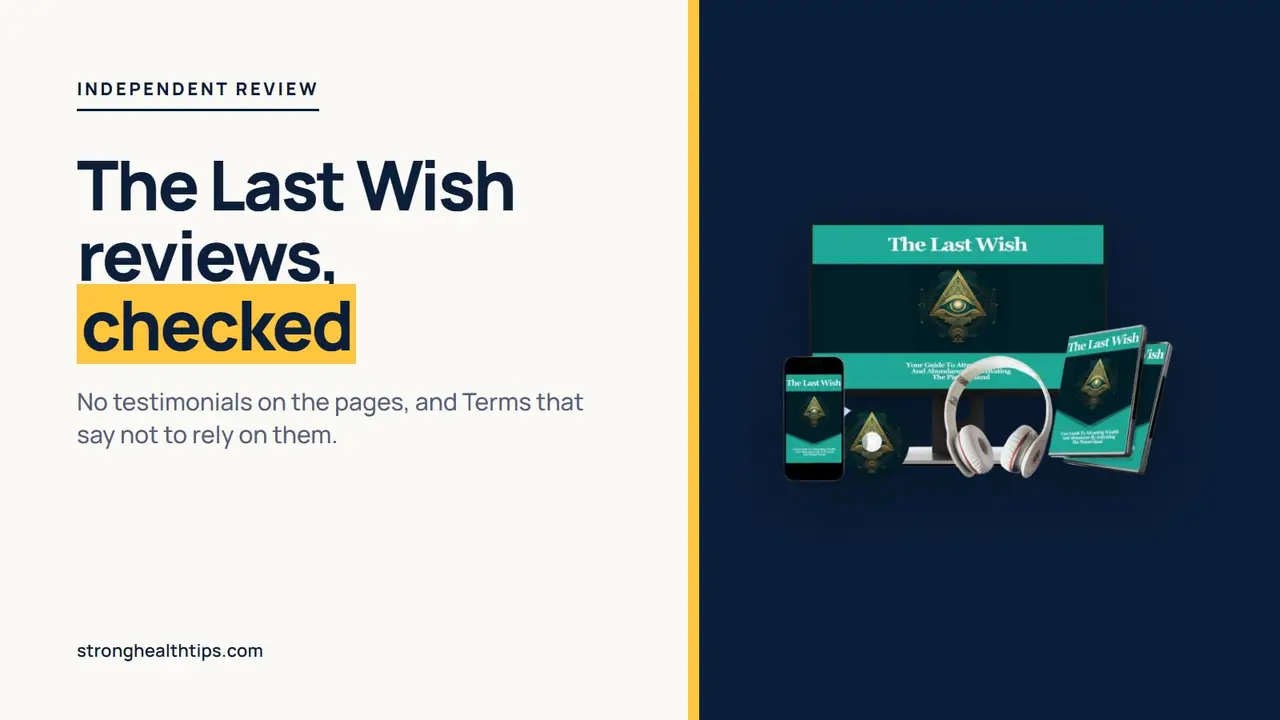
The Last Wish is sold on two pages of messageofmanifestation.org. The order page, where our link lands, is a short text page with price boxes, a “365-DAY MONEY BACK GUARANTEE” badge and a list of three free gifts. The video page at the site’s root asks for your email first, then plays a sales video of about 26 minutes, told by a narrator who calls himself Danny Kelly.
On the copies we saved on 9 October 2026, neither page shows a single customer testimonial, star rating or review count. What the order page does carry is a footer line written as if testimonials were there. It says testimonials, case studies and examples on the page “have been forwarded to us by users” and are “not intended to represent or guarantee” that anyone will get the same results.
That gap matters. On many products, a search for buyer feedback turns up quotes lifted straight from the sales page. Here there were none to lift when we checked, so a “customer review” quoted somewhere else did not come from the seller’s own pages as they stood that day.
What the fine print says about testimonials
The site’s Terms page is the most useful document the seller publishes, and it is blunt on this point. In its own words:
- Testimonials “are from real people” but “may have been compensated or incentivized in line with guidelines on consumer endorsements”.
- They “represent exceptional results and may not reflect typical experiences”.
- “We do not verify the accuracy of testimonials and are not responsible for omissions, errors, or the authenticity of customer experiences.”
- “Names and details in marketing materials may be changed or represented by pen names”, and “Some scenarios may be dramatized for entertainment purposes.”
- Images or videos “may be dramatizations”.
Put plainly, the seller tells you that any testimonial could be paid, could be untypical, and has not been checked by the people selling the product. The US Federal Trade Commission’s guides on endorsements expect paid connections to be disclosed and typical results to be made clear, which is why fine print like this exists. It is fair to credit the seller for publishing it. It also means a testimonial cannot do the job you want a review to do.
The Terms add one more line that frames everything else. Under the heading “For Entertainment Purposes Only”, they say the site provides “content, products, and brain entrainment techniques for entertainment purposes only” and that “they are not exact sciences”.
What we could verify, and what we could not
We read the order page, the video page and a transcript of its sales video, the Terms, the two footer pages the video page links to, and the ClickBank checkout. We did not buy the product or listen to it. This is where that leaves things.
| Question a buyer would ask | What we found | Verified? |
|---|---|---|
| What is it? | Digital audio “recordings”; the checkout lists a “Digital Product” | Yes |
| What does it cost? | $37.44 in the Terms; local currency plus tax at checkout | Yes |
| How many recordings, how long? | Video says 11 minutes each night; order page says “under 7 minutes” | No |
| How is it delivered? | “Immediate access” once payment is approved; method not shown | Partly |
| Refund window | 60 days in the Terms and at the ClickBank checkout | Yes |
| Who made it? | The narrator, who calls himself Danny Kelly | No |
| Does it bring money? | Only the narrator’s own stories; no study | No |
| Research claim | “Harvard and University of Michigan”; no study named | No |
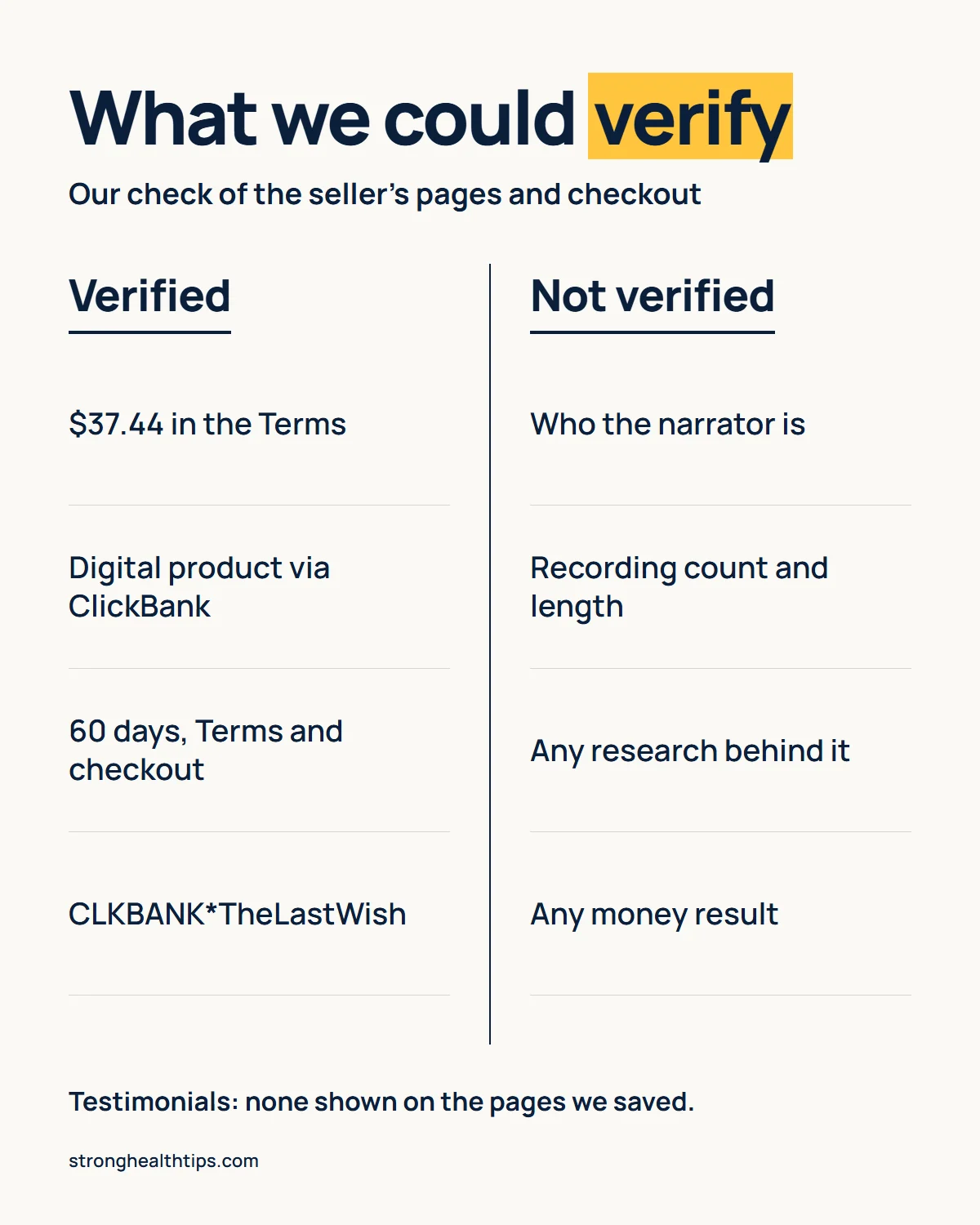
The buying side checks out. The product side, and everything it promises, does not.
The stories in the video are not reviews
Most of the persuasion in this funnel comes from one voice. The narrator, who calls himself Danny Kelly, says a priest he calls Father Michael, “the head of St. Anthony’s church”, told him about a parchment that fell from a prayer book dating to 309 AD in the Vatican’s Secret Archives, and later gave him a CD of recordings. He then describes what happened once he started listening in the dark: $3,617 in commissions in one day, a letter about a $10,137 IRS refund, a $2,000 scratch-off win, and later a dream car, a bigger house and travel.
None of this can be checked, and the seller’s own Terms say names may be pen names and scenarios may be dramatized. We cannot confirm that the narrator exists under that name, that the priest existed, or that the parchment story happened. For context, the archive he describes was renamed the Vatican Apostolic Archive in 2019 and is open to qualified researchers. The income stories are a sales narrative, not results, and nobody should expect money from listening.
To be respectful about it: many people find real meaning in prayer, scripture and spiritual practice, and nothing here questions that. The point is narrower. A story told in a sales video, by a narrator the Terms allow to be a pen name, is not evidence that a product works.
Know what you are buying
Digital recordings and three gifts, sold as entertainment.
$37.44 plus any local tax. Optional extras appear at checkout.
Check the current priceThe claims an honest buyer report would have to test
If people who bought it posted honest accounts, these are the claims they would be testing. Published evidence already says a good deal about each.
“Activates the pineal gland.” The pineal gland is a small gland in the brain that makes melatonin and helps set the sleep-wake cycle. Light at night lowers melatonin, which is one reason a dark room suits a bedtime routine. Calcification of the gland is common with age. There is no evidence that sound “activates” it, or that decalcifying it affects money or luck. The video also says the gland “has a retina in it”; the human pineal gland has no retina, and light affects it indirectly through the eyes. And the video’s link between “cherubim” and “cerebrum” is wordplay: “cherub” is Hebrew and “cerebrum” is Latin.
“Backed by research from Harvard and University of Michigan.” The order page names no study, author or link, and we could not find one tied to this product.
“You’ll just receive.” Manifestation outcomes are not evidence-based. What research does support is narrower and more practical: picturing the steps toward a goal, and mental contrasting, where you picture the goal, then the obstacles, then make an if-then plan. Nothing shows that wishing, listening or a gland causes money or events to appear.
The fair positive, which an honest buyer could report: a short, quiet listening routine in a dark room may feel relaxing, the way any wind-down habit can. Our guide to sleep hygiene habits covers free habits in the same spirit.
The refund promise any buyer account should mention
The seller’s Terms say: “We offer a generous 60-day refund policy.” The ClickBank checkout says ClickBank “will allow for the return or replacement of any product within 60 days from the date of purchase.” Those two agree, so 60 days is the number to use.
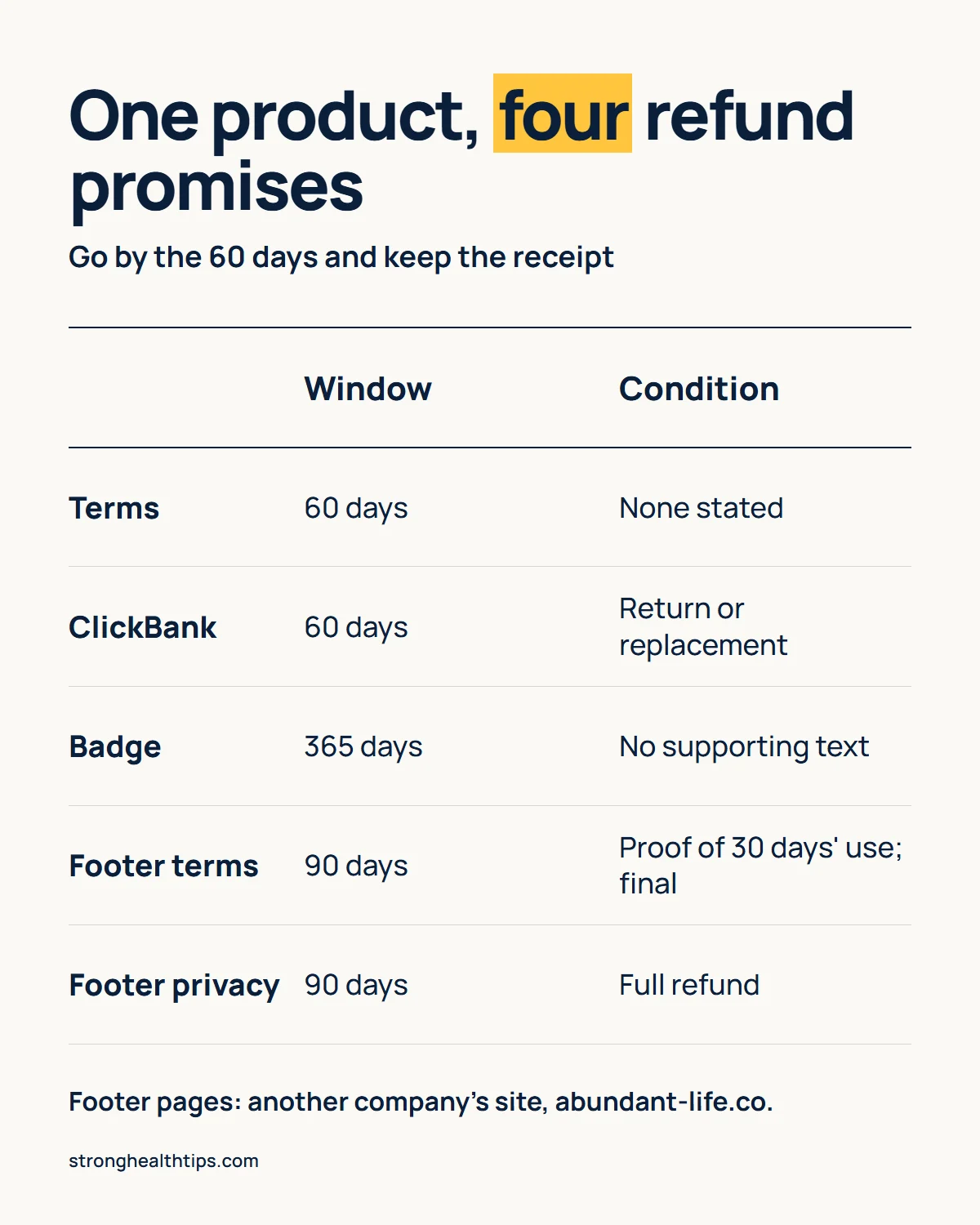
Other pages in the funnel say other things. Both sales pages show a 365-day badge with no text anywhere to support it. The video page’s footer links lead to another company’s site, abundant-life.co, whose terms ask for 30 consecutive days of use, “documented proof”, a request within 90 days, and a decision that is “final and binding”. That site’s privacy page promises a full refund within 90 days. We simply report the four promises as they appear. If you buy, keep the ClickBank receipt and use ClickBank’s route: clkbank.com or 1-800-390-6035. Your card statement will show CLKBANK*TheLastWish, and product support is [email protected].
If you decide to try it anyway
- The price. $37.44 one time per the Terms; the video page shows 37.11. “Normally $309.77” is the seller’s reference price. The checkout converts to your local currency and adds tax, so your total may differ.
- The add-on. The checkout offers “The Wealth Wave Technique” as an optional extra, though its image is labeled “Wealth Miracle: The Guided Recordings”. Leave it unticked unless you want it.
- The upsells. The Terms name The Abundance Brain Accelerator at $97.19 and The Abundance Sequence at $47.19. All of them are optional.
- The gifts. The Last Wish Official Guide, The Pineal Gland Decalcification Plan and The Wealth Scripts.
- The format. Digital audio. The mockup shows discs and cases, but nothing is shipped, and it is not an app or a book. How you receive it is not shown before purchase.
- The emails. The Terms say buyers may be subscribed to email lists that can include third-party offers. Each email has an unsubscribe link.
- The pressure. The countdown timer, the “Today Only” price, the “could be taken down” warning and the line that “the powers that be” do not want this shared are sales tactics. Take your time.
If you want to try it
Read the Terms first, then decide at your own pace.
60 days to ask ClickBank for a refund. Keep the receipt.
See the official order pageA word about money
If you are drawn to this because money is tight, please put the $37.44 toward something more certain first. A simple written budget, a free session with a nonprofit credit counselor, and the FTC’s guide on how to get out of debt will do more for most people than any recording. Do not spend money you need, and do not make money decisions based on expected “abundance”. On hard days, our page on managing daily stress may also help.
The bottom line
The Last Wish reviews you hoped to find mostly do not exist on the seller’s side, and the Terms tell you not to lean on testimonials anyway. What can be checked is ordinary: a $37.44 digital product sold through ClickBank with 60 days to ask for a refund. What cannot be checked is everything that makes it sound special: the narrator, the priest, the parchment, the research and the money. For our scored verdict, area by area, see our full review with the scorecard.
Entertainment disclaimer: the seller’s Terms say The Last Wish is “For Entertainment Purposes Only” and not a substitute for medical, legal or financial advice. No recording can promise money, luck or love. Do not spend money you need on it.
Your decision, your pace
See the offer and the Terms for yourself.
$37.44 one-time via ClickBank. Entertainment only. 60-day refund window.
Questions people ask
Are there customer testimonials on the official pages?
Not on the pages we saved on 9 October 2026. The order page and the video page show the narrator's own story, three free gifts and price boxes, but no customer reviews, star ratings or review counts. The order page footer still says testimonials are 'forwarded to us by users' and do not guarantee the same results.
Can I trust a testimonial for this product if I find one?
Read it with care. The seller's Terms say testimonials 'may have been compensated or incentivized', represent 'exceptional results', and that 'We do not verify the accuracy of testimonials'. The same Terms say names may be changed and images or videos may be dramatizations.
Are the money stories in the video real results?
They are stories told by the narrator, who calls himself Danny Kelly: $3,617 in commissions in one day, a $10,137 IRS refund and a $2,000 scratch-off win. None of them can be checked, and the Terms say scenarios may be dramatized. They are not results anyone should expect.
Is there research behind the recordings?
The order page says 'Backed By Research From Harvard and University of Michigan', but it names no study, author or link, and we found no study tied to this product. No published study tests The Last Wish.
What could you actually verify?
The $37.44 price in the Terms, the ClickBank checkout that sells a 'Digital Product', the 60-day refund wording in the Terms and at checkout, the CLKBANK*TheLastWish statement name and the support email [email protected]. We could not verify the narrator, the origin story, the number or length of the recordings, or any outcome.
Should I decide based on what other buyers say?
There is very little to go on, because the seller shows no testimonials and its Terms qualify any that exist. Decide on the facts instead: an entertainment product, $37.44 plus local tax, and 60 days to ask ClickBank for a refund. If the money is needed for bills or debt, keep it.
Sources
Not medical advice. This guide is general information and does not replace a consultation with a qualified healthcare professional who knows your history. Full disclaimer.
Written by
Strong Health Tips Editorial Team
We research, write and fact-check every guide against current guidance from major health bodies and peer-reviewed studies, then rewrite it in plain English. How we work.