FemiCore Review 2026 Women: Who It Fits and Who Should Skip It, Situation by Situation
FemiCore review 2026 women guide: our verdict by situation, from menopause and childbirth to repeat UTIs, regular medicines, pregnancy and kidney disease.
- Author
- Strong Health Tips Editorial Team
- Published
- Reading time
- 8 min read

Affiliate disclosure: this review contains links to the official FemiCore website. If you buy through them we may earn a commission at no extra cost to you. It does not change our assessment. Details.
FemiCore is sold to women, but women are not one group. A capsule that is a fair experiment for one woman can be a poor idea for her pregnant sister or her mother on five prescriptions. This FemiCore review 2026 women guide gives a separate verdict for each common situation: after menopause, after childbirth, with repeat urinary infections, on regular medicines, pregnant or breastfeeding, and with kidney disease.
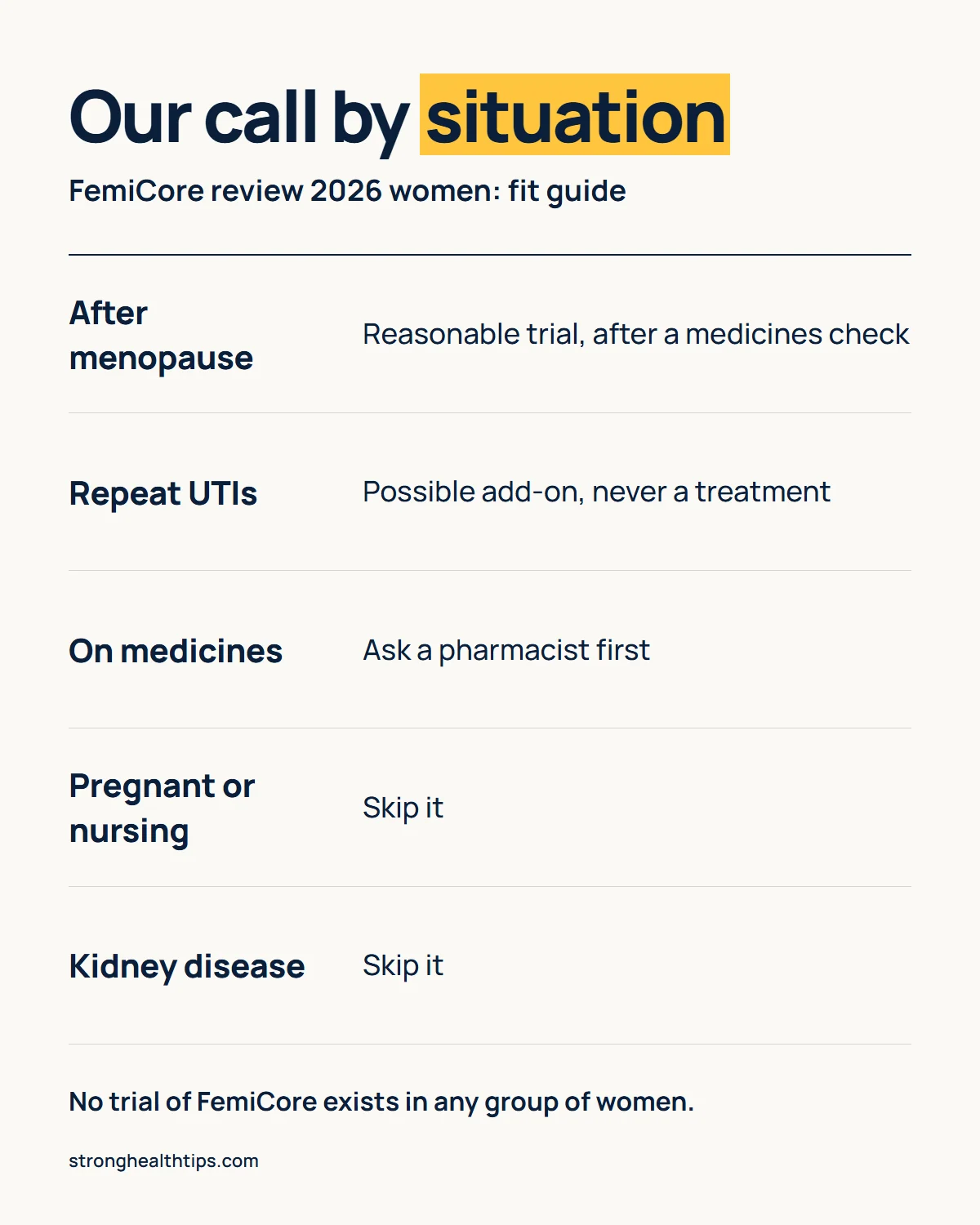
One thing applies to every section. No trial of the finished FemiCore formula exists, in any group of women. Each verdict below is our judgment from what is known about the nine ingredients and their cautions, not a result from a study.
Know what you are taking
See the official FemiCore label before you decide.
Nine ingredients, one capsule a day, 60 days from delivery for a refund.
View FemiCore on the official siteThe verdict at a glance
| Your situation | Our call | The main reason |
|---|---|---|
| After menopause, urgency or frequent trips | Reasonable trial, after a medicines check | Fits the product’s aim; no trial in this group |
| After childbirth, breastfeeding | Skip | Berberine unsafe; bearberry to be avoided |
| After childbirth, not breastfeeding | See your doctor or midwife first | New leaks deserve a check |
| Repeat urinary infections | Possible add-on, never a treatment | Cranberry has the best data; dose not disclosed |
| On regular medicines | Ask a pharmacist first | Berberine, bearberry and cranberry interactions |
| Pregnant | Skip | Berberine unsafe; bearberry to be avoided |
| Kidney disease | Skip | Bearberry to be avoided |
| Prone to kidney stones | Ask your doctor first | Cranberry contains oxalate |
| Severely weakened immune system | Ask your doctor first | Rare probiotic infections |
The official site gives similar advice in one line: see a physician if you are pregnant, nursing, on medication or have a medical condition. The sections below explain why.
After menopause
This is the group FemiCore’s marketing most often speaks to: women with sudden urges, frequent trips and night-time waking. The science behind the idea is relevant here. Since about 2012, sequencing studies have found the female bladder is not sterile, and some saw fewer Lactobacillus bacteria in women with urgency incontinence. FemiCore’s five Lactobacillus species are aimed at that finding.
What we cannot tell you is whether the capsule works in this group, because nobody has tested it. The idea is plausible and early.
If you try it, measure it. Before the first capsule, count your sudden urges, night trips and leaks over a normal day or two. Count them again on similar days around day 50 after delivery. The seller advises giving FemiCore at least 3 months, but the refund window closes 60 days after delivery, so your own numbers at day 50 are what you will have to decide on.
Our call: a reasonable trial if urgency is your main problem, after one practical step. If you take any regular medicines, take the label and your medicine list to a pharmacist before day 1. Berberine is the ingredient most likely to matter.
After childbirth
Two very different situations sit under this heading.
If you are breastfeeding, skip FemiCore. Berberine is considered unsafe during breastfeeding, and bearberry should be avoided. That is not a close call, and the official site’s own advice is to see a physician if you are nursing.
If you are not breastfeeding, the question is what is behind your symptoms. New leaks after giving birth are worth raising with your doctor or midwife before you buy any supplement, because a capsule cannot check what has changed. Pelvic floor training and a medical check are different kinds of help, and they look at causes that a probiotic and herb formula does not.
Our call: skip while breastfeeding; otherwise, get checked first and treat FemiCore as an optional extra at most.
With repeat urinary infections
This is the situation where FemiCore’s ingredients have their best human data, and also where it is easiest to misuse.
- Cranberry: a 2023 Cochrane review found cranberry products can reduce repeat UTIs in women prone to them. Earlier reviews were mixed, and the effect depends on the PAC dose. FemiCore does not disclose its PAC content.
- L. crispatus: a small placebo-controlled trial found fewer repeat UTIs, but it used a vaginal product, not a capsule you swallow. Effects are strain-specific, and FemiCore names species only.
Our call: a possible add-on to your doctor’s plan, never a substitute for it. FemiCore is not a treatment for an infection. Burning, fever or chills, flank pain or blood in your urine need a doctor the same day you notice them.
If it fits your situation
FemiCore from $49 to $79 a bottle on the official site.
One-off purchase. Free US shipping on 3 and 6 bottles.
See the official FemiCore packagesOn regular medicines
FemiCore is not a harmless extra if you take prescriptions. Three of its nine ingredients have interactions worth checking.
| Ingredient | What it can do | Medicines to ask about |
|---|---|---|
| Berberine | Can lower blood sugar; may lower blood pressure; slows CYP3A4 and CYP2D6, raising levels of many drugs | Diabetes medicines, blood pressure medicines, cyclosporine and many others |
| Bearberry | Interacts with lithium | Lithium |
| Cranberry | Case reports of interaction | Warfarin (INR checks) |
FemiCore does not disclose the berberine dose, so a pharmacist cannot work out exactly how much you would be taking. Bring the bottle or a photo of the label anyway. A pharmacist can still tell you whether the ingredient itself is a problem with what you take.
Our call: ask a pharmacist first. If they say no, it is no.
Protected by the refund policy
60 days from delivery to ask for your money back.
Buy only from the official site so the policy applies.
Go to the official FemiCore storePregnant or breastfeeding: skip it
This is the clearest verdict on the page. Berberine is considered unsafe in pregnancy and breastfeeding, and bearberry should be avoided in both. With doses undisclosed, there is no way to judge the exposure. Bladder changes during and after pregnancy deserve a conversation with your midwife or doctor, who can suggest options that are known to be safe for you and your baby.
With kidney disease or kidney stones
Kidney disease: skip it. Bearberry should be avoided in kidney disease. It is also an herb that European regulators describe for short courses of about a week, while FemiCore is taken every day for months.
Prone to kidney stones: ask your doctor first. Cranberry contains oxalate, and the cranberry amount in FemiCore is not stated.
A severely weakened immune system: ask your doctor first. Probiotics can rarely cause infections in severely immunocompromised people.
Women it may simply not suit
Some women have no medical reason to avoid FemiCore and may still be a poor fit.
- Women who want to see doses first. If you only take supplements with stated amounts, FemiCore will not pass: the label names nine ingredients and gives no amount for any of them.
- Women who want quick results. The seller itself advises at least 3 months before judging. A capsule that might help over months is the wrong tool if you need change this week.
- Women who will not track anything. Without a before and after count, it is hard to know whether to keep going or use the refund, and the refund has a deadline.
- Women buying from a marketplace. The seller says FemiCore is not an authorized Amazon, Walmart or eBay product. A marketplace bottle may be a fake or old stock, and it loses the 60-day guarantee.
- Women who would rather not post a parcel. A refund means sending every bottle back, empty or full, to Tallmadge, Ohio, with return postage paid by you.
None of these is a safety issue. They are reasons the experiment may not be worth your money.
Symptoms that rule out a supplement for any woman
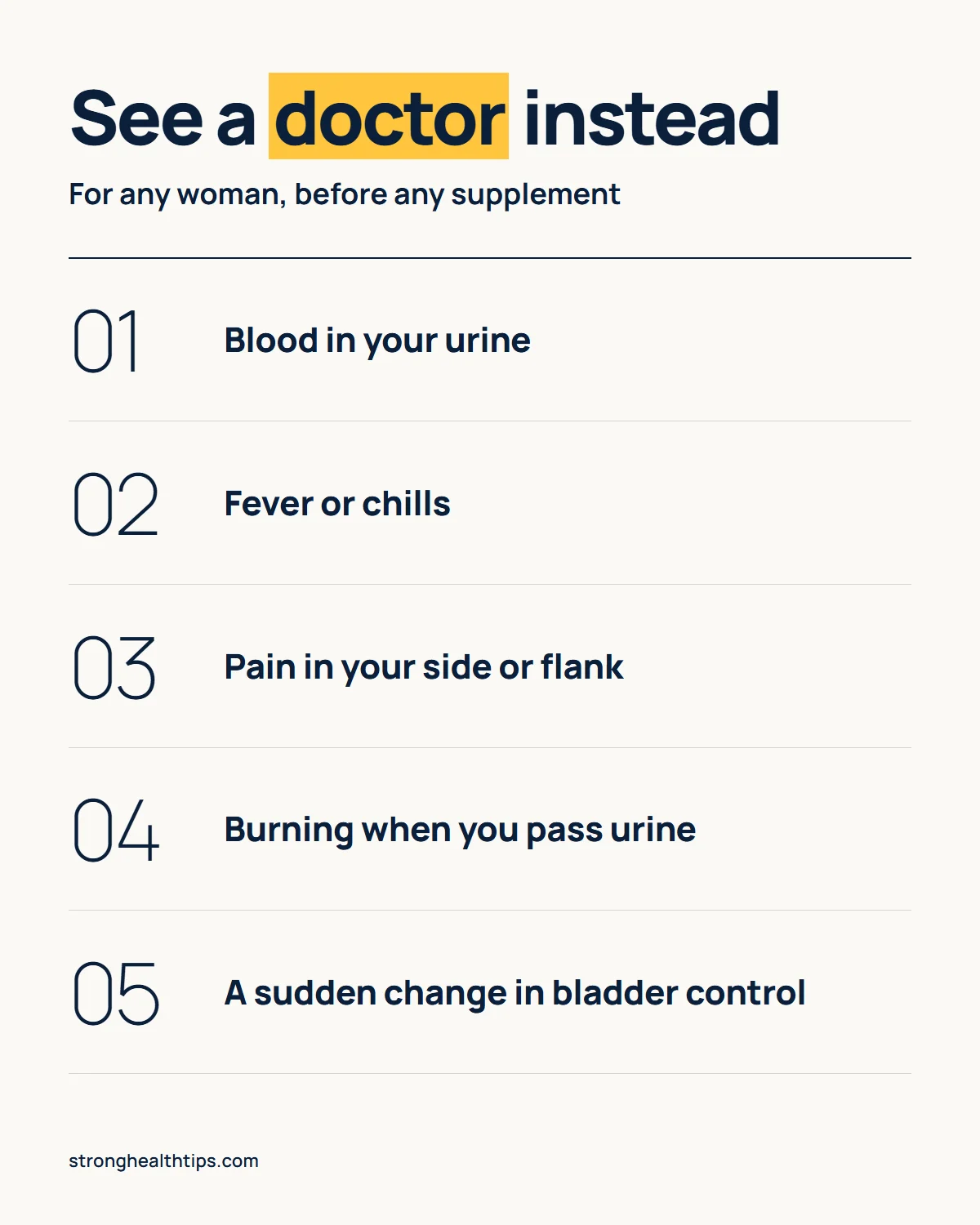
Whatever your age or situation, see a doctor instead of ordering FemiCore if you have:
- Blood in your urine
- Fever or chills
- Pain in your side or flank
- Burning when you pass urine
- A sudden change in bladder control
- Confusion in an older relative who also has urinary symptoms
For the effects you may feel once you start, such as gas or bloating in the first one or two weeks, see our guide to FemiCore side effects. For a broader fit check that is not tied to life stages, see who should use FemiCore.
Our overall verdict for women
For a woman whose main problem is urgency, frequent trips or night-time waking, who has no warning symptoms, is not pregnant or breastfeeding, has no kidney disease and has cleared her medicines with a pharmacist, FemiCore is a reasonable, protected experiment. Our editorial score is 4.2 out of 5, our own judgment rather than a customer rating, held back mainly by the hidden doses and the lack of any trial. Our FemiCore review 2026 verdict explains the score and the terms as checked this year.
If you go ahead, buy from the official site, note the delivery date and decide before day 60. The seller advises at least 3 months before judging, but the refund window is 60 days from delivery, every bottle has to go back, and you pay return shipping. For packages, ingredients and safety on one page, see our FemiCore product hub.
Decide for your situation
Genuine FemiCore, official prices, a written refund policy.
We are independent, not the seller, and may earn a commission through our links.
Order from the official websiteQuestions people ask
Is FemiCore suitable for women after menopause?
It may be a reasonable trial if your main problem is urgency or frequent trips and you have no warning symptoms. No trial of FemiCore exists in any group, including women after menopause. If you take any regular medicines, check with a pharmacist first.
Can I take FemiCore after having a baby?
Not while breastfeeding. Berberine is considered unsafe during breastfeeding and bearberry should be avoided. If you are not breastfeeding, talk to your doctor or midwife about any new leaks first, because a supplement cannot check what changed.
Does FemiCore help women with repeat UTIs?
It contains cranberry, which a 2023 Cochrane review found can reduce repeat UTIs in women prone to them, but the effect depends on the PAC dose and FemiCore does not disclose it. FemiCore is not a treatment for an active infection. Burning, fever, chills or flank pain need a doctor.
Can I take FemiCore with diabetes or blood pressure medicine?
Ask a pharmacist first. Berberine can lower blood sugar and may lower blood pressure, so it can add to those medicines. It also slows the enzymes CYP3A4 and CYP2D6, which raises the levels of many drugs.
My mother has urinary symptoms and seems confused. Should she try FemiCore?
No. Confusion in an older relative with urinary symptoms is a reason to see a doctor promptly, not to start a supplement.
Is FemiCore safe if I have had kidney stones?
Check with your doctor first. Cranberry contains oxalate, which matters for women prone to kidney stones, and the cranberry amount in FemiCore is not disclosed. Women with kidney disease should avoid it because of the bearberry.
Sources
- Williams G et al. (2023). Cranberries for preventing urinary tract infections. Cochrane Database of Systematic Reviews
- Pearce MM et al. (2014). The female urinary microbiome in women with and without urgency urinary incontinence. mBio
- NIDDK: Bladder control problems (urinary incontinence) in women
- FDA: Tips for dietary supplement users
Not medical advice. This guide is general information and does not replace a consultation with a qualified healthcare professional who knows your history. Full disclaimer.
Written by
Strong Health Tips Editorial Team
We research, write and fact-check every guide against current guidance from major health bodies and peer-reviewed studies, then rewrite it in plain English. How we work.