Who Created The Last Wish Manifestation? The Narrator, the Pen-Name Terms and the Seller Trail
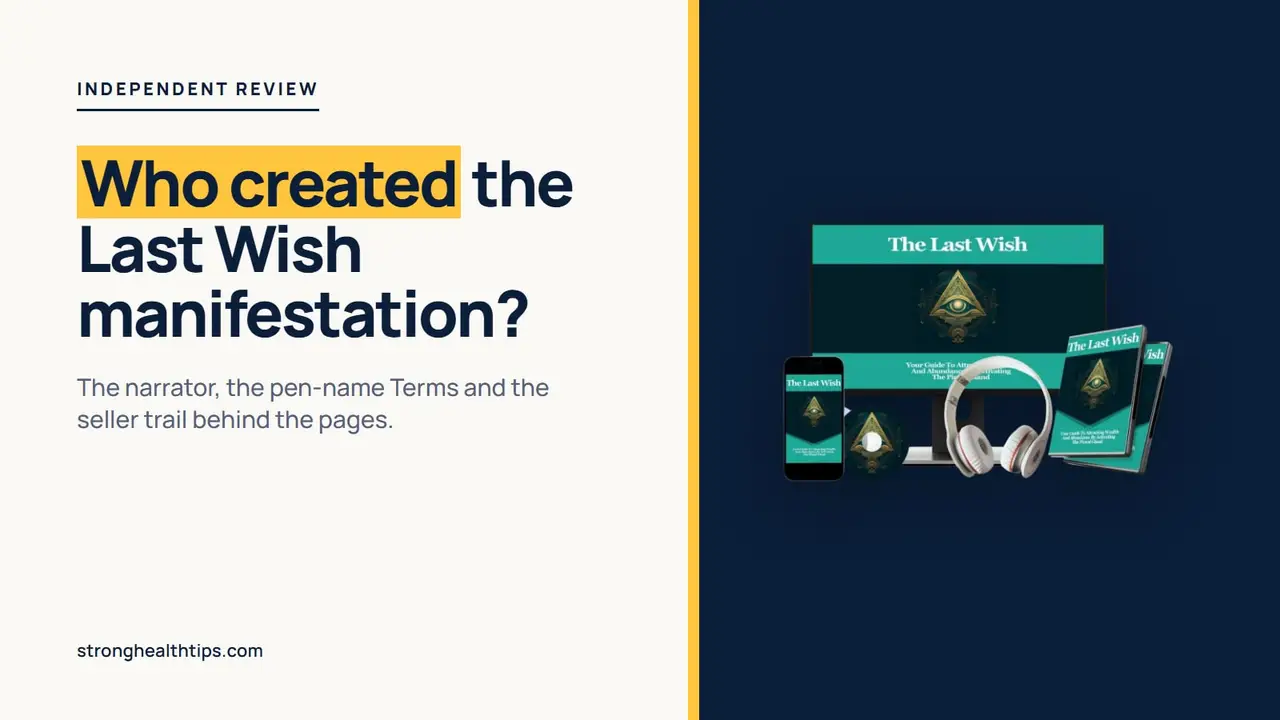
Who created the Last Wish manifestation: the narrator who calls himself Danny Kelly, the pen-name Terms, the unverified Vatican story and the seller trail.
- Author
- Strong Health Tips Editorial Team
- Published
- Reading time
- 9 min read
Affiliate disclosure: this review contains links to the official The Last Wish website. If you buy through them we may earn a commission at no extra cost to you. It does not change our assessment. Details.
People who ask who created the Last Wish manifestation usually want one thing: to know whether the man in the video is real before they trust his story. We followed every name, email address and domain we could find on the seller’s pages, the 25:44 sales video, the Terms and the ClickBank checkout. This is what can be traced, what cannot, and why the seller’s own fine print matters more than the story.
The product itself is a set of digital audio recordings sold for $37.44. The seller’s Terms describe its content as “For Entertainment Purposes Only”.
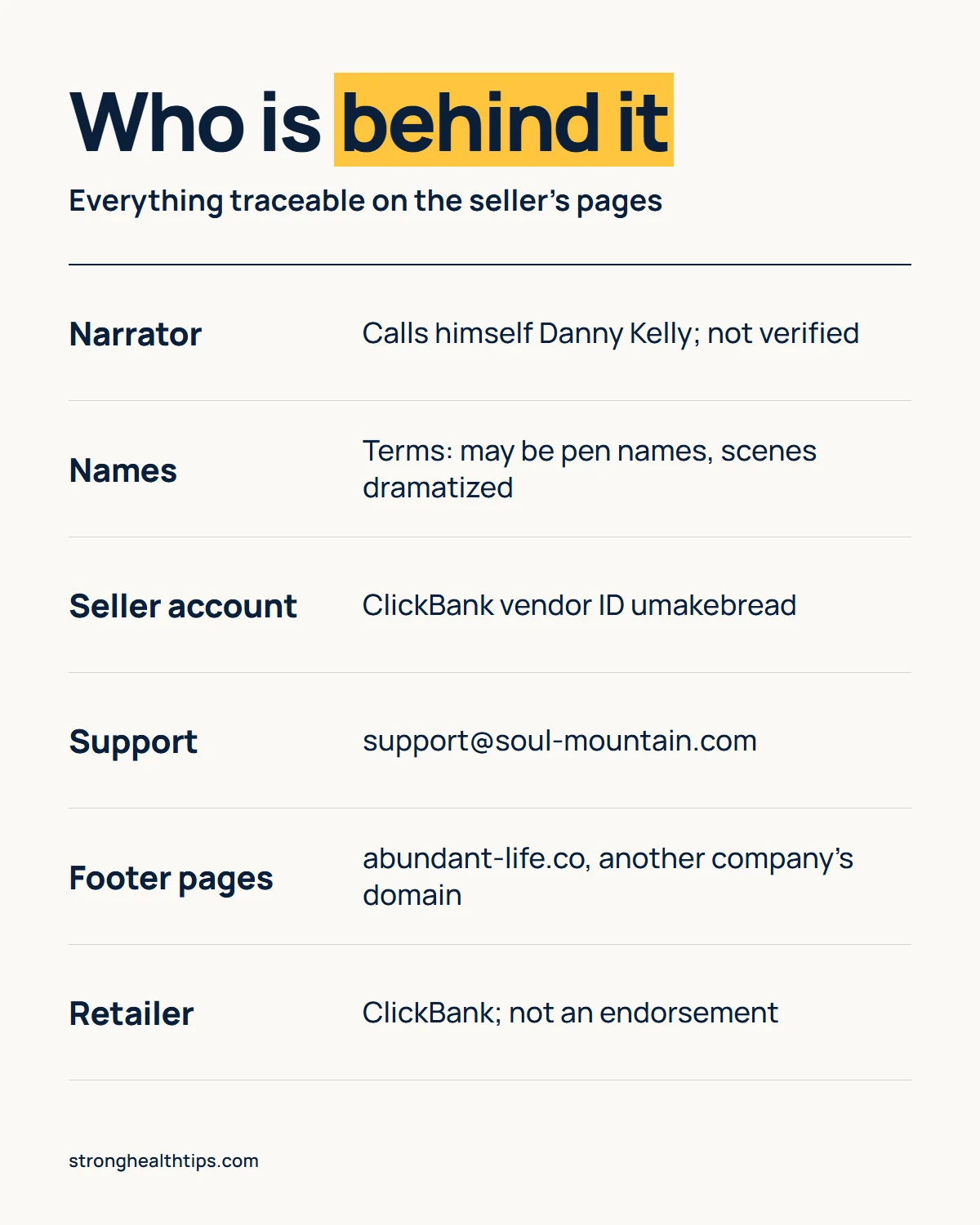
Who is behind it
A narrator we cannot verify, a ClickBank seller account and a support email.
Payment and refunds run through ClickBank, the retailer.
See the official order pageThe short answer
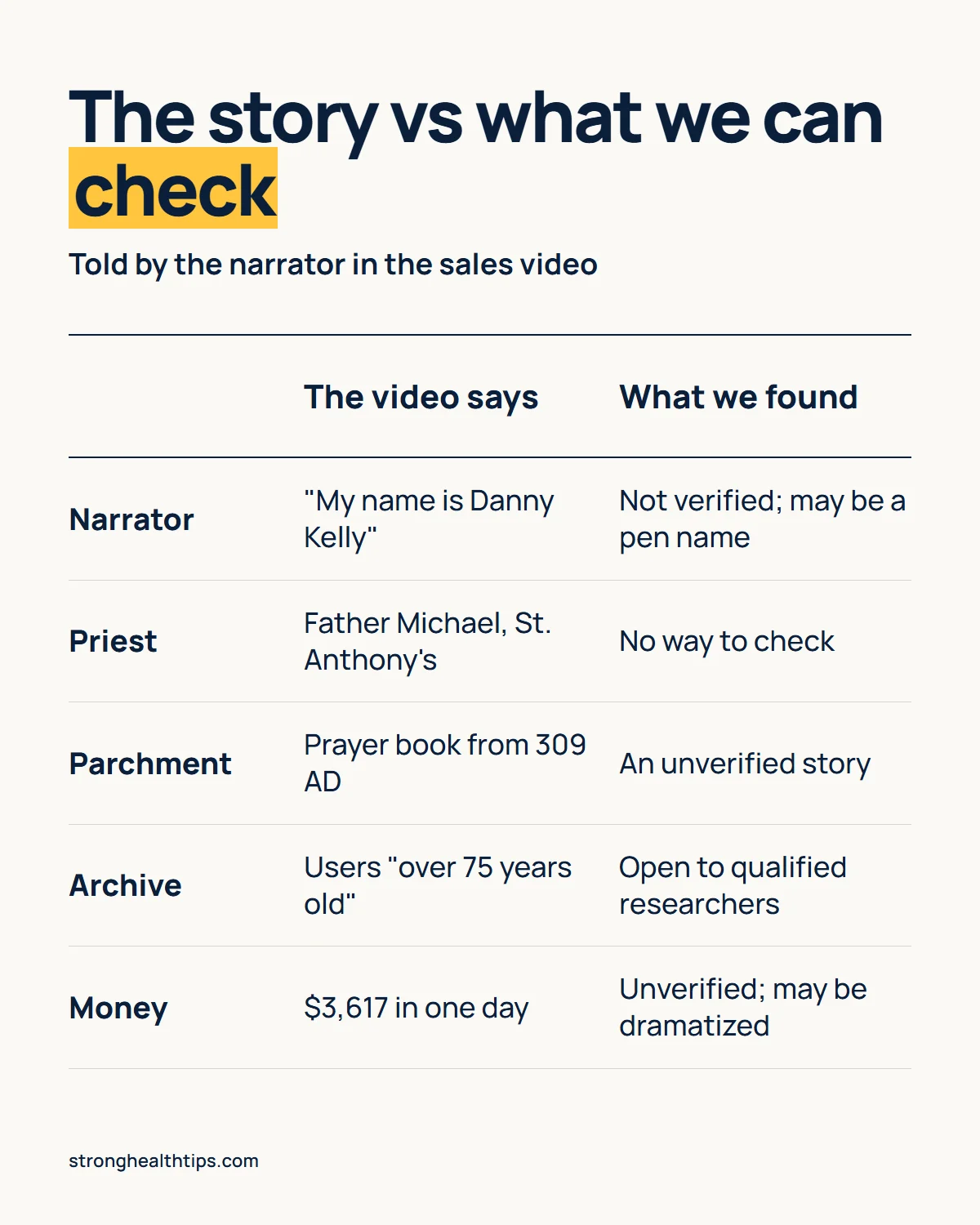
The face of the product is the narrator, who calls himself Danny Kelly. We could not confirm that this person exists or that his story happened. The seller’s Terms say “Names and details in marketing materials may be changed or represented by pen names” and that “Some scenarios may be dramatized for entertainment purposes.” Behind the pages, the traceable parts are a ClickBank vendor account, a support email and links to a second company’s web pages. No company name, address or real author is given anywhere we could reach.
The narrator, who calls himself Danny Kelly
The video opens with a man who says his “time is near” and that he is “living the end of my days”. He introduces himself as Danny Kelly about four and a half minutes in, signs off as “Dan Kelly”, and a photo caption on the video page repeats the name. He describes a past of two jobs, a crowded small house and arguments about money, followed by twenty years of wealth after discovering the recordings.
A few details are worth noticing. At several points the narrator asks someone named James to put a Bible verse or a picture on the screen, which tells you this is a produced video, not a home recording. He also says he “improved and updated” the recordings “with sound engineers”. And he says the price is not money “we keep”, only enough to maintain the website “and help the next person”. None of these claims can be checked.
We do not show his photo, and we do not treat the name as a real identity.
What the seller’s Terms say about names
This is the most important document for this question, and it was written by the seller. The Terms include:
- Pen names: names and details “may be changed or represented by pen names to protect individuals’ privacy”.
- Dramatization: “Some scenarios may be dramatized for entertainment purposes.”
- Testimonials: they “may have been compensated or incentivized”, and “We do not verify the accuracy of testimonials”. The pages we saved show no testimonials at all.
- Entertainment: the content and “brain entrainment techniques” are “for entertainment purposes only” and “not exact sciences”.
Put together, the seller tells you in writing that the person and the story may not be what they appear. The FTC’s guides on endorsements and testimonials exist for exactly this kind of advertising, so read the video as marketing.
The priest and the parchment, as the video tells it
The origin story, in the video’s words, goes like this. About twenty years ago the narrator sheltered from rain in a chapel and met “Father Michael, the head of St. Anthony’s church”. The priest said he had found a parchment in the Vatican’s Secret Archives, tucked in a prayer book “dating back to 309 AD”, showing a brain diagram with the Hebrew word for God at its center. The priest later gave the narrator a CD of recordings.
We cannot verify any part of this, and we do not present it as true. One detail can be put in context: the video says archive users “must be over 75 years old”. The archive was renamed the Vatican Apostolic Archive in 2019 and is open to qualified researchers.
Faith runs through this story, and many readers hold those beliefs sincerely. Questioning an advertisement’s story is not questioning anyone’s faith.
Know what you are buying
Digital recordings for $37.44, sold as entertainment.
The story behind them is unverified. The 60-day refund is in writing.
Visit the official websiteThe business trail behind the pages
Here is everything traceable that we found on the seller’s own pages and checkout.
| Clue | What it shows |
|---|---|
| messageofmanifestation.org | The seller’s site: a text order page at /main and a video page at the root |
| ClickBank vendor ID umakebread | The seller account behind the checkout |
| [email protected] | The support address in the Terms; soul-mountain.com did not load on 2026-10-09 |
| abundant-life.co | Footer pages on the video page, another company’s domain |
| Delaware | The governing law named in the Terms |
| CLKBANK*TheLastWish | The name on your card statement |
The site has no separate contact, FAQ or refund page; those addresses return errors, and the Terms and Privacy policy share one page. ClickBank is the retailer, and its footer on the order page says that role “does not constitute an endorsement, approval or review of this product”.
One product, two sets of terms
The “Terms And Conditions” and “Privacy Policy” links in the video page footer do not point to the seller’s own Terms. They go to abundant-life.co and redirect to addresses named “ex-back-thank-you-page”. That terms page covers “The Last Wish, The Abundance Brain Accelerator, And The Abundance Sequence”, so one set of terms is shared across several products sold in the same funnel.
The refund rules on those pages differ from the seller’s own. Across the funnel you will find four promises:
- 60 days in the seller’s Terms and on the ClickBank checkout.
- 365 days on badges on the sales pages, with no supporting text.
- 90 days with conditions on the abundant-life.co terms: proof of 30 consecutive days’ use, and the company’s decision is “final and binding”.
- 90 days on the abundant-life.co privacy page.
Go by the 60 days. ClickBank processes refunds under its own 60-day policy, so ask through clkbank.com or 1-800-390-6035 and keep your receipt.
What the creator claims and what can be checked
| Claim in the funnel | Status |
|---|---|
| “Backed By Research From Harvard and University of Michigan” | No study, author or link is named |
| $3,617 in commissions in one day | An unverified story from the video |
| A $10,137 IRS refund and a $2,000 scratch-off win | Unverified stories, not results |
| Works “from the very first time you use it” | A seller claim with no evidence |
| “Could be taken down at any moment” | A sales tactic, like the countdown timer and “Today Only” |
Does the creator’s identity change the evidence?
Not really. Even if every name were real, the central idea would still lack support. The video says the pineal gland is where “you meet God” and holds the key to wealth. In medical terms it is a small gland that makes melatonin and helps set your sleep-wake cycle; light at night lowers melatonin. Calcification is common with age. There is no evidence that sound “activates” it, or that decalcifying it affects money or luck.
Manifestation outcomes are not evidence-based. What research does support is more practical: picturing the steps toward a goal, and mental contrasting, where you picture the goal and the obstacle and then make an if-then plan. Our guide to manifestation claims versus the evidence goes deeper. On the fair side, a short quiet listening routine in a dark room may feel relaxing, like any wind-down habit.
How to reach the people behind it
If you buy, these are the channels that exist:
- Product questions: [email protected], the address in the Terms.
- Payment and refunds: ClickBank at clkbank.com or 1-800-390-6035, with your order number.
- Your records: the ClickBank receipt and the CLKBANK*TheLastWish line on your statement.
At checkout the price is $37.44 (the video page shows 37.11), converted to your local currency plus tax. The video page’s “Normally $309.77” is a reference price. The seller lists three free gifts: The Last Wish Official Guide, The Pineal Gland Decalcification Plan and The Wealth Scripts. An optional add-on called “The Wealth Wave Technique” appears with an image labeled “Wealth Miracle: The Guided Recordings”, and the Terms name two more optional offers, The Abundance Brain Accelerator at $97.19 and The Abundance Sequence at $47.19. The Terms also say buyers may be added to email lists that include third-party offers.
Order with records
ClickBank checkout, optional extras, receipt kept.
Refunds within 60 days through ClickBank.
Check the current priceIf you are hoping this will fix money problems
The video speaks to people who feel stuck, and its money stories are powerful. Please treat them as unverified marketing. If bills are piling up, a simple budget, a nonprofit credit counselor and the FTC’s guide on how to get out of debt are real help. Do not spend money you need on any product that promises abundance. If you are still deciding, our The Last Wish manifestation buy guide has a five-question test.
The bottom line
Nobody verifiable created The Last Wish, as far as the pages show. The narrator, who calls himself Danny Kelly, may be a pen name by the seller’s own Terms, and the priest and parchment story is unverified. The real trail leads to a ClickBank vendor account called umakebread, a support email and another company’s terms pages. Judge the product on what is in writing: entertainment only, $37.44, and a 60-day refund through ClickBank. Our editorial score is 3.0 out of 5; it is ours, not a customer rating.
We are independent, not the seller, and we may earn a commission if you buy through our links.
Entertainment disclaimer: the seller’s Terms say The Last Wish is for entertainment purposes only. It is not financial, medical or legal advice, and no recording can promise money, luck or health.
Your call
An unverified story, a real checkout and a 60-day refund. Our score: 3.0 out of 5.
Entertainment only, per the seller’s Terms.
Questions people ask
Is Danny Kelly a real person?
We could not verify it. The narrator introduces himself as Danny Kelly in the video and in a photo caption on the video page, and says Dan Kelly at the end. The seller's Terms say names in marketing materials may be changed or represented by pen names, and that some scenarios may be dramatized.
Did a priest really find a parchment in the Vatican archives?
That is the video's story and nothing in it can be checked. The video also claims archive users must be over 75. For context, the archive was renamed the Vatican Apostolic Archive in 2019 and is open to qualified researchers.
Who sells it and takes the payment?
The checkout runs through ClickBank under the vendor account umakebread. ClickBank is the retailer, and its footer says that role is not an endorsement, approval or review of the product.
Why do some links go to abundant-life.co?
The footer links on the video page point to Terms and Privacy pages on abundant-life.co, a different domain. Those pages cover this product and two others, and set refund rules that differ from the seller's own Terms.
Who do I contact for support or a refund?
The seller's Terms list [email protected] for product questions. For refunds, use ClickBank at clkbank.com or 1-800-390-6035 with your order number, within 60 days of purchase.
Are the money stories and testimonials verified?
No. The income stories are told by the narrator and are unverified. The Terms say testimonials may have been compensated or incentivized and that the seller does not verify their accuracy.
Sources
Not medical advice. This guide is general information and does not replace a consultation with a qualified healthcare professional who knows your history. Full disclaimer.
Written by
Strong Health Tips Editorial Team
We research, write and fact-check every guide against current guidance from major health bodies and peer-reviewed studies, then rewrite it in plain English. How we work.