The Genius Switch Binaural Beats: Claims, Research and Safe Listening
The Genius Switch binaural beats question: what the video claims, what the sales page cites, what binaural research shows and how to listen safely.
- Author
- Strong Health Tips Editorial Team
- Published
- Reading time
- 10 min read
Affiliate disclosure: this review contains links to the official The Genius Switch website. If you buy through them we may earn a commission at no extra cost to you. It does not change our assessment. Details.
If you have searched for the Genius Switch binaural beats, you have probably noticed that the product’s own marketing does not give a straight answer. The sales video insists the method “has nothing to do with brain waves”. The sales page, a scroll further down, lists studies on 40 Hz binaural beats and gamma stimulation as its references. So which is it, and does it matter?
This guide explains what a binaural beat is, sets the seller’s words next to what it cites, summarises what the research can and cannot tell you, and ends with advice on listening safely. We read the sales page, the full sales video and the site’s Terms first.
The short version: The Genius Switch is a single 8-minute digital audio track, sold for $39 through ClickBank and emailed to you after checkout. Nobody has published a study of the track itself, and every benefit you hear about is the seller’s claim.
The product in one line
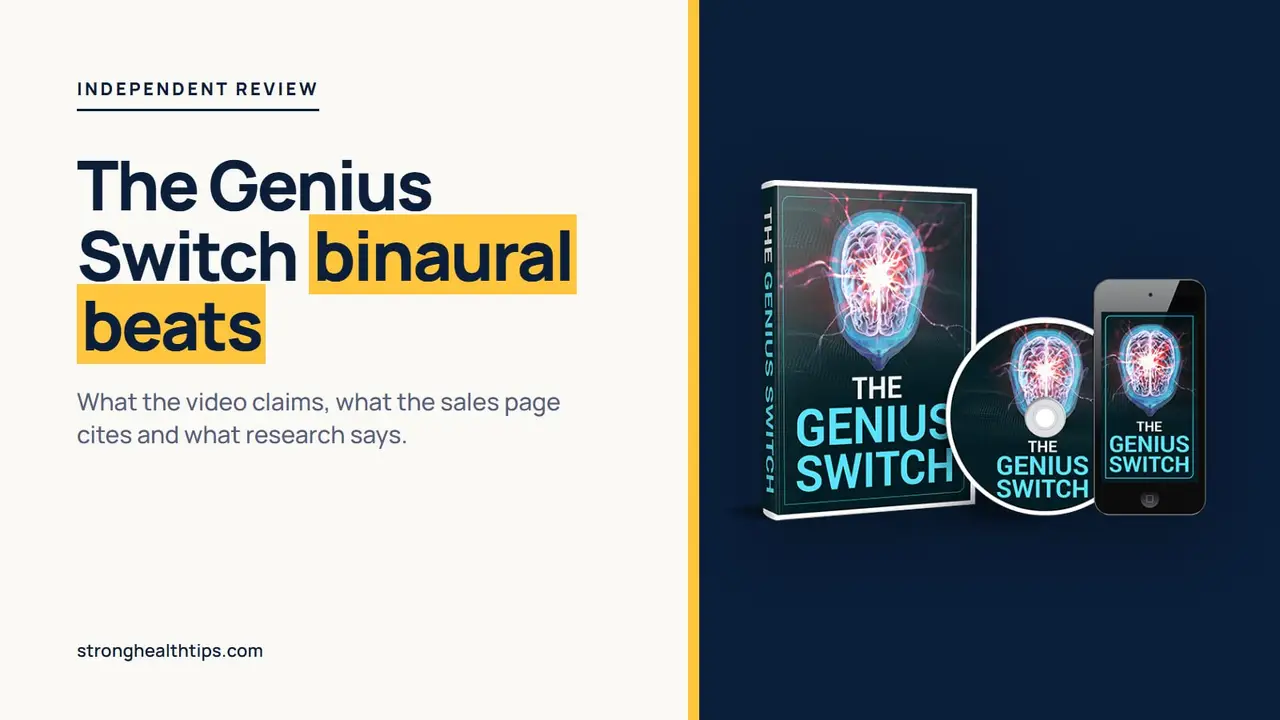
An 8-minute audio track for headphones, sent by email after checkout.
$39 one-time through ClickBank, plus local tax. 90-day refund window in the seller’s Terms.
See the current offer for The Genius SwitchIs The Genius Switch a binaural beats track?
Honestly, we cannot say for certain, and the seller does not say either. Here is what the sales materials do tell us:
- The product is described as a “targeted auditory sequence”, eight minutes long, turned into a digital audio track.
- The video says the track uses “neural sync technology” that syncs the two halves of the brain, and that one hour of neural sync was compressed into eight minutes.
- You are told to put on headphones, close your eyes and listen once a day.
- The sales page lists research on 40 Hz binaural beats and gamma stimulation among its references.
Headphones and binaural beat references point one way. The video’s insistence that this is “not a brain wave” points the other. Until someone independent analyses the audio, the safest description is the seller’s own: an 8-minute audio sequence. Be wary of any page that tells you confidently either way, because the seller has not published that detail.
What a binaural beat actually is
A binaural beat is not a sound on the recording. It is something your brain produces when each ear hears a slightly different steady tone. Play one tone in the left ear and a tone of a slightly different pitch in the right ear, and most listeners perceive a gentle pulsing or “beat” at the difference between the two. When people talk about a “40 Hz binaural beat”, they mean the two tones are 40 hertz apart.
That is why headphones matter. Through ordinary speakers both tones reach both ears and mix in the air, so the effect is lost. Each ear needs its own channel.
A few practical points follow from this:
- Stereo is essential. A mono speaker, a single earbud or a “mono audio” accessibility setting on your phone would defeat any binaural element.
- Volume does not need to be high. The beat is a perception, not a loud signal.
- The beat itself proves nothing. Hearing a pulse tells you the tones are there. It does not tell you anything about memory, focus or luck.
What the video says vs what the page cites
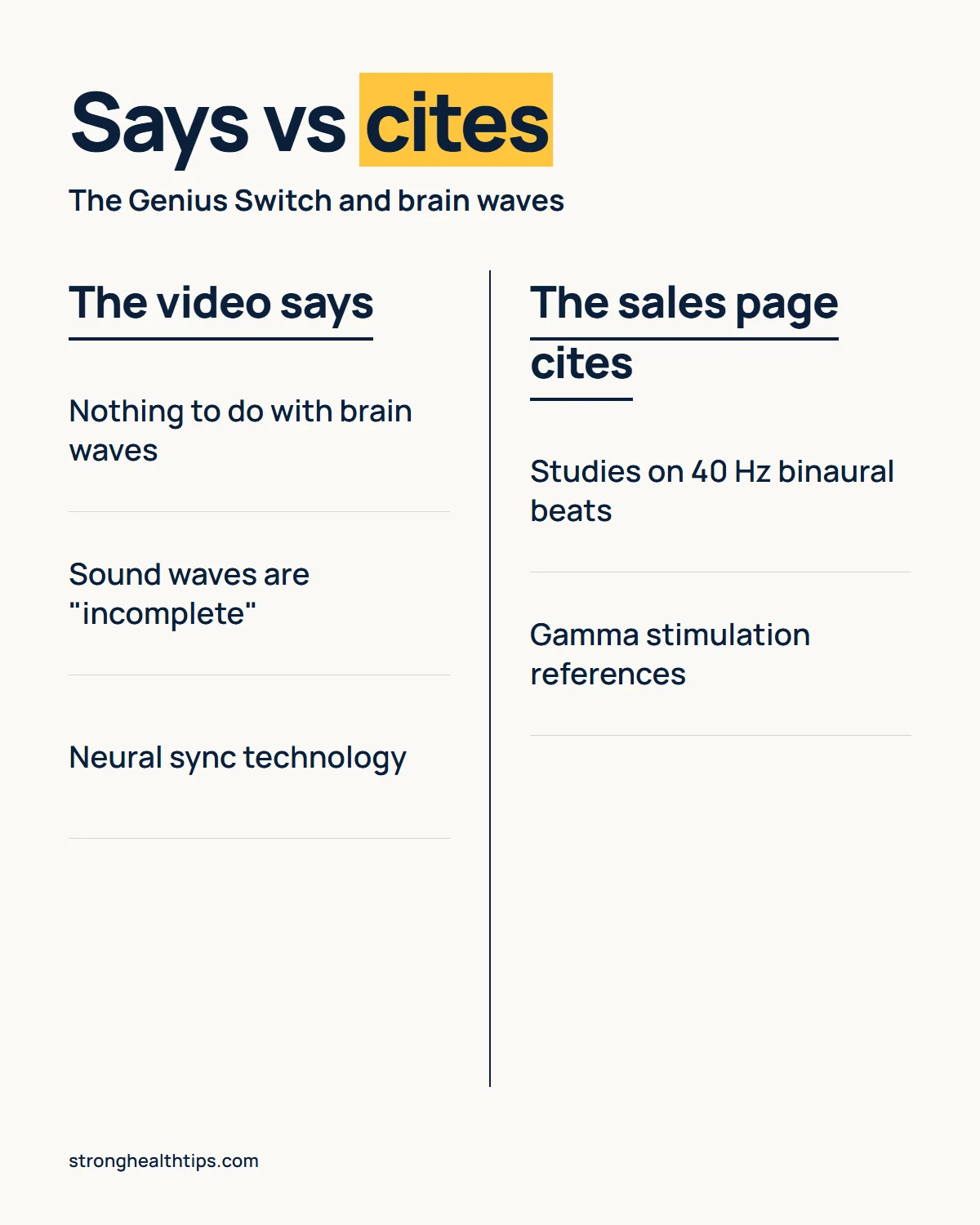
This is the contradiction at the centre of the search term, so it is worth laying out side by side.
| The video says | The sales page cites |
|---|---|
| The method “has nothing to do with brain waves” | Studies on 40 Hz binaural beats |
| Sound waves “are an incomplete method” that “only address brain waves” | References on gamma stimulation |
| The track uses “neural sync technology” to sync both hemispheres |
In the video, the presenter, who introduces himself as Dr. Daniel Barone, lists ways to reach what he calls “whole brain activation”: meditation, a neurofeedback machine, “sound waves” and, finally, his targeted auditory sequence. He rejects sound waves as incomplete and says the answer “isn’t brain pills or brainwaves”. Yet the 40 Hz studies on the sales page are about exactly the kind of audio that many people would call brain wave or sound wave products. 40 Hz sits in the range scientists call gamma, which likely explains why the gamma references sit next to it.
This does not prove anything sinister; sales copy often mixes “this is new” with “science backs this up”. But you cannot lean on the cited studies as evidence for the track while also accepting that the track is something other than what they tested. We could not verify the presenter’s identity or his involvement with the product, so we report his statements as the seller’s statements.
What binaural beat research says
Research on binaural beats is real, but it is easy to overstate. A fair summary:
- A 2019 meta-analysis found a medium effect. It pooled 22 studies and found a medium overall effect on memory, attention, anxiety and pain, with results depending on beat frequency and timing.
- The results are mixed. Some studies report short-term effects on attention or mood. Others do not, and a 2023 review found that most studies did not show the brainwave change (entrainment) the idea rests on.
- The effects measured are short-term. Most look at what happens during or shortly after listening, not at lasting change over weeks or months.
The study the site cites that stands out is Ross and Lopez (2020), which looked at 40 Hz binaural beats and the “attentional blink”, a brief gap in attention that happens when two targets appear in quick succession. It is a narrow, lab-based question about attention. It is not a study of memory, career success, luck, weight or health, and it did not test The Genius Switch.
That last point is the one to hold on to. No published study tests The Genius Switch track itself. Even if binaural beats had strong evidence behind them, a specific commercial track would still need its own testing to support specific claims.
If your real goal is calmer days or better focus, habits with a stronger track record are worth putting first. Our guide on how to manage daily stress covers the basics, and a regular daily walk is one of the simplest of them.
Curious enough to try it?
Eight minutes a day, headphones on, expectations modest.
Digital track by email, no shipping. Refund requests within 90 days under the seller’s Terms.
Check The Genius Switch order pageWhole brain activation and the Sperry Nobel
The video builds its story on a “forgotten study that won the Nobel Prize”. That refers to Roger Sperry, who shared the 1981 Nobel Prize in Physiology or Medicine for his split-brain research, work that showed how the two hemispheres of the brain specialise in different tasks.
Sperry did not win a Nobel for “whole brain activation”. That phrase is the seller’s term, not a clinical one. Linking a famous prize to a product borrows credibility from real science without the science saying what the product needs it to say.
What the seller claims the track does
The list of promised benefits in the video is long. Attributed clearly to the seller, it includes:
- Insights and “eureka moments”, faster learning and better memory
- Luck, “synchronicities”, promotions and money
- Better relationships and conversation
- Stories of weight loss, quitting smoking, and headaches or joint pain easing
- Children’s grades improving
The video also says the track “starts working the very first time you listen”, that “many customers notice a difference within the first two to three days” and that most people see results “within a couple weeks”. It says the track has helped “18,456 everyday Americans”. That is the seller’s figure and we found nothing that verifies it.
On one point the presenter is candid: talking about a casino win, he says “there is of course no evidence to support that the genius switch caused that”. That honesty applies to the rest of the list as well. None of these outcomes has been shown for this track, and The Genius Switch is not a treatment for any condition. The site’s own disclaimer says it is “not intended to diagnose, treat, cure, or prevent any disease”.
The video also presents testimonials from named listeners. The site’s own Terms say feedback may be dramatized with digital avatars or actors, that some featured people have a personal connection to the creators, and that the results shown are exceptional, not typical. Read them as advertising.
How to listen safely
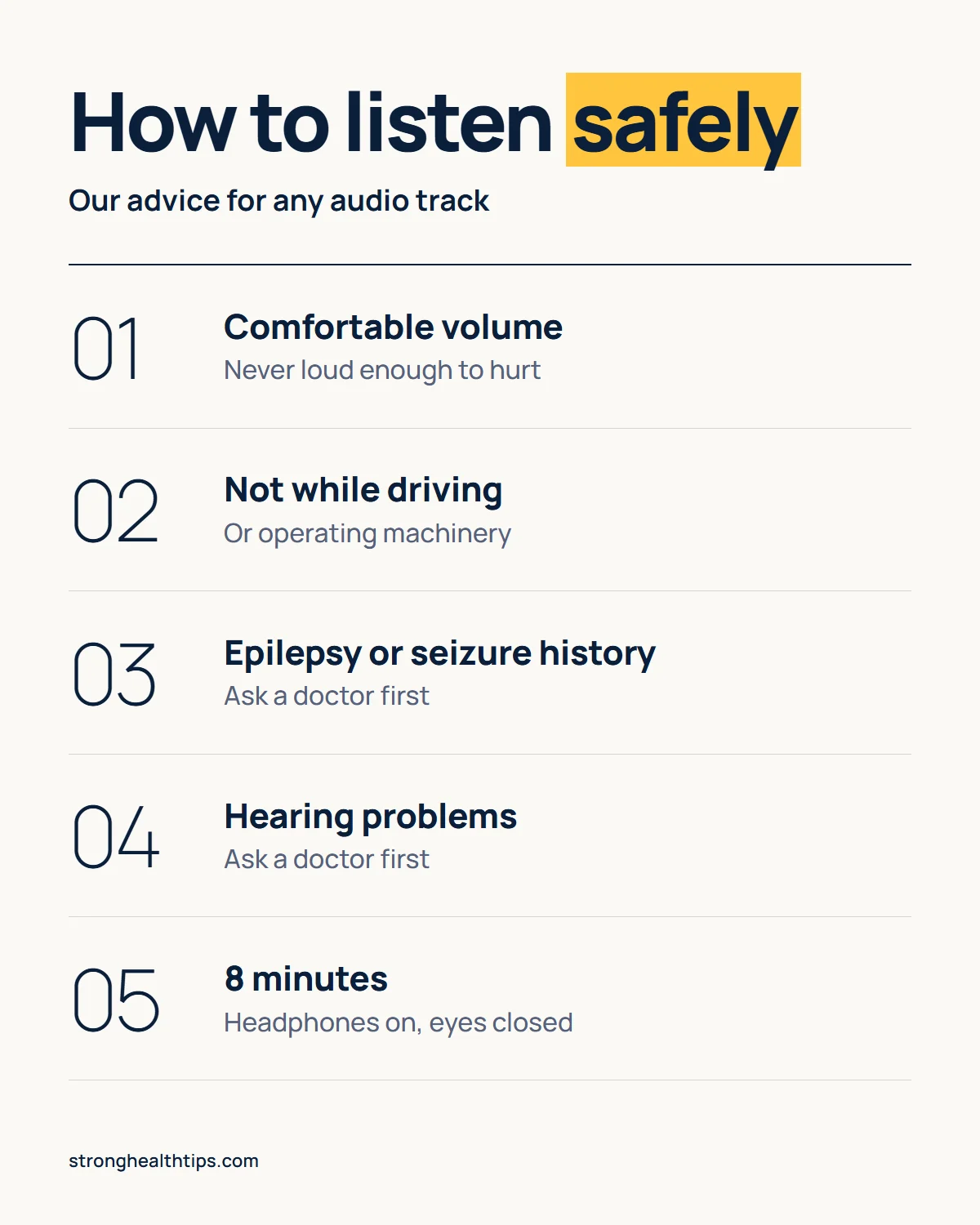
Eight minutes of audio through headphones is low risk for most adults if you are sensible. Our advice, based on general caution for audio-entrainment products:
- Keep the volume comfortable. You should be able to hear someone speaking to you. Long-term exposure to loud sound through headphones is a known cause of hearing damage.
- Never listen while driving or operating machinery. The video tells you to close your eyes and relax. Do it sitting or lying somewhere safe.
- Epilepsy or a seizure history: ask a doctor first. Rhythmic audio stimulation is a reasonable thing to check with your doctor before trying.
- Hearing problems: ask a doctor first. That includes tinnitus or hearing aids.
- Follow the format. Eight minutes, headphones, eyes closed. There is no reason to listen louder or longer than that.
If you hope it will help you wind down at night, pair it with the basics in our sleep hygiene habits guide rather than relying on a track alone. And stop if you feel dizzy, anxious or unwell while listening.
Before you buy
Read the claims as claims, and keep your receipt.
$39 one-time. Track emailed right after payment, plus four digital bonuses.
View the official offerPrice, refunds and the fine print
If you decide to try it, order through the official order page, which hands you over to a ClickBank checkout. A few details worth knowing:
| Item | What the seller’s pages say |
|---|---|
| Price | $39 one-time, shown in local currency plus tax at checkout |
| Delivery | Emailed immediately after payment, digital only |
| Bonuses | Four digital extras, including a guided visualization and a printable habits infographic |
| Refunds | Terms: within 90 days of initial purchase. ClickBank: within 90 days from the date of purchase |
| Card statement | CLKBANK*GeniusSwitch |
| Order support | ClickBank, 1-800-390-6035 |
One oddity: the site’s separate refund page is a copied policy for “NeuroActivate” bottles, with a 60-day window for unopened bottles. It does not fit a digital audio track. The Terms page and ClickBank’s 90-day policy are the ones that apply. Keep your ClickBank receipt so you have the order number if you want your money back. The video also says the track is not sold on YouTube or Spotify, so a free “The Genius Switch” upload there is not the seller’s product.
Our take on the binaural beats question
The Genius Switch may or may not contain binaural beats. The seller’s video says the method has nothing to do with brain waves, while its sales page leans on binaural beat and gamma research. That research is mixed, with a medium effect in a 2019 meta-analysis but little sign of entrainment in a 2023 review, and none of it tests this track. What you can be sure of is the format: an 8-minute audio file, $39, a 90-day refund window and a long list of benefits that are the seller’s claims.
If you like the idea of a short daily listening ritual and can treat the $39 as a refundable experiment, it is a low-risk thing to try. If you need proof first, that proof does not exist yet.
Our verdict, in brief
An unproven 8-minute track with a clear 90-day refund window.
Pay through ClickBank only. Not a treatment for any condition.
Go to The Genius Switch order pageQuestions people ask
Does The Genius Switch use binaural beats?
The seller does not say so clearly. The video describes the track as a targeted auditory sequence using what it calls neural sync technology and says the method has nothing to do with brain waves. The sales page, however, lists studies on 40 Hz binaural beats and gamma stimulation as references. From the sales materials alone, we cannot tell exactly what is on the track.
Do binaural beats actually work?
Some small studies report short-term effects on attention or mood, such as the 2020 Ross and Lopez study on 40 Hz binaural beats and the attentional blink that the sales page cites. Overall the evidence is mixed: a 2019 meta-analysis found a medium effect on outcomes such as memory, attention and anxiety, while a 2023 review found most studies did not show the brainwave change (entrainment). That is not the same as proof that any particular track improves memory, focus or anything else.
Do I need headphones for The Genius Switch?
The video tells you to put on headphones, close your eyes and listen for 8 minutes. Headphones also matter for any binaural beat, because each ear has to hear its own tone for the beat to form.
Has The Genius Switch track been tested in a study?
Not that we could find. The studies the sales page lists are about binaural beats and gamma stimulation in general. No published study tests The Genius Switch track itself.
Is it safe to listen to The Genius Switch?
For most people an 8-minute audio track at a comfortable volume is low risk. Our advice: keep the volume moderate, never listen while driving or operating machinery, and talk to a doctor first if you have epilepsy, a history of seizures or any hearing problem. It is not a treatment for any condition.
What did Roger Sperry win the Nobel Prize for?
Roger Sperry shared the 1981 Nobel Prize in Physiology or Medicine for his split-brain research on how the two hemispheres of the brain specialise. The phrase whole brain activation used in the video is the seller's own term, not a clinical one.
Sources
- The Nobel Prize: Roger W. Sperry, Physiology or Medicine 1981, facts
- NIDCD: Noise-induced hearing loss
- FTC: Guides concerning the use of endorsements and testimonials in advertising
- Ingendoh RM et al. (2023). Binaural beats to entrain the brain? A systematic review of the effects of binaural beat stimulation on brain oscillatory activity. PLOS ONE
Not medical advice. This guide is general information and does not replace a consultation with a qualified healthcare professional who knows your history. Full disclaimer.
Written by
Strong Health Tips Editorial Team
We research, write and fact-check every guide against current guidance from major health bodies and peer-reviewed studies, then rewrite it in plain English. How we work.