Phytomem One Ingredients Explained: All 10, With the Seller's Stated Roles
Phytomem One ingredients explained: saffron, fucoxanthin, berberine, Morosil and six more, each with the seller's stated role and general background research.
- Author
- Strong Health Tips Editorial Team
- Published
- Updated
- Reading time
- 7 min read
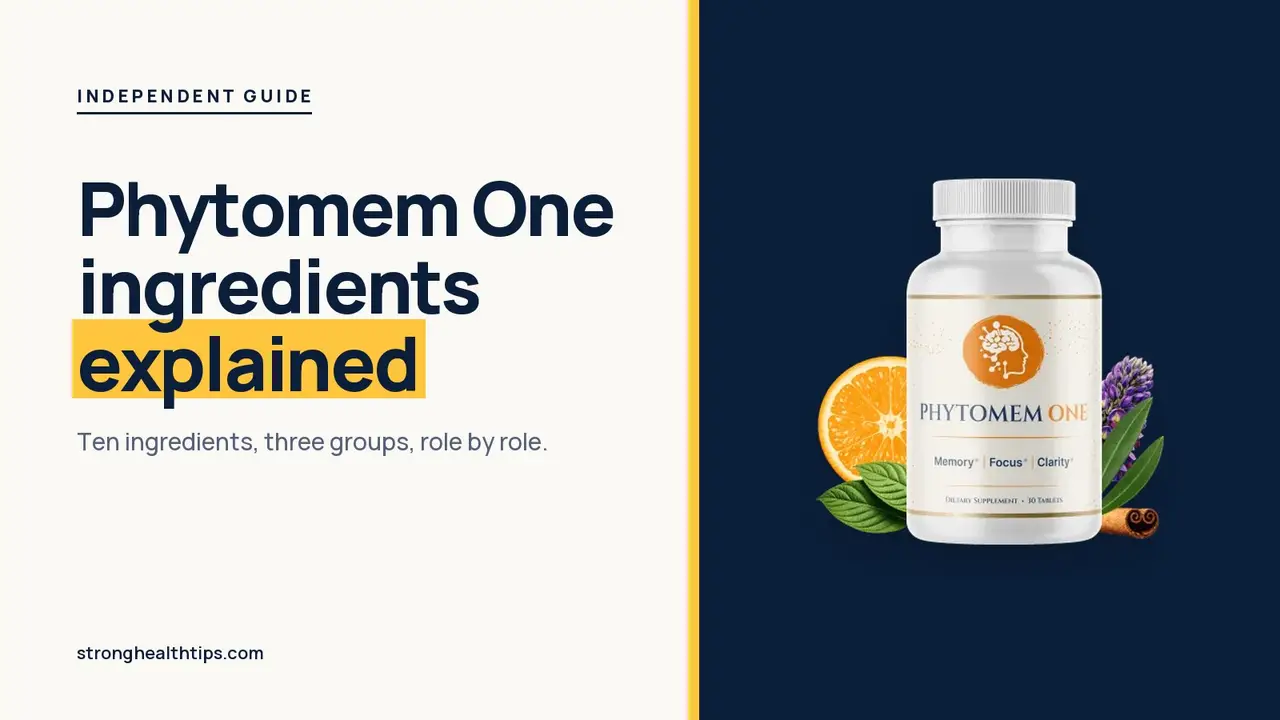
A supplement label is a short document with a lot of unfamiliar words, and the best way to read it is one ingredient at a time. This guide to the Phytomem One ingredients covers all ten, with the role the seller gives each and a note on the general research behind a few. Every statement of what an ingredient does is the seller’s, and we label it that way.
See the formula
Read the seller’s page and compare each ingredient with this guide.
Ten ingredients, one chewable tablet a day and 60 days to decide.
View the Phytomem One formulaPhytomem One ingredients: the big picture
Each chewable tablet carries a proprietary blend of 458 mg. The seller organizes it into three groups, which it presents as a dual-defense idea with a finishing complex. Group one is aimed at antioxidant support, group two at healthy glucose use so brain cells stay energized, and group three at metabolic function and cognitive fuel. The seller calls the whole a 10-in-1 neuro-essential formula designed to support memory, focus and mental clarity.
Our ingredients page holds the summary, and below we take each ingredient in turn.
Group 1: the Cellular Defense Matrix
Saffron (Crocus sativus L.) bulb extract. The seller describes it as having rich antioxidant properties, supporting a healthy inflammatory response and helping protect brain cells from daily oxidative stress. A placebo-controlled trial in the Journal of Clinical Pharmacy and Therapeutics, 2020, looked at saffron on mood and food craving in overweight women. It is background on saffron and not a test of Phytomem One.
Fucoxanthin (from Laminaria japonica, a sea kelp). The seller says it is studied for healthy neural communication and cognitive flexibility.
Fucoidan (also from Laminaria japonica). The seller describes a potent antioxidant profile that helps protect brain tissue from everyday oxidative challenges.
Oleuropein (olive leaf extract). The seller says it supports healthy blood sugar already within normal ranges and acts as a whole-body antioxidant.
Group 2: the Brain Fuel and Vitality Complex
Berberine HCl. The seller says it helps activate AMPK, which it calls a metabolic master switch, and promotes optimal glucose use so brain cells stay energized. A 2024 systematic review and meta-analysis in Frontiers in Pharmacology looked at berberine for blood sugar in type 2 diabetes. It is general research on the ingredient and not a trial of Phytomem One.
Ceylon cinnamon bark (Cinnamomum verum). The seller says it supports healthy insulin sensitivity and normal glucose balance, and works with berberine.
Corosolic acid (from banaba leaf extract). The seller says it supports healthy glucose transport to active brain cells.
Kudzu (Pueraria montana) flower extract. The seller describes isoflavones that support healthy cellular glucose uptake.
Four ingredients, one theme
The second group is built around healthy glucose use.
One tablet a day, free e-books and a 60-day guarantee from delivery.
Begin my ten-ingredient routineGroup 3: the Neural Amplifier System
Morosil (Moro blood orange, Citrus sinensis, from Mount Etna, Sicily). The seller says it supports healthy metabolic function, antioxidant defense and nutrient absorption. A 2022 randomized controlled trial in Nutrients examined Moro blood orange extract and weight loss in overweight adults. Again, it is background on the ingredient and not a trial of Phytomem One.
Xylitol. The seller describes it as clean cognitive fuel without sudden blood sugar spikes.
How to read an ingredient guide like this one
A guide of this kind can feel like a lot of information, so a few reading tips help. First, separate the seller’s statements from the research. When we write that the seller says an ingredient supports something, that is the seller’s description, and we attach no promise to it. When we mention a study, it is background about the ingredient, not evidence about the product.
Second, notice the verbs. The seller’s roles use supportive wording, such as supports, helps protect and promotes, which fits a dietary supplement. A formula built around support is designed to sit beside a good diet, sleep and movement, and not to replace them.
Third, keep the formula in proportion. Ten ingredients inside a 458 mg blend means each one is present in a modest amount, and the seller does not publish the split. That is why a conversation with your doctor or pharmacist is the right place for dose questions.
Read it on the seller’s page
Compare this guide with the seller’s own ingredient notes.
The full label, three free e-books and a 60-day guarantee.
See the Phytomem One ingredient notesPutting the ten together in a daily routine
The practical side of the formula is pleasantly simple. All ten ingredients arrive in one chewable tablet, taken once a day with food, as the label and the seller’s FAQ say. You do not need to remember which ingredient belongs to which time of day, and the seller describes the tablets as gentle on the stomach and non-habit forming.
A sensible plan is to anchor the tablet to breakfast, keep a short weekly note on how your mornings feel and give the routine a full month before you judge it. The seller’s FAQ says many users report improvements in mental clarity, word recall and morning sharpness in just a few weeks, which is the seller’s statement. Results vary, and the 60-day guarantee gives you time to find out for yourself. Our price guide compares the packages if you are choosing how long to try it, and the Phytomem One product page shows the offer.
The other ingredients
Besides the blend, the label lists natural flavors, stearic acid, magnesium stearate, silicon dioxide and stevia (Reb A). They are the supporting cast of a chewable tablet, helping with flavor, texture and manufacturing. The label presents them separately from the active blend.
What the label does not tell you
Honest ingredient guides say what is missing. Here, the missing piece is dose. The label gives the blend weight, 458 mg, but not how much of each ingredient it holds. We therefore do not list any individual amounts. If dose detail matters to you, show the label to your doctor or pharmacist. The full label is also on our Phytomem One product page.
How the story hangs together
The seller’s story links brain health to environmental stressors and to how well the brain uses glucose, and it says the formula was inspired by research on environmental stressors and brain energy. We pass that on softly and as the seller’s own explanation. The structure is easy to follow, though: antioxidant support in group one, glucose use in group two and a finishing complex in group three.
For the bigger picture of how that is meant to play out, read our does it really work guide.
Who should ask a doctor first
The label caution is clear: do not exceed the dose, and ask a doctor first if you are pregnant or nursing, under 18 or have a medical condition. Because berberine is studied in connection with blood sugar, anyone taking blood sugar medicines should speak to a doctor before starting. Our side effects guide covers the sensible questions to bring to that conversation.
Good to know
- Every ingredient role here is the seller’s stated role, and individual results vary.
- The studies cited are general research and are not trials of Phytomem One.
- Ask your doctor first if you are pregnant or nursing, under 18, take blood sugar medicines or have a medical condition.
The ingredients in short
Ten named ingredients, three clear groups, a 458 mg blend and a readable label. It is a tidy formula to learn, and the seller explains its thinking in plain language. We give Phytomem One an editorial score of 4.6 out of 5, our own score and not a customer rating.
Try the formula
Choose your package and start with one chewable tablet a day.
Three groups, ten ingredients and 60 days from delivery to decide.
Order Phytomem One and try the formulaQuestions people ask
What are the Phytomem One ingredients?
Saffron bulb extract, fucoxanthin, fucoidan, oleuropein, berberine HCl, Ceylon cinnamon bark, corosolic acid, kudzu flower extract, Morosil blood orange extract and xylitol, in a 458 mg proprietary blend.
What are the three groups?
The Cellular Defense Matrix, the Brain Fuel and Vitality Complex and the Neural Amplifier System, as the seller names them.
What is Morosil?
A Moro blood orange extract from Mount Etna in Sicily, which the seller says supports healthy metabolic function, antioxidant defense and nutrient absorption.
Does Phytomem One contain berberine?
Yes, berberine HCl, in the Brain Fuel and Vitality Complex. It is studied in connection with blood sugar, so ask a doctor first if you take blood sugar medicines.
Are the doses of each ingredient published?
No. The label shows a 458 mg proprietary blend per tablet and does not split it by ingredient.
What are the other ingredients?
Natural flavors, stearic acid, magnesium stearate, silicon dioxide and stevia (Reb A).
Sources
- Berberine for blood sugar in type 2 diabetes: systematic review and meta-analysis. Front Pharmacol, 2024
- "Moro" blood orange extract and weight loss in overweight adults: randomized controlled trial. Nutrients, 2022
- Saffron (Crocus sativus) on mood and food craving in overweight women: placebo-controlled randomized controlled trial. J Clin Pharm Ther, 2020
Not medical advice. This guide is general information and does not replace a consultation with a qualified healthcare professional who knows your history. Full disclaimer.
Written by
Strong Health Tips Editorial Team
We research, write and fact-check every guide against current guidance from major health bodies and peer-reviewed studies, then rewrite it in plain English. How we work.