Nitric Boost Ingredients Explained: All Eight, Each With Its Role
Nitric Boost ingredients explained: beet root, L-arginine, L-citrulline, niacin, epimedium, ginkgo, dong quai and D-aspartic acid, with each one's role.
- Author
- Strong Health Tips Editorial Team
- Published
- Updated
- Reading time
- 7 min read
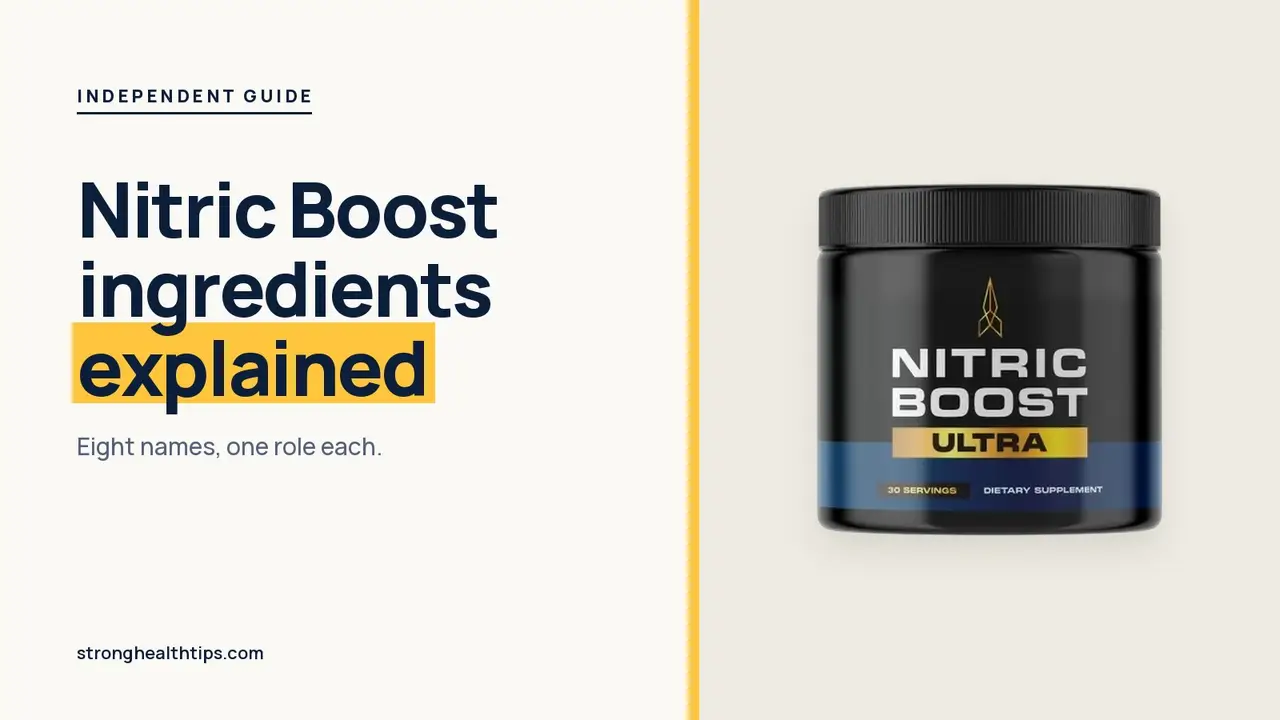
Open any supplement page and the ingredient list is the part everyone scrolls to first. With Nitric Boost it is short and easy to read: eight names, one scoop a day. This Nitric Boost ingredients guide goes through the eight names the seller lists for the powder in the Nitric Boost Ultra jar, one at a time, using the role the seller gives each, and it says clearly what is not published. A note before we begin: no label image and no amounts exist on the seller’s page, so we never quote a dose. Every line about what an ingredient does is the seller’s statement, not our claim, and individual results vary. For the whole offer, the Nitric Boost hub has it.
See the ingredient list at the source
The seller’s order page names all eight ingredients.
One scoop a day, in water, a smoothie or tea.
View the Nitric Boost order pageNitric Boost ingredients: the seller’s big idea
The seller starts from nitric oxide, a gas that helps blood vessels relax and widen, and builds the formula in three layers. Nitrates, which the body can convert into nitric oxide. Amino acids, which the body uses as raw material. And a supporting cast of vitamins and plants described as helping circulation and offering antioxidant support. That is the framework we use to walk through the list below. How the pieces fit is explained in our guide on whether Nitric Boost really works.
Reading a list that has no amounts
A list of names without amounts is not the same as a full label, and it helps to know what you can and cannot take from it. The order the seller uses may reflect its own story rather than quantity, so we do not read anything into who comes first. What the list does tell you is which ingredients the seller chose to name, and that gives a clear picture of the plan. What it does not tell you is how strong each part is, which is why we call the blend by the name the seller uses: proprietary.
1. Beet root powder
First on the list, and the one most people recognize. The seller says beet root powder is loaded with natural nitrates that the body converts straight into nitric oxide, and adds that runners take it for endurance. In the seller’s story, beets are the nitrate layer. They are a familiar name in the training world, which is part of why the formula feels approachable.
2. L-arginine
An amino acid, and the one the seller calls the raw material the body uses to make nitric oxide. If beets are the nitrate route, L-arginine is the building-block route. People who follow sports nutrition will have seen it before. The seller does not say how much is in a scoop.
3. L-citrulline DL-malate
Another amino acid, listed in a form paired with malate. The seller says it works with L-arginine to support nitric oxide levels and that the malate side supports energy. That pairing is why the two amino acids sit side by side in the seller’s explanation: one is the raw material, the other is described as its companion.
Eight names, one routine
Look at the full list on the order page.
Free US delivery on 3 and 6 jars, with two months to decide.
See the ingredient listCurious about the full picture?
Read how the seller describes the formula on the order page.
Containers can be returned within 60 days, even when empty.
View the formula4. Niacin (vitamin B3)
A familiar vitamin. The seller links niacin to healthy, flexible blood vessels, which fits the formula’s circulation theme. It is the one entry on the list that most people already know from a multivitamin label. As with every ingredient here, the amount is not published, so we cannot say how it compares with a daily value.
5. Epimedium
A traditional herb, and that is how we describe it. The seller lists it as the fifth ingredient, and we leave the detail there. Readers who are curious about a traditional herb can ask their doctor or pharmacist what they would like to know.
6. Ginkgo biloba powder
Ginkgo biloba is a well-known leaf extract. The seller describes it as antioxidant support for the blood vessels. It rounds out the plant side of the formula alongside dong quai and epimedium. Ginkgo is also a good example of an ingredient where a short chat with a doctor or pharmacist is sensible if you take any prescription medicine.
7. Dong quai
A traditional herb that the seller calls a circulatory tonic that supports healthy blood flow. Like epimedium, it adds a plant-based, long-used element to a formula that is otherwise mostly nitrates and amino acids. The seller says nothing about amounts.
8. D-aspartic acid
An amino acid, and the last name on the list. We describe it only that way, and we leave any further detail to the seller’s own page. Like the others, it is part of the proprietary blend, and its amount is not stated.
Ingredients in everyday life
Most of these names will already be familiar. Beets turn up in juices and powders, amino acids in sports nutrition, niacin in multivitamins and ginkgo in herbal aisles. What is distinctive is the combination in one scoop, rather than any single item. That is useful to keep in mind if you already take other supplements, because overlaps are possible. Your doctor or pharmacist can look at your own list and tell you whether anything doubles up, which is a more reliable check than any article, including ours.
What is not published
| Detail | Published? |
|---|---|
| Names of all eight ingredients | Yes |
| Amount of each | No |
| Scoop weight | No |
| Flavor description | No |
| Other-ingredients list | No |
We will not fill those gaps. If amounts matter to you, ask the seller before you order: the email is [email protected]. Our ingredient table shows what exists at a glance.
Three questions to ask about any blend
Whatever supplement you are reading about, three questions help. Are the ingredients named clearly? Here, yes: all eight. Are the amounts shown? Here, no. And is there a clear way to ask and to return the product if you are unhappy? Here, yes: support by email and phone, and a 60-day refund window on every package. Two out of three is a fair result for a product that sells through a simple order page, and it explains why we mention the missing amounts so openly while still scoring the offer 4.6 out of 5 as our own editorial rating.
The quality notes that go with the list
The seller says the powder is made in a GMP-certified US facility, is non-GMO, vegan, dairy-free, soy-free and vegetarian, and is non-habit forming. It also mentions third-party inspections. These are the seller’s statements, and we have not audited anything, but they help explain what the eight names sit inside.
Good to know
- Roles shown are the seller’s descriptions, not medical claims, and outcomes differ between people.
- If you take medicine, are pregnant or nursing, or have a medical condition, check with your doctor or pharmacist before starting.
- No doses are published, so we show none.
Going a step further
If you like to read around a topic, the simplest next move is a short conversation. A pharmacist can look at the eight names and explain, in terms of your own situation, what is familiar and what deserves a closer look. You can also email the seller at [email protected] and ask whether amounts can be shared. Neither step costs anything, and either one will tell you more about the formula than another article could, including this one.
Putting the eight together
Read down the list and the plan is easy to see: nitrates from beets, two amino acids as raw material, a vitamin tied to flexible vessels and three plant ingredients with traditional or antioxidant reputations, finished with a final amino acid. Whether that plan suits you is for you and your doctor to weigh. If it appeals, the six-jar package costs $49 a jar, and the ingredients page shows the list in a compact layout. Our side-effects guide covers the safety questions that naturally follow, and the Nitric Boost hub shows how each package is priced.
Try the formula for 60 days
Choose a package and keep the refund window on your side.
The jar holds 30 servings.
Order Nitric Boost todayQuestions people ask
What are the Nitric Boost ingredients?
Beet root powder, L-arginine, L-citrulline DL-malate, niacin (vitamin B3), epimedium, ginkgo biloba powder, dong quai and D-aspartic acid.
What does beet root do in the seller's story?
The seller says it is loaded with natural nitrates that the body converts into nitric oxide, and that runners take it for endurance.
Are doses listed?
No. The seller calls the formula a proprietary blend and does not publish amounts.
What is epimedium?
A traditional herb. The seller lists it among the eight ingredients, and we describe it only that way.
Is it all natural?
We do not make that claim. The seller says it is non-GMO, vegan, dairy-free, soy-free and vegetarian, and it lists no other ingredients.
Who should ask a doctor first?
Anyone who takes medicine, is pregnant or nursing, or has a medical condition. Ask your doctor or pharmacist before starting.
Not medical advice. This guide is general information and does not replace a consultation with a qualified healthcare professional who knows your history. Full disclaimer.
Written by
Strong Health Tips Editorial Team
We research, write and fact-check every guide against current guidance from major health bodies and peer-reviewed studies, then rewrite it in plain English. How we work.