NeuroSalt Ingredients: All Five Label Herbs With Their Amounts
NeuroSalt ingredients explained: passionflower, marshmallow root, corydalis, prickly pear and California poppy seed, each with its label amount and a soft role.
- Author
- Strong Health Tips Editorial Team
- Published
- Updated
- Reading time
- 7 min read
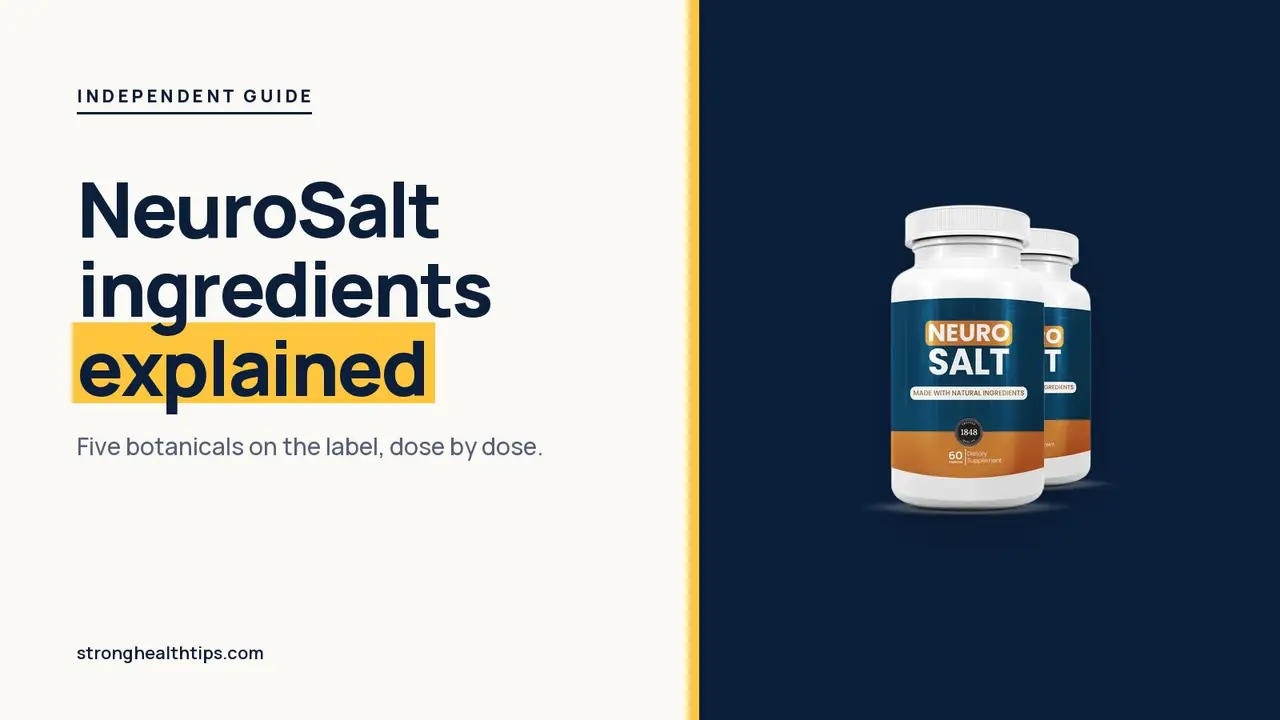
What exactly would you be swallowing each day? This tour of the NeuroSalt ingredients walks down the Supplement Facts panel one herb at a time. Every entry gives the weight per serving, then a light note on why a plant like that might sit in a formula meant for nerve comfort. Roles are attributed throughout: some echo how the herb is traditionally described, others the maker’s own pitch, and none is a promise about your health.
Five botanicals, one label
Each weight is printed in full, with no blend to hide behind.
The biggest pack costs $49 per bottle and ships free in the US.
Lock in the lowest bottle rateThe NeuroSalt ingredients at a glance
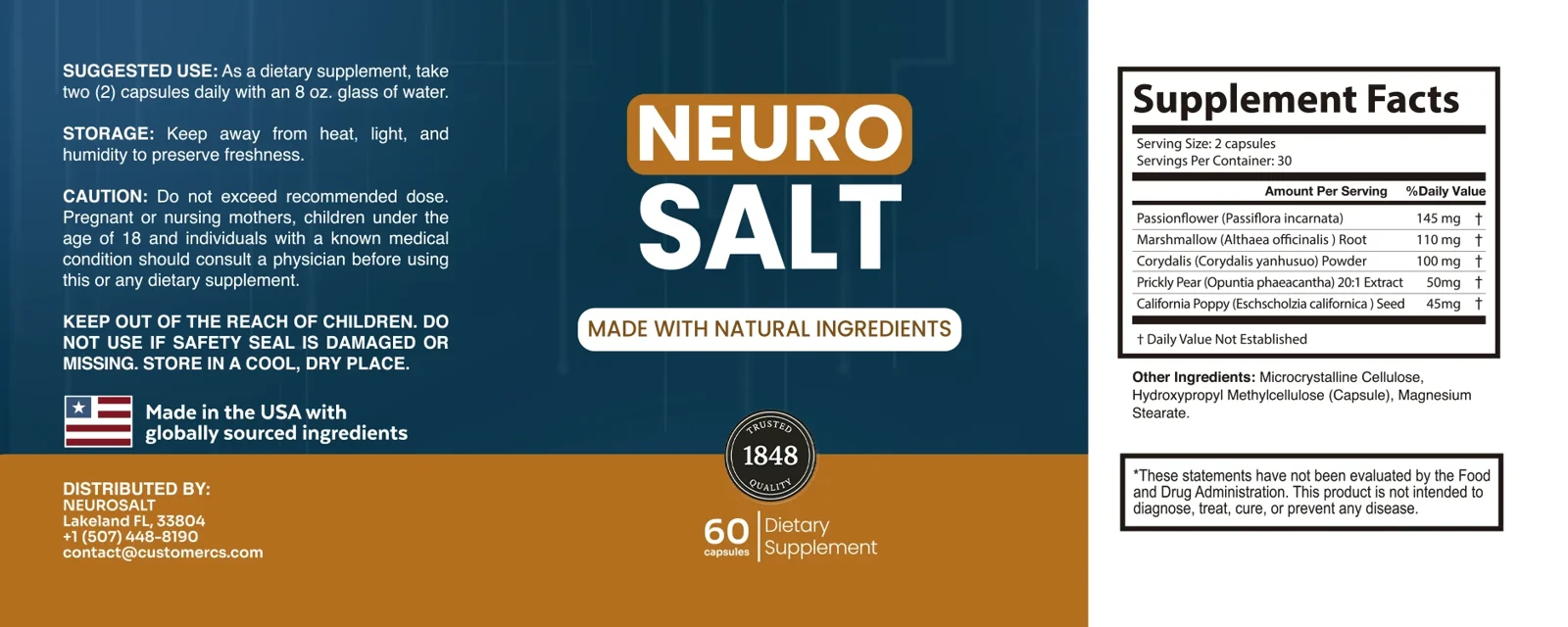
One serving means two capsules, so a 60-capsule bottle holds 30 servings. The label names the plant part or extract type on each line, and we list the heaviest first.
| Weight per serving | Plant and Latin name | Part or form |
|---|---|---|
| 145 milligrams | Passionflower, Passiflora incarnata | Herb |
| 110 milligrams | Marshmallow, Althaea officinalis | Root |
| 100 milligrams | Corydalis, Corydalis yanhusuo | Powder |
| 50 milligrams | Prickly pear, Opuntia phaeacantha | Extract, 20 to 1 |
| 45 milligrams | California poppy, Eschscholzia californica | Seed |
Together the five rows come to 450 milligrams of plant material per serving. Each botanical gets its own row, so its share is easy to read.
Passionflower, the heaviest entry
Passionflower tops the panel by weight. This climbing vine has a long record in herbal traditions, where it is usually mentioned alongside calm and quiet evenings, and that reputation explains why it keeps turning up in wind-down products. Sleepiness is possible, so skim the safety note further down before your first dose.
Marshmallow root and corydalis
Marshmallow root. Forget the campfire sweet: this is a perennial whose root is full of a slippery, gel-like substance called mucilage. Herbal references call it soothing, and the maker leans on that word to describe the formula’s overall feel. Consider it the gentle, supportive entry in the lineup.
Corydalis powder. Corydalis yanhusuo has been used for centuries in traditional Chinese herbal practice, and here it is ground into a powder. It joins passionflower and California poppy in the calming group, so it too may bring on sleepiness. Anyone using drugs for nerve pain should mention this herb to a doctor first.
Prickly pear and California poppy
Prickly pear extract. This cactus, Opuntia phaeacantha, is used as a 20 to 1 extract, meaning roughly twenty parts of plant were concentrated into one. So the figure printed for it describes a concentrate and not raw cactus. The label gives no stated purpose for it, so we stop at describing what it is.
California poppy seed. Eschscholzia californica is a bright orange wildflower, and the seed is the part used here. Tradition regards it as a calming herb, and the maker files it beside passionflower and corydalis. With three drowsiness-prone herbs in the mix, the safe habit is leaving alcohol and sedatives alone and keeping off the road whenever you feel sleepy.
Simple to follow
One routine: two capsules, one glass of water.
The 3-bottle pack costs $69 a bottle and ships at no charge.
Take the 3-bottle packThe supporting ingredients
Under the herb rows, the label names the supporting ingredients: microcrystalline cellulose, magnesium stearate and hydroxypropyl methylcellulose, the last being the plant-derived material that forms the capsule shell. Their role is mechanical, helping the capsule fill and flow. Anyone on a special diet or with an allergy should read the full panel on the bottle or order page and show it to a doctor.
On manufacturing, the maker reports American production at a registered facility with ingredients derived from nature. Registration describes the building, not the product. Dietary supplements live under their own rulebook rather than drug approval, so no brand is cleared in advance. That applies to the whole shelf, which makes the label, your doctor and a clear refund policy your best tools.
Taking it, and who should check first
The directions are brief: you swallow two capsules a day and follow them with an 8 oz glass of water. Prescribed medicines stay in your routine, and a doctor should hear about NeuroSalt before you begin, above all if your list includes drugs for nerve pain, diabetes, blood pressure or sleep, or a blood thinner. According to the seller’s FAQ, pregnant and nursing women, minors and people with a medical condition should put the label in front of a physician first. Cautions get their own safety guide, and a shorter ingredients page keeps a compact version of this table.
How to read the panel on your own bottle
When the parcel arrives, give the label two minutes. It is the quickest way to confirm that the bottle in your hand matches what you read. Begin with the serving line: two capsules, thirty servings. Next, run the five botanical rows against the table above, paying attention to the plant part (herb, root, powder, extract or seed). Last, scan the other ingredients and compare them with any allergy or diet notes of your own.
A few reading tips make the panel friendlier:
- Weights add up. The 450-milligram total is split across two capsules, so each capsule carries half of every row.
- Extract is not raw plant. A 20 to 1 extract is concentrated, which is why a small prickly pear figure can sit beside a much larger passionflower one.
- Latin names matter. They let you check that a similar-looking product uses the same species, handy if you ever compare bottles from different sellers. A note on ordering from the right page explains how to avoid copies.
Should the label you receive ever differ from this description, contact support with your order details and hold off on the capsules until you hear back. A photo of the panel, stored next to your confirmation email, records exactly what was sent. Should you decide to order, the hub page holds the package options together.
What a month and half a year cost
Knowing the contents is one thing; knowing the daily cost is another. These numbers come from the seller’s order page, read on 2 November 2026.
- The six-bottle pack asks $294 ($49 per bottle), carries no US delivery charge and comes to about $1.63 daily.
- The three-bottle pack asks $207 ($69 per bottle), also delivered free, at about $2.30 daily.
- The two-bottle pack asks $158 ($79 per bottle) and adds $9.99 for delivery, so about $2.80 daily.
Both larger packs add five digital guides, and every pack is covered by a refund promise lasting two months after you pay. Billing happens once and no subscription follows. A product page shows the packs together.
Best value
Half a year of the full formula, near $1.63 a day.
Five guides come free, and eight weeks lets you decide.
Begin the two-month trialWho this formula suits
Imagine the reader this label was written for. They lean toward plants, they are happy with a daily capsule, and they prefer seeing every weight to a vague blend. They also want an exit if the routine does not suit them. To that person, five botanicals with printed weights and a two-month refund window make a clear proposition. Anyone who would rather assemble a mix from single herbs is free to, though they would compare weights, bottle counts and combined cost alone. The guarantee in practice is covered in a refund article.
We rate NeuroSalt 4.5 on a five-point editorial scale, reflecting a readable label, a simple routine and a trial that protects your money. The number is our own and not a buyer rating.
Try the formula
Find a daily capsule a home in your routine.
A single charge, nothing recurring.
Order my NeuroSalt nowGood to know
Keep your prescriptions going and have a word with your doctor before any new supplement. Every weight here is per two-capsule serving, as printed on the label.
Questions people ask
What is in NeuroSalt?
Per serving of 2 capsules: passionflower 145 mg, marshmallow root 110 mg, corydalis powder 100 mg, prickly pear 20:1 extract 50 mg and California poppy seed 45 mg.
What are the other ingredients in the capsule?
Microcrystalline cellulose, hydroxypropyl methylcellulose (the capsule shell) and magnesium stearate.
Which NeuroSalt herbs are calming?
Passionflower, California poppy and corydalis are calming herbs and may cause drowsiness. Avoid alcohol and sedatives with them, and do not drive if you feel drowsy.
What does the 20:1 mean on prickly pear?
It marks a concentrated extract, in which about 20 parts of the plant go into 1 part of extract. The label lists 50 mg of it per serving.
How is NeuroSalt taken?
The directions are 2 capsules daily with an 8 oz glass of water. A bottle of 60 capsules lasts 30 days.
Is the formula made in the USA?
According to the seller, it is made in the USA in an FDA-registered facility from naturally derived ingredients. Supplements follow the FDA's dietary-supplement rules rather than drug approval.
Not medical advice. This guide is general information and does not replace a consultation with a qualified healthcare professional who knows your history. Full disclaimer.
Written by
Strong Health Tips Editorial Team
We research, write and fact-check every guide against current guidance from major health bodies and peer-reviewed studies, then rewrite it in plain English. How we work.