LottoChamp Safe Play: A Friendly Guide to Budget, Age and Fun
LottoChamp safe play: a friendly guide to setting a budget, checking the legal age, keeping it fun and using the 60-day guarantee if it is not for you.
- Author
- Strong Health Tips Editorial Team
- Published
- Updated
- Reading time
- 8 min read
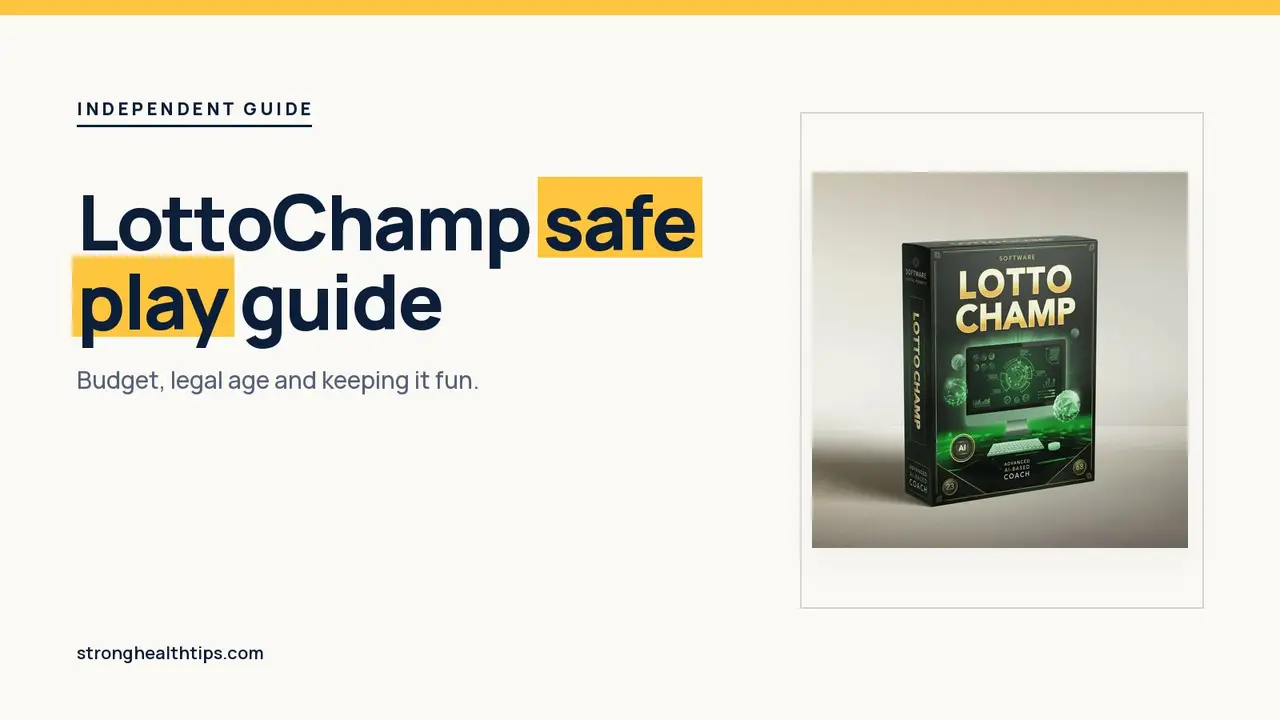
LottoChamp safe play starts well before any order is placed. This friendly walk-through covers the habits that keep a lottery hobby pleasant: a budget chosen in advance, money you can truly spare, a check of the legal age that applies where you live, and a clear sense of when to stop. If the routine stops being enjoyable, free help is close at hand. The 60-day guarantee gets its own section here, offered as one route if LottoChamp does not suit your situation.
Plan first
Read the budget rules, then consider the order.
A set limit makes the $197 order easier to weigh.
Order with your budget in mindFix the budget first
Pick the budget before the web app opens. Write down the amount you feel fine spending on lottery fun, and keep it visible while you work through the tool. A limit set beforehand is simpler to hold than one improvised midway, when the numbers on screen can make almost any amount feel reasonable.
If the $197 order alone would strain that limit, the sensible course is to leave the order alone. The price has no bearing on your budget arithmetic, and no offer should push you beyond the line you drew. Treat the limit as fixed rather than as a number to revise because a session feels promising.
Keep bills, food and rent out of it
Cash earmarked for bills, food or rent should never flow into lottery play. Spending on games should come from what is left once essential costs are covered, and it should be sums you could lose without hardship. The same principle applies to LottoChamp as to any other lottery purchase, whether that is a scratch card, a draw ticket or a number-suggestion session.
If household money runs short in a month when lottery spending rose, read that as a plain signal to stop. Do not shift essential funds to cover the gap, because that is how a hobby turns into a debt.
Keep a simple spending note
A short written note makes the budget easier to see. Record the limit you set, the amount you have spent in the current period and what remains. The figures take a moment to write, and they show at a glance whether you are still inside the plan. Keep the note next to your confirmation message, so the order and the spending sit together.
Breaks and how the session feels
Step away from the screen at intervals you set for yourself, and notice how the session feels while it runs. A short session that you enjoy is a different experience from feeling pulled back to the screen, and the difference is worth watching. If you catch yourself chasing losses, stop at that point. Attempting to recover money already spent is never a sound reason to continue.
After every session, put one question to yourself: was I inside the budget I set? A no should steer the following decision.
Age and where you live
Access is restricted to adults of legal age, since the seller’s terms exclude anyone under 18. Age rules for lotteries differ between places, so look up what applies locally before ordering. Meeting the age requirement is a condition of use, not a formality to skim past.
Adults only
Confirm your age, then review the order.
The web app is for adults of legal age.
Review the order if you are of ageFree, confidential help
If playing stops being fun, or if you feel pressure to keep playing, free, confidential help can be reached at 1-800-GAMBLER (ncpgambling.org). Waiting for a crisis is not required before you call. Reaching out early is a sensible move, and it costs nothing. Store the number where it is easy to reach, and tell someone you trust if the topic feels hard to bring up.
Questions to ask after each session
Check-ins work best when the questions are settled in advance. Ask yourself these three after each session:
- Did I stay inside the budget I wrote down before starting?
- Did I use only money that was never needed for bills, food or rent?
- Am I still enjoying the routine, or am I playing to recover something?
If any answer leaves you uneasy, stop for the day and revisit the questions later. Nothing about the product requires you to keep going.
When to pause for the day
- You are spending more than the limit you wrote down.
- You feel you must keep playing to recover what is already gone.
- Money for essentials is being moved toward lottery play.
If any of these shows up, pause for the day, leave the screen and speak with someone you trust. The free help line mentioned above is available for the same purpose.
If LottoChamp is not right for you
Each purchase includes a 60-day money-back guarantee. Keep your confirmation message, which records the purchase. If the product does not fit your circumstances, the guarantee opens a route to ask for money back, and the money-back guarantee post shows how to write to the seller. Nothing comes back, since the product is digital.
Your option
Keep the 60-day guarantee in view.
A plain money-back route, with your confirmation message as the record.
Keep this guarantee in mindLimits of the tool
The web app proposes number sets from the game, date and budget you give it. Lottery draws run the same way whatever the tool shows, and no result is assured. Think of the number sets as a playful output, not a forecast to build plans on. Holding onto that distinction is one of the simplest safe-play habits you can adopt.
Time as well as money
Money is not the only resource a session uses. Time matters too. Choose in advance how long you will sit with the tool, and set a reminder for the end of that period. When the time is up, close the browser and return to the rest of your day. A limit on minutes works alongside the limit on money, and it is easier to hold when it is written down.
Talking it over with someone you trust
A second opinion can help. Tell a friend, a relative or a support worker what budget and time limit you have set, and ask them to say so if they notice you going past it. Having one person who knows the plan makes it harder to drift away from it unnoticed, and it takes no more than a short conversation.
Changing a limit the right way
If you want to change a limit, make the change before a session starts, never during one. A new figure chosen while the screen is open tends to reflect how the last few minutes felt rather than what was planned. Write the revised figure down, date it and keep to it for the next period.
Why limits protect the fun
A limit keeps the activity in proportion. When spending and time stay within the plan, the routine remains a light pastime rather than a source of worry. Concerns that spoil a hobby often begin with money that was never set aside on purpose, so the simple act of setting the figure in advance does a great deal of the work.
Recognising when the fun has changed
Enjoyment shifts gradually. A session that once felt light can start to feel urgent, and a budget that once held can start to feel tight. Noticing that shift early, while the amounts are still small, makes it easier to step back. The free help line above is there for exactly that moment, whether the change is large or small.
Setting a stopping point before you start
Decide, before the first session, what would make you stop. It might be a figure on the budget note, a set period of time or a feeling that the session has stopped being light. Writing that stopping point down makes it easier to honour when the screen is in front of you. A stopping point is not a sign of failure. It is part of the plan, and it is the part that keeps the hobby in proportion.
Making room for other things
Lottery play should sit alongside work, family time, sleep and the other parts of a normal week. If it begins to push those aside, that is worth noticing. Rearranging the rest of your life around a session is the opposite of the light, occasional routine this guide has in mind.
Good to know
Lottery games are games of chance; no tool can predict numbers. Play only if you are of legal age (18+ or as your state requires) and only with money you can afford to lose.
Where to find more
Our catalog’s safety page condenses the budget and age points. For the offer itself, see the LottoChamp hub; for the routine, the how it works guide covers each step inside the members area.
Final word
Start only with a plan you can keep.
The $197 web app, online at once, plus the 60-day guarantee.
Order within the plan you setQuestions people ask
How do I set a budget for LottoChamp?
Decide a fixed amount before you open the tool, and spend only money you can afford to lose.
Can I use money meant for bills or rent?
No. Never use money you need for bills, food or rent.
What is the minimum age?
LottoChamp is for adults of legal age. The seller's terms bar anyone under 18, and local lottery age rules may be higher.
Where can I get free help?
Free, confidential help is available at 1-800-GAMBLER (ncpgambling.org).
What if the tool is not right for me?
The order carries a 60-day money-back guarantee. Keep your confirmation email and read the money-back guarantee post for the steps.
Does LottoChamp promise results?
No. The tool suggests number sets for fun, and no tool can change how a draw is run.
Not medical advice. This guide is general information and does not replace a consultation with a qualified healthcare professional who knows your history. Full disclaimer.
Written by
Strong Health Tips Editorial Team
We research, write and fact-check every guide against current guidance from major health bodies and peer-reviewed studies, then rewrite it in plain English. How we work.