The Genius Switch Audio for Brain: Where It Sits Among Sound-Based Brain Products
The Genius Switch audio for brain, in context: what brain-audio products promise, what binaural research shows, safe listening and where this $39 track fits.
- Author
- Strong Health Tips Editorial Team
- Published
- Reading time
- 9 min read
Affiliate disclosure: this review contains links to the official The Genius Switch website. If you buy through them we may earn a commission at no extra cost to you. It does not change our assessment. Details.
People who search for The Genius Switch audio for brain are usually asking a bigger question underneath: can listening to something actually change how your brain performs? The Genius Switch is one answer on sale, an 8-minute recording for $39 that its seller says produces “whole brain activation”. But it belongs to a wider category of sound-based brain products, and it is easier to judge once you can see the whole shelf.
This guide steps back from the single product. It sorts brain audio into broad kinds, ranks the usual promises from easy to check to impossible to check, summarizes what the research most often cited in this area shows, sets out safety rules that apply to all of it, and then places The Genius Switch on that map.
One product in a crowded field
An 8-minute brain-audio track, $39 once, refundable for 90 days.
Sold through ClickBank and emailed right after payment.
See where to get the trackThe main kinds of brain audio
“Audio for the brain” covers several quite different things. Here is a simple way to sort them, with what you do while listening and what our sources can say about each.
| Kind | What you do | What our sources can say |
|---|---|---|
| Tone tracks, such as binaural beats (many are free) | Listen through headphones | The research is mixed: a medium effect in a 2019 meta-analysis, little entrainment in a 2023 review |
| Guided audio, such as a visualization or relaxation voice | Follow a voice with your eyes closed | Not covered by the research discussed here |
| Branded recordings like The Genius Switch | Listen to a track whose contents are not described | No published study tests The Genius Switch track |
| Brain-training games (for comparison, not audio) | Solve puzzles and get scores | A different category; not assessed here |
The Genius Switch actually touches two rows. The main product is the branded recording, and one of its four bonuses is a guided visualization from a creator the seller describes as top-rated on the Calm app.
The difference that matters most is disclosure. With a tone track, the tones are the product, so you know roughly what you are getting. With The Genius Switch, you are told what the recording is called, not what is on it.
The promises, from checkable to uncheckable
Brain-audio marketing tends to stack promises, and they are not all equal. Some describe things you can notice for yourself. Others are so broad that no listener could ever tie them to a recording. The Genius Switch video is a useful example because its list runs the whole range.
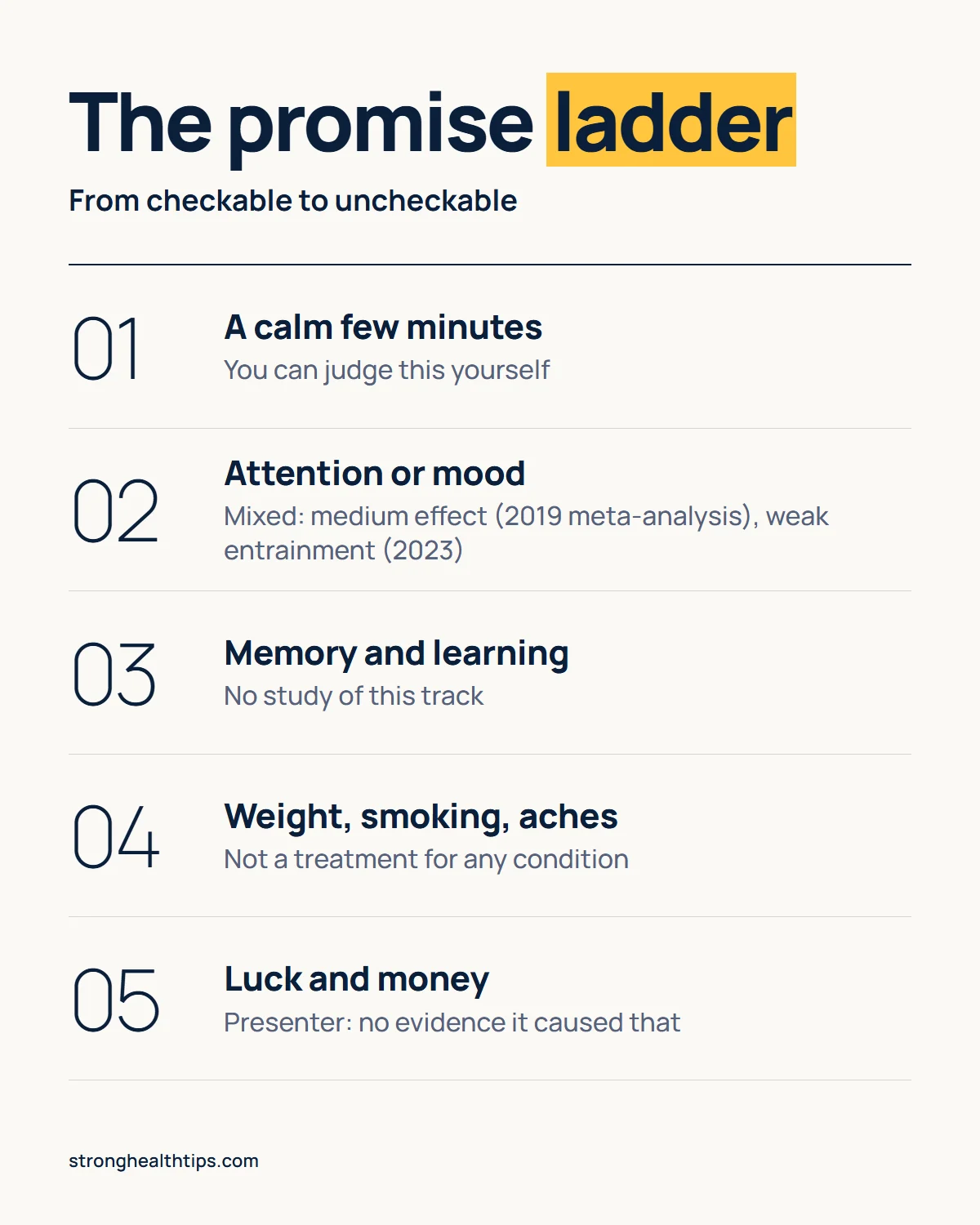
- A calm few minutes. You can judge this yourself after one listen. It is also something many quiet activities provide.
- Attention or mood. This is where the binaural research sits, with mixed findings: a medium overall effect in a 2019 meta-analysis, but little sign of brainwave entrainment in a 2023 review.
- Memory and faster learning. The Genius Switch video promises both. No published study tests the track for either.
- Weight, smoking, headaches and joint pain. The video tells stories in all four areas. The seller’s own disclaimer says the product is “not intended to diagnose, treat, cure, or prevent any disease”.
- Luck, money and promotions. On a casino story, the presenter, who introduces himself as Dr. Daniel Barone, says “there is of course no evidence to support that the genius switch caused that”.
A sensible rule from us: give a brain-audio product credit only for the rungs near the top of this list, and only after you have tried it.
What the binaural research shows
Binaural beats are the part of this category with the most research behind it, which is why sellers tend to cite them. A binaural beat forms when each ear hears a steady tone at a slightly different pitch, and the listener perceives a soft pulse at the gap between them. That is why headphones matter for this kind of audio.
The findings are mixed. Some small studies report short-term effects on attention or mood. One that The Genius Switch sales page cites, by Ross and Lopez (2020), looked at 40 Hz binaural beats and the attentional blink, a brief lapse in attention when two targets appear close together. Overall, a 2019 meta-analysis found a medium effect on outcomes such as memory, attention and anxiety, while a 2023 review found that most studies did not show the brainwave change (entrainment).
Two limits are worth keeping in mind. First, a short-term lab effect on attention is a long way from better grades or a pay rise. Second, results on binaural beats in general say nothing about a particular commercial recording. That is especially true for The Genius Switch, whose video says the method “has nothing to do with brain waves” and calls sound waves “incomplete”, even as its sales page lists binaural-beat and gamma studies as references.
Seven questions to ask any brain-audio product
Before paying for any track, these questions sort careful sellers from the rest. Here is how The Genius Switch answers each one, based on its own sales page, video, Terms and checkout.
| Question | The Genius Switch answer |
|---|---|
| Has this recording been tested? | No published study tests it |
| Does the seller say what is on it? | No; it is called a “targeted auditory sequence” |
| Is the science story consistent? | No: “nothing to do with brain waves”, yet binaural studies are cited |
| Who stands behind it? | The presenter named above; identity not verified |
| What does the fine print say? | The Terms call the products “for entertainment purposes only” |
| Are the testimonials typical? | The Terms say they may be acted and show exceptional results |
| Can you get your money back? | Yes, 90 days in the Terms and at the ClickBank checkout |
The last row is the strongest point in the product’s favor. The others explain why our expectations stay low.
Low-cost experiment
Curious about brain audio? Try 8 minutes a day with a refund route.
$39 one-time, shown in local currency plus tax. Four digital bonuses included.
Check the current priceListening safely, whatever you choose
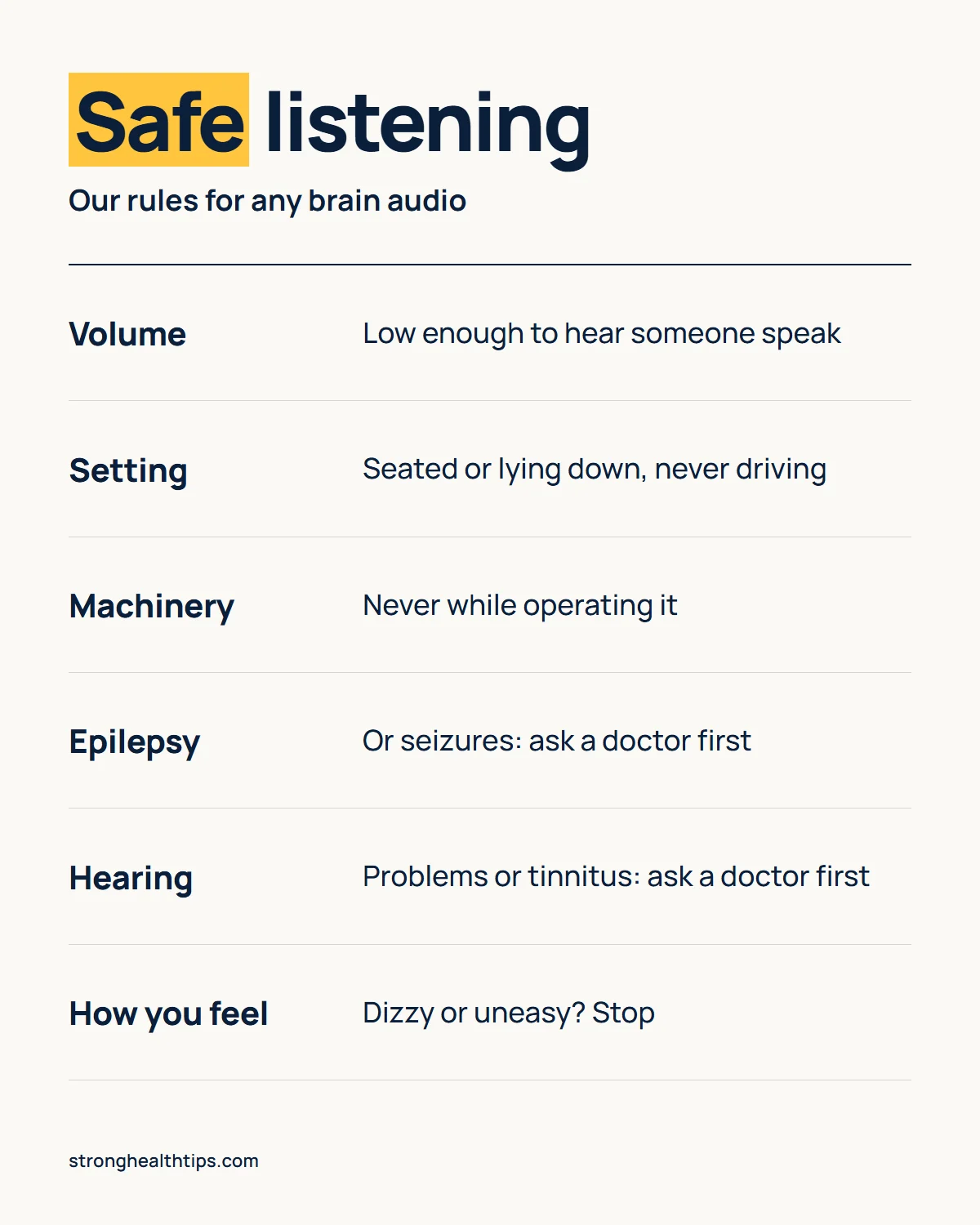
These rules are our own and apply to any brain-audio product, free or paid:
- Volume. Keep it low enough that you could hear someone speaking to you. Loud sound through headphones can damage hearing over time, and nothing about brain audio requires loudness.
- Setting. Sit or lie somewhere safe. Most of these products ask you to close your eyes, so never listen while driving.
- Machinery. The same goes for operating tools or machinery of any kind.
- Epilepsy or seizures. Ask a doctor before trying rhythmic audio of any sort.
- Hearing problems. Ask a doctor first, including if you have tinnitus or wear hearing aids.
- How you feel. Stop if you become dizzy, anxious or uncomfortable.
Where The Genius Switch fits
On the map above, The Genius Switch is a branded recording with an unusually large promise and unusually little disclosure. The product is a single digital audio track that runs for 8 minutes. You download it from the delivery email to a phone or computer, put on headphones, close your eyes and listen once a day. The video says missing a day is “okay”. There is no app and no game.
The seller says the track uses “neural sync technology” to sync the brain’s two hemispheres, with one hour of neural sync compressed into 8 minutes. It links the idea to Roger Sperry, who won the 1981 Nobel Prize for split-brain research, not for anything called “whole brain activation”, which is the seller’s own term. The video claims the track has helped “18,456 everyday Americans”, a seller figure we could not verify, and its testimonials come with the Terms’ own warning that they may be dramatized with digital avatars or actors.
On price and protection, it compares reasonably. The Terms of Sale say “You are paying $39 today”, the checkout adds local currency and tax, and the refund window is 90 days in both the Terms and the ClickBank checkout. A separate refund page on the site belongs to “NeuroActivate” bottles and does not fit a digital track. If you buy, use the official order page, keep the ClickBank receipt, and look for CLKBANK*GeniusSwitch on your statement.
Know what you are buying
A branded 8-minute recording, not a tested brain treatment.
Refunds within 90 days via the Terms and ClickBank, order support 1-800-390-6035.
View The Genius Switch offerFree ways to give your brain a break
If what you want from brain audio is a clearer, calmer head, some of the most reliable options cost nothing. A daily walk gets you moving and away from screens. Steady sleep hygiene habits protect the rest your brain depends on. And a few simple routines for managing daily stress can do much of what people hope an audio track will do. None of these rules out trying a track as well.
The bottom line
Brain audio is a broad category with a narrow evidence base. The best-studied part, binaural beats, has mixed research: a 2019 meta-analysis found a medium effect on some outcomes, while a 2023 review found most studies showed no brainwave entrainment. The Genius Switch sits at the less transparent end: a recording whose contents are not described, a method that is not published, a science story that contradicts its own references, and Terms that call the products “for entertainment purposes only”.
That still leaves room for a modest use. Eight quiet minutes with your eyes closed may suit some people, and the 90-day refund makes the experiment cheap to undo. Our editorial score, which is ours and not a customer rating, is 3.0 out of 5. For a one-page summary of the product, see our quick guide.
We are independent, not the seller, and we may earn a commission if you buy through our links.
Brain audio, in perspective
Mixed research. One untested track. A 90-day safety net.
$39 one-time. Listen at a comfortable volume, never while driving.
Go to The Genius Switch pageQuestions people ask
Can sound really affect the brain?
Hearing anything involves the brain, so in that broad sense yes. The narrower question is whether a specific track improves focus, memory or mood. Binaural-beat research is mixed: a 2019 meta-analysis found a medium effect on outcomes such as attention and anxiety, while a 2023 review found most studies did not show the brainwave change (entrainment). No published study tests The Genius Switch track.
Is a free brain-audio track on YouTube the same as The Genius Switch?
No. The sales video says the product is not sold on YouTube, Spotify or Amazon, and the presenter says tracks found on YouTube or Spotify are not the same. Because the seller does not publish what is on its recording, a free track cannot be compared with it either.
Do I need special headphones for brain audio?
The Genius Switch video asks for headphones but does not ask for any particular kind. Ordinary headphones or earbuds that are comfortable for 8 minutes with your eyes closed are what the instructions describe. Wear both earpieces.
How long should a brain-audio session last?
The Genius Switch is designed as one 8-minute listen a day, and the video says missing a day is okay. Our advice is to follow the length a product sets rather than looping it, and to stop if you feel unwell.
Can this kind of audio replace treatment for a health problem?
No. The Genius Switch site says the product is not intended to diagnose, treat, cure, or prevent any disease, and its Terms call the products for entertainment purposes only. See a doctor about memory, mood, pain or any other health concern.
Is brain audio safe for children?
The seller's marketing mentions children's grades, but there is no study of the track in children or adults. Our advice: keep the volume especially low, supervise, and ask the child's doctor first if there is any history of seizures or hearing problems.
Sources
- NIDCD: Noise-induced hearing loss
- FTC: Guides concerning the use of endorsements and testimonials in advertising
- FTC: Shopping online, avoiding scams and protecting your payment
- Ingendoh RM et al. (2023). Binaural beats to entrain the brain? A systematic review of the effects of binaural beat stimulation on brain oscillatory activity. PLOS ONE
Not medical advice. This guide is general information and does not replace a consultation with a qualified healthcare professional who knows your history. Full disclaimer.
Written by
Strong Health Tips Editorial Team
We research, write and fact-check every guide against current guidance from major health bodies and peer-reviewed studies, then rewrite it in plain English. How we work.