Energy Revolution System vs Solar Panel Kit: What Each One Gives You
Energy Revolution System vs a ready-made solar panel kit: a $39 DIY PDF guide next to a finished kit, with warranty, instructions and permits as general points.
- Author
- Strong Health Tips Editorial Team
- Published
- Updated
- Reading time
- 7 min read
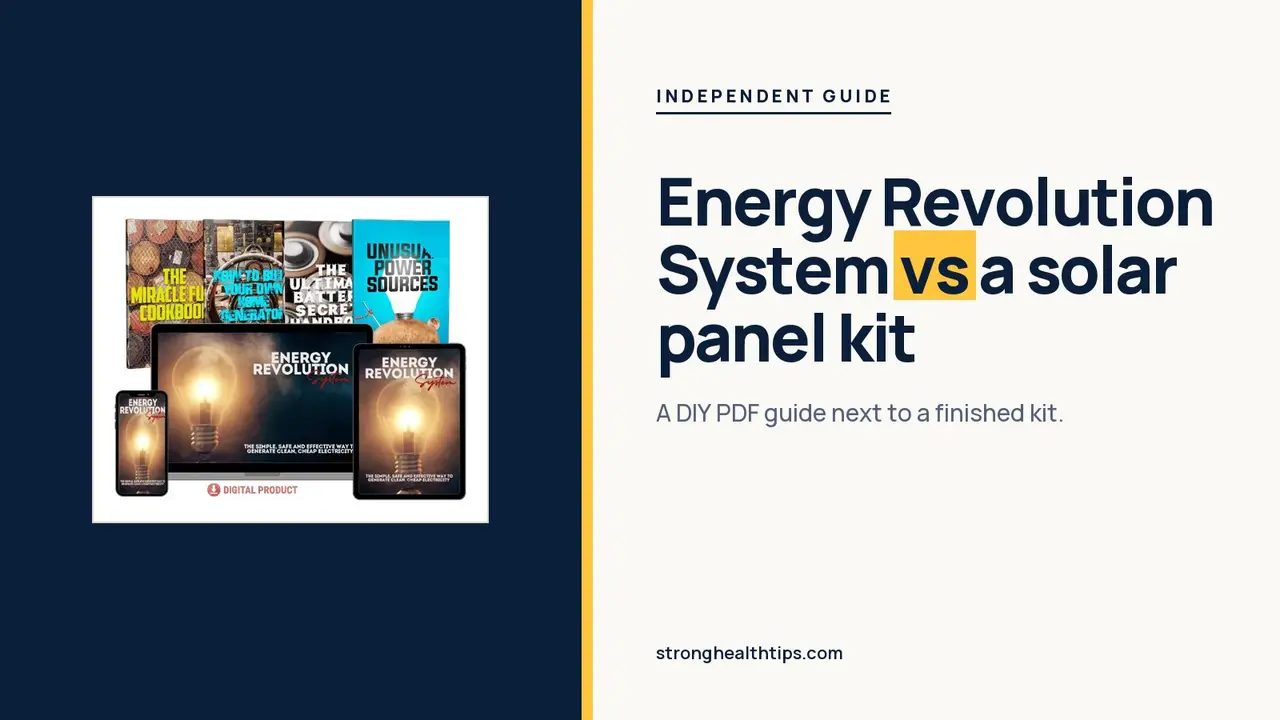
People comparing energy revolution system vs solar panel kit options are usually choosing between two different things: a written guide you read before spending on hardware, and a finished product that arrives with its own terms. This page sets the two side by side in general terms. It makes no claims about solar output, panel size or running costs, and it names no brands, because the right choice depends on your roof, your local rules and your plans.
A guide, not a kit
The PDF is the whole product
$39 in one payment, delivered by download link.
See the $39 guideEnergy Revolution System vs solar panel kit, side by side
The table below compares what each route usually gives you. The guide column reflects what the seller describes. The kit column is a general picture of physical solar products, not a description of any one kit.
| Point | Energy Revolution System | A solar panel kit, in general |
|---|---|---|
| What you receive | A PDF guide by download link, per the seller | Physical parts, if you buy a kit |
| Shipping | Nothing ships | Parts are delivered by the kit’s seller |
| Price shown | $39 in one payment for the guide | The kit’s own price, set by its seller |
| Instructions | A beginner quick-start guide and a materials list, per the seller | Installation instructions, if the kit includes them |
| Warranty | The seller’s 60-day money-back guarantee | Warranty terms set by the product’s manufacturer, which you should read |
| Permits | Your job to check with the local office | Permits and utility approval often apply to grid-connected systems |
| Best fit | Studying a plan before buying hardware | A finished product with its own terms |
The table is a general comparison. It does not describe a particular kit and it is not a verdict on any product.
What a finished kit brings that a guide does not
A kit arrives as hardware, and that brings advantages a document cannot offer. The parts are chosen to work together, the instructions can be tied to those parts, and the seller may stand behind a warranty. If you want a physical product and clear terms from the company that sold it, a kit answers that need in a way a PDF does not.
Check the warranty length, what it covers and who handles a claim before you buy any kit. Read the installation instructions for any step that involves wiring, and look for a note on permits. Those points matter as much as the headline price, and they are often easier to compare on paper than in a sales page.
What a guide brings that a kit does not
A guide lets you study a plan before you spend on hardware. Picture a reader with a shed and a single outlet near the door. That reader can learn what a project requires, price the parts at a shop nearby and check the local rules before anything is bought. The seller describes the Energy Revolution System download as a beginner quick-start guide with a materials list, delivered by email for $39 in one payment.
The guide does not supply hardware. A builder who wants every component in one box will need a different route, and the guide’s price does not cover those components.
Study first, then source
Read the plan before the parts
The materials list and quick-start guide arrive in one download.
Get the guide for $39Warranty and support, in plain terms
Warranty and support are where the two routes differ most in practice. A kit’s warranty is set by the company that makes or sells it, and its length and coverage vary from product to product. Keep your receipt and follow that company’s claim steps if something fails. A guide has a different kind of protection: the seller’s 60-day money-back guarantee, handled by email, with a refund route set out in the seller’s terms. The hub page also has the guide’s details in one place.
Support differs too. A kit’s support runs through its seller, while the guide’s support runs through the seller’s help channels and ClickBank order support. Neither route promises a visit to your home. Ask what each seller covers in writing before you rely on it, and read that wording rather than a summary of it.
Permits, wiring and the rules that apply to both
Permits and utility approval often apply to grid-connected systems, and the same local checks reach any home power project. Any work that connects to house wiring belongs with a licensed electrician, whichever route you pick. A kit does not remove that duty, and a guide does not remove it either. The final word on what you may connect rests with your local office and the electrical code that governs your building.
Electrical and fuel work carries fire and shock risks. A kit’s installation sheet and a guide’s materials list both leave those risks in place, so the checks before any connection stay the same. Fuel-burning equipment should never run indoors, whatever the source of power.
Installation and inspection, in general
Installation is where safety rules are tested in practice. A kit’s instructions describe the steps its company expects you to follow, while a guide describes a plan that you must check against your own site. In either case, an inspector or a permit office may add requirements of its own. Grid-connected work in particular often needs approval from the local utility as well as a permit. Plan for those checks from the start rather than treating them as an afterthought, and keep fuel-burning equipment outdoors, never indoors.
Choosing by what you need
If you prefer finished hardware with its own warranty and instructions, a kit fits better. If you would rather learn the plan first and buy with the rules in front of you, the guide fits better. A hobbyist with a garage workbench who enjoys planning may find the guide’s structure satisfying. Someone who wants a product to install on a chosen day may find a kit easier to live with. Neither choice is a shortcut past the local checks, and both leave you with the same questions to put to your permit office.
A household with a fixed budget for the year may find it helpful to split the spending into two parts. The first part covers the study stage, which for the guide is the $39 in one payment. The second covers hardware, permits and any electrician’s fee, which the guide does not include. Seeing those two parts side by side makes the real total easier to read than a headline price on its own. A practical way to use the comparison table is to copy its rows into your own sheet and add a column for local notes. Fill that column after you speak to the permit office, since those answers will tell you more about your route than any general comparison can.
Either way, the local rules and the electrician come first. Neither route removes the need to ask the right people before the first wire is touched.
Questions to answer before you pick a route
Ask yourself three plain questions. Do you want to study and source parts yourself, or would you rather buy a finished product from one seller? Will you read the local rules before you spend? Will you bring in a licensed electrician for any link to house wiring? Your answers point toward the route that suits your plans, and they also show where the work sits.
Your plan, your route
Start with the guide
A PDF for $39 in one payment, with the 60-day money-back guarantee.
Open the order pageWhere to go next
The review sets out what the guide covers, its strengths and its limits. The price post walks through the $39 total and what sits outside it. For the download contents, the what’s included page gives the seller’s description, and the hub page collects the product details in one place.
Good to know
Electrical work around a house or shed carries fire and shock dangers, whether the project uses a kit or a guide. Look up local codes and permit rules before you connect anything, and hand any tie-in to house wiring to a licensed electrician. Fuel-burning equipment stays outdoors, never inside a room.
Ready to compare
Read the Energy Revolution System guide
One payment of $39, a download by email and a 60-day money-back guarantee.
Get the PDF guideQuestions people ask
Is Energy Revolution System a solar product?
The seller describes it as a digital guide to a small home power device. No solar panel ships with it, because nothing ships at all.
Do solar panel kits come with a warranty and instructions?
Some do, but terms differ from one kit to the next. Read the warranty and the installation instructions for the specific product you are considering.
Do I need a permit for either route?
Permits and utility approval often apply to grid-connected systems. Check with your local office before connecting anything, whichever route you pick.
Is the $39 the whole cost of the guide route?
$39 is the guide's price in one payment. Parts, tools, permits and any electrician's fee are separate costs that you cover.
Who is a guide better suited to?
Someone who wants to study a plan, source parts locally and learn the rules before spending on hardware.
Who is a finished kit better suited to?
Someone who wants a physical product, its own instructions and warranty terms, and a clear route to the seller for support.
Please note. This guide is general information only, not professional, legal or safety advice. Follow local building, electrical and water rules, and use a licensed professional where the law or your safety calls for one. Prices, plans, bonuses and refund terms can change; the official order page is the final word. Full disclaimer.
Written by
Strong Health Tips Editorial Team
We research, write and fact-check every guide against current guidance from major health bodies and peer-reviewed studies, then rewrite it in plain English. How we work.