Does The Genius Switch Work? The Claims, the Evidence and a Fair 90-Day Test
Does The Genius Switch work? We set the seller's claims against binaural research, explain the brain-wave contradiction and show how to test it in 90 days.
- Author
- Strong Health Tips Editorial Team
- Published
- Reading time
- 9 min read
Affiliate disclosure: this review contains links to the official The Genius Switch website. If you buy through them we may earn a commission at no extra cost to you. It does not change our assessment. Details.
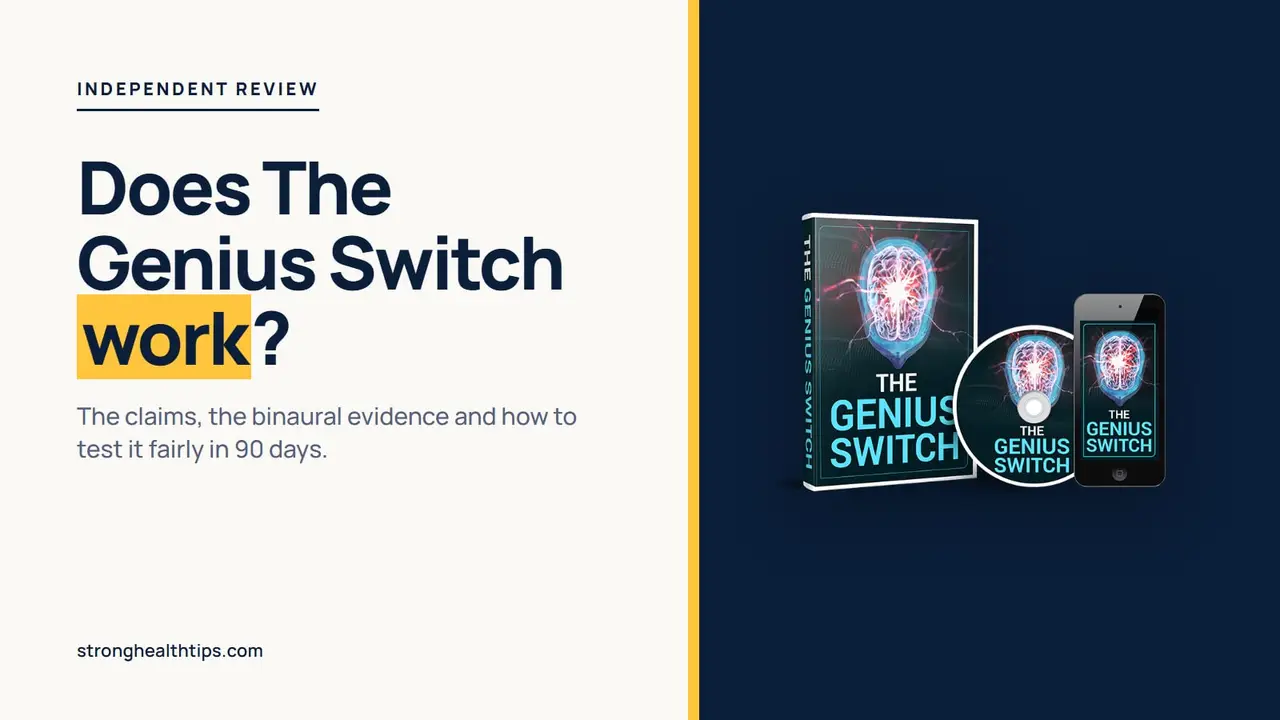
Does The Genius Switch work? The honest answer is that nobody knows, because nobody has tested it. No published study looks at this 8-minute audio track. The seller’s own video contradicts the research it cites, and the presenter admits there is no evidence behind one of his most eye-catching stories. That does not prove the track does nothing. It means the only test available to you is one you run yourself.
This article sets the claims against what the evidence can and cannot say, and then lays out a simple way to test the track fairly within the 90-day refund window, so you finish with an answer of your own rather than a hunch.
What you would be testing
One 8-minute audio track, $39, with 90 days to decide.
Emailed after a ClickBank checkout. Every benefit is the seller’s claim.
See what the order includesWhat “working” would have to mean
Before asking whether something works, it helps to be clear about what it promises. The video makes a long list of claims, all of them the seller’s:
- Insights and “eureka moments”
- Learning faster and remembering more
- Luck, “synchronicities”, promotions and money
- Better relationships
- Weight loss (one anecdote mentions 17 pounds), quitting smoking, and headaches or joint pain easing
- Children’s grades improving
It also sets a timetable. The video says “it starts working the very first time you listen”, that “many customers notice a difference within the first two to three days” and that “most people … begin to see results within a couple weeks”.
Some of these are things you could notice, like how well you sleep or how easily you focus on a task. Others, like luck and synchronicities, are almost impossible to measure, because a lucky day is easy to remember and an ordinary one is easy to forget. Any fair test has to stick to the first kind.
How the seller says it works
The pitch is delivered by the presenter, who introduces himself as Dr. Daniel Barone, a New York City neurologist. His identity, and whether he had any role in the product, are things we were unable to confirm.
The idea he describes is “whole brain activation”: getting the two hemispheres of the brain to work in sync. He links it to Roger Sperry, who won the 1981 Nobel Prize for split-brain research. Sperry’s prize was not for “whole brain activation”, which is the seller’s term rather than a clinical one. The track is said to use “neural sync technology”, with an hour of neural sync compressed into 8 minutes. The seller does not publish any technical description of what is on the recording.
The brain-wave contradiction
Here is the problem at the center of the evidence question. On camera, the method is said to have “nothing to do with brain waves”, and sound waves are dismissed as “incomplete”. On the sales page, the references list studies on 40 Hz binaural beats and gamma stimulation.
Those two positions pull in opposite directions. If the track is something other than a brain-wave or binaural product, the binaural studies say nothing about it. If it is a binaural product after all, the video’s dismissal of sound waves is misleading. Either way, the cited research cannot do the job the sales page gives it, which is to make the track look tested.
What binaural research can and cannot tell you
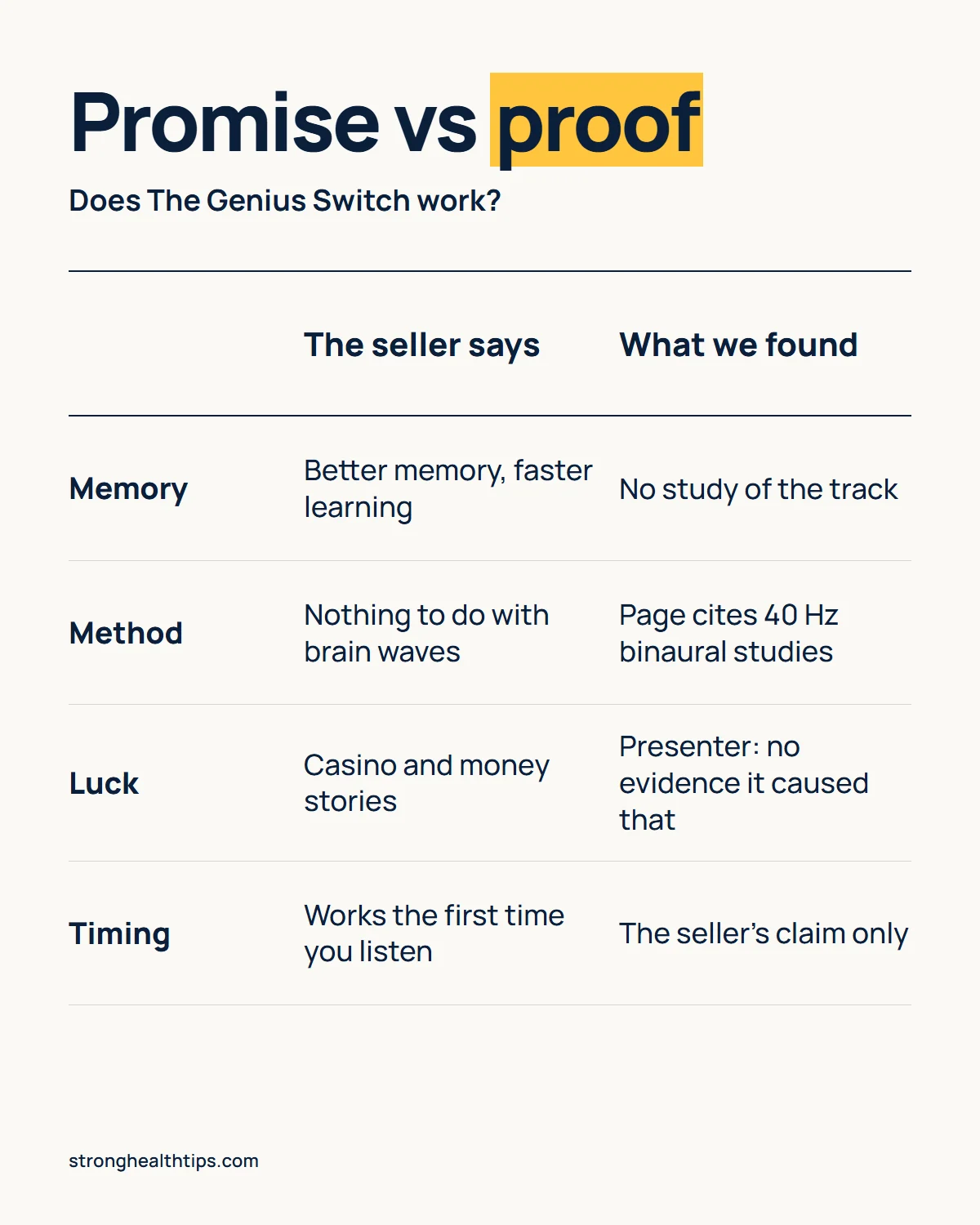
Binaural beats are a real research topic. Some small studies, including the 40 Hz attentional-blink study the site cites (Ross and Lopez, 2020), report short-term effects on attention or mood. Overall the evidence is mixed: a 2019 meta-analysis found a medium overall effect on outcomes such as memory, attention and anxiety, while a 2023 review found that most studies did not show the brainwave change (entrainment) the idea rests on.
| Question | What the evidence supports |
|---|---|
| Do binaural beats ever affect attention or mood? | Some small studies report short-term effects; the overall picture is mixed |
| Has The Genius Switch track been studied? | No published study tests it |
| Is there evidence for lasting memory gains from this track? | None |
| Is there evidence for luck, money or promotions? | None, and the presenter says so about luck |
| Is it a treatment for any condition? | No, by the seller’s own disclaimer |
The gap between the first row and the rest is the whole story. A narrow lab finding about attention is a long way from better grades, a pay rise or easier joints.
The presenter’s own casino remark
One of the most revealing moments in the video is a question about gambling. Customers, it says, have shared stories about wins on slots, roulette and sports betting. The presenter’s reply is unusually candid: “there is of course no evidence to support that the genius switch caused that”.
That is the right standard, and it is worth applying to every other result in the video too. A story about a promotion, a weight loss or a better school report is a story. Without a comparison, nobody can say whether the track caused it.
The testimonials need the same caution. The site’s Terms say feedback may be dramatized with digital avatars or actors, that some featured people may be “early supporters, friends, or family members of the company’s founders”, and that the results shown “may not reflect the experience of a typical customer”. The Terms also include a section headed “For Entertainment Purposes Only”, which says “brain entrainment is not an exact science and we recommend that you do not treat it as such. The products are provided for entertainment purposes only.”
Test it, do not trust it
The 90-day window is long enough for an honest home test.
Terms and ClickBank checkout both state 90 days from purchase.
Check the current priceCould it help anyone at all?
It may feel good to some people, and that is not nothing. Eight minutes with your eyes closed and headphones on is a short, quiet break, and plenty of us rarely take one. If you finish feeling calmer, that is a real experience.
The difficulty is telling what caused it. Would you feel the same after 8 minutes of sitting still in silence? The video cannot answer that, and neither can a testimonial. Only a comparison can, which is why the test below includes silent days as well as listening days.
How to test it fairly within 90 days
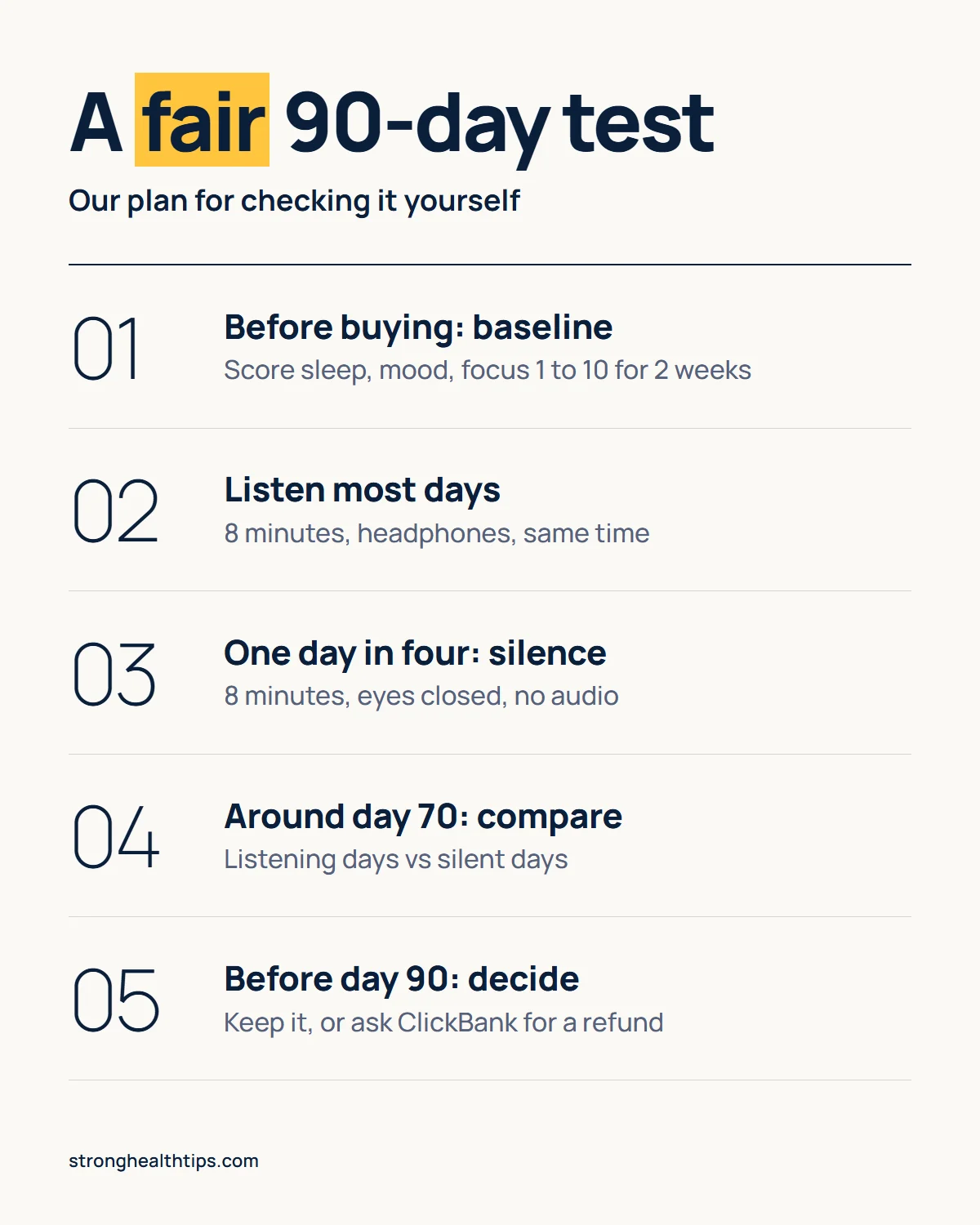
This is our own plan, designed to fit inside the refund window and to give the track a fair chance without fooling yourself.
| Phase | When | What you do |
|---|---|---|
| Baseline | Two weeks before you buy | Each evening, score sleep, mood and focus from 1 to 10 |
| Set-up | Purchase day | Save the receipt, note the date, set reminders for day 70 and day 85 |
| Listening | Most days from day 1 | 8 minutes, headphones, eyes closed, same time of day |
| Comparison | One day in four | Sit for 8 minutes with eyes closed and no audio |
| Review | Around day 70 | Compare average scores: baseline, listening days, silent days |
| Decision | Before day 90 | Keep it, or ask ClickBank for a refund |
A few tips make the numbers more useful:
- Score at the same time every day. Evenings work well because the day is done.
- Write the scores down straight away. Memory flatters whatever we hope is working.
- Pick one concrete task if memory is your goal. For example, how many items from a short list you recall the next morning. Do it the same way throughout.
- Do not change three other habits at once. If you start exercising and sleeping earlier in the same month, you will not know what helped. The routines in our sleep hygiene habits guide are worth adopting, but start them before your baseline or after the test ends.
- Accept the result. If listening days and silent days score the same, the track is not adding anything you cannot get for free.
When you review, a clear gap in favor of listening days is worth taking seriously for you personally. No gap, or a gap that matches the silent days, is your answer too. In that case, request the refund well before day 90: ring ClickBank order support on 1-800-390-6035, quote the order number from your receipt, and look for the charge on your statement as CLKBANK*GeniusSwitch. Ignore the site’s separate refund page, which is a leftover policy for “NeuroActivate” bottles (60 days, unopened bottles, a return address in Tallmadge, Ohio). Your 90 days come from the Terms and the ClickBank checkout, not from that page.
Stay safe while you test
These cautions are our own, for any audio-entrainment product:
- Keep the volume comfortable. Years of loud headphone listening is a known route to hearing damage.
- Never listen while driving or operating machinery.
- If you have epilepsy, a history of seizures or a hearing problem, ask a doctor before starting.
- Stop if you feel dizzy or unwell.
Before you start the clock
Score yourself for two weeks first, then order.
$39 one-time plus local tax. The track arrives by email right after payment.
Go to the order pageOur answer
Does The Genius Switch work? For the big promises, there is no evidence that it does. No study tests the track, the binaural research the sales page leans on is mixed and about something the video says the product is not, and the presenter concedes the luck stories are unsupported. The seller’s own Terms put it plainly: brain entrainment “is not an exact science”, and the products are “for entertainment purposes only”.
For a smaller promise, a calm 8-minute pause, it may well suit some people, and you can find out cheaply. Our editorial score, which is ours and not a customer rating, is 3.0 out of 5. If you want to try it, start from the official order page, run the test above and let your own numbers decide. For a quick overview of the product before you commit, see our quick guide. And if stress is the real reason you are searching, our guide on how to manage daily stress has free habits with far more research behind them.
Health note: An audio track is not medical care. Talk to a doctor about memory, mood, pain, weight or smoking concerns, and do not delay care while testing an audio product.
Your test, your verdict
Unproven claims, a real refund window. Let your own scores decide.
Keep the ClickBank receipt. Refund requests within 90 days of purchase.
See The Genius Switch offerQuestions people ask
How long does The Genius Switch take to work, according to the seller?
The video says it starts working the very first time you listen, that many customers notice a difference within the first two to three days, and that most people begin to see results within a couple of weeks. These are the seller's claims; no published study backs them.
Is there a scientific study of The Genius Switch?
Not that we could find. The sales page lists research on 40 Hz binaural beats and gamma stimulation, such as the Ross and Lopez (2020) attentional-blink study, but those studies did not use The Genius Switch track.
Does the video say the track uses brain waves?
No, it says the opposite. The video says the method has nothing to do with brain waves and calls sound waves incomplete. The sales page then cites binaural-beat and gamma research, which is a contradiction the seller does not explain.
Can The Genius Switch help me win at the casino?
There is no reason to think so. When the topic comes up in the video, the presenter says there is of course no evidence to support that the genius switch caused the wins customers described.
What if it does nothing for me?
The Terms allow refund requests on digital products within 90 days of the initial purchase, and the ClickBank checkout also states 90 days. Keep your receipt and contact ClickBank order support on 1-800-390-6035 before the window closes.
Can I use The Genius Switch instead of treatment for a health problem?
No. The site says the product is not intended to diagnose, treat, cure, or prevent any disease. If you have a memory, mood, pain or weight concern, speak to a doctor.
Sources
- FTC: Guides concerning the use of endorsements and testimonials in advertising
- The Nobel Prize: Roger W. Sperry, Physiology or Medicine 1981, facts
- NIDCD: Noise-induced hearing loss
- Ingendoh RM et al. (2023). Binaural beats to entrain the brain? A systematic review of the effects of binaural beat stimulation on brain oscillatory activity. PLOS ONE
Not medical advice. This guide is general information and does not replace a consultation with a qualified healthcare professional who knows your history. Full disclaimer.
Written by
Strong Health Tips Editorial Team
We research, write and fact-check every guide against current guidance from major health bodies and peer-reviewed studies, then rewrite it in plain English. How we work.